🌍 Your knowledge portal
Science and Nature

Race Against Time: NASA Accelerates Nancy Grace Roman Space Telescope Launch to August 2026

📅 2026-07-26⏱️ 7 min read📝
⚡

Quick Summary

NASA and SpaceX officially confirm the acceleration of the launch schedule for the Nancy Grace Roman Space Telescope to August 30, 2026, opening new scientific frontiers on dark matter and dark energy. Space exploration is set to take a giant leap forward much earlier than originally planned.

Key Takeaways:

  • While the James Webb Space Telescope focuses on narrow-field, ultra-deep observations of specific targets in the infrared spectrum, Nancy Grace Roman is engineered for survey speed and wide coverage.
  • The acceleration of the Roman launch represents a scientific urgency to resolve growing discrepancies in standard cosmological models.
  • Beyond fundamental cosmology, the Nancy Grace Roman Telescope will deliver dramatic advances in searching for new worlds orbiting distant stars.
Race Against Time: NASA Accelerates Nancy Grace Roman Space Telescope Launch to August 2026
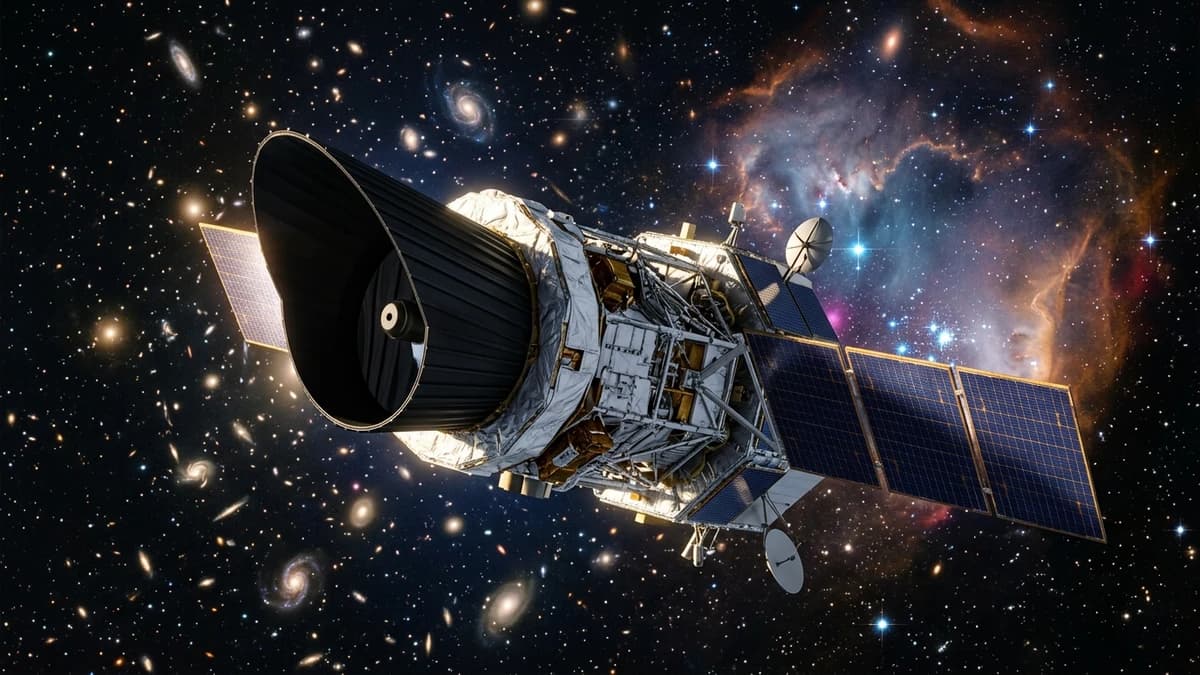
Race Against Time: NASA Accelerates Nancy Grace Roman Space Telescope Launch to August 2026 — High-Fidelity Artistic Illustration created by artificial intelligence based on scientific research.

Race Against Time: NASA Accelerates Nancy Grace Roman Space Telescope Launch to August 2026

NASA Nancy Grace Roman Space Telescope in orbit

Space exploration is set to take a giant leap forward much earlier than originally planned. NASA and SpaceX have officially confirmed that the launch of the revolutionary Nancy Grace Roman Space Telescope has been accelerated by eight months. The new launch date is scheduled for August 30, 2026, aboard the powerful Falcon Heavy rocket from Elon Musk's aerospace company.

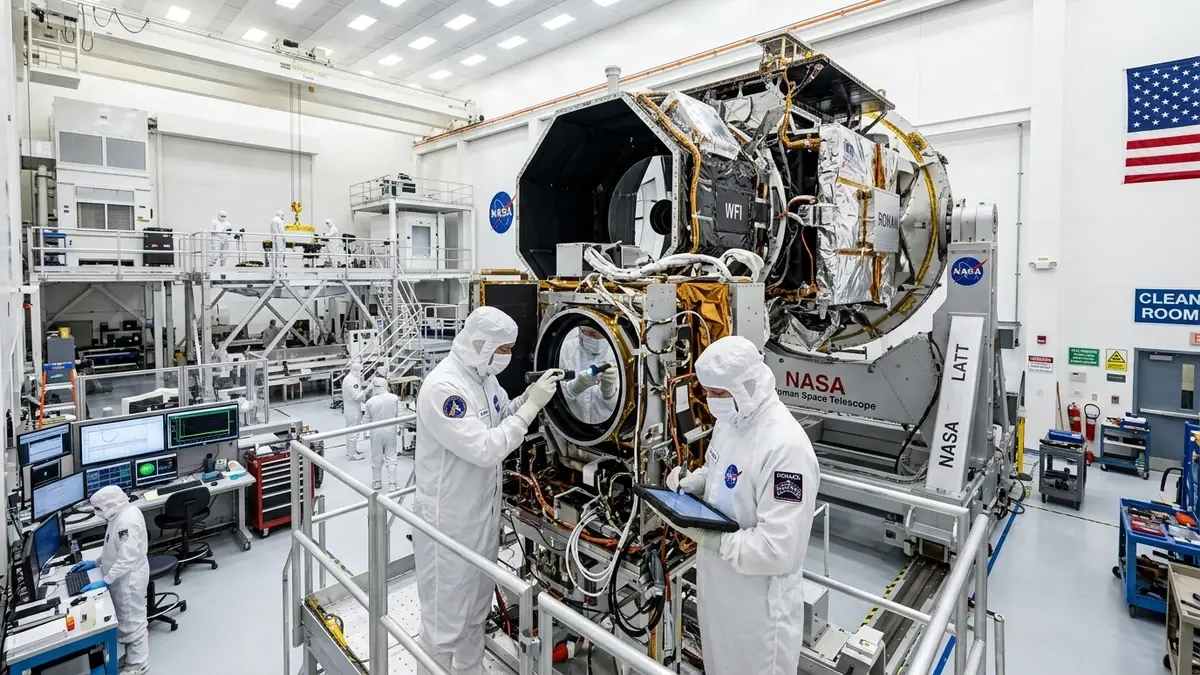
This significant progress in the mission schedule was made possible by the early completion of rigorous system integration and thermal vacuum tests at the Goddard Space Flight Center. The observatory has already arrived at the Kennedy Space Center in Florida, where it is undergoing final preparations and cleanroom hardware inspections. Scientists worldwide are celebrating this schedule acceleration, which will place this next-generation cosmic mapping tool at the second Lagrange point (L2) sooner than anticipated.

The telescope's primary objective is to investigate the most profound mysteries of the physical universe: dark matter and dark energy. These two invisible components are estimated to make up about 95% of the cosmos, yet they remain almost entirely unknown to modern physics. As detailed in recent cosmic studies by the Euclid Telescope, advanced cosmological mapping tools are vital to answer fundamental questions that have puzzled astronomers for generations.
A Cosmic Window 100 Times Larger than Hubble #

While the James Webb Space Telescope focuses on narrow-field, ultra-deep observations of specific targets in the infrared spectrum, Nancy Grace Roman is engineered for survey speed and wide coverage. It features a 2.4-meter primary mirror, matching the diameter of the legendary Hubble Space Telescope. However, its state-of-the-art wide-field instrument provides a field of view at least 100 times larger than Hubble's in a single exposure.

This enormous capability means Roman can map large patches of the night sky in a fraction of the time required by other observatories. The core instrument of Roman is a giant 300-megapixel camera, designed to capture highly detailed panoramic images with scientific precision. This vast cosmic coverage will facilitate the detection of millions of distant galaxies and assist in constructing an unprecedented three-dimensional map of our observable universe.

The rapid scanning ability is crucial for conducting large-scale statistical surveys of gravitational lensing events and distant stellar explosions. Astronomers will utilize these massive datasets to trace the cosmic expansion rate and the structural evolution of galaxies throughout cosmic history. This scientific advance will directly complement the findings from recent space missions studying the exoplanet LHS 1140b and other planetary systems.


Comparative Table: Key Specs of Major Space Observatories #

Technical Specification Hubble Space Telescope (HST) James Webb Space Telescope (JWST) Nancy Grace Roman (RST)
Primary Mirror Diameter 2.4 meters 6.5 meters 2.4 meters
Field of View 1x (Reference Base) ~0.8x (Narrow Focus) More than 100x (Wide Field)
Primary Light Spectrum Visible and Ultraviolet Mid-to-Near Infrared Near-Infrared and Visible
Main Camera Resolution ~16 Megapixels ~40 Megapixels 300 Megapixels
Orbital Destination Low Earth Orbit (~530 km) Sun-Earth L2 (1.5 million km) Sun-Earth L2 (1.5 million km)

Deciphering the Hidden Nature of Dark Matter and Dark Energy #

The acceleration of the Roman launch represents a scientific urgency to resolve growing discrepancies in standard cosmological models. Dark energy acts as a cosmic repulsive force that accelerates the expansion rate of the observable universe. Conversely, dark matter acts as an invisible gravitational glue that keeps galaxies from flying apart under their high rotational velocities.

Nancy Grace Roman undergoing tests in NASA cleanroom

Roman will employ three distinct astrophysical methods to analyze the invisible signatures of these cosmic entities across space-time. The first is studying baryon acoustic oscillations, which act as cosmic standard rulers to measure the geometric history of the universe. The second involves measuring the tiny shapes of distant galaxies distorted by weak gravitational lensing caused by dark matter concentrations.

The third technique will monitor thousands of type Ia supernovas to precisely chart the historical acceleration of cosmic expansion. These discoveries will allow physicists to test whether dark energy behaves like a classical cosmological constant or a dynamic field. These results are highly anticipated and could require a major revision of Albert Einstein's general theory of relativity.


Exoplanet Hunter and the Search for Habitable Worlds #

Beyond fundamental cosmology, the Nancy Grace Roman Telescope will deliver dramatic advances in searching for new worlds orbiting distant stars. It features an advanced technology demonstration coronagraph, specifically designed to block out the blinding glare of host stars. This light suppression will allow the direct imaging of gas giants and smaller rocky planets orbiting relatively close to their parent suns.

This innovative coronagraph will be the first in space to utilize deformable mirrors controlled in real time by tiny actuators. This active adaptive optics technology will correct minute optical wavefront errors in the telescope with nanometer-scale precision. Consequently, the camera will photograph planets that would otherwise remain completely hidden by the light of their home stars.

Roman will also utilize gravitational microlensing to discover thousands of exoplanetas located in the inner bulge of the Milky Way. This method detects the bending of starlight when a planetary system passes in front of a more distant background star. The instrument's sensitivity will enable it to find worlds with masses similar to Earth, complementing deep-space studies like NASA's New Horizons mission at the solar system's edge.


The Powerful Launch Aboard SpaceX's Falcon Heavy #

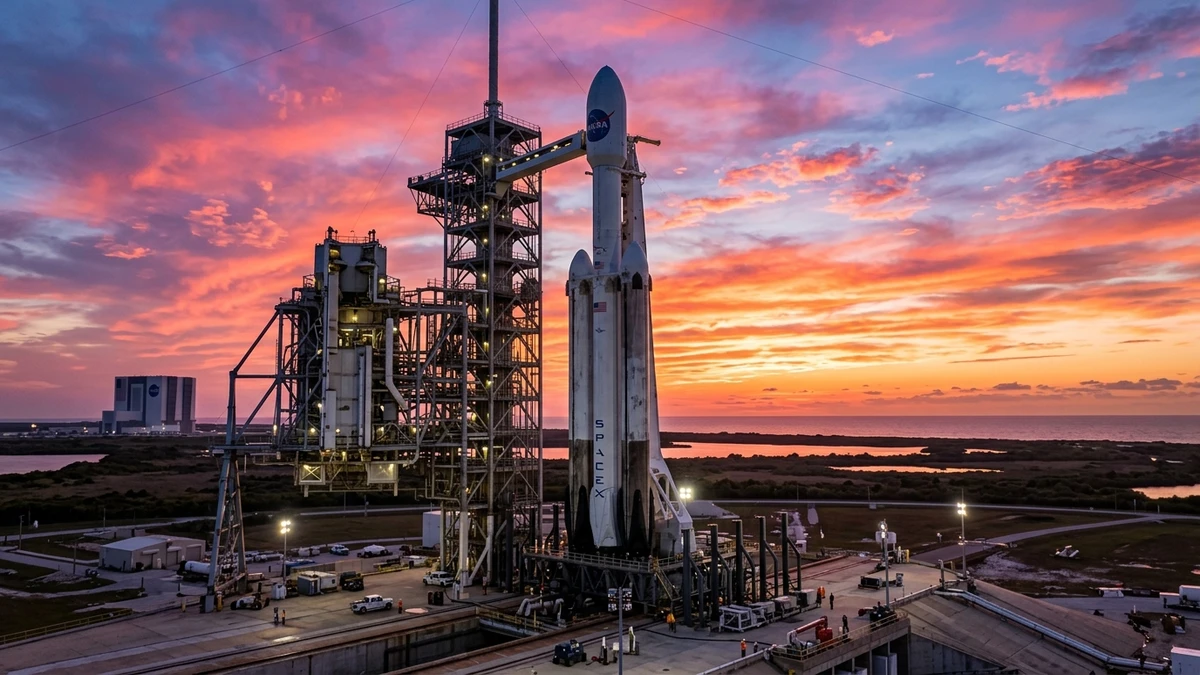
The selection of SpaceX's Falcon Heavy for this mission was calculated due to the heavy launch mass of the observatory. Falcon Heavy is one of the most powerful operational rockets in the world, providing the energy required to inject the telescope directly into L2. This gravitational point is located about 1.5 million kilometers from Earth on the side directly opposite the Sun.

SpaceX Falcon Heavy on Launchpad 39A preparing for Roman telescope launch

The payload fairing of the Falcon Heavy has been specifically modified to safely house the telescope during high-velocity flight. SpaceX and NASA engineering teams have completed structural integration testing of the payload adapter and performed comprehensive acoustic simulations of the liftoff. These detailed tests ensure that the intense launch environment will not harm the sensitive mirrors and scientific instruments.

The transit to the L2 orbital destination will take approximately thirty days of space travel. During this journey, engineers will execute small mid-course correction maneuvers to refine the path with high precision. Once established in its operational orbit, the observatory will begin a ninety-day intensive commissioning phase to calibrate all instruments.

The launch will take place from the historic Launch Complex 39A, the starting point for the historic Apollo missions to the Moon. The launchpad is currently undergoing final checkouts, and static fire tests of the Merlin engines are planned for early August. The acceleration of this mission timeline stands as a triumph of modern space engineering and highlights the collaboration between NASA and the commercial space industry.


References and High-Authority Sources #

🏷️ Tags:

#nancygraceromantelescope#nasa2026#spacexfalconheavy#darkmatter#darkenergy#astrophysics#exoplanets#newspacetelescopes

📢 Gostou deste artigo?

Compartilhe com seus amigos e nos conte o que você achou nos comentários!

❓Frequently Asked Questions

NASA was able to advance the launch date because all phases of system integration and hardware testing were completed ahead of schedule. Crucial optical components, including the 2.4-meter primary mirror and the 300-megapixel camera, underwent successful integrated testing at the Goddard Space Flight Center. The overall logistical efficiency and the flawless execution of thermal vacuum chambers allowed the agency to ship the spacecraft to the Kennedy Space Center eight months earlier than originally projected.
While Roman shares the same primary mirror size as Hubble, it offers a field of view 100 times larger, enabling rapid mapping of the night sky. In contrast, James Webb is a narrow-field observatory designed for deep-infrared spectroscopy of specific cosmic targets. Roman is a wide-field survey telescope operating in the near-infrared and visible light, making it the perfect tool to map large-scale structures that would be impossible to survey with Hubble or Webb.
The Nancy Grace Roman telescope will study dark matter and dark energy by creating highly accurate three-dimensional maps of millions of distant galaxies. It will measure weak gravitational lensing distortions caused by the invisible gravity of dark matter structures across the cosmos. Additionally, the observatory will catalog thousands of type Ia supernovas to measure the expansion rate of space-time over billions of years, providing critical cosmological data to test current gravitational theories.

Receba novidades!

Cadastre seu email e receba as melhores curiosidades toda semana.

🔒 Sem spam. Cancele quando quiser.

💬 Comentários (0)

Seja o primeiro a comentar! 👋

📚Related Articles

The Enigma of Giant Moons: How Jupiter's Magnetic Field Saved Its Moons Unlike SaturnScience and Nature

The Enigma of Giant Moons: How Jupiter's Magnetic Field Saved Its Moons Unlike Saturn

A new astrophysical study reveals why Jupiter kept several giant moons, while Saturn lost its own, leaving Titan as the sole survivor.

⏱️6 minLer mais →
The Enigma of Metallicity: Supercomputers Solve the Mystery of 'Missing Silver' in the SunScience and Nature

The Enigma of Metallicity: Supercomputers Solve the Mystery of 'Missing Silver' in the Sun

Scientists use supercomputers to solve the enigma of the Sun's 'missing silver'. Learn about the new metallicity simulation.

⏱️6 minLer mais →
Euclid Discovers the Universe's Oldest QuasarsScience and Nature

Euclid Discovers the Universe's Oldest Quasars

The Euclid space telescope has discovered 31 of the oldest quasars in the Universe. This historic discovery challenges current models of black hole growth.

⏱️6 minLer mais →
Students Find Ancient Star From Dawn of UniverseScience and Nature

Students Find Ancient Star From Dawn of Universe

University of Chicago undergraduates discovered SDSS J0715-7334, one of the most ancient and pristine stars ever found, which migrated from another galaxy into.

⏱️11 minLer mais →
Signs of Life Beyond Earth in 2026Science and Nature

Signs of Life Beyond Earth in 2026

The James Webb Telescope detected biosignatures on exoplanets, Mars revealed mysterious structures and Europa may harbor ocean life. Discover the findings.

⏱️7 minLer mais →
Vera C. Rubin Observatory: World's Largest Camera Begins Cosmic Mappingscience-nature

Vera C. Rubin Observatory: World's Largest Camera Begins Cosmic Mapping

The 3,200-megapixel LSST camera at the Vera C. Rubin Observatory has begun its 10-year mission in Chile. Discover the technology that will reveal the dark universe.

⏱️7 minLer mais →
Receba novidades no WhatsApp!