🌍 Your knowledge portal
Science and Nature

The Enigma of Giant Moons: How Jupiter's Magnetic Field Saved Its Moons Unlike Saturn

📅 2026-07-27⏱️ 6 min read📝
⚡

Quick Summary

A new astrophysical study reveals why Jupiter kept several giant moons, while Saturn lost its own, leaving Titan as the sole survivor. One of the biggest questions regarding satellite formation in the Solar System has just gained a definitive astrophysical answer.

Key Takeaways:

  • Jupiter's magnetic field is the largest continuous structure in the Solar System, being generated by the turbulent movement of liquid metallic hydrogen in its deep core.
  • In absolute contrast to Jupiter, the planet Saturn developed a much weaker and geographically limited magnetic shield.
  • Titan's survival as Saturn's only giant moon is explained by its considerable physical mass and surface gravity.
The Enigma of Giant Moons: How Jupiter's Magnetic Field Saved Its Moons Unlike Saturn
The Enigma of Giant Moons: How Jupiter's Magnetic Field Saved Its Moons Unlike Saturn — High-Fidelity Artistic Illustration created by artificial intelligence based on scientific research.

The Enigma of Giant Moons: How Jupiter's Magnetic Field Saved Its Moons Unlike Saturn

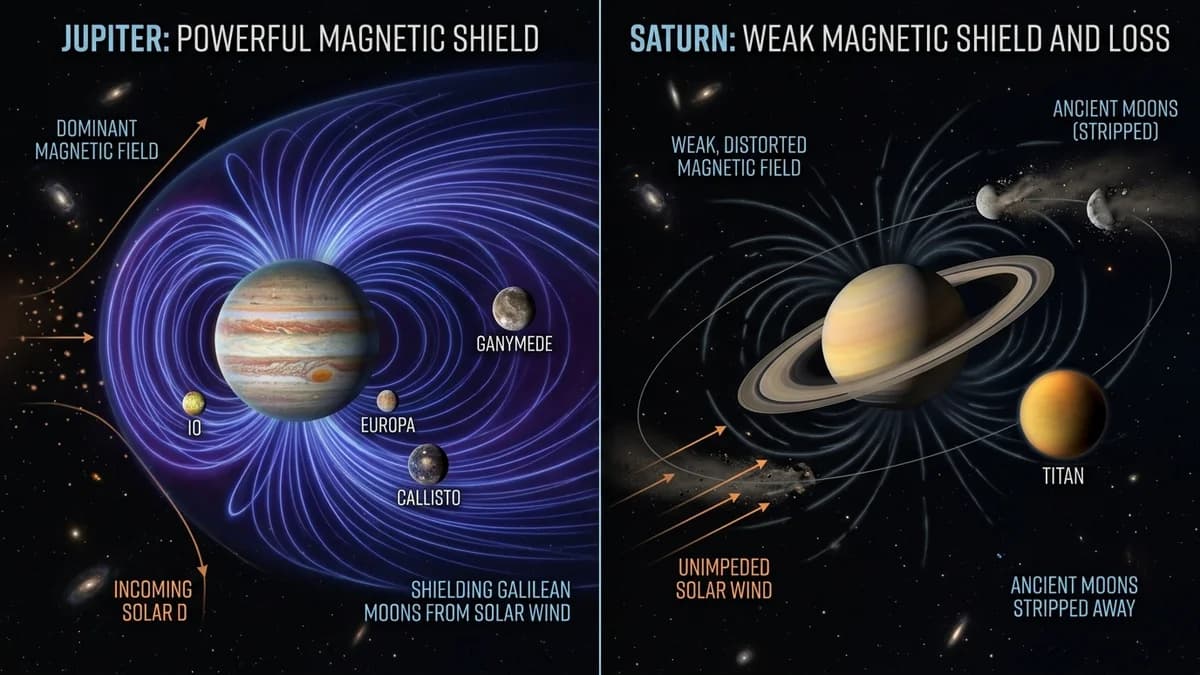
Scientific illustration comparing Jupiter's protective magnetic field with Saturn's loss of moons

One of the biggest questions regarding satellite formation in the Solar System has just gained a definitive astrophysical answer. A new theoretical study detailed why Jupiter maintained four stable gigantic moons (Io, Europa, Ganymede, and Callisto), while Saturn has only Titan as a large satellite. Computer models indicate that Jupiter's powerful magnetic shield functioned as a protective barrier against the destructive solar wind. This electromagnetic shielding guaranteed the survival and growth of these icy worlds over billions of years.

On the other hand, Saturn's weak primitive magnetic field was unable to offer similar shelter to its moons in formation. During the early phase of the Solar System's consolidation, the high-energy solar wind swept away most of the gases and volatile materials from the disk orbiting Saturn. This process of violent stripping deprived other potential moons of sufficient mass to grow, permanently halting their physical development. The study revolutionizes models of planetary accretion and helps explain the discrepant architecture of the two gas giants.

The detailed modeling of these magnetic bubbles is essential to understanding how giant planets shape their immediate environments. Tidal physics and radiation also play important roles in determining the temperature and habitability of these moons. These scenarios help guide the search for life in the Solar System and provide data to simulate the geology of other ancient satellites, such as the records obtained about the moon Miranda at Uranus.


The Powerful Magnetic Shield of Jupiter #

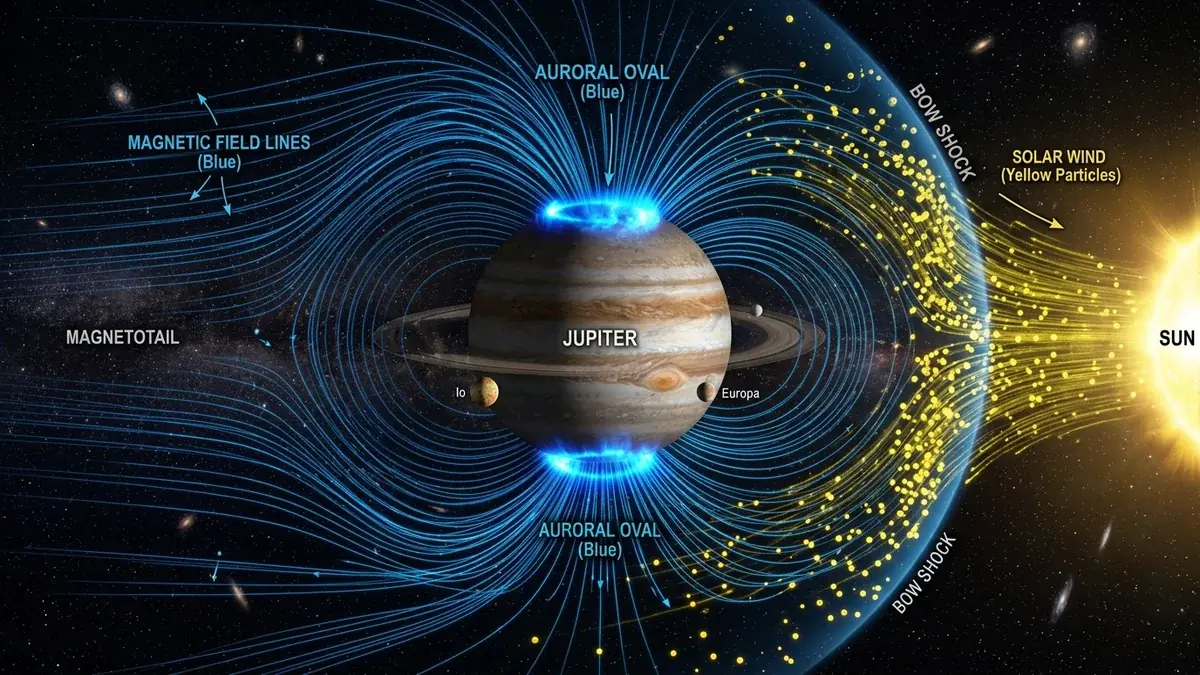
Jupiter's magnetic field is the largest continuous structure in the Solar System, being generated by the turbulent movement of liquid metallic hydrogen in its deep core. This colossal planetary dynamo creates a protective bubble, the magnetosphere, which extends over seven million kilometers in the direction of the Sun. The orbits of the four large Galilean moons are completely immersed in this massive electromagnetic cocoon. This continuous immersion deflects the torrent of protons and electrons constantly fired by the solar corona.

The powerful bright-blue magnetic field of Jupiter deflecting the yellow solar wind

The strength of this magnetic shield is so intense that it generates severe radiation belts and gigantic polar auroras at Jupiter's poles. For the Galilean moons, the magnetosphere acts as a ceiling that prevents direct erosion of their thin atmospheres of oxygen and carbon dioxide. The orbital dynamics of Io, for example, are shaped by this intense magnetic climate, as revealed by the data on its internal tidal heating detailed in research on the moon Io.

Physical simulations show that the Jovian magnetosphere intercepts the solar wind with such efficiency that the rate of atmospheric loss of the moons is reduced to minimal fractions. This stable environment allowed Europa and Ganymede to retain global oceans of liquid water beneath their thick surface ice layers. Jupiter's magnetic shield, therefore, not only protected the physical integrity of the moons but also created the habitability conditions that scientists are trying to decipher today.

Furthermore, the interaction between the Jovian magnetosphere and the moons generates intense auroral emissions that can be observed from Earth in the radio spectrum. These electromagnetic signals reveal fluctuations in the density of the plasma surrounding the orbits of the Galilean satellites. The study of these emissions provides an indirect method to monitor geological activity and the release of volatile compounds by the moons.


Atmospheric Erosion and the Stripping of Saturn's Moons #

In absolute contrast to Jupiter, the planet Saturn developed a much weaker and geographically limited magnetic shield. Although Saturn is a gas giant of considerable size, its smaller internal mass limits the generation of stable electrical currents in its interior. The resulting magnetosphere is about twenty times weaker than Jupiter's, leaving the outer regions of the Saturnian system exposed. During the Sun's youth, the solar wind blew with much more violence, easily crossing this weak defensive barrier.

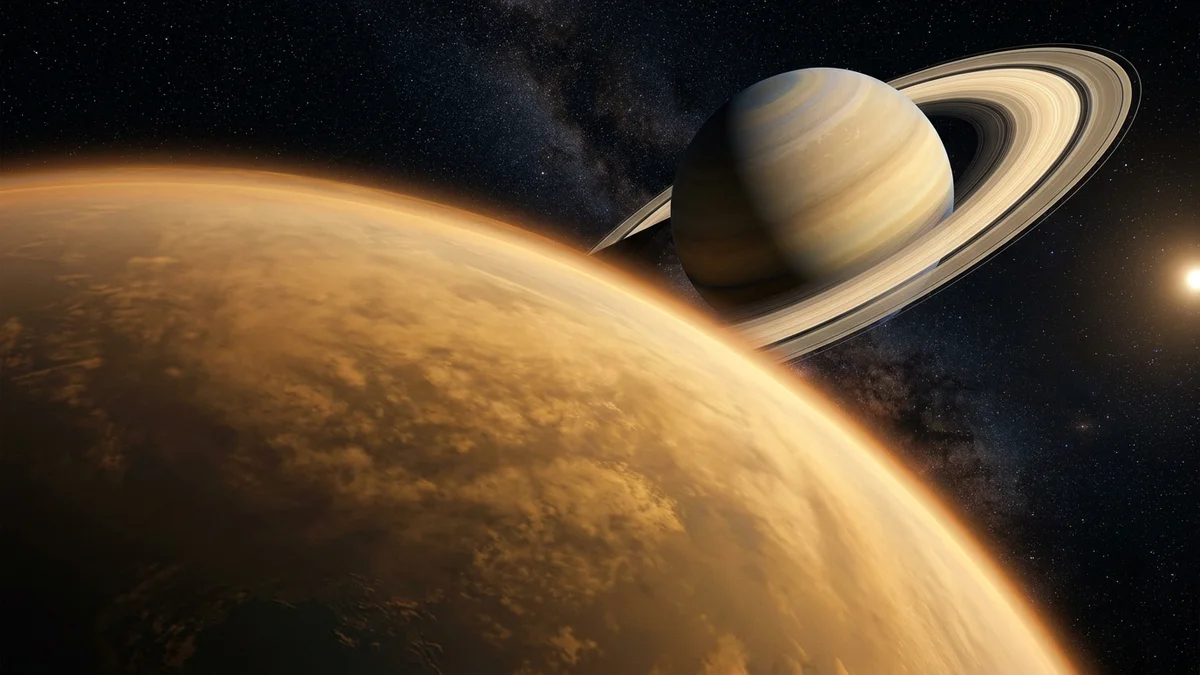
The dense orange atmosphere of Titan with Saturn and its prominent rings in the background

This relentless solar wind directly bombarded Saturn's protoplanetary disk, from which the moons were supposed to condense. Ionizing radiation and fast-moving particles collided with the forming blocks of ice and rock, vaporizing volatile compounds of water, ammonia, and methane. Without the protection of a strong magnetic shield, the evaporated gases were blown away from Saturn's system irreversibly. The scarcity of remaining material prevented the growth of other large bodies around the ringed planet.

The small satellites we observe today around Saturn, such as Enceladus and Mimas, are the surviving fragments of this initial cosmic stripping. They failed to accumulate enough mass to retain thick atmospheres or maintain long-term geological heat stably. Only the moon Titan, which formed in a region of high material density, managed to overcome this process of physical destruction. The table below compares the fundamental parameters of the magnetic shields of Jupiter and Saturn and their effects on satellite populations.


Comparative Table: Magnetic Shields and Moons of Jupiter and Saturn #

Magnetic and Orbital Parameter Jupiter System Saturn System Impact on Moon Evolution
Magnetic Field Strength 20,000 times Earth's 600 times Earth's Jupiter offers much broader protection
Magnetosphere Extent 7,000,000 kilometers (solar side) 1,200,000 kilometers Saturn's outer moons remain exposed
Giant Moons Retained 4 satellites (Galilean) 1 satellite (Titan) Saturn's weak shield reduced accretion
Type of Survivors High-density and water worlds Small icy and fragmented moons Saturn is dominated by smaller bodies
Exposure to Solar Wind Continually deflected by shield Frequent direct impact on the system Volatile loss altered moon geology

The Unique Case of Titan and the Future of Space Missions #

Titan's survival as Saturn's only giant moon is explained by its considerable physical mass and surface gravity. Titan has a diameter larger than the planet Mercury and accumulates enough gravitational pull to hold heavy molecules like nitrogen. This gravity prevented the orange atmosphere from being completely swept away by the solar wind, even during periods when Saturn's magnetosphere shrank. Titan is a resilient survivor that challenged the hostile conditions of the primitive Saturnian system.

Additionally, Titan's chemical composition rich in complex hydrocarbons acts as a secondary thermal shield that reduces energy dissipation. The orange haze reflects harmful solar radiation, keeping liquid methane on its surface in a stable state of evaporation and rain. Titan's atmosphere is so dense that surface pressure is 50% greater than Earth's, a unique case for a natural satellite. This exotic ecosystem attracts the attention of astrobiologists worldwide.

The study of magnetic and gravitational interactions between giant planets and their moons will guide the design of the next space exploration probes. Probes like NASA's Dragonfly and ESA's JUICE were designed to navigate these intense radiation fields and unlock the mysteries of the moons. The physics that shaped the survival of these distant worlds continues to provide valuable answers about the formation and habitability of worlds across the galaxy.

Data collected by the Cassini probe and future mapping by Dragonfly will also help understand the pre-biotic chemical evolution of the satellite. The study of complex organic molecules in Titan's atmosphere offers clues about the chemistry that gave rise to life on early Earth. This continuous exploration promises to reveal crucial answers about the distribution of organic habitability in the Milky Way. By analyzing chemical pathways under Titan's unique conditions, scientists can better define the organic constraints for extraterrestrial life.

Magnetohydrodynamic Bow-Shock Shielding Versus Circumplanetary Disk Migration at Saturn #

Magnetohydrodynamic simulations comparing the circumplanetary environments of the gas giants show that Jupiter's 20,000-gauss internal dynamo established an expansive magnetospheric cavity early in Solar System history, shielding the Galilean moons from solar wind stripping and halting inward gas-driven orbital decay. Conversely, Saturn's weaker, axisymmetric magnetic field allowed dense circumplanetary gas to exert strong Type I Lindblad torques on primordial giant satellites, spiraling them past the Roche limit where tidal disruption pulverized their icy mantles into Saturn's massive ring system while leaving Titan as the lone surviving giant moon.


Scientific References and Further Reading #

  • For official data and images of the Jupiter and Saturn systems, visit NASA Science.
  • Details on planetary magnetic field research are available on the European Space Agency (ESA) portal.
  • The comparative study on the stripping of gas giant moons was published in the journal Nature Physics.

🏷️ Tags:

#MoonsofSaturn#JupiterMagneticShield#Titan#SolarWind#Astronomy#Astrophysics#Space

📢 Gostou deste artigo?

Compartilhe com seus amigos e nos conte o que você achou nos comentários!

Receba novidades!

Cadastre seu email e receba as melhores curiosidades toda semana.

🔒 Sem spam. Cancele quando quiser.

💬 Comentários (0)

Seja o primeiro a comentar! 👋

Receba novidades no WhatsApp!