Euclid Discovers the Universe's Oldest Quasars
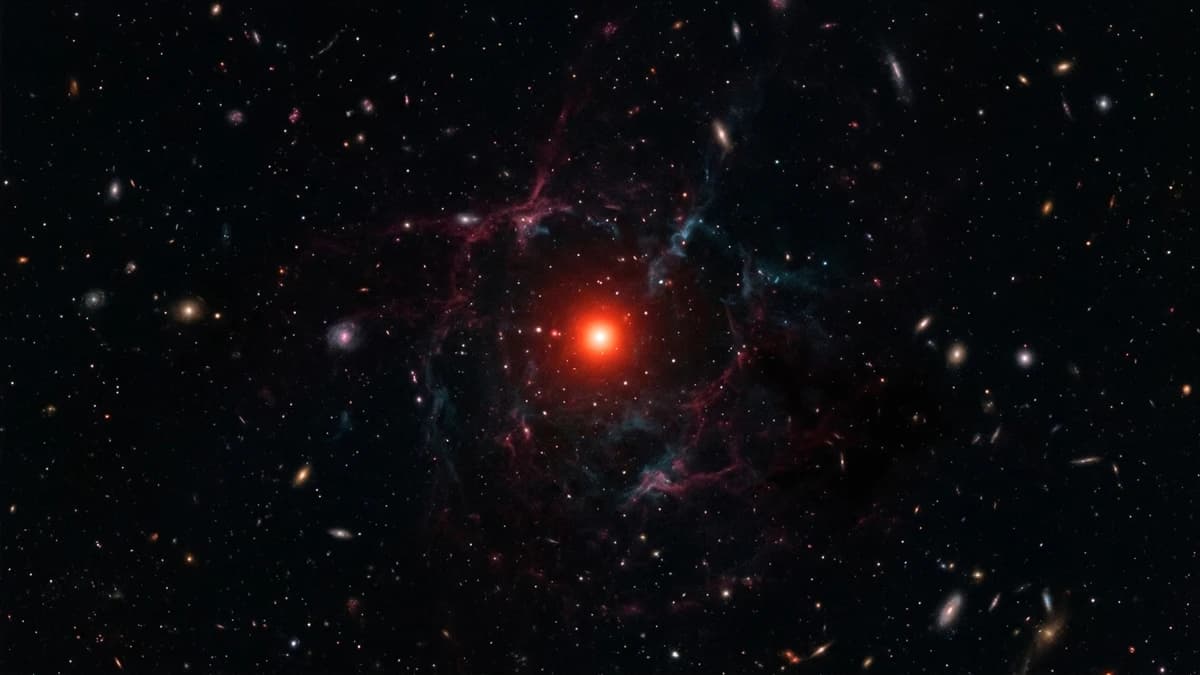
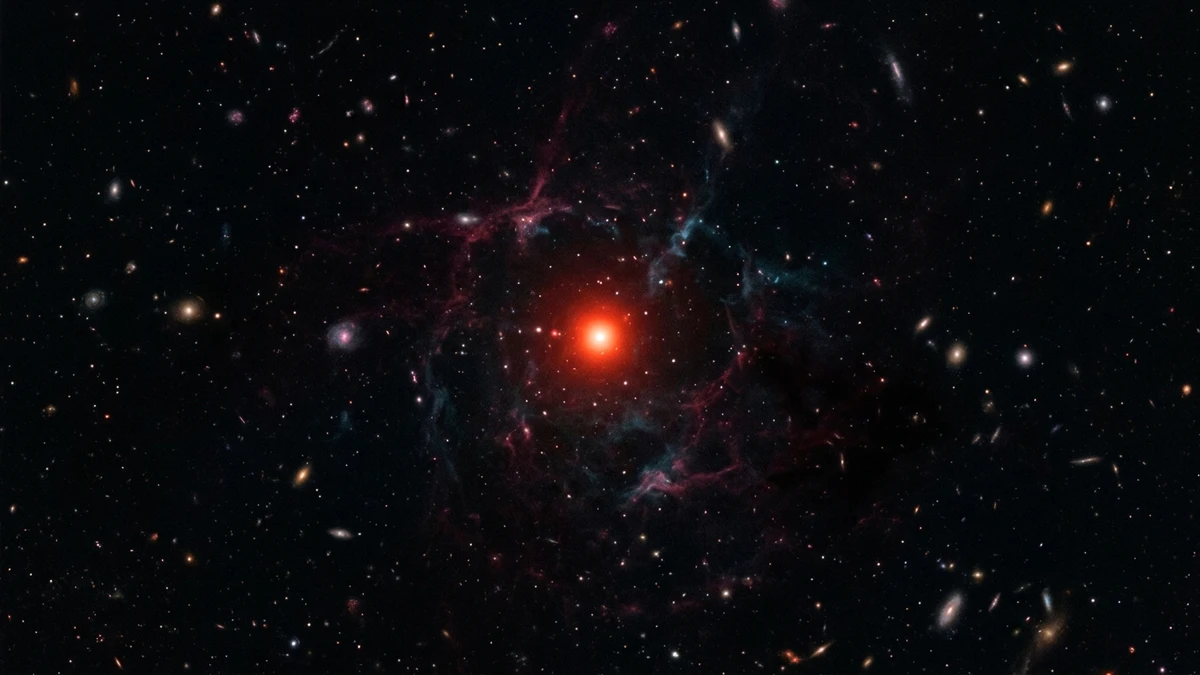
On July 6, 2026, astronomers witnessed a profound redefinition of cosmic time. The European Space Agency announced that the Euclid space telescope detected 31 extremely ancient quasars deep in space. These brilliant beacons of energy date back to an era when the Universe was only 5% of its current age.
This historic discovery pushes the boundaries of our knowledge about the infancy of the cosmos. It brings to light a fascinating mystery regarding the rapid growth of early supermassive black holes. The revelation that these monsters existed so early challenges known laws of stellar physics.
To understand the scale of this breakthrough, scientists are already revising simulations of galactic evolution. Euclid has proven that its wide-field scanning capability is the most powerful tool in modern astronomy. This milestone officially marks a new era in observational cosmology.
What Happened
The Euclid space telescope, launched in July 2023, has proven to be a revolutionary instrument for mapping the early Universe. A study led by astronomer Daming Yang of Leiden University, published in Astronomy & Astrophysics, revealed 31 ancestral quasars at high redshifts. The research used Euclid's infrared sensitivity to identify these rare cosmic beacons.
Among the detected objects, two broke previous distance records. The quasar EUCL J172902.75+641018.1, with a redshift of 7.77, and EUCL J125308.55+705432.3, with a redshift of 7.69, date to when the Universe was 670 million years old. Spectroscopic confirmation revealed active supermassive black holes in the cosmos's infancy.
To investigate these findings, Silvia Belladitta of the Max Planck Institute led complementary observation campaigns. This parallel work focused on analyzing the host galaxy of one of these ancestral quasars. The combined results open new paths for understanding how early black holes and galaxies grew together.

Context and History
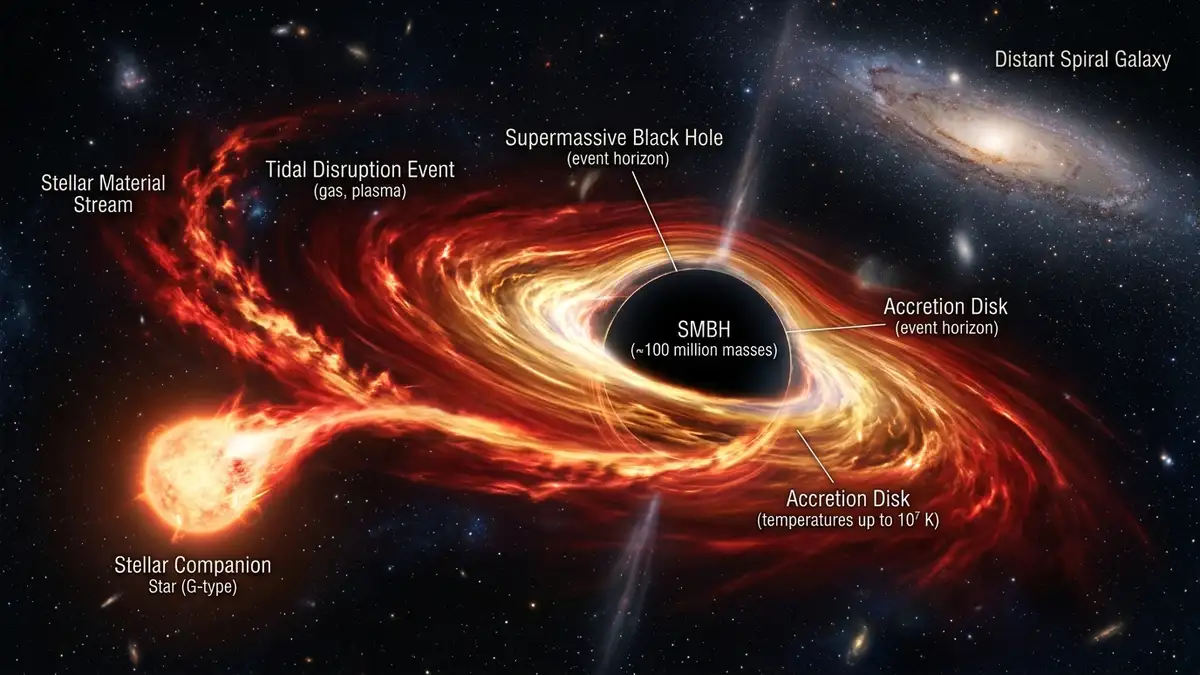
Quasars are active galactic nuclei that are extraordinarily bright and energetic. They are powered by supermassive black holes devouring gas and dust at extreme velocities. As matter falls in, it reaches extreme temperatures and emits radiation outshining entire galaxies.
Historically, searching for these primitive objects was slow due to the narrow field of view of other telescopes. Euclid changed this paradigm by mapping vast areas of the deep sky in the near-infrared spectrum. This approach doubled the number of known ancient quasars in just two years.

However, finding these massive monsters so early challenges traditional models on how supermassive black holes are born. Under accepted theories, stellar-mass black holes need billions of years of gradual accretion to grow so large. Their existence just 670 million years after the Big Bang creates a major puzzle.
This mystery suggests that the first black holes formed directly from the collapse of massive primordial gas clouds. Alternatively, they may have experienced periods of accelerated super-Eddington accretion. Euclid provides the ideal database for theoretical astrophysicists to decipher this paradox.
Impact on the Population
Although this research seems distant, space engineering generates direct benefits for daily life. The cryogenic infrared sensor technologies developed for Euclid find applications in medical imaging diagnostics and civilian thermal cameras. These advances actively stimulate the high-tech global economy.
Additionally, discovering cosmic records stimulates student engagement and scientific literacy. Understanding the history of the cosmos connects humanity to its fundamental origins. Knowing how the first structures formed helps us comprehend where the matter composing Earth came from.
| Aspect | Before | After | Impact |
|---|---|---|---|
| Primordial Mapping | Few known quasars above redshift $z \ge 7$, limiting statistical analysis. | Sample size doubled by Euclid with the detection of 31 new quasars. | Robust statistics on the abundance of black holes in the cosmic infancy. |
| Growth Models | Linear theories of gradual matter accretion from stellar seeds. | Proof of accelerated growth (super-Eddington) or direct collapse. | Complete revision in astrophysics textbooks and stellar physics models. |
| Applied Technology | Restricted infrared sensors prone to thermal noise interference. | Ultra-high fidelity cryogenic sensors developed specifically for Euclid. | Technological spin-offs applied to medical imaging and civilian security. |
| Academic Engagement | Study of the early universe based on sparse data from very few probes. | Constant weekly data stream accessible to students and researchers. | Encouragement to study physics, scientific computing, and complex data analysis. |
Thus, space science acts as a strong catalyst for innovation and intellectual development. Each breakthrough at the edge of the universe translates into tangible improvements in everyday terrestrial technologies. Investing in cosmic exploration expands human knowledge while generating indirect economic benefits through high-tech innovation.
What Those Involved Say
Daming Yang, the lead researcher at Leiden University, highlighted the relevance of the mission's data. "Euclid allowed us to scan immense areas and locate extremely rare objects," the scientist stated. He emphasized that this library of primitive quasars is fundamental for astronomers.
Silvia Belladitta from the Max Planck Institute resubmitted the importance of observing host galaxies. "Understanding the environment where these ancient quasars grew reveals how dark matter and gas merged," she declared. Her analysis shows the complexity of gravitational interactions in the early Universe.
ESA specialists celebrated the success of the optical instruments aboard the orbiting spacecraft. They pointed out that the results exceeded the original expectations of the international scientific community. The formal announcement of this discovery in 2026 marks a decisive milestone for astrophysics.
Next Steps
Astronomers plan to use the James Webb Space Telescope for deep spectroscopic analysis of the 31 targets. The goal is to map the chemical composition of the accretion disks of these ancient quasars. In the future, giant ground-based telescopes like the ELT will analyze gas movement around them.
Meanwhile, Euclid continues its systematic sky survey, which is scheduled to run until 2029. Scientists hope to discover quasars at even higher redshifts, possibly breaking the redshift 8.0 barrier. This new data will help calibrate numerical simulations of the epoch of cosmic reionization.
Cosmology theorists will also use supercomputers to simulate the physical models of colossal primordial gas seeds. The fresh statistics provided by Euclid will serve as the foundation to refine theoretical limits of accretion. Unraveling the infancy of black holes will help explain the modern structure of the Universe.
Closing
The discovery of the oldest quasars by Euclid opens a direct window into our deep cosmic past. These giants illuminate the infancy of the Universe, a period once considered inaccessible to direct observation. Decoding this ancient light from over 13 billion years ago helps us understand our origins.
This achievement contributes significantly to mapping the accelerated expansion of outer space. To unravel these invisible forces, scientists actively investigate the mysteries of dark energy with the Euclid telescope. Each discovery of a primordial quasar becomes a crucial reference point in this cosmological journey.
Euclid proves that the history of the cosmos is written in faint signals of infrared light. As we translate these ancient signatures, we realize that scientific learning is only beginning. The infancy of the Universe continues to reveal itself as far more complex and fascinating than we imagined.