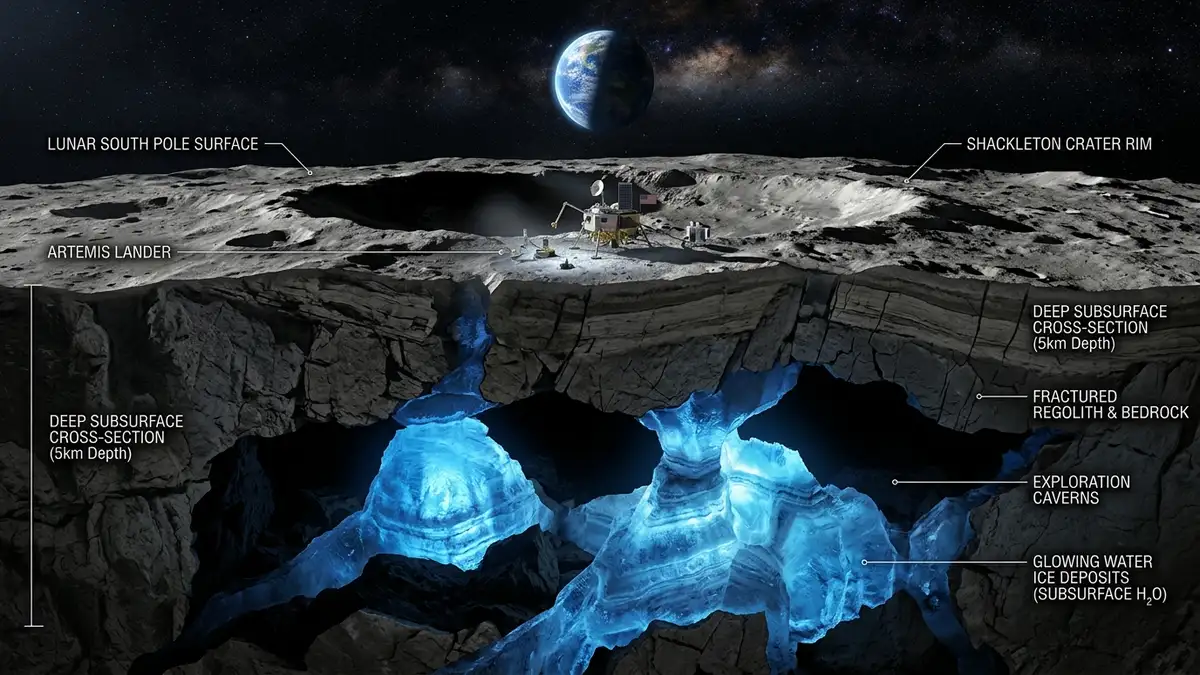
Are We Alone? Science Is Closer to Answering
For millennia, humanity has looked at the night sky and asked the same question: is there anyone out there? In 2026, for the first time in history, we have real scientific data suggesting the answer may be yes.
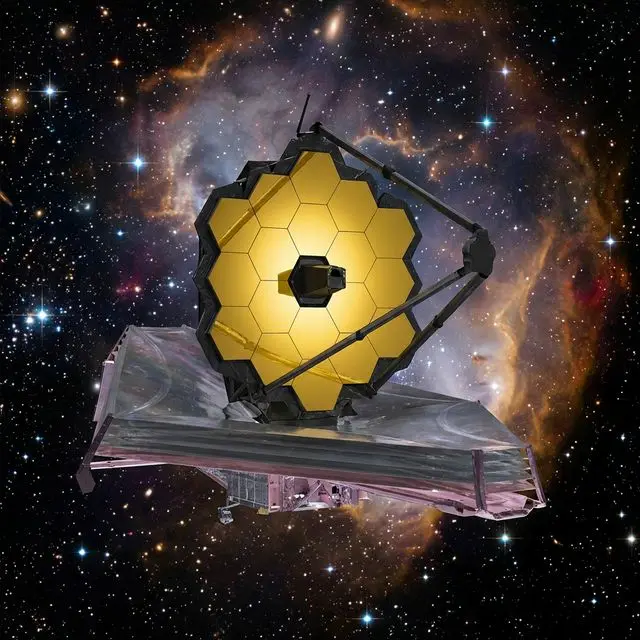
The James Webb Space Telescope (JWST) detected what scientists call biosignatures — chemical indicators that may point to the presence of life — in the atmospheres of distant exoplanets. Mars missions revealed unexplainable underground structures. And Jupiter's moon Europa has confirmed itself as the most promising place in the Solar System to find life.
This article gathers the most recent discoveries, explains the science behind them, and analyzes what they mean for humanity.
What Are Biosignatures?
The Chemical Fingerprint of Life
"Biosignatures" are molecules or combinations of molecules in a planet's atmosphere that could indicate the presence of living organisms. The main ones:
| Biosignature | What It Indicates | Example on Earth |
|---|---|---|
| Oxygen (O₂) | Photosynthesis | Produced by plants and cyanobacteria |
| Methane (CH₄) | Metabolism | Produced by bacteria and geological processes |
| Ozone (O₃) | Stable O₂ presence | Protective atmospheric layer |
| Dimethyl sulfide (DMS) | Marine biological activity | Produced by phytoplankton |
| Phosphine (PH₃) | Anaerobic metabolism | Found on Venus (controversial) |
The key is the combination: oxygen + methane together in the same atmosphere are extremely unlikely without life, because methane is naturally destroyed by oxygen. If both coexist, something is replenishing the methane — and on Earth, that "something" is living organisms.
The Major Discoveries of 2025-2026
1. TRAPPIST-1e: Earth's "Twin"
In September 2025, the JWST published data that shook the scientific community:
The exoplanet TRAPPIST-1e, 40 light-years from Earth, showed:
- Dimethyl sulfide (DMS) in its atmosphere — on Earth, only produced by living beings
- Water vapor at levels compatible with liquid oceans
- Estimated temperature: 15°C to 25°C on the surface
- Size: 91% of Earth's radius
What it means: It's not definitive proof of life, but it's the strongest biosignature ever detected outside the Solar System. The geological probability of DMS without life is extremely low.
The scientific community reacted with cautious excitement. NASA scheduled additional JWST observations to confirm the data throughout 2026.
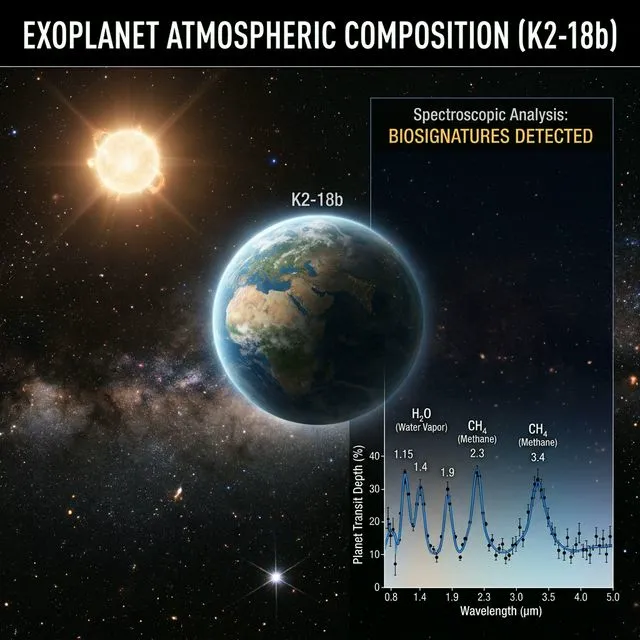
2. K2-18b: Methane + CO₂ Without Clouds
Another exoplanet that drew global attention:
- K2-18b is a "super-Earth" 124 light-years away, in its star's habitable zone
- The JWST detected methane and carbon dioxide without dense clouds — an environment compatible with life
- In 2025, additional data showed possible traces of DMS (confirmation pending)
- It's an ocean world — possibly entirely covered by water
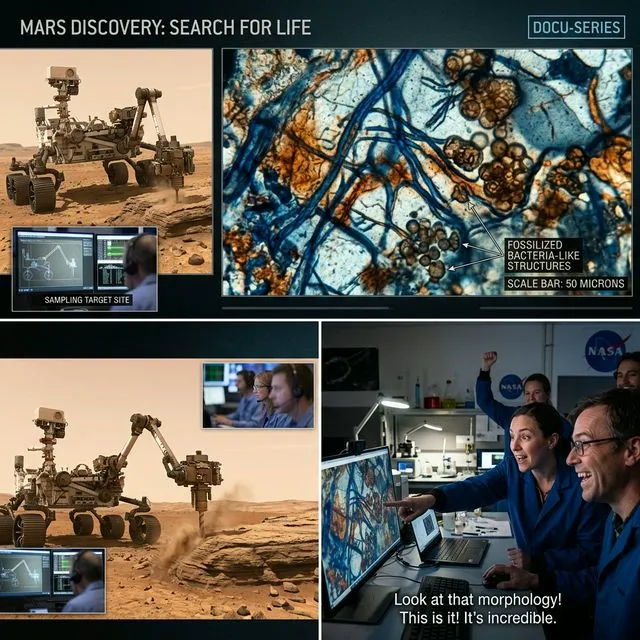
3. Mars: The Underground Structures
The Perseverance rover and the Ingenuity helicopter (retired in 2024) made intriguing discoveries:
- Orbital radar (SHARAD) detected underground cavities 2-3km deep
- Rock samples collected at Jezero Crater contain organic compounds
- Seasonal methane: The rover detected methane spikes coinciding with Martian seasons — a pattern compatible with biological or geological activity
The Mars Sample Return mission is planned for 2031 — when we'll finally be able to analyze Martian rocks in an Earth laboratory.
4. Europa: The Ocean Beneath the Ice
Jupiter's moon Europa is considered the most promising place to find life in the Solar System:
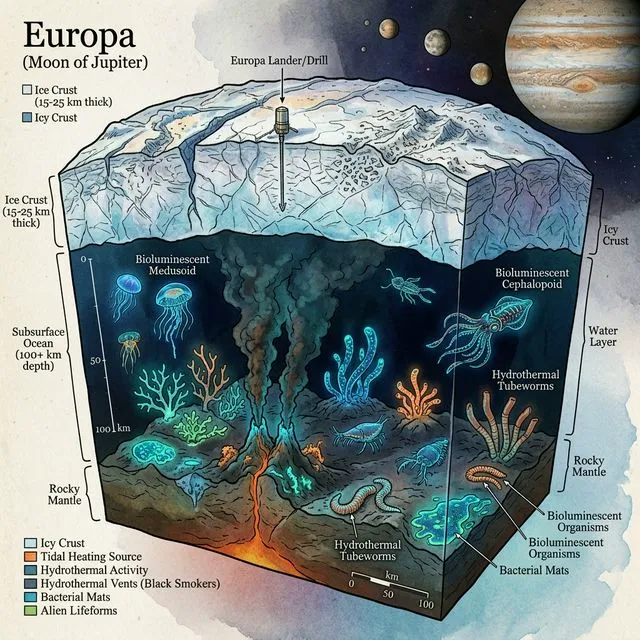
- Liquid water ocean approximately 100km deep beneath an ice crust
- Probable hydrothermal vents on the ocean floor (similar to Earth's "black smokers" that sustain life)
- The Europa Clipper mission (launched October 2024) will arrive at Jupiter in 2030
- In 2025, JWST data showed water jets emanating from cracks in Europa's ice, confirming the connection between the subsurface ocean and the surface
5. Enceladus: Saturn's Surprise
Saturn's small moon gained prominence:
- The Cassini probe (mission ended 2017) found all the ingredients for life
- Amino acids were detected in Enceladus's ice jets
- NASA is studying a dedicated mission: Enceladus Life Finder (proposed for launch in the 2030s)
- Neutral pH, adequate temperature, and complete chemical elements = "recipe for life"
The SETI Project and the Search for Intelligent Signals
The Search Continues
The SETI (Search for Extraterrestrial Intelligence) project has operated for over 60 years searching for signals from intelligent civilizations:
- Breakthrough Listen: The largest search program for intelligent life, funded by Yuri Milner ($100 million)
- FAST Telescope (China): The world's largest radio telescope, dedicating 20% of its time to SETI
- BLC1 (2020): Signal detected from the direction of Proxima Centauri — still not definitively explained
The Fermi Paradox Persists
If the universe is so large and old, where is everyone? The main hypotheses:
- The Great Filter Hypothesis: Civilizations self-destruct before they can communicate
- The Zoo Hypothesis: Advanced civilizations observe us but don't interfere
- The Dark Forest Hypothesis (inspired by Liu Cixin): Civilizations hide out of fear of cosmic predators
- Distance and time: The universe is simply too large — signals haven't arrived yet
- Incomprehensible life forms: Life may exist in forms we don't recognize
The Updated Drake Equation
In 1961, Frank Drake created an equation to estimate the number of civilizations in the Milky Way. With 2026 data:
- N = R × fp × ne × fl × fi × fc × L*
- Where: R* = star formation rate | fp = fraction with planets | ne = habitable planets | fl = with life | fi = intelligent | fc = with technology | L = duration
Updated Estimates (2026)
With JWST and Kepler data:
- R* = 7 stars/year in the Milky Way
- fp = 0.5 (50% of stars have planets — confirmed)
- ne = 2.0 (average 2 planets in habitable zone — revised upward)
- fl = 0.01 to 1.0 (great uncertainty — biosignatures give hope)
- fi = unknown
- fc = unknown
- L = unknown
Conservative estimate: 1 to 10 civilizations active in the Milky Way now
Optimistic estimate: ~10,000 civilizations
Cultural and Philosophical Impact
What Would Change If We Found Life?
Confirmation of extraterrestrial life — even microbial — would have profound impacts:
- Religion: Theologians already discuss how to integrate alien life into doctrines (the Vatican has an astronomical observatory and declared that "the existence of extraterrestrial life does not contradict faith")
- Philosophy: Biological geocentrism — the idea that life is unique to Earth — would be destroyed
- Science: Confirming a second "independent emergence" of life would mean that life is common in the universe
- Economy: The space race would be enormously accelerated, with trillions in investments
- Collective psychology: The "Copernican effect" — humanity is not the center of anything
Public Opinion Surveys
A global Pew Research Center survey (2025) revealed:
- 65% of people believe intelligent life exists elsewhere in the universe
- 87% want governments to invest more in space exploration
- 24% believe we've already been visited by aliens
- 52% think discovering alien life would be positive for humanity
Next Steps: What Lies Ahead
2026-2030
- JWST: Will continue analyzing exoplanet atmospheres — more biosignatures expected
- Nancy Grace Roman Telescope (launch 2027): Will hunt exoplanets with direct imaging
- Europa Clipper: Will arrive at Jupiter in 2030 to study Europa
- Mars Sample Return: Planned to bring Mars samples to Earth
2030-2040
- HWO Space Telescope (Habitable Worlds Observatory): Designed specifically to directly photograph habitable exoplanets
- Enceladus Mission: Proposal under NASA review
- Dragonfly: Mission to Saturn's moon Titan (launch 2028, arrival 2038)
The Grand Dream
- Starshot: Send nanosatellites at 20% the speed of light to Proxima Centauri — arrival in ~20 years
Frequently Asked Questions
Have we found extraterrestrial life?
Not definitively yet. What we've found are biosignatures — chemical indicators consistent with life, but that could also have geological explanations. Science works with accumulated evidence, not a single proof.
Can the JWST see aliens?
Not directly. The JWST analyzes the chemical composition of atmospheres of exoplanets as starlight passes through them. It detects molecules, not organisms.
How close are we to confirmation?
It depends on the definition. For microbial life (bacteria), perhaps 10-20 years with missions to Europa and Enceladus. For intelligent life, it could be tomorrow or never — we have no way to predict.
If aliens exist, why don't they communicate?
That's the essence of the Fermi Paradox. The most accepted answers involve enormous cosmic distances (even radio signals take thousands of years to cross the galaxy) and the possibility that intelligent life is extremely rare.
Conclusion: At the Frontier of Knowledge
We're living through one of the most exciting moments in the history of science. The JWST has given us unprecedented tools to study other worlds. Missions to Europa, Enceladus, and Mars promise to reveal secrets hidden for billions of years. And the question — are we alone? — may finally have an answer within our generation.
Regardless of the outcome, the search for extraterrestrial life has already transformed our understanding of the universe and our place in it. And if the history of science has taught us anything, it's that the most transformative answers come from the questions we dare to ask.
Look at the sky tonight. Someone may be looking back.
Sources and References
- NASA - James Webb Space Telescope
- NASA - Europa Clipper
- SETI Institute
- Nature - Biosignatures in Exoplanets
- Pew Research Center - Space Exploration Survey
- Breakthrough Listen
Last updated: February 12, 2026