🌍 Your knowledge portal
science-nature

Atmosphere Detected on Exoplanet LHS 1140 b

📅 2026-07-21⏱️ 6 min read📝
⚡

Quick Summary

Scientists confirm the detection of a stable atmosphere on exoplanet LHS 1140 b, opening unprecedented paths for the search of extraterrestrial life in space in 2026. On July 21, 2026, astronomers turned their telescopes toward the constellation Cetus, about 48 light-years from Earth.

Key Takeaways:

  • The official announcement of the discovery consolidated years of observations focused on the star LHS 1140.
  • Discovered in 2017, the exoplanet LHS 1140 b has always been considered a strong candidate for deep habitability studies.
  • The confirmation of a stable atmosphere on a temperate exoplanet significantly alters our view of life in the galaxy.
Atmosphere Detected on Exoplanet LHS 1140 b
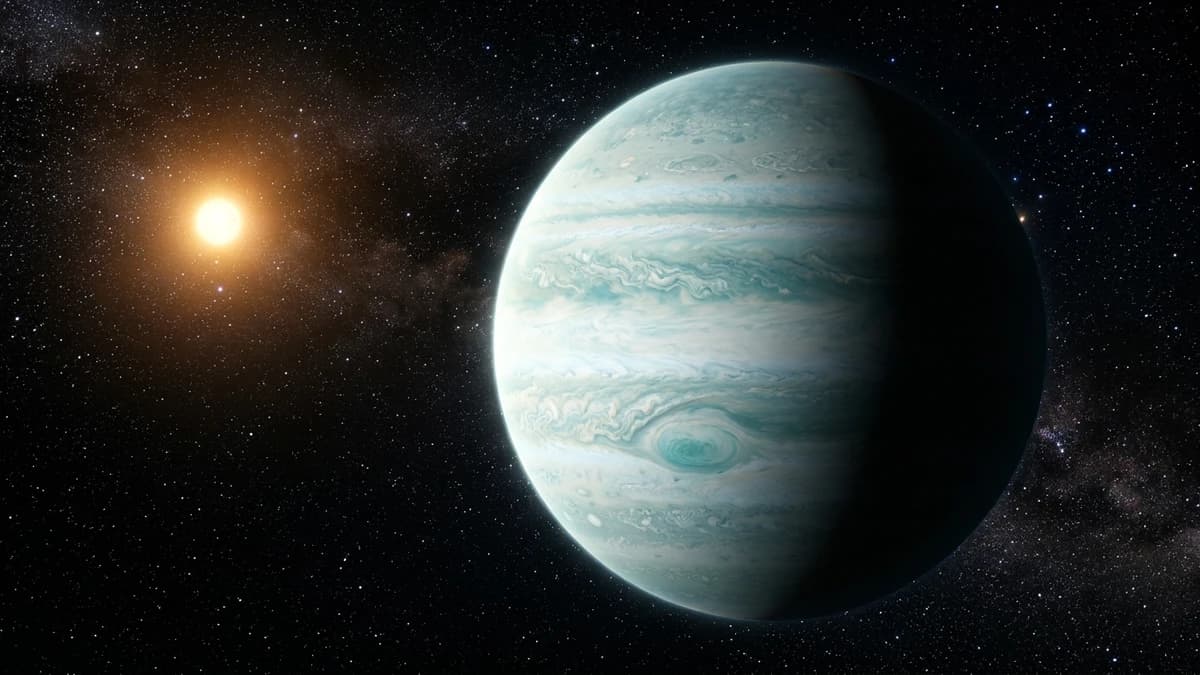
Atmosphere Detected on Exoplanet LHS 1140 b — High-Fidelity Artistic Illustration created by artificial intelligence based on scientific research.

On July 21, 2026, astronomers turned their telescopes toward the constellation Cetus, about 48 light-years from Earth. There, the exoplanet LHS 1140 b was confirmed as the first rocky world outside our Solar System with a stable atmosphere. This breakthrough represents a major milestone in astrobiology's search for extraterrestrial life in our galaxy.

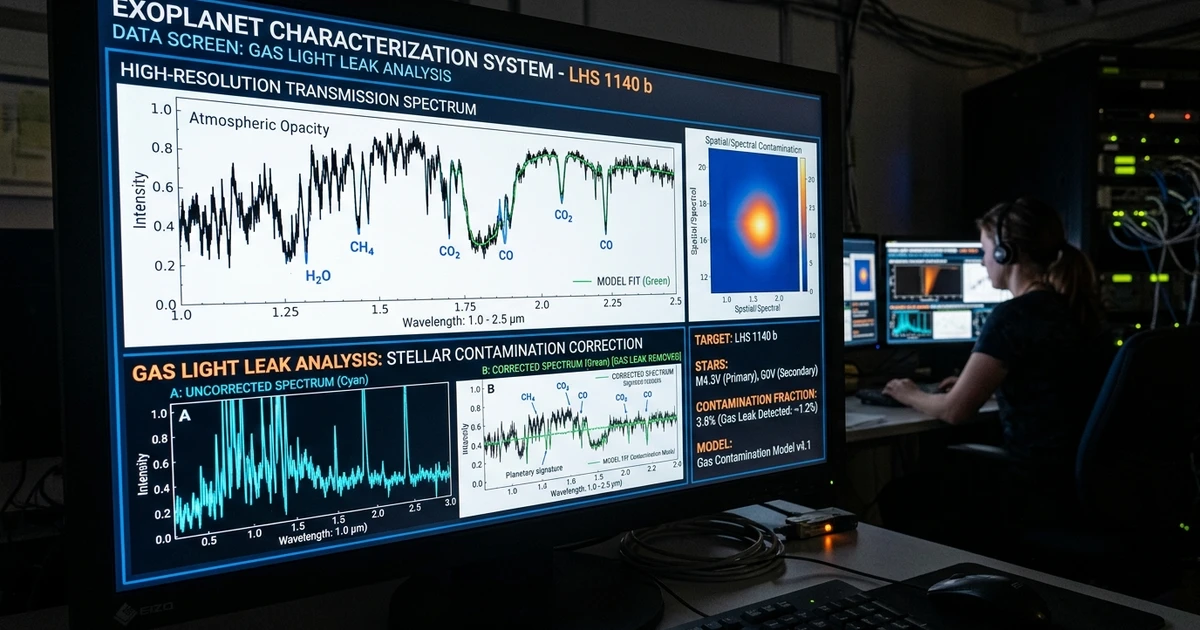
The detection was achieved using refined data from the James Webb Space Telescope (JWST) and partnering ground-based observatories. These spectroscopic analyses ruled out the possibility that the planet is an inhospitable, gaseous mini-Neptune. Scientists believe LHS 1140 b possesses a nitrogen-rich atmosphere, similar to Earth, sustaining conditions favorable for liquid water.

An artistic representation of LHS 1140 b showing its newly detected atmosphere under the glow of its star.

What Happened #

The official announcement of the discovery consolidated years of observations focused on the star LHS 1140. An international team of scientists, led by researchers from the University of Montréal, utilized high-resolution transit spectroscopy to isolate the atmosphere's signal. This method captures subtle changes in the star's brightness when the planet crosses its orbit.

Unlike other previously analyzed super-Earths, where violent stellar winds stripped away any gas, LHS 1140 b successfully resisted. The spectroscopic confirmation rules out the hypothesis that the planet is surrounded only by a dense mantle of light hydrogen. The data confirms a stable gaseous envelope composed of much heavier and denser elements.

Furthermore, a detailed analysis of its density points out that the planet is not composed purely of dry rocks. Refined mathematical models indicate that the water content on LHS 1140 b is extraordinarily high, reaching up to nineteen percent of its total mass. This scenario suggests we are dealing with a true water world or a glacial planet with a global ocean.

Context and History #

Discovered in 2017, the exoplanet LHS 1140 b has always been considered a strong candidate for deep habitability studies. The host star is an M-type red dwarf, but it possesses unusually low and stable magnetic activity. This calm behavior allowed the planet's atmosphere to survive without being eroded by cosmic radiation storms over billions of years.

Although LHS 1140 b orbits a highly stable star, our own sun frequently reminds us of space's volatility. On Earth, we monitor the risks of a solar super-eruption threatening global communication networks, highlighting the fragility of our technology. This violent orbital dynamic in our system contrasts with LHS 1140's calm, favoring the stability of that distant atmosphere.

Some astrobiologists theorize that the subglacial oceans of LHS 1140 b could harbor hydrothermal vents similar to those on Earth. This environment would be comparable to the secrets of the Lost City in the depths of the Atlantic, which offer ideal conditions for primitive life. The absence of direct sunlight on the frozen surface would not prevent chemosynthetic ecosystems from developing in these hydrothermal fissures.

Spectroscopic analysis performed by astronomical computers using data collected by the telescope.

Impact on the Population #

The confirmation of a stable atmosphere on a temperate exoplanet significantly alters our view of life in the galaxy. For society, this discovery brings us closer to answering the ultimate cosmic mystery regarding the existence of interstellar neighbors. Beyond feeding public curiosity, this achievement fosters academic interest in cutting-edge basic scientific careers.

In the long term, technologies developed to decipher faint signals from deep space bring direct practical benefits to Earth. Optical sensors designed for astrophysics are frequently adapted for the detailed environmental monitoring of our own terrestrial ecosystems. Thus, the search for distant habitable worlds ends up generating immediate improvements in preserving life on our planet.

To understand the relevance of LHS 1140 b, scientists compare it with other rocky exoplanets orbiting in their stars' habitable zones. The following table summarizes the main characteristics that make this exoplanet the most balanced candidate of our time.

Planet Name Distance (Light-Years) Star Type Mass (Earth Masses) Atmospheric Indicators
LHS 1140 b 48 Stable Red Dwarf (M) 5.6 Probable nitrogen, escaping helium
Proxima Centauri b 4.2 Active Red Dwarf (M) 1.17 No dense atmosphere detected
TRAPPIST-1 f 40 Active Red Dwarf (M) 0.93 Signs of severe atmospheric loss
Kepler-186 f 582 Red Dwarf (M) 1.4 Inconclusive signals due to distance
HD 137010 b 146 Solar Type (G/K) 1.06 Thin atmosphere with greenhouse gas under study

These structured data reinforce that physical distance is not the only determining factor in the search for habitable worlds. Although Proxima Centauri b is much closer, its star's severe magnetic activity destroys any local biological chances. The mass of LHS 1140 b is ideal for protecting planetary gases against space weathering.

What Those Involved Say #

The astrophysicists leading the study expressed immense satisfaction with the pioneering data collected during this observation campaign. Charles Cadieux, lead researcher at the University of Montréal, highlighted the central role this planet will play in future planetary astronomy. According to him, LHS 1140 b may be the best bet for one day confirming liquid surface water.

This positive perspective is supported by René Doyon, director of the prestigious Trottier Institute for Research on Exoplanets in Canada. He pointed out that characterizing a temperate planet's atmosphere is an achievement that highlights the excellence of modern spectrographs. For Doyon, we are facing an unprecedented natural laboratory that will rewrite classical astrobiology theories.

However, independent scientists who analyzed the James Webb data urged caution before declaring that life exists there. They warn that the nitrogen signature needs to be corroborated by more planetary transits to eliminate stellar noise. This analytical rigor ensures that every new scientific conclusion is built on a solid empirical foundation.

Next Steps #

Future plans for astronomers focus on scheduling new exclusive observation rounds using the James Webb Telescope in the coming months. The main objective is to measure thermal variations on different faces of the planet during its short orbital period. This will reveal if the atmosphere distributes heat efficiently, creating a temperate zone.

Simultaneously, progress on thirty-meter giant telescopes in Chile promises to revolutionize the direct imaging of exoplanets from the ground. These terrestrial tools will be capable of isolating the light reflected by the surface of LHS 1140 b independently. With this, astronomers hope to map the exact proportion between oceans and continents.

Finally, planetary climatology teams are developing complex computational models to simulate wind circulation on this distant world. These simulation tools estimate how moisture evaporates from the central ocean and condenses as snow on the dark sides. Such simulations will guide future searches for gaseous biological signatures in the atmosphere.

Illustration of the surface of LHS 1140 b showing the presence of liquid water surrounded by vast ice fields.

Transmission Spectroscopy and Secondary Atmosphere Retention Around Red Dwarfs #

The confirmation of a nitrogen-rich secondary atmosphere surrounding LHS 1140 b by the James Webb Space Telescope's NIRISS and NIRSpec instruments marks a turning point in comparative planetology. Orbiting a quiet M-dwarf star 48 light-years away in the constellation Cetus, LHS 1140 b avoided the extreme ultraviolet stellar stripping that eroded the atmospheres of closer rocky worlds in the TRAPPIST-1 system, preserving volatile gases across billions of years.

Radiative-convective climate modeling indicates that an atmospheric surface pressure comparable to Earth's, combined with moderate carbon dioxide greenhouse warming, stabilizes a substellar liquid water ocean measuring roughly 4,000 kilometers in diameter across the tidally locked dayside. Future multi-transit campaigns will target subtle molecular absorption bands of methane, nitrous oxide, and ozone within this temperate marine niche to evaluate prebiotic and biological disequilibrium.

Conclusion #

The historic discovery of an atmosphere on the exoplanet LHS 1140 b opens an unprecedented window for the future of astrobiology. This finding proves that the empirical study of temperate rocky worlds is within the reach of human technology. The success of this detection renews hopes of deciphering the mysteries surrounding the deep cosmos.

At the same time, the exotic conditions of this distant world remind us of the value of our own biosphere. Studying the hostile climates of exoplanets provides crucial data to appreciate the stable thermal balance we enjoy at home. Scientific progress in deep space always returns to Earth as ecological wisdom to protect our world.

With the constant improvement of telescopes and computational systems, the barriers of the unknown recede with each observation. LHS 1140 b is a vivid reminder that the search for cosmic answers is only in its infancy. Humanity's next steps will lead us even further in this great journey of cosmic exploration.


Sources and References #

🏷️ Tags:

#LHS1140b#atmospheredetected#habitableexoplanet#extraterrestriallife#JamesWebb#JWST#astronomy2026#habitableplanet

📢 Gostou deste artigo?

Compartilhe com seus amigos e nos conte o que você achou nos comentários!

Receba novidades!

Cadastre seu email e receba as melhores curiosidades toda semana.

🔒 Sem spam. Cancele quando quiser.

💬 Comentários (0)

Seja o primeiro a comentar! 👋

📚Related Articles

Receba novidades no WhatsApp!