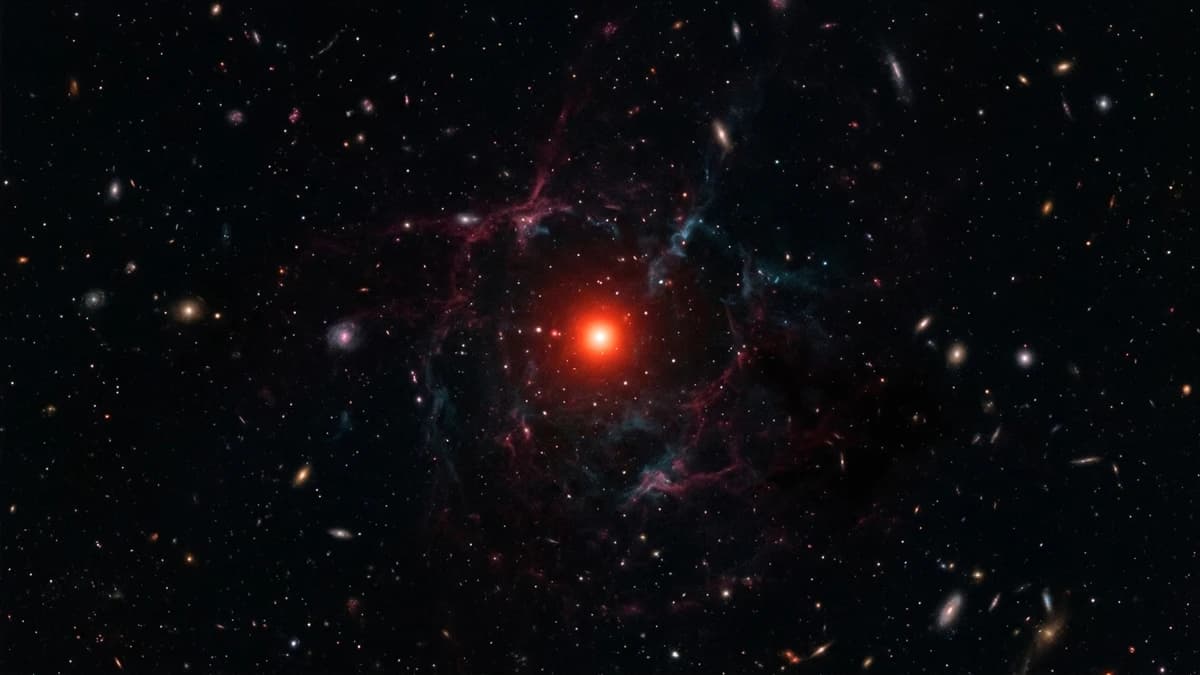
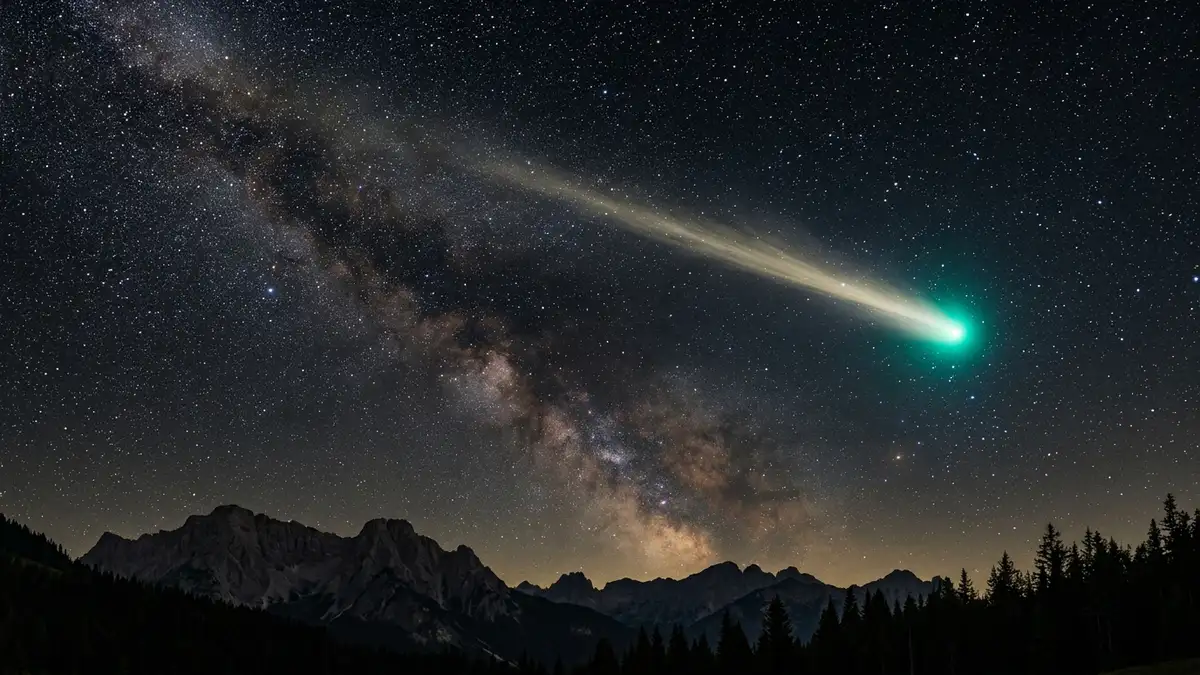
A star with 29 times the mass of the Sun, floating 79,256 light-years away, carries in its chemical composition a message from 13 billion years ago — and it was undergraduate students who deciphered that message. SDSS J0715-7334 is not just one of the most ancient and pristine stars ever cataloged: it is a cosmic traveler that was born in another galaxy before being swallowed by the Milky Way, making it a living time capsule from the dawn of the universe.
The discovery, led by students at the University of Chicago under the guidance of Professor Alexander Ji, rewrites what we knew about the formation of the first stars and how our galaxy grew by devouring smaller neighbors over billions of years.
What Happened
In 2025, undergraduate students at the University of Chicago made a discovery typically reserved for astronomers with decades of experience: they identified one of the most primitive stars ever found in the observable universe. The star, cataloged as SDSS J0715-7334, is a red giant with approximately 29 times the mass of our Sun, located at a distance of 79,256 light-years from Earth.
What makes this star truly exceptional is not its size or distance, but its chemical composition. SDSS J0715-7334 is composed almost entirely of hydrogen and helium — the two lightest and oldest elements in the universe, created in the first minutes after the Big Bang. The amount of heavy elements (which astronomers collectively call "metals," including everything heavier than helium) is extraordinarily low, making it one of the most "pristine" or "pure" stars ever observed.
To understand why this is so significant, one must grasp how the universe evolved chemically. Shortly after the Big Bang, approximately 13.8 billion years ago, the universe contained only hydrogen, helium, and traces of lithium. All other elements — carbon, oxygen, iron, gold, uranium — were forged later inside stars and dispersed through space when those stars exploded as supernovae. Each generation of stars enriched the interstellar gas with more heavy elements, so younger stars tend to contain more metals than older ones.
SDSS J0715-7334, with its nearly pure hydrogen and helium composition, must have formed from gas enriched by only one or two primordial supernovae — possibly among the first stellar explosions in the history of the universe. This places it among the oldest stars still in existence, a direct relic of the first generation of cosmic star formation.
The discovery was made using data from the Sloan Digital Sky Survey (SDSS), one of the most comprehensive astronomical surveys ever conducted, which has mapped spectra of millions of celestial objects. The students, working under the guidance of Professor Alexander Ji — one of the leading experts in stellar archaeology — developed criteria to filter stars with anomalous chemical compositions from the vast SDSS databases.
A fascinating detail of the story is that the star had already been identified in 2014 data by astronomer Kevin Schlaufman, but was rediscovered completely independently by the students in 2025. This independent rediscovery not only validated the original finding but also demonstrated the robustness of the methods used and the importance of revisiting existing astronomical data with fresh perspectives.
Among the team members, the participation of an Indian-origin student stands out, reinforcing the international and diverse character of modern astronomical research. The team used high-resolution spectroscopy techniques to confirm the star's chemical composition and determine that it could not have formed in the typical chemical environment of the Milky Way.
Background and Context
The search for extremely metal-poor stars — technically called "metal-poor" or "ultra metal-poor" stars — is one of the most active frontiers in contemporary astrophysics. These stars are the living fossils of the primitive universe, and finding them is like discovering a perfectly preserved dinosaur in amber: they carry information about conditions that existed billions of years before our Solar System formed.
The first generation of stars in the universe, known as Population III, formed from the primordial gas of pure hydrogen and helium. These stars were probably enormous — hundreds of times more massive than the Sun — and lived short, violent lives, exploding as supernovae after only a few million years. No Population III star has been directly observed to date, as they all became extinct long ago.
However, the supernovae of these first stars enriched the surrounding gas with small amounts of heavy elements, enabling the formation of a second generation of stars — Population II. These stars, while not as primitive as Population III, still contain very low amounts of metals and can survive for billions of years if they are sufficiently small. SDSS J0715-7334 belongs to this category: a second-generation star that preserves the chemical signature of the young universe.
The Sloan Digital Sky Survey, launched in 2000, revolutionized astronomy by creating a detailed three-dimensional map of hundreds of millions of celestial objects. Its data is made publicly available, allowing researchers around the world — including undergraduate students — to make significant discoveries without needing exclusive telescope time. This democratization of astronomy is one of the SDSS's most important legacies.
The University of Chicago has a long and distinguished tradition in astrophysics. Professor Alexander Ji, who mentored the students in this discovery, specializes in "stellar archaeology" — the field that uses the chemical composition of ancient stars to reconstruct the history of the primitive universe. His research group had already identified other notable stars with unusual chemical compositions, but SDSS J0715-7334 stands out for its combination of extreme primitiveness and evidence of extragalactic origin.
The idea that the Milky Way grew by absorbing smaller galaxies is not new. The European Space Agency's Gaia satellite, launched in 2013, mapped the motions of more than one billion stars in the Milky Way and revealed clear evidence of multiple galactic merger events throughout our galaxy's history. The most significant of these events, called "Gaia-Enceladus" or "Gaia Sausage," involved the absorption of a dwarf galaxy approximately 10 billion years ago. SDSS J0715-7334 may be a survivor of a similar — or even older — event.
What distinguishes this discovery from previous findings is the combination of three factors: the star's extreme metal poverty (indicating very ancient formation), its orbit and position in the Milky Way (inconsistent with local formation), and the fact that it was discovered by undergraduate students using public data. This triad makes SDSS J0715-7334 not only scientifically valuable but also a powerful symbol of how open science can produce extraordinary results.
Impact on Society
The discovery of SDSS J0715-7334 has implications ranging from fundamental cosmology to how we understand our place in the universe. The table below summarizes the main fields impacted:
| Field | Before the Discovery | After the Discovery | Impact |
|---|---|---|---|
| Cosmology | Few known primitive stars | New time capsule from the young universe | Better understanding of the Big Bang and first stars |
| Galaxy formation | Theoretical models of galactic mergers | Direct evidence of an immigrant star | Validation of Milky Way growth models |
| Stellar archaeology | Search limited to Milky Way stars | Stars from absorbed galaxies identifiable | New method to study extinct galaxies |
| Science education | Discoveries reserved for senior researchers | Undergraduates make cutting-edge findings | Democratization of astronomical research |
| Open science | Public data underutilized | Independent rediscovery validates open data | Strengthening of the open science model |
| Nucleosynthesis | Incomplete chemical enrichment models | Signature of few primordial supernovae | Refinement of chemical evolution models |
Cosmology and first stars: SDSS J0715-7334 functions as a cosmic time capsule. Its chemical composition preserves information about conditions that existed when the universe was only a few hundred million years old. By analyzing the traces of heavy elements present in the star, astronomers can infer the properties of the first supernovae — how massive they were, how much energy they released, and which elements they produced. This information is impossible to obtain otherwise, since the first stars disappeared billions of years ago.
Formation and evolution of the Milky Way: The evidence that SDSS J0715-7334 migrated from another galaxy provides a concrete piece of the puzzle of how the Milky Way formed. Our galaxy did not appear fully formed — it grew over billions of years by absorbing dozens of smaller galaxies. Each of these absorbed galaxies left traces in the form of stars with distinct chemical compositions and orbits. Identifying these "immigrant" stars allows reconstruction of the Milky Way's merger history with unprecedented precision. For those interested in how the universe works on larger scales, this discovery adds a fascinating layer of complexity.
Democratization of science: Perhaps the most inspiring aspect of this discovery is who made it. Undergraduate students, not tenured professors or researchers with decades of experience, identified one of the most important stars ever cataloged. This was possible because SDSS data is public and accessible to anyone with the technical knowledge to analyze it. The story of SDSS J0715-7334 is a powerful argument in favor of open science and the importance of investing in quality science education.
Archaeology of extinct galaxies: The star allows the study of a galaxy that no longer exists. The smaller galaxy where SDSS J0715-7334 was born was completely absorbed by the Milky Way, losing its identity as a separate entity. But its stars survived, carrying the chemical signature of their original environment. By studying stars like SDSS J0715-7334, astronomers can reconstruct the properties of galaxies that disappeared billions of years ago — a form of cosmic archaeology that would be impossible otherwise.
Primordial nucleosynthesis: The star's extremely primitive chemical composition provides important constraints for nucleosynthesis models — the process by which elements are created inside stars and in supernova explosions. The specific traces of heavy elements found in SDSS J0715-7334 may reveal whether it was enriched by a single massive supernova or by a small number of explosions, helping refine our understanding of how the first heavy elements in the universe were produced.
What the Experts Say
The astronomical community received the discovery with significant enthusiasm, recognizing both the scientific value of the finding and the inspiring story behind it.
Professor Alexander Ji, who mentored the students in the research, emphasized that SDSS J0715-7334 represents exactly the type of star astronomers have been searching for over decades: an almost untouched relic of the primitive universe that can tell us what the first generations of stars were like. Ji stressed that the star's extreme metal poverty, combined with evidence of extragalactic origin, makes it a unique natural laboratory for studying conditions that existed in the first billion years after the Big Bang.
The students involved in the discovery expressed surprise and excitement upon realizing the significance of what they had found. The identification process involved systematic analysis of stellar spectra in the SDSS databases, searching for chemical anomalies indicating exceptionally ancient stars. When the spectral patterns of SDSS J0715-7334 revealed its nearly pure hydrogen and helium composition, the team initially suspected an error in the data — so unusual was the result.
Astronomers not directly involved in the research praised the methodology and highlighted the importance of the independent rediscovery. The fact that the star had been previously identified by Schlaufman in 2014 data and was found again independently by the students in 2025 enormously strengthens confidence in the result. This independent convergence is considered one of the strongest indicators of validity in science.
Experts in galaxy formation observed that the discovery fits perfectly with theoretical models of hierarchical growth of the Milky Way, where large galaxies grow by absorbing smaller ones over cosmic time. SDSS J0715-7334 provides direct observational evidence of this process, complementing data from the Gaia satellite and other surveys.
Researchers in the area of diversity in science highlighted the participation of an Indian-origin student on the team, emphasizing how modern astronomy benefits from diverse perspectives and international collaboration. The discovery demonstrates that scientific talent exists in all parts of the world and that cutting-edge research opportunities should be accessible to everyone.
Next Steps
The discovery of SDSS J0715-7334 opens multiple lines of investigation that should occupy astronomers in the coming years.
The immediate priority is to obtain even higher-resolution spectra of the star, using large telescopes such as the European Southern Observatory's Very Large Telescope (VLT) or the Subaru Telescope in Hawaii. These spectra will allow precise measurement of the abundances of dozens of individual elements, providing a detailed chemical portrait that may reveal the specific properties of the supernovae that enriched the gas from which the star formed.
Another line of investigation involves determining the star's precise orbit within the Milky Way. By combining position and velocity data from the Gaia satellite with spectroscopic measurements, astronomers can calculate the star's trajectory over billions of years and potentially identify which absorbed galaxy it originated from. This would allow reconstruction of the properties of that extinct galaxy — its size, mass, and star formation history.
The search for stars similar to SDSS J0715-7334 should also intensify. If such a primitive star was found by undergraduate students in public data, it is likely that others are hidden in the same databases, awaiting identification. New astronomical surveys, such as the Legacy Survey of Space and Time (LSST) at the Vera C. Rubin Observatory, which is expected to begin operations soon, promise to multiply the number of cataloged stars and dramatically increase the chances of finding more relics of the primitive universe.
Researchers also plan to compare the chemical composition of SDSS J0715-7334 with theoretical models of Population III supernovae — the first stars in the universe. These comparisons may reveal whether the star was enriched by a core-collapse supernova, a pair-instability supernova, or some other type of primordial stellar explosion. Each type of supernova produces a distinct chemical signature, and SDSS J0715-7334 may help determine which type dominated the early universe.
The discovery should also stimulate the development of new machine learning algorithms to identify primitive stars in large astronomical databases. The amount of data produced by modern surveys is so vast that manual analysis is impractical, and artificial intelligence techniques can dramatically accelerate the identification of rare and scientifically valuable objects.
For those following the most recent scientific discoveries, SDSS J0715-7334 represents a milestone connecting observational astronomy with fundamental questions about the origin of the universe.
Closing Thoughts
The story of SDSS J0715-7334 is, in many ways, a story about the universe itself told through a single star. Born in a galaxy that no longer exists, formed from gas nearly as pure as what existed minutes after the Big Bang, this red giant traversed billions of years and billions of light-years to end up in the Milky Way — where undergraduate students, armed with public data and relentless curiosity, found it hidden among millions of other stars.
SDSS J0715-7334 is an ancient immigrant in every sense: ancient because it carries the chemistry of the young universe, and immigrant because it came from somewhere else. It reminds us that the Milky Way is not an isolated entity but a mosaic built over billions of years through the absorption of smaller galaxies — each contributing its stars, its gas, and its history to the galaxy we call home.
And perhaps most remarkable of all: this window into the dawn of the universe was opened not by a billion-dollar telescope or a Nobel laureate, but by students who were just beginning their scientific careers. If that is not proof that the universe rewards curiosity, it is hard to imagine what would be.
Sources and References
- University of Chicago — Discovery of primitive star by undergraduate students, Professor Alexander Ji's team (2025-2026)
- Sloan Digital Sky Survey (SDSS) — Public database of stellar spectra and astronomical survey
- ScienceDaily — Coverage on ultra metal-poor stars and stellar archaeology in the Milky Way