🌍 Your knowledge portal
Science and Nature

The Cosmic Conveyor: James Webb Telescope Reveals How NGC 4696's Black Hole Feeds

📅 2026-07-29⏱️ 6 min read📝
The Cosmic Conveyor: James Webb Telescope Reveals How NGC 4696's Black Hole Feeds
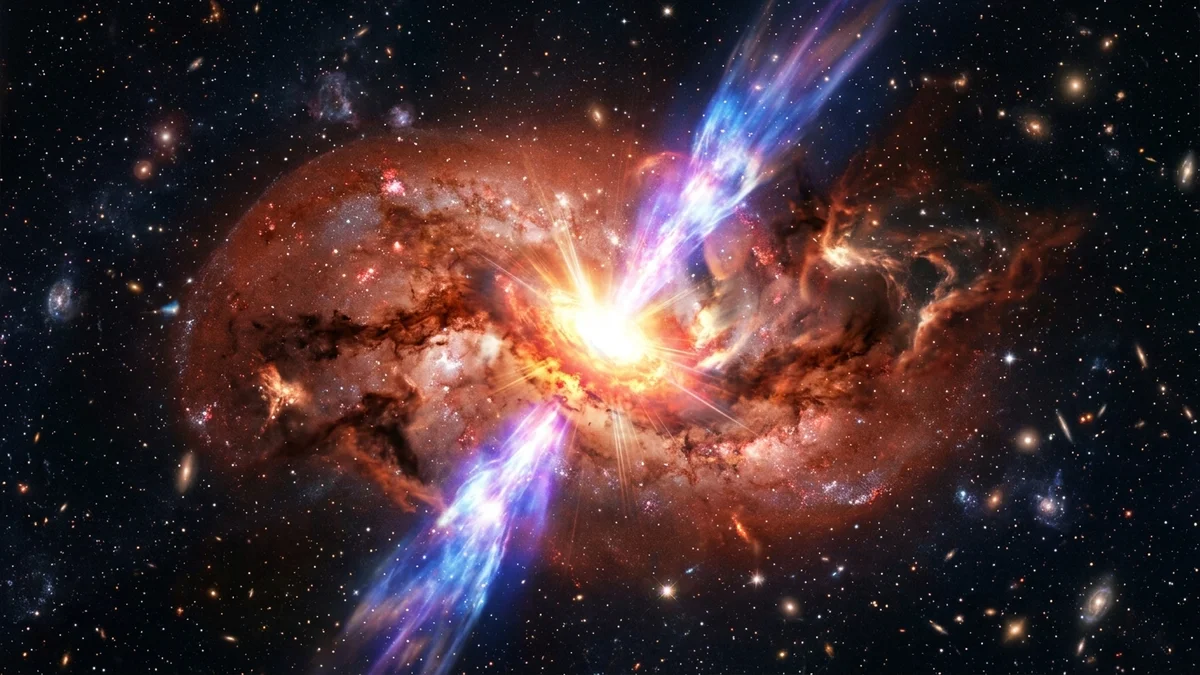
The Cosmic Conveyor: James Webb Telescope Reveals How NGC 4696's Black Hole Feeds — High-Fidelity Artistic Illustration created by artificial intelligence based on scientific research.
⚡

Quick Summary

Astronomers use James Webb observations to map the self-regulating cycle of gas feeding the central supermassive black hole of the NGC 4696 galaxy. A new investigation conducted with the James Webb Space Telescope has brought unprecedented answers about the feeding behavior of supermassive black holes in the deep universe.

Key Takeaways:

  • Capturing these hidden gas flows was only possible thanks to the extraordinary instrumental sensitivity of the NASA/ESA/CSA James Webb Space Telescope.
  • Understanding the self-heating and cooling dynamics that govern NGC 4696 requires processing complex physical models of magnetohydrodynamics.
  • The results obtained in the NGC 4696 galaxy support cosmological models about the co-evolution of black holes and host galaxies.

The Cosmic Conveyor: James Webb Telescope Reveals How NGC 4696's Black Hole Feeds

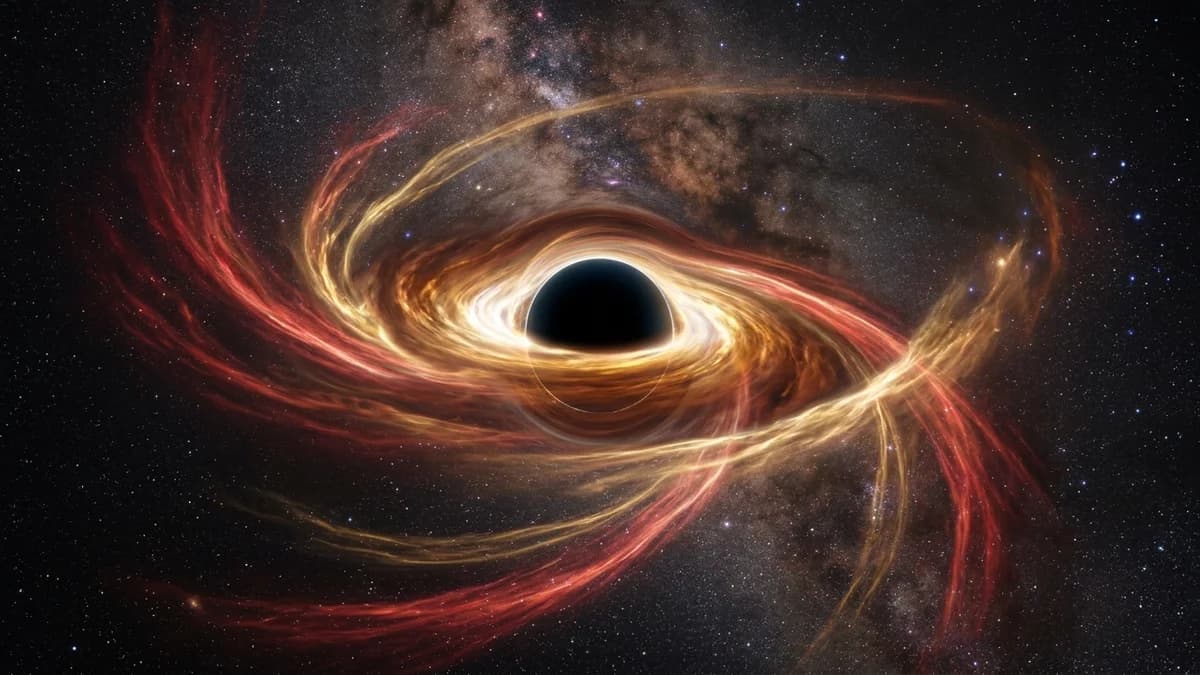
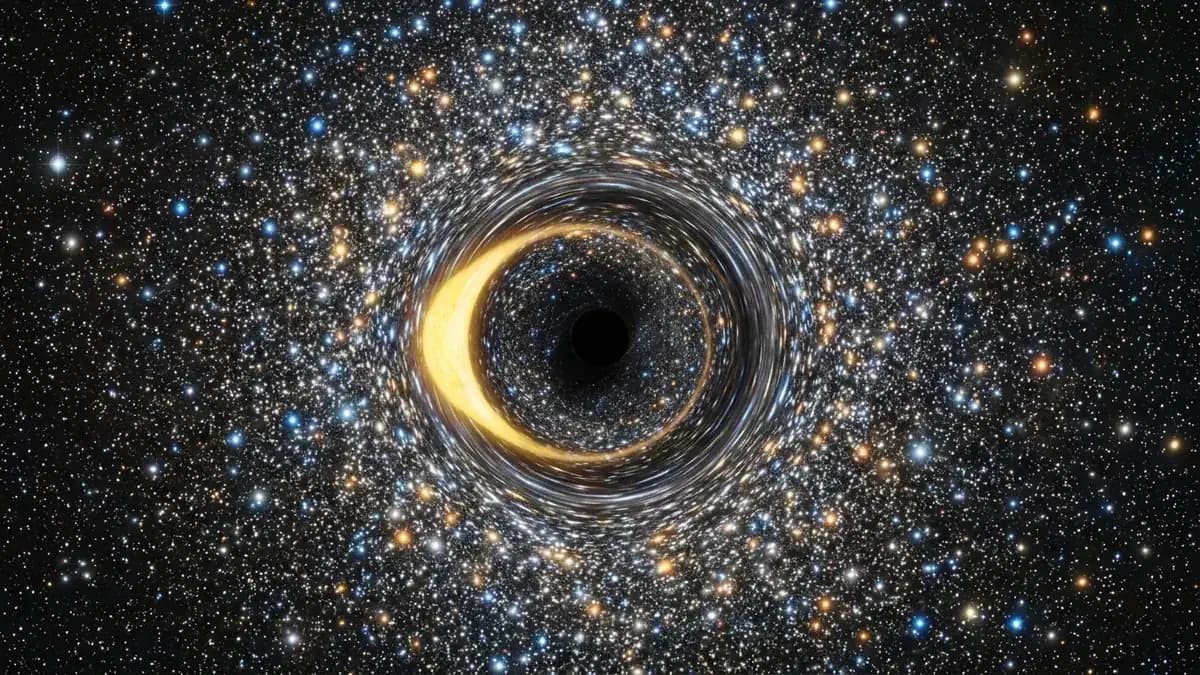
Scientific visualization of the black hole in the NGC 4696 galaxy and its gas filaments in the near-infrared spectrum

A new investigation conducted with the James Webb Space Telescope has brought unprecedented answers about the feeding behavior of supermassive black holes in the deep universe. Astronomers mapped in detail the gaseous filaments that nourish the central gravitational well of the NGC 4696 galaxy, the largest in the Centaurus cluster. The observations revealed a feedback cycle of matter that functions as a true self-regulating cosmic conveyor belt. The study resolves a long-standing paradox about how these giants maintain continuous growth without consuming or repelling all of their fuel quickly.

The discovered dynamic mechanism indicates that the black hole's violent activity regulates its own matter intake in prolonged cycles. Energy jets fired by the galactic nucleus heat the nearby molecular gas, pushing it away from the center at high speed. However, as this material moves away, it loses temperature, condenses, and forms thin interstellar filaments of cool gas. Under the relentless gravitational pull of the central giant, this cool dust falls back toward the core in a constant spiraling pattern.

This dynamic balance between thermal expulsion and gravitational attraction shapes the evolution of the largest elliptical galaxies in the observable universe. The discovery of similar dynamic cycles has already been recorded in other dense regions, such as in the thermal behavior of other black holes described recently on the portal. The interactions of this physical feedback help calibrate knowledge about complex systems, such as the detailed astrometry data used to search for the first stellar-mass black hole in Omega Centauri.
The James Webb Telescope and the Power of Infrared #

Capturing these hidden gas flows was only possible thanks to the extraordinary instrumental sensitivity of the NASA/ESA/CSA James Webb Space Telescope. While conventional optical telescopes find it difficult to register clear images of the core due to the dense stellar dust of NGC 4696, infrared light crosses these barriers easily. Astronomers used the NIRSpec (Near-Infrared Spectrograph) instrument to obtain the precise thermal signature of the molecular hydrogen filaments. Spectroscopic tracking revealed the exact velocity and direction with which matter moves inside the galactic core.

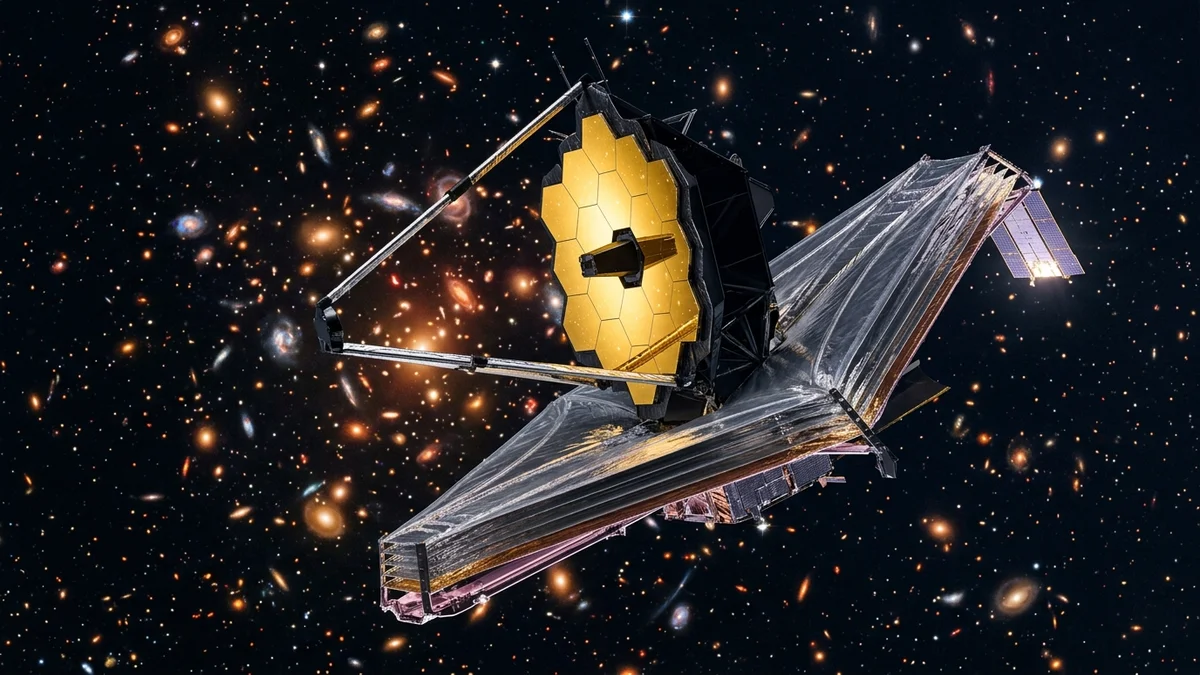
The James Webb Space Telescope operating in deep space focused on the Centaurus constellation

The collected data indicates the presence of a rotating disk structure with approximately 800 light-years in diameter at the base of the black hole. This disk acts as a transit zone, where filamentary matter accumulates before crossing the final event horizon. Computrometric modeling of the dust flow confirmed that the fall of cool gas occurs in an orderly fashion from the edges of the central disk. This direct physical observation validates theoretical models of accretion that previously lacked confirmation in high spatial resolution.

Integrating James Webb data with historical images from the Hubble Telescope allowed scientists to construct a highly realistic three-dimensional model of the gaseous currents. Hubble had already mapped dark dust structures in the center of NGC 4696 in a helical shape, but without data on their actual vector velocity. The new spectrum obtained resolved the doubts that had puzzled astrophysicists since the end of the last century in the Centaurus cluster. This same synergy of historical and infrared data has been successfully employed to map anomalies in the mysterious Red Potato Galaxy.


The Feedback Cycle and Computer Simulation #

Understanding the self-heating and cooling dynamics that govern NGC 4696 requires processing complex physical models of magnetohydrodynamics. The energetic jets act as thermostats that prevent the galaxy from converting all of its gas into new stars in an uncontrolled manner. If all of the molecular gas cooled simultaneously, the galaxy would undergo a burst of star birth that would consume resources in a few million years. The thermal feedback of the black hole, therefore, acts as the primary regulator of galactic longevity in the cosmos.

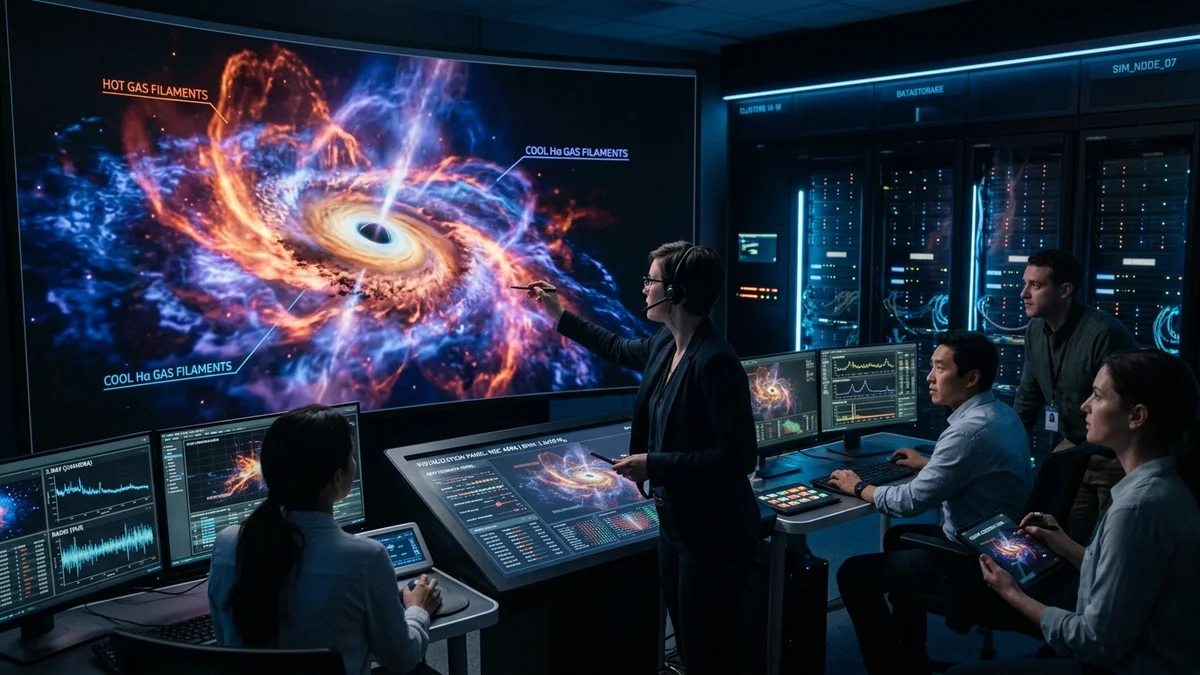
Scientists in a supercomputing center analyzing the three-dimensional simulation of the gaseous filaments of NGC 4696

The precision of models generated on high-performance supercomputers is compared to the data observed in real-time by infrared instruments. Scientists test different gas density scenarios to predict the stability of the orbital feeding flow over long cosmological eras. Three-dimensional simulations reveal that the turbulence generated by plasma jets creates temporary thermal exclusion zones in the galactic core. This cyclic fluctuation keeps the galaxy stable and prevents premature aging of its existing stellar population.

This modeling of multiple thermal flows is essential to decode energy distribution in highly complex gravitational astrophysics systems. Similar physical equations are applied to decode behaviors and thermal transfers in smaller bodies, including the severe gravitational interactions that heat Jupiter's moon Io. The calibration of these thermodynamic simulations in deep space supports the development of new analysis algorithms for future next-generation orbital observatories.


Comparative Table: Black Hole Feeding Models #

Aspect for Comparison Chaotic Accretion (Classic) Self-Regulated Feedback (NGC 4696) Direct Collapse Accretion
Physical State of Fuel Dispersed and unstable gas clouds Continuous filaments of cool gas Massive primordial dense clouds
Thermal Regulator Absent (Violent and rapid accretion) Present (Cyclic jet feedback) Pure gravity in abrupt collapse
Growth Rate Extremely variable with short peaks Stable and constant over the long term Rapid on short timescales
Radiation Emission High emission of X-rays and gamma rays Infrared emission from filaments Hidden until the horizon forms
Energy Efficiency Low due to premature dispersion High due to retention cycle Variable depending on envelope mass

Cosmic Implications and the Fate of NGC 4696 #

The results obtained in the NGC 4696 galaxy support cosmological models about the co-evolution of black holes and host galaxies. This evolutionary process suggests that the final size of an elliptical galaxy is directly limited by the energy output of its active nucleus. The observations confirm that supermassive black holes are not just destructive agents, but the primary regulating thermostats of galactic cosmic ecology. The thermal balance generated by this feedback prevents the local universe from suffering from a premature shortage of free molecular gas.

The stellar currents that form galaxy clusters like the one in Centaurus suffer continuous gravitational influence from this central giant. The energy dissipated by the jets of NGC 4696 heats the intra-cluster medium, influencing the behavior of neighboring smaller satellite galaxies. Identifying this feedback cycle in real-time allows mapping matter transfer across scales of millions of light-years. James Webb's high-fidelity data serves as a basis for simulating future collisions of large structures in the cosmic web of the universe.

Astronomers hope to extend this search based on infrared spectroscopy to other globular clusters and nuclei of massive galaxies. The systematic identification of new cold filaments will help map the hidden population of stellar fuel in our cosmic neighborhood. This ongoing exploration promises to reveal crucial answers about the distribution of baryonic matter and extreme gravitational physics in deep space. The success of this thermodynamic mapping opens new fronts of astrophysical research that science will continue to decipher in the coming decades of space exploration.


Scientific References and Further Reading #

🏷️ Tags:

📢 Gostou deste artigo?

Compartilhe com seus amigos e nos conte o que você achou nos comentários!

Receba novidades!

Cadastre seu email e receba as melhores curiosidades toda semana.

🔒 Sem spam. Cancele quando quiser.

💬 Comentários (0)

Seja o primeiro a comentar! 👋

📚Related Articles

The Mystery of the 'Red Potato' Galaxy: How a Black Hole Prevents Star FormationScience and Nature

The Mystery of the 'Red Potato' Galaxy: How a Black Hole Prevents Star Formation

Astronomers unravel the mystery of the 'Red Potato' galaxy. Its supermassive black hole prevents the formation of new stars.

⏱️6 minLer mais →
NASA’s "Big Bang": The Risky Command That Saved Voyager 2 in Interstellar SpaceScience and Nature

NASA’s "Big Bang": The Risky Command That Saved Voyager 2 in Interstellar Space

Discover how NASA engineers performed an emergency electrical maneuver to extend Voyager 2's lifespan 20 billion km from Earth.

⏱️6 minLer mais →
Rubin Mapping of the COSMOS Field Reveals Unprecedented Details of the UniverseScience and Nature

Rubin Mapping of the COSMOS Field Reveals Unprecedented Details of the Universe

The Vera Rubin Observatory obtains an ultra-deep image of the COSMOS field, mapping over 650,000 galaxies and 50,000 stars.

⏱️6 minLer mais →
Enigma Under the Crust: Juno Probe Reveals Jupiter's Moon Io is Much Hotter Than EstimatedScience and Nature

Enigma Under the Crust: Juno Probe Reveals Jupiter's Moon Io is Much Hotter Than Estimated

New data from NASA's Juno spacecraft reveal that the moon Io is dramatically hotter beneath the surface than models predicted.

⏱️6 minLer mais →
The Enigma of Metallicity: Supercomputers Solve the Mystery of 'Missing Silver' in the SunScience and Nature

The Enigma of Metallicity: Supercomputers Solve the Mystery of 'Missing Silver' in the Sun

Scientists use supercomputers to solve the enigma of the Sun's 'missing silver'. Learn about the new metallicity simulation.

⏱️6 minLer mais →
Race Against Time: NASA Accelerates Nancy Grace Roman Space Telescope Launch to August 2026Science and Nature

Race Against Time: NASA Accelerates Nancy Grace Roman Space Telescope Launch to August 2026

NASA and SpaceX officially confirm the acceleration of the launch schedule for the Nancy Grace Roman Space Telescope to August 30, 2026, opening new scientific frontiers on dark matter and dark energy

⏱️7 minLer mais →
Receba novidades no WhatsApp!