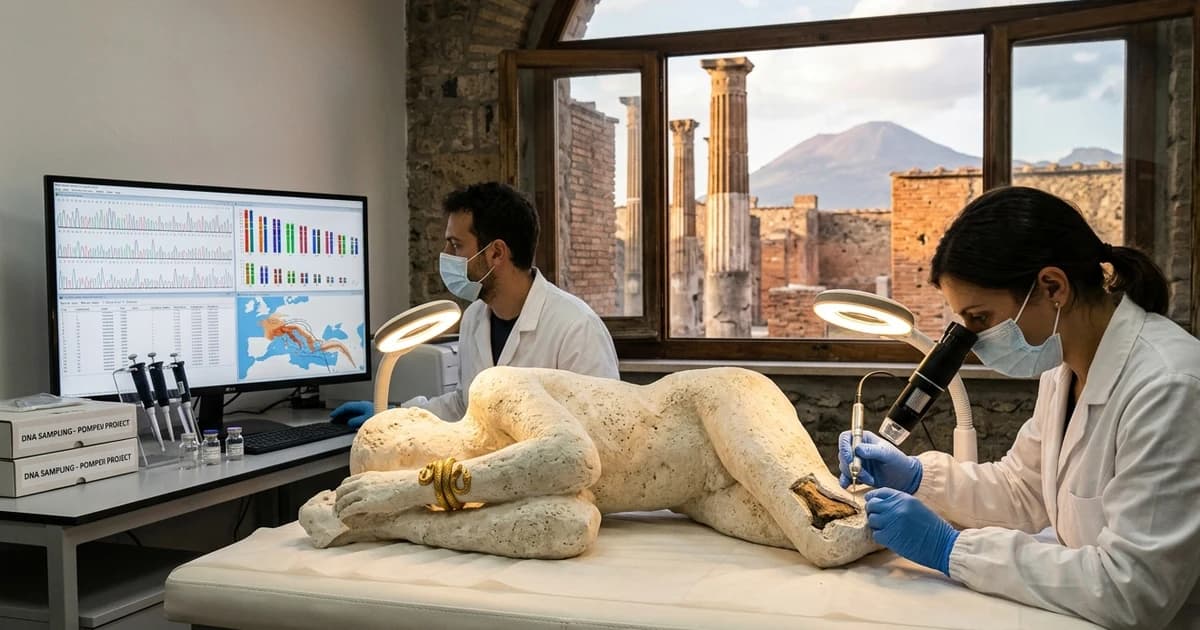
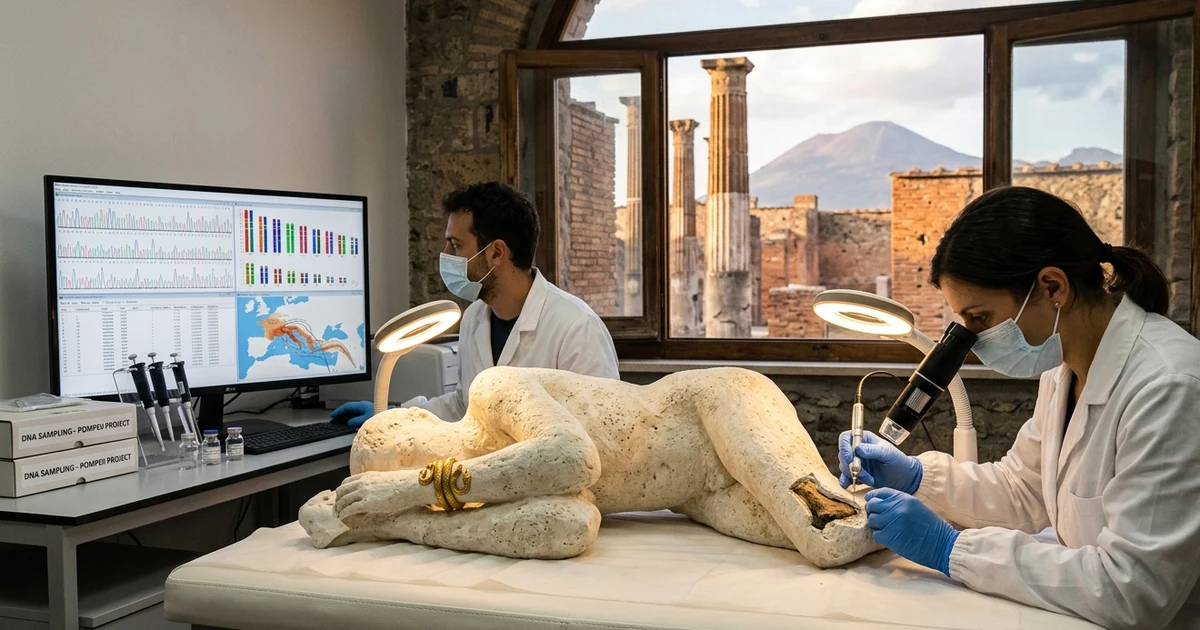
Inside ultra-clean ancient DNA laboratories at the University of Florence and Harvard Medical School, scientists applied strict ultraviolet irradiation and chemical pre-treatment protocols to eliminate modern DNA contamination introduced by excavators, restorers, and tourists who had handled the casts over more than a hundred years. Subsequently, the team led by Alissa Mittnik and David Reich employed single-stranded DNA library preparation combined with in-solution hybridization capture targeting more than 1.2 million informative single-nucleotide polymorphisms (SNPs) across the human genome (1240k capture panel). This precision methodology allowed the researchers to authenticate endogenous ancient DNA through characteristic post-mortem cytosine deamination signatures at molecule ends and successfully reconstruct high-resolution nuclear genomic profiles for 5 victims, alongside diagnostic sex-chromosome and mitochondrial markers in the remaining samples.
The most explosive revelation of the entire forensic dossier centered on the opulent House of the Golden Bracelet (Casa del Bracciale d'Oro, cataloged in Pompeian topography as Regio VI, Insula 17 [Insula Occidentalis], 42), an aristocratic multi-level residence built on panoramic terraces overlooking the Bay of Naples and renowned for its lush garden frescoes depicting birds and fountains. During excavations conducted in 1974, archaeologists uncovered four bodies huddled together at the foot of an interior staircase leading toward the lower garden, crushed by the collapse of the upper floor during the final phase of the eruption: Casts 50, 51, 52, and 53.
For fifty years, the physical arrangement of those four bodies fueled one of the most famous family narratives of the ancient world. The adult individual corresponding to Cast 50 and a toddler approximately two years old (Cast 53) lay next to another adult (Cast 52), who held a young child around five years of age (Cast 51) against their hip. Because the adult in Cast 52 wore an extraordinary piece of jewelry on the arm—a solid-gold bracelet weighing 610 grams (1.34 pounds), sculpted in the shape of a two-headed serpent holding a lunar disk bearing the bust of the moon goddess Selene—and carried the young child against their torso, the 1974 excavators immediately concluded that this figure was the mother of the family, perishing beside her husband (Cast 50) and their two young sons while attempting to flee with a strongbox containing 40 gold coins (aurei) and 180 silver coins (denarii).
When geneticists in Florence and Harvard sequenced the sex chromosomes and autosomal DNA of all four individuals from the House of the Golden Bracelet, the traditional story collapsed completely. Analyzing the ratio of sequencing reads aligned to the X and Y chromosomes proved, with 100% statistical certainty, that all four individuals (Casts 50, 51, 52, and 53) were biologically male (XY). The supposed "mother" wearing the 610-gram gold bracelet and holding the five-year-old boy on his hip (Cast 52) was, in reality, an adult man.
Even more astonishing was the outcome of the biological kinship analysis based on autosomal allele sharing as well as mitochondrial DNA (mtDNA) and Y-chromosome haplogroups: none of the four individuals shared any biological relatedness with one another, not even down to the third degree (they were neither father and son, nor brothers, nor uncle and nephew, nor first cousins). Furthermore, forensic phenotypic reconstruction using the HIrisPlex-S prediction system revealed that the man wearing the golden bracelet (Cast 52) had dark skin and black hair. Rather than a traditional biological nuclear family, the four men and boys killed beneath the stairs were likely domestic servants, enslaved people, freedmen, or members of a complex Roman household (familia in the broad Roman legal sense encompassing all household dependents), in which an adult male tried to comfort or shield an unrelated child during the final moments of the cataclysm while carrying the household's gold jewelry and coin hoard in a desperate bid for survival.
The dismantling of long-held archaeological myths driven by the Current Biology study extended to two other emblematic landmarks within the Archaeological Park of Pompeii: the House of the Cryptoporticus (Casa del Criptoportico, Regio I, Insula 6, 2) and the world-famous Villa of the Mysteries (Villa dei Misteri), located in the suburban northwest outskirts beyond the city walls.
In the House of the Cryptoporticus—a noble residence featuring a vaulted subterranean passageway decorated with painted scenes from Homer's Iliad, a classic literary motif also highlighted in the Oxyrhynchus mummy burying a papyrus of Homer's Iliad discovered in Egypt—excavations conducted in 1914 by archaeologist Vittorio Spinazzola uncovered nine victims in the upper garden who had tried to flee across the pumice layer. Two of those victims (Casts 21 and 22) were immortalized in plaster lying side by side in an intimate embrace, with the head of one resting gently against the chest and abdomen of the other.
For more than a century, this moving pair was presented in academic literature and museum guides under three competing hypotheses inspired by the slender contours of their plaster forms: they were assumed to be two sisters, mother and daughter, or female lovers. Although nuclear DNA from Cast 21 was too degraded to yield a definitive chromosomal sex determination, successful genetic extraction from Cast 22 (cataloged in the study as individual I3690) categorically proved that this victim was a genetically male individual (XY). Additionally, comparing the mitochondrial DNA sequences recovered among the grouped victims in the House of the Cryptoporticus ruled out maternal relatedness in at least one of the tested pairs, permanently burying the century-old narrative of the "two sisters" or "mother and daughter."
At the Villa of the Mysteries (Villa dei Misteri), famous for its monumental frescoes of Dionysiaca initiation rites, scientists analyzed Cast 25 (individual I3682). This body had been discovered alone inside a room lying atop an accumulated layer of volcanic ash, wearing remnants of a heavy cloak and carrying an iron ring set with a carnelian gemstone engraved with a female figure, five bronze coins, and traces of a short whip, leading early excavators to identify him as the estate's watchman or doorkeeper (ostiarius) and caretaker. In this specific case, forensic genetics confirmed the traditional osteological and archaeological interpretation: Cast 25 belonged to an adult male (XY) of medium stature (estimated at approximately 1.65 meters) carrying mixed ancestry linked to Eastern Mediterranean and Italic Peninsula populations.
To systematically organize the scientific data revealed by the international research team in Current Biology, the technical table below contrasts traditional historical narratives against the genomic, isotopic, and phenotypic evidence obtained in the laboratory:
| Location / Building in Pompeii |
Cast Identifier / Sample ID |
Traditional Narrative (19th–20th Centuries) |
Genetic Sex Result (aDNA) |
True Biological Kinship |
Genomic Ancestry and Phenotype |
| House of the Golden Bracelet (VI, 17, 42) |
Cast 52 (Individual I3685) |
"The Mother": adult woman wearing a 610g gold bracelet and holding her son on her hip |
Male (XY) — Adult biological man |
Zero kinship with the child (Cast 51) or the other two victims |
Eastern Mediterranean / North African ancestry; dark skin and black hair |
| House of the Golden Bracelet (VI, 17, 42) |
Cast 51 (Individual I3684) |
Young son (~5 years old) carried by his supposed mother on the stairs |
Male (XY) — Young boy (~5 years old) |
Zero biological kinship down to 3rd degree with Casts 50, 52, and 53 |
Eastern Mediterranean / Levantine ancestry; brown eyes and dark hair |
| House of the Golden Bracelet (VI, 17, 42) |
Cast 50 (Individual I3683) |
"The Father": adult man leading the family's escape down the staircase |
Male (XY) — Adult biological man |
Zero biological kinship with the supposed wife or the two children |
Genetic lineage associated with Anatolian and Eastern Mediterranean populations |
| House of the Golden Bracelet (VI, 17, 42) |
Cast 53 (Individual I3691) |
Youngest son (~2 years old) of the presumed Roman nuclear family |
Male (XY) — Toddler boy (~2 years old) |
Zero biological kinship with the other three individuals in the group |
Genomic profile matching recent immigrants from the Eastern Mediterranean |
| House of the Cryptoporticus (I, 6, 2) |
Cast 22 (Individual I3690) |
One of the "Two Sisters" or "Mother and Daughter" perishing in a garden embrace |
Male (XY) — Biological male individual |
Maternal kinship excluded via mitochondrial DNA comparison |
Strong genetic component from the Eastern Mediterranean and the Levant |
| House of the Cryptoporticus (I, 6, 2) |
Cast 21 (Paired with Cast 22) |
Second member of the female embrace ("Sister" or "Mother") |
Nuclear DNA insufficient for sexing; mtDNA recovered |
No confirmed maternal bond with other tested casts in the residence |
Multi-ethnic first-century CE Roman domestic household context |
| Villa of the Mysteries (Northwest Suburb) |
Cast 25 (Individual I3682) |
Solitary watchman or doorkeeper (ostiarius) with iron ring and bronze coins |
Male (XY) — Adult biological man |
Solitary individual; no relatives identified in the sample set |
Mixed Italic / Eastern Mediterranean and Levantine ancestry |
| Total Forensic Campaign |
14 Sampled Casts (out of 86 in restoration) |
Interpretations driven by jewelry ownership, posture, and historic restorations |
Chromosomal sex and/or lineages determined; 5 full nuclear genomes |
Systematic refutation of the biological nuclear family assumption |
Overwhelming predominance of Eastern Mediterranean and Egyptian/North African immigration |
Beyond correcting the individual identities of Pompeii's most famous victims, the genome-wide sequencing conducted by the team of David Reich, Alissa Mittnik, and David Caramelli opened an unprecedented window into the demographic and ethnic makeup of the Roman Empire at the height of the Flavian dynasty. When the scientists projected the complete genomes of the Pompeii individuals onto a Principal Component Analysis (PCA) alongside hundreds of ancient Eurasian and African populations, they discovered that the analyzed Pompeians did not descend primarily from the early Iron Age Italic populations (such as the Samnites, Oscans, or Etruscans who inhabited the peninsula centuries earlier).
Instead, the residents buried by Mount Vesuvius exhibited a genetic signature strongly shifted toward the Eastern Mediterranean, clustering closely with ancient and modern populations from Anatolia (modern Turkey), the Levant (Syria, Lebanon, Jordan, and Israel), and North Africa (particularly Hellenistic and Roman Egypt). One of the individuals from the House of the Golden Bracelet displayed pronounced genetic affinity with Levantine and North African populations combined with dental enamel strontium isotopes ($^{87}\text{Sr}/^{86}\text{Sr} \approx 0.7080\text{–}0.7090$) reflecting Mediterranean coastal and volcanic geology. This remarkable genetic diversity corroborates other extraordinary archaeological discoveries regarding mobility across the Roman world, such as the Greco-Roman tombs containing golden tongues unearthed at Marina el-Alamein in Egypt and the submerged Nabataean sanctuary in Puteoli, situated just kilometers away from Pompeii across the Bay of Naples.
From a historical and sociological perspective, these genomic findings illuminate the true nature of the Roman domestic household (familia). In Ancient Rome, a wealthy urban residence (domus) did not house merely a blood-related married couple and their biological children, but rather an expansive household community comprising estate owners, enslaved people brought from across the eastern frontiers of the Empire, freedmen (liberti) who remained economically tied to their former masters, artisans, Greek tutors, and children raised collectively within the servile environment (vernae).
This social reality explains why four biologically unrelated males—including a man of Eastern Mediterranean/North African descent wearing or carrying a 610-gram solid-gold bracelet while holding a young child on his hip—died together on the staircase of the House of the Golden Bracelet. During the apocalyptic panic of the Vesuvius eruption, bonds of solidarity, protective care toward the household's children, and efforts to salvage family valuables in the face of imminent death did not depend on blood kinship, while carrying or wearing heavy gold jewelry during an evacuation defined neither gender nor maternal status.
Another vital contribution of the investigation led by the Archaeological Park of Pompeii and the University of Florence was exposing how artistic interventions by nineteenth- and twentieth-century restorers actively misled both archaeologists and the general public. Computed tomography scans performed across the 86 historic casts revealed that early craftsmen did not merely pour liquid plaster into volcanic ash cavities, but frequently sculpted, reshaped, and smoothed the external surfaces after the plaster set—repairing broken limbs, narrowing waists, remodeling facial features, and adjusting postures to make the tableaus appear more dramatic and aesthetically appealing to royal visitors and European tourists.
As Archaeological Park of Pompeii director Gabriel Zuchtriegel and geneticist David Caramelli emphasized in the study's conclusions, the combination of creative plaster restorations with the Victorian and modern mindset of observers generated enduring "archaeological fictions." Whenever an excavator saw a slenderly sculpted cast wearing gold jewelry beside a child, or two bodies intertwined in a garden, they reflexively projected modern bourgeois family stereotypes onto the Roman past, unaware that the actual human bones sealed beneath the plaster shell told an entirely different biological story.
The genomic analysis published in the peer-reviewed journal Current Biology conclusively demonstrated that the four individuals discovered together at the foot of the staircase in the House of the Golden Bracelet in 1974 (Casts 50, 51, 52, and 53) did not form a biological nuclear family of father, mother, and two sons as traditional archaeology claimed for half a century. Sex-chromosome sequencing and autosomal markers proved with absolute statistical certainty that all four bodies belonged to biological males (XY chromosomes) and that no genetic kinship existed among any of them down to the third degree. Furthermore, the adult in Cast 52, who wore the sumptuous 610-gram solid-gold two-headed serpent bracelet on his arm while holding a five-year-old boy on his hip, was an adult man carrying phenotypic markers for dark skin and black hair rather than the child's mother.
When Italian archaeologist Giuseppe Fiorelli invented in 1863 the technique of pouring liquid plaster of Paris into the hollow cavities left by decomposed bodies inside Pompeii's hardened volcanic ash, the actual human skeletons of the victims remained encapsulated inside the three-dimensional sculptures. During a comprehensive conservation and computed tomography (CT) scanning campaign across 86 historic casts at the Archaeological Park of Pompeii, researchers from the Universities of Florence and Harvard collected micro-samples of bone powder and dental fragments already exposed through structural fractures in 14 casts. By applying ultra-sensitive single-stranded library preparation and hybridization capture enrichment for over 1.2 million genomic markers inside high-containment cleanrooms, geneticists overcame both the thermal degradation from the 79 AD pyroclastic surges and the chemical contamination from the plaster.
Comparing the complete nuclear genomes recovered from Pompeii's victims against reference databases of thousands of ancient and modern populations revealed that the port city on the Bay of Naples was extraordinarily cosmopolitan and multi-ethnic during the first century CE. Far from descending exclusively from pre-Roman Italic populations of the Apennine Peninsula, every individual yielding genome-wide data displayed predominant genetic ancestry derived from recent immigrants from the Eastern Mediterranean, encompassing populations from Anatolia, the Levant (Middle East), and North Africa, including lineages associated with Hellenistic and Roman Egypt. This genetic portrait accurately reflects the bustling maritime trade routes of the neighboring port of Puteoli and the social structure of the Roman Empire, where eastern merchants, free artisans, freedmen, and enslaved people brought from eastern provinces formed the demographic backbone of urban villas.
Verified Scientific Sources and References:
- Current Biology (Original Peer-Reviewed Study): Pilli, E., Vai, S., Moses, V. C., Morelli, S., Lari, M., Modi, A., ... Caramelli, D., Reich, D., & Mittnik, A. (2024). Ancient DNA challenges prevailing interpretations of the Pompeii plaster casts. Current Biology, 34(22), 5307–5315.e7. DOI: 10.1016/j.cub.2024.10.007
- Harvard Medical School: Pompeii Victims' DNA Reveals Unexpected Stories
- Max Planck Institute for Evolutionary Anthropology: Ancient DNA rewrites histories of Pompeii victims
- Università degli Studi di Firenze & Parco Archeologico di Pompei: Archaeogenetic Investigation of the Pompeii Casts