The Remarkable Discovery in the Sands of Turpan
The ancient oasis city of Turpan, nestled deeply within the harsh but breathtaking landscapes of the Xinjiang region, has once again yielded a phenomenal archaeological treasure that redefines our historical understanding. Researchers and highly trained archaeologists excavating a remote desert site have recently unearthed a magnificent, incredibly well-preserved 1,300-year-old tomb dating back to the illustrious Tang Dynasty. This high-status burial chamber offers an unprecedented, vivid glimpse into the cosmopolitan nature of ancient China during its absolute golden age of international commerce and cultural integration.
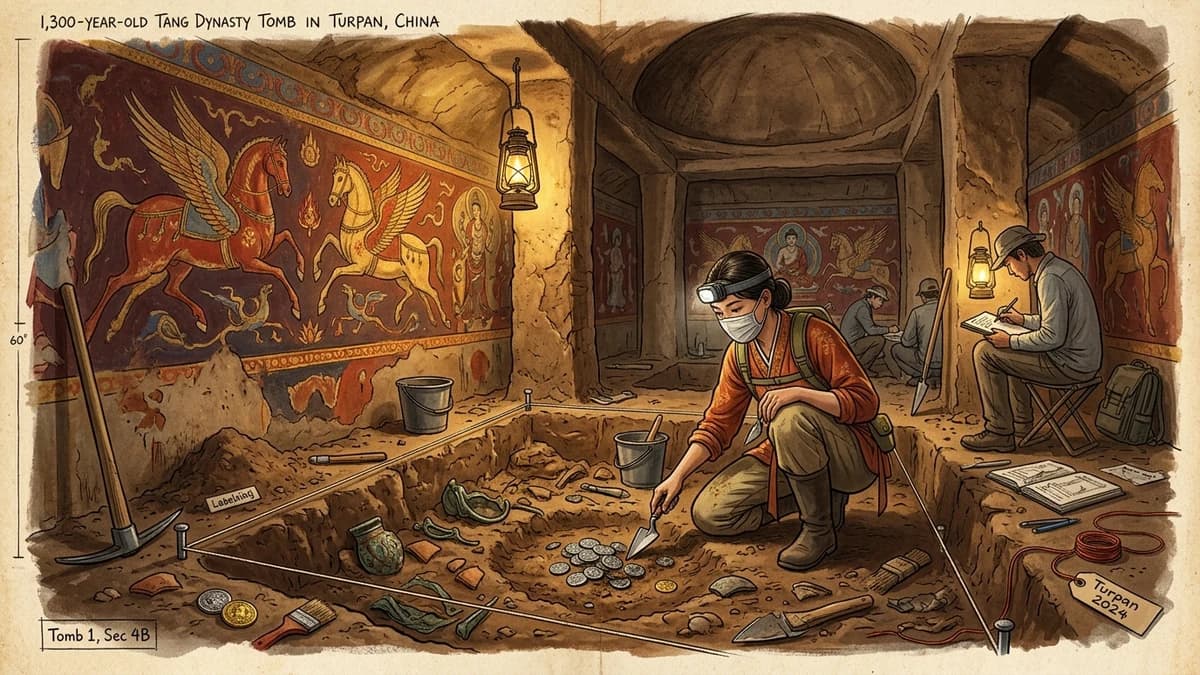
For decades, the arid climate of the Turpan Depression has acted as a natural preservative, safeguarding organic materials and delicate artistic expressions that would have otherwise perished in more humid environments. The latest excavation revealed a complex underground structure, meticulously carved into the earth, which clearly belonged to an individual of immense wealth and significant social standing within the regional administration. As researchers cleared away centuries of accumulated sand and debris, they were immediately struck by the astonishing vibrancy of the colors adorning the subterranean walls and the sheer opulence of the burial goods.
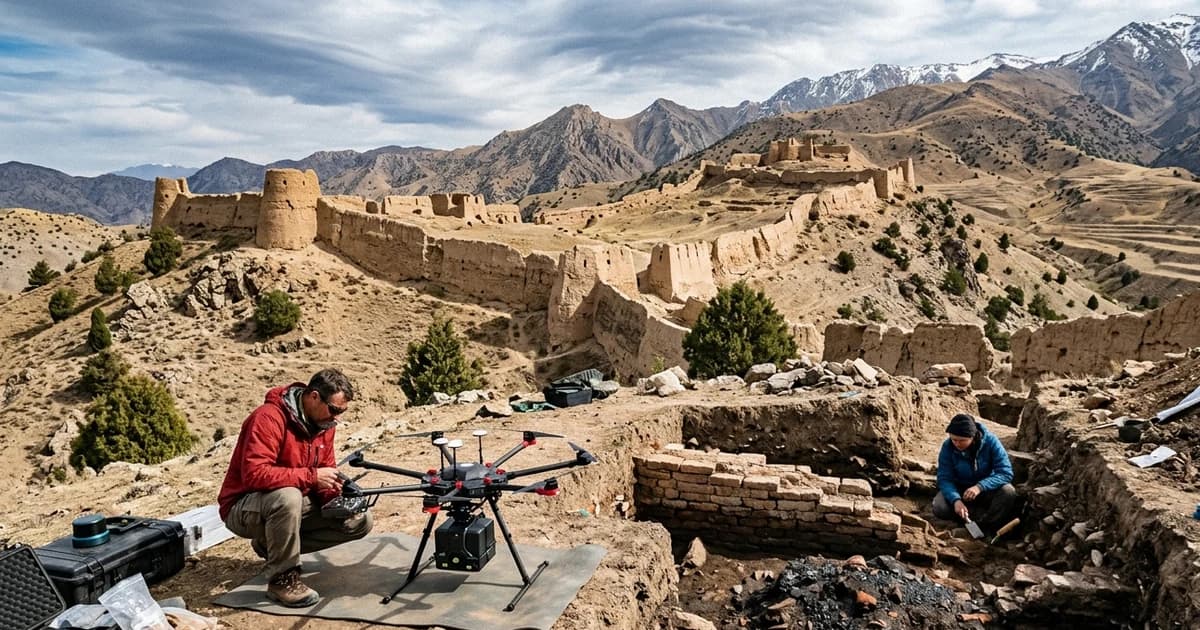
The sheer scale of this archaeological undertaking cannot be overstated, as the team employed cutting-edge ground-penetrating radar and 3D photogrammetry to meticulously map the site before initiating the physical dig. Every handful of sand removed from the tomb's entrance brought the modern world one step closer to an era where the East and West were inextricably linked by the legendary Silk Road. The artifacts recovered from this single location possess the profound potential to rewrite entire chapters of historical textbooks regarding the flow of global wealth and ideological concepts.
The Magnificent Murals of Winged Horses
Upon entering the main burial chamber, the archaeological team was greeted by a breathtaking series of murals that completely covered the expansive earthen walls in a brilliant display of ancient artistry. The centerpiece of these astonishing frescoes features a dynamic, masterfully rendered depiction of mythological winged horses galloping across a stylized celestial landscape filled with swirling clouds and celestial bodies. These majestic creatures, painted with exceptionally rare mineral pigments such as lapis lazuli and cinnabar, exhibit a level of anatomical precision and energetic movement that is rarely seen in contemporary artifacts.
The mythological winged horses represent a fascinating and complex visual syncretism, flawlessly blending indigenous Chinese mythological concepts with imported Central Asian and Hellenistic artistic motifs that traveled along the trade routes. In traditional Chinese folklore, the legendary "Tianma" or heavenly horses were revered as divine, supernatural beasts capable of bridging the immense gap between the mortal realm and the heavenly domains. However, the explicit addition of grand, feathered wings strongly suggests the unmistakable aesthetic and cultural influence of Persian iconography, demonstrating how fluidly ideas permeated Tang Dynasty society.
These magnificent creatures were purposefully painted on the dark tomb walls to serve as eternal celestial guides, tasked with safely and swiftly transporting the soul of the deceased to the immortal realm. Furthermore, the remarkably vibrant and enduring pigments used in these elaborate frescoes reflect the highly advanced chemical knowledge and refined artistic sophistication possessed by Tang Dynasty craftsmen. The seamless synthesis of these diverse cultural elements perfectly highlights the remarkable ideological openness and intellectual tolerance that characterized this specific, highly celebrated golden age of Chinese history.
Byzantine Gold and Persian Sasanian Silver
Equally astounding as the celestial murals was the discovery of a literal treasure trove of foreign currency, carefully placed near the remains of the tomb's primary occupant as a symbol of prosperity. Archaeologists meticulously cataloged a substantial collection of gleaming Byzantine gold solidi and intricately stamped Persian Sasanian silver drachmas, providing undeniable physical evidence of transcontinental economic networks. These precious coins, minted thousands of miles away in entirely different empires, somehow made their long, perilous journey across treacherous mountains and unforgiving deserts to find their final resting place in China.
The presence of Byzantine gold solidi in a Chinese tomb perfectly illustrates the vast, incredibly complex and deeply interconnected economic machinery that powered the ancient Silk Road trade routes. Merchants originating from the distant Mediterranean basin continuously traveled across Central Asia, enthusiastically trading precious metals, fine textiles, and exotic spices with their eager Chinese imperial counterparts. Interestingly, these foreign coins often completely bypassed standard currency circulation in China and were instead highly prized as exotic status symbols or worn as protective amulets by the wealthy Tang elite.
Similarly, the large quantity of Sasanian silver coins discovered in the burial chamber underscores the profound economic influence of the Persian empire on the regional commerce of ancient Xinjiang. The continuous flow of these silver drachmas facilitated massive, large-scale transactions involving highly coveted Chinese silk, fine ceramics, and raw jade, enriching both the traders and the local oasis authorities. The deliberate inclusion of these specific international currencies in the burial goods emphatically demonstrates the deceased's extensive involvement in global trade and their deeply cosmopolitan worldview.
The Economic Machinery of the Silk Road
To fully appreciate the magnitude of this discovery, one must understand the incredibly intricate and highly organized economic machinery that characterized the Silk Road during the height of the Tang Dynasty. Turpan did not merely function as a passive waypoint for exhausted travelers; rather, it was a bustling, strictly regulated economic hub where complex taxation, banking, and commercial law were actively enforced. The local administration meticulously recorded the passage of caravans, collecting necessary tariffs and ensuring the safe transit of valuable goods, which directly contributed to the phenomenal wealth observed in this tomb.
The individuals who navigated these harsh trade routes were a diverse, polyglot community of Sogdian merchants, devout Buddhist monks, ambitious diplomatic envoys, and opportunistic adventurers seeking their absolute fortune. They established sophisticated credit systems and maintained extensive communication networks that allowed them to coordinate massive commercial operations stretching from the bustling markets of Constantinople to the imperial capital of Chang'an. The artifacts unearthed in Turpan serve as the tangible, surviving remnants of these incredibly complex human interactions, freezing a moment of bustling economic prosperity in the unforgiving desert sands.
Furthermore, the Silk Road was never a single, solitary highway, but rather a constantly shifting, dynamic network of interconnected routes that dynamically adapted to political stability, environmental challenges, and market demands. The strategic geographic location of Turpan provided a vital, life-sustaining oasis that allowed these sprawling networks to function efficiently, ensuring the survival of the caravans traversing the deadly Taklamakan Desert. This remarkable tomb stands as a glorious, silent monument to the enduring human spirit of exploration, risk-taking, and the relentless pursuit of cultural and material exchange across vast distances.
Key Silk Road Trade Hubs and Artifact Discoveries
| Trade Hub | Geographic Location | Primary Artifacts Discovered | Cultural Significance |
|---|---|---|---|
| Turpan | Xinjiang, Northwestern China | Byzantine/Sasanian coins, winged horse murals, textiles | A vital oasis that perfectly preserved administrative documents and elite multicultural tombs due to its arid climate. |
| Dunhuang | Gansu Province, China | Buddhist manuscripts, diamond sutras, exquisite cave frescoes | The spiritual and cultural crossroads where religious texts and artistic traditions from India, Tibet, and China merged. |
| Xi'an (Chang'an) | Shaanxi Province, China | Terracotta figurines, gold ornaments, Roman glass vessels | The grand imperial capital of the Tang Dynasty, serving as the eastern terminus and absolute epicenter of global wealth. |
This comprehensive table clearly highlights the distinct, yet entirely complementary roles that these three major ancient cities played in facilitating the unprecedented growth of the Silk Road. While Chang'an functioned as the primary consumer and absolute political center, hubs like Dunhuang and Turpan served as the indispensable cultural and economic filters managing the influx of foreign influence. Together, these remarkably diverse locations forged an interconnected, highly resilient transcontinental network that forever altered the developmental trajectory of human civilization.
Historical Context of the Tang Dynasty in Xinjiang
The Tang Dynasty's expansion into the western regions, commonly referred to as the Xiyu, was a calculated, highly strategic military and political maneuver designed to firmly secure control over lucrative trade routes. By establishing a series of heavily fortified military garrisons and imposing complex administrative protectorates, the imperial court effectively stabilized the volatile region and actively encouraged the safe passage of international commerce. This period of sustained, unprecedented stability allowed oasis cities like Turpan to wildly flourish, attracting a vibrant, incredibly diverse population of skilled artisans, wealthy merchants, and religious scholars from across Asia.
The elite individuals living in these remote frontier outposts often aggressively adopted a hybrid lifestyle, enthusiastically embracing the luxurious goods and exotic customs brought by foreign traders while maintaining their core Chinese identity. The tomb recently discovered in Turpan is the ultimate, perfect physical manifestation of this unique cultural blending, featuring traditional Chinese burial architecture heavily augmented by distinctly Western and Central Asian aesthetics. This extraordinary fusion of diverse cultures created a remarkably rich, sophisticated frontier society that was completely unlike anything seen in the more traditional, deeply conservative heartland of the sprawling Chinese empire.
Unfortunately, this spectacular golden age of untethered cosmopolitanism eventually came to a tragic, violent end as the Tang Dynasty weakened and devastating regional conflicts inevitably disrupted the fragile Silk Road networks. The bustling oasis cities were slowly, inexorably reclaimed by the encroaching desert sands, burying their immense wealth and fascinating secrets for more than a thousand years until modern archaeologists finally arrived. Today, these continuous, groundbreaking excavations allow us to painstakingly piece together the forgotten history of a vibrant, beautifully diverse ancient world that was remarkably similar to our modern globalized society.
Frequently Asked Questions
How did Byzantine coins end up in a Tang Dynasty tomb in Turpan?
The presence of Byzantine gold solidi in a Chinese tomb perfectly illustrates the vast, deeply interconnected economic network that continuously powered the ancient Silk Road trade routes. Merchants originating from the distant Mediterranean basin tirelessly traveled across Central Asia, trading precious metals, fine textiles, and exotic spices with their wealthy Chinese imperial counterparts. These foreign coins often bypassed standard daily currency use and were instead highly prized as exotic status symbols or protective amulets by the affluent Tang elite.
Turpan functioned as a critical, highly strategic oasis bottleneck where diverse cultures and foreign currencies inevitably collided, making it a natural repository for vast amounts of international wealth. Consequently, high-ranking regional officials and affluent local merchants frequently hoarded these foreign treasures to prominently showcase their cosmopolitan connections and immense personal prosperity to their peers. Ultimately, burying these exceptionally rare items with the deceased was a deeply held spiritual practice believed to eternally ensure a wealthy, comfortable, and highly prestigious existence in the afterlife.
What do the winged horse murals represent in Tang Dynasty culture?
The mythological winged horses vividly depicted in the Turpan tomb murals represent a fascinating, highly complex visual blend of indigenous Chinese spiritual beliefs and imported Central Asian artistic motifs. In traditional Chinese mythology, the legendary "Tianma" or heavenly horses were deeply revered as divine, supernatural creatures capable of effortlessly bridging the gap between the mortal realm and the heavens. The explicit addition of majestic wings, however, strongly suggests the undeniable aesthetic influence of Persian and Hellenistic art brought by traveling artisans and foreign diplomats.
These magnificent, brilliantly colored creatures were purposefully painted on the dark tomb walls to serve as eternal celestial guides, safely transporting the soul of the deceased to the immortal realm. Furthermore, the incredibly vibrant and long-lasting pigments used in these elaborate frescoes reflect the highly advanced chemical knowledge and refined artistic sophistication of Tang Dynasty craftsmen. The seamless synthesis of these culturally diverse elements highlights the remarkable ideological openness, religious tolerance, and intellectual curiosity that boldly characterized this specific golden age of Chinese history.
Why is Turpan considered a crucial archaeological site for Silk Road history?
Turpan is uniquely positioned within a deep, geographically isolated depression, resulting in an extremely arid climate that naturally and perfectly preserves organic materials and delicate artifacts for millennia. This immense geographical advantage has consistently allowed dedicated archaeologists to recover remarkably intact textiles, fragile ancient documents, and vibrant wooden paintings that would have completely disintegrated in humid environments. Consequently, the entire region serves as an unparalleled, pristine time capsule for deeply understanding the daily lives, complex administrative systems, and diverse religious practices of ancient Silk Road inhabitants.
The continuous, highly successful discoveries in Turpan, including the incredibly famous Astana Cemetery, provide concrete, undeniable physical evidence of the intricate cultural and economic exchanges between the East and West. By systematically analyzing the incredibly diverse burial goods, modern researchers can accurately and meticulously trace the migration patterns of Sogdian merchants, devoted Buddhist monks, and ambitious imperial envoys. Ultimately, Turpan offers a comprehensive, brilliantly multicultural historical mosaic that radically transforms and immensely enriches our modern understanding of globalized trade and communication in human antiquity.
References
- Archaeology Magazine - Comprehensive reports on the latest Silk Road excavations and Central Asian historical discoveries.
- UNESCO World Heritage Centre - Detailed documentation regarding the protection and cultural significance of the Silk Roads network.
- National Museum of China - Extensive academic archives detailing Tang Dynasty artifacts, ancient trade routes, and imperial history.