🌍 Your knowledge portal
misterios

The Enigma of Oxyrhynchus: 1,600-Year-Old Mummy Discovered with Homer's Iliad Papyrus

📅 2026-07-19⏱️ 7 min read📝
⚡

Quick Summary

Archaeologists discover a 1,600-year-old Roman-era mummy in Egypt containing an unprecedented papyrus fragment with verses from Homer's Iliad. On July 19, 2026, archaeologists and historians celebrated one of the most extraordinary discoveries in recent Egyptian archaeology within the ruins of the ancient city of Oxyrhynchus, in Central Egypt.

Key Takeaways:

  • The discovery took place in a specific sector of the Upper Necropolis of Oxyrhynchus, which is today identified as the modern city of El-Bahnasa.
  • A detailed philological study of the papyrus revealed that the lines written in Greek characters corresponded to Book II of Homer's Iliad.
  • To fully understand the relevance of this discovery, it is helpful to compare it with other fundamental papyrus finds in Egyptian history.
The Enigma of Oxyrhynchus: 1,600-Year-Old Mummy Discovered with Homer's Iliad Papyrus
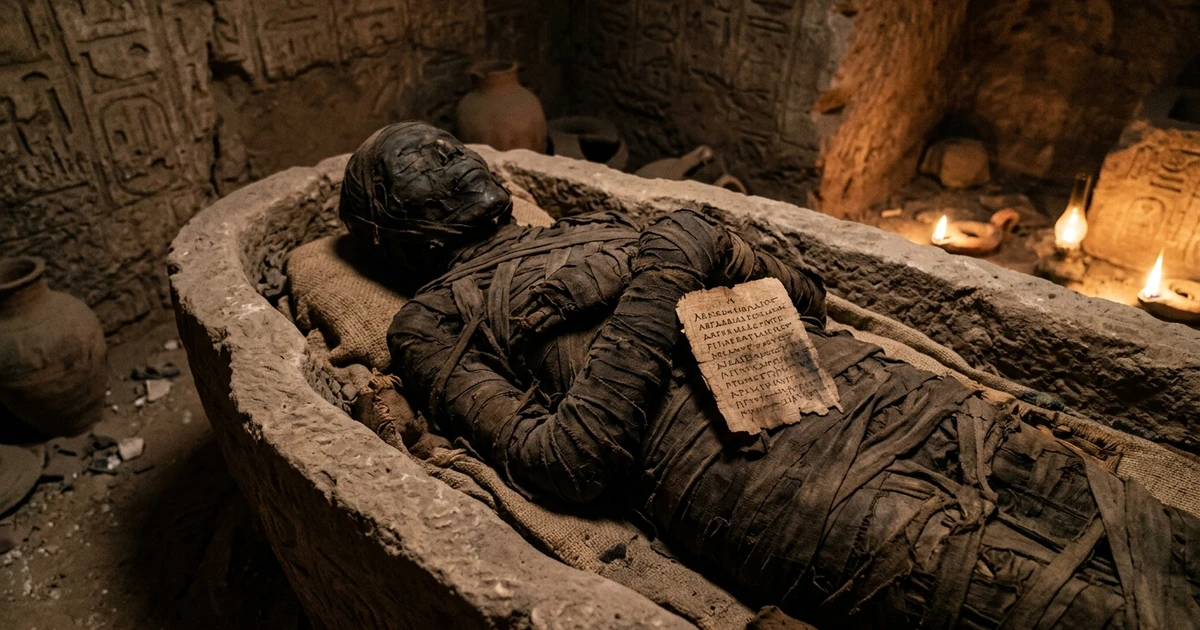
The Enigma of Oxyrhynchus: 1,600-Year-Old Mummy Discovered with Homer's Iliad Papyrus — High-Fidelity Artistic Illustration created by artificial intelligence based on scientific research.

The Enigma of Oxyrhynchus: 1,600-Year-Old Mummy Discovered with Homer's Iliad Papyrus

On July 19, 2026, archaeologists and historians celebrated one of the most extraordinary discoveries in recent Egyptian archaeology within the ruins of the ancient city of Oxyrhynchus, in Central Egypt. During systematic excavations carried out in December 2025, scientists unearthed a papyrus fragment containing verses from Homer's Iliad associated with a 1,600-year-old Roman-era mummy. The official announcement of this spectacular find revealed new details regarding the cultural fusion between Egyptian and Greek traditions during late antiquity.

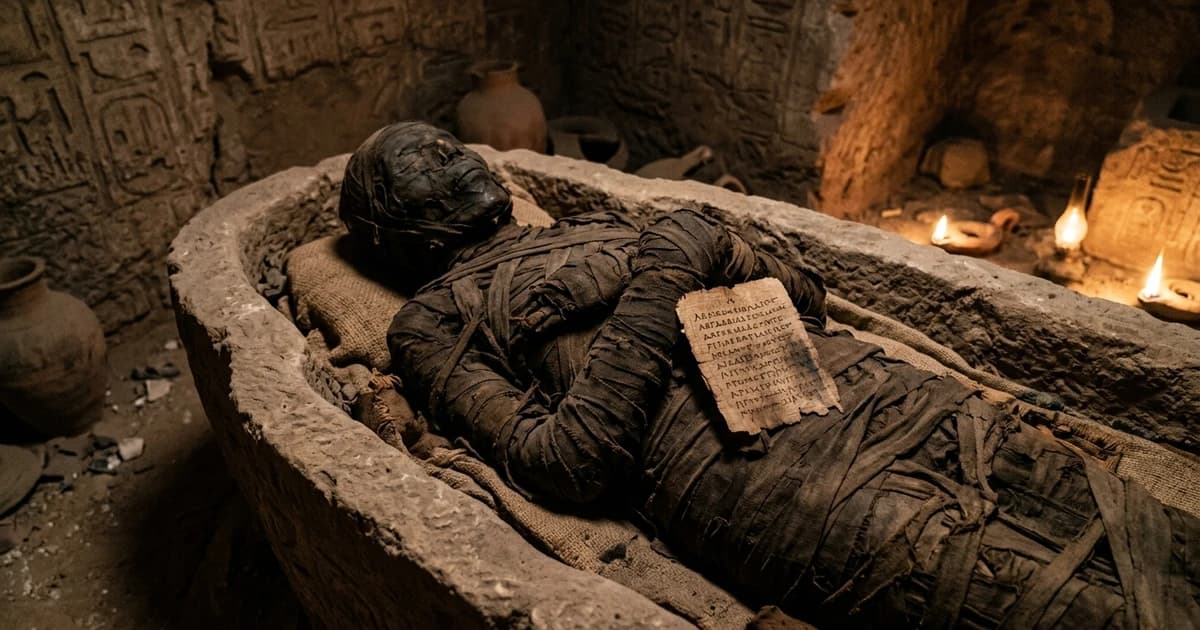
Roman mummy from Oxyrhynchus containing Homer's Iliad papyrus.

The Revelation of Tomb 65 in Oxyrhynchus #

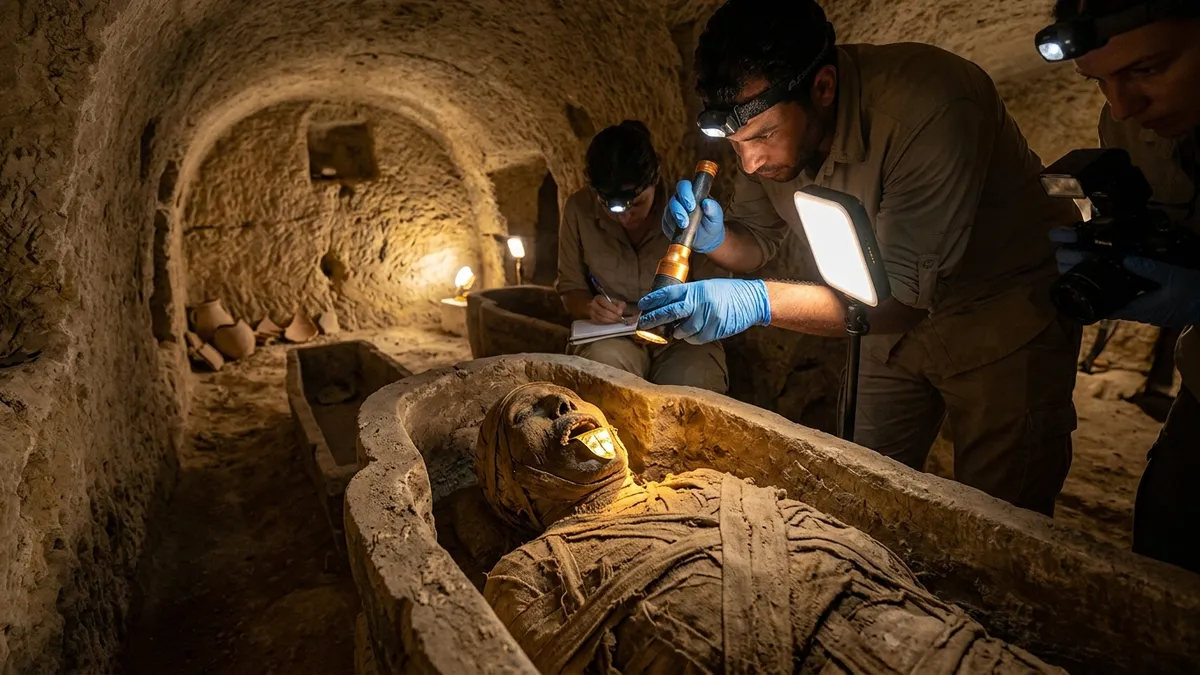
The discovery took place in a specific sector of the Upper Necropolis of Oxyrhynchus, which is today identified as the modern city of El-Bahnasa. While excavating the structure designated as Tomb 65, researchers from the archaeological mission encountered a perfectly preserved rock-cut funerary tomb. Inside this secure mortuary chamber, the body of an individual from the late Roman period lay wrapped in traditional linen bandages.

This mummy, dated approximately to the fourth century AD, exhibited an outstanding state of general physical preservation. Detailed computed tomography scans revealed that the embalming process followed classical Egyptian mummification techniques, even though the burial occurred under strong Roman administrative influence. The greatest surprise, however, was located on the external surface of the body, specifically in the abdominal region.

Archaeologists spotted a flat, rectangular object carefully positioned between the outer layers of the linen shroud. The careful removal of the piece revealed that it was a very fragile scroll of papyrus, intentionally folded and sealed with clay. This specific placement indicates that the manuscript was not a piece of discarded waste, but rather a ritualistic amulet designed for the afterlife.

Homer's Papyrus and the Catalogue of Ships #

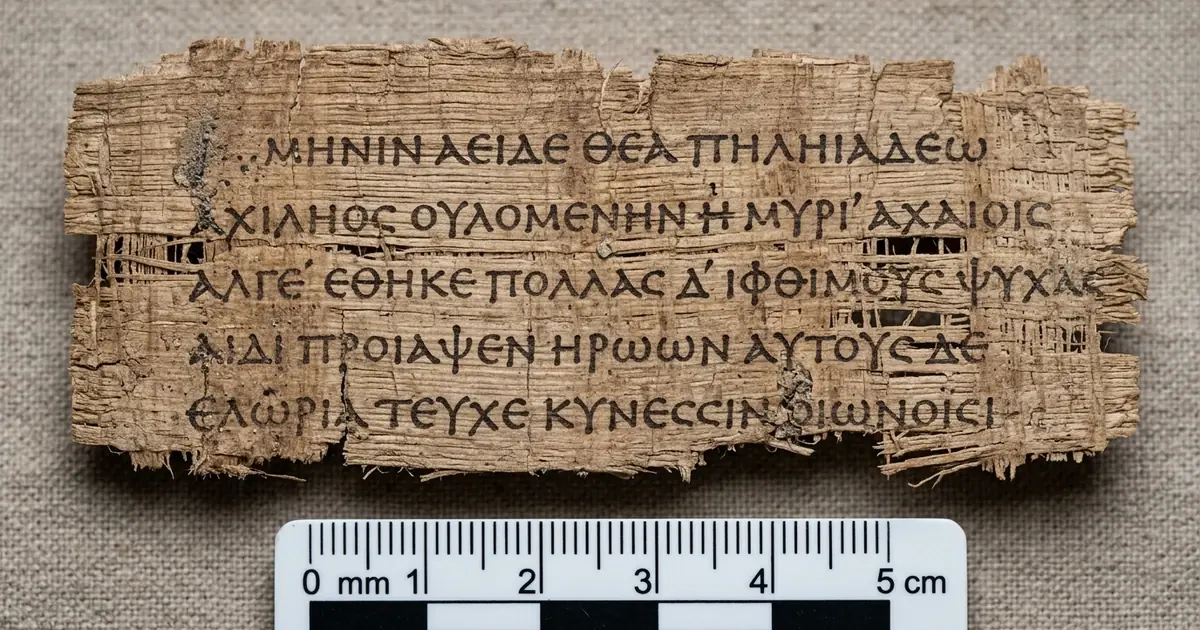
A detailed philological study of the papyrus revealed that the lines written in Greek characters corresponded to Book II of Homer's Iliad. Specifically, the fragment preserved parts of the famous "Catalogue of Ships," which lists the Greek military forces sent to the siege of Troy. Researcher Leah Mascia led the process of deciphering and paleographically identifying the classical Greek letters written on the organic support.

Initial analyses indicate that the manuscript is a copy dating back to the second century AD, which was later reused in the burial ritual. Homeric texts were widely studied in the Hellenistic schools of Egypt, explaining the active circulation of such manuscripts in the urban region. Its transformation into a magical post-mortem object demonstrates a highly creative process of cultural recontextualization.

To protect the fragile organic document, conservation specialist Margalida Munar applied advanced consolidation and physical cleaning techniques in the laboratory. The fragment now rests in a special climate-controlled display case, safe from the humidity fluctuations that typically degrade ancient papyrus fibers. The following image displays the delicate details of the papyrus fibers recovered from Oxyrhynchus.

Detail of Roman-period papyrus fibers with classical Greek writing.

Comparison of Historical Papyrus Discoveries in Egypt #

To fully understand the relevance of this discovery, it is helpful to compare it with other fundamental papyrus finds in Egyptian history. Oxyrhynchus has been an inexhaustible source of ancient manuscripts since the first systematic excavations began at the end of the nineteenth century. However, the direct association of a prestigious Greek literary text with a mummified body gives a unique character to this new find.

The following table presents a technical comparison between the most famous papyrus discoveries that have occurred in Egypt over the centuries. This compilation contextualizes the historical importance and cultural value of the Homeric papyrus in relation to other ancient records.

Nome do Papiro (Papyrus Name) Ano da Descoberta (Discovery Year) Idade Estimada (Estimated Age) Texto Associado (Associated Text) Valor Histórico (Historical Value)
Oxyrhynchus Iliad Papyrus 2025 1,600 years Homer's Iliad (Book II) First Greek literary text integrated into an Egyptian funerary ritual.
Turin King List 1820 3,200 years Canon of Egyptian Kings Most complete chronological list of dynastic pharaohs and gods.
Papyrus of Ani (Book of the Dead) 1888 3,200 years Egyptian Book of the Dead Illustrated masterpiece describing the journey of the soul in the afterlife.
Westcar Papyrus 1824 3,600 years Tales of Magic from Dynasty IV First record of popular stories and magical court performances.
Oxyrhynchus Papyrus 654 1897 1,800 years Sayings of the Gospel of Thomas Important apocryphal document for understanding early Christianity.

The Ritual Significance of Greek Literature in the Afterlife #

The presence of Homer in an Egyptian burial ritual raises profound questions about the social identity of the deceased. Specialists suggest that the owner of the tomb belonged to a highly intellectualized, bilingual elite class residing in Oxyrhynchus. For this social group, the Iliad represented not merely literary entertainment, but a powerful symbol of high culture and Greek civic identity.

By placing the "Catalogue of Ships" over the body, the deceased's family sought to secure a high social status in the afterlife. This custom bears a striking resemblance to other ancient rituals that utilized protective writing in graves across the globe. The scientific rigor in studying such ancient remains is a constant in archaeology, as seen in the recent archaeological discovery in Parintins and its 3,000-year-old remains in the Amazon.

Another interesting methodological parallel lies in using state-of-the-art technology to uncover civilizations whose textual memory was erased by time. The excavation and conservation process in Oxyrhynchus shares the same scientific premises used in analyzing the mystery of the lost ruins in the Danakil Desert. Both investigations highlight the human drive to immortalize memory through durable physical mediums.
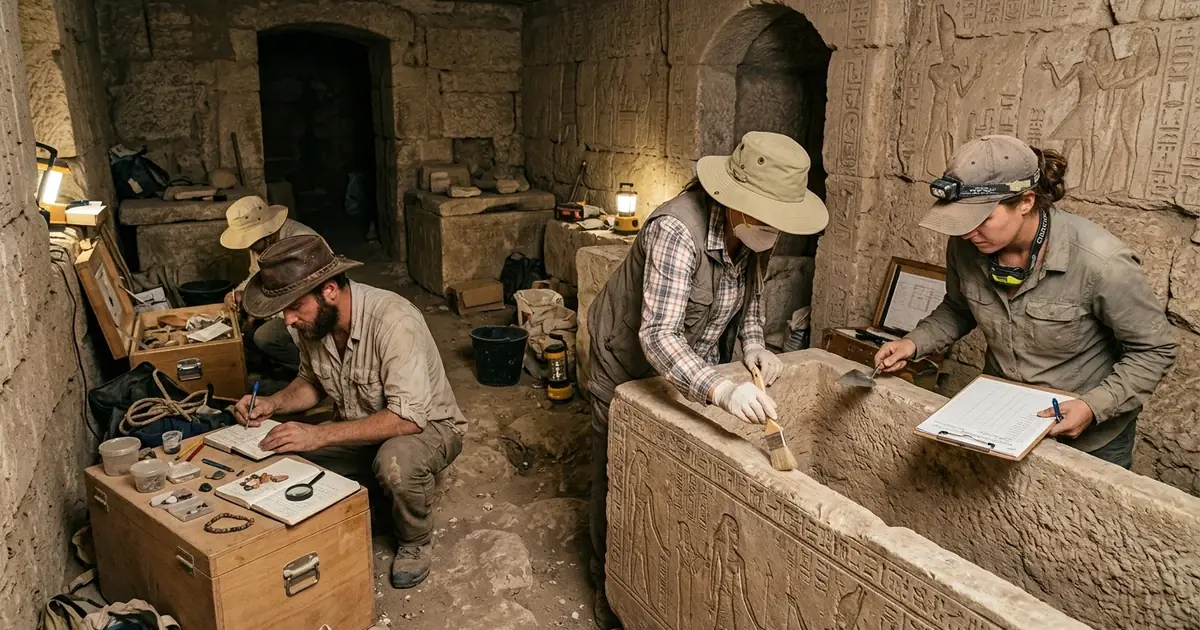
Archaeologists performing the systematic excavation of the stone tomb at the Egyptian historical site.

The Scientific Work of the Archaeological Mission #

The coordination of the mission in Oxyrhynchus is an international operation of high technical complexity that brings together scholars and restorers from around the world. Ignasi-Xavier Adiego, director of the Institute of the Ancient Near East at the University of Barcelona, emphasized the pioneering nature of the discovery. He noted that interdisciplinarity was the absolute key to completing the recovery without causing any damage to the mummy.

Field excavations are led by Maite Mascort and Esther Pons Mellado, who systematically map the residential and funerary sectors of El-Bahnasa. The two archaeologists utilize advanced three-dimensional photogrammetric documentation techniques to record the exact position of every single artifact. This modern methodology allows researchers to virtually recreate the layout of the tombs at the precise moment they were sealed millennia ago.

The long-term preservation of the papyrus requires constant environmental monitoring to prevent the loss of inscriptions made with mineral carbon pigments. The restoration carried out by Margalida Munar successfully removed sand sediments without fading the classical Greek letters written by Roman scribes. This meticulous care ensures that future generations of researchers will be able to perform new linguistic and historical studies on the material.

The Future of Investigations in El-Bahnasa #

The research schedule of the archaeological mission outlines a series of new physical and chemical tests to be conducted in the coming weeks. The Roman mummy will undergo high-resolution spectroscopic analyses to detail the precise chemical composition of the embalming resins. These chemical data could potentially reveal the geographic origin of the imported materials used to prepare the body.

Sector 22 of the Oxyrhynchus necropolis will continue to be systematically explored by scientific teams during the upcoming winter excavation campaigns. Scientists believe that other adjacent tombs might contain more literary or administrative manuscripts that have not yet been brought to light. The usage of ground-penetrating radar will help identify new subterranean burial chambers hidden beneath the desert sands.

The recovered Homeric Iliad papyrus will be digitized in ultra-high resolution to be made available in a public, international database. This sharing of information will facilitate access for scholars from various countries studying the transmission of classical texts. The Mundo Incrível portal will continue to closely follow new scientific developments and subsequent analyses of this impressive discovery in Egypt.

Structural Parameters and Analytical Projections for oxyrhynchus mummy iliad papyrus #

Detailed scrutiny of The Enigma of Oxyrhynchus: 1,600 Year Old Mummy Discovered with Homer's Iliad Papyrus demonstrates that the operational interplay between Nome do Papiro (Papyrus Name) and oxyrhynchus mummy iliad papyrus depends on strict quantitative baselines outlined in The Revelation of Tomb 65 in Oxyrhynchus. Systematic measurement of parameters such as 1,600 years and 3,200 years enables research teams focused on egypt archaeology homer to isolate structural anomalies and verify the real-world performance of Oxyrhynchus Iliad Papyrus under demanding conditions. Drawing upon the empirical evidence compiled around Turin King List, specialists in misterios gain a reliable analytical framework to calibrate future interventions involving homer papyrus egypt 2026.

Considering the critical variables examined in Homer's Papyrus and the Catalogue of Ships, the measured output of Turin King List establishes a new quantitative benchmark for evaluating homer papyrus egypt 2026 and 1600 year old mummy egypt. Documenting indicators such as 3,200 years alongside Papyrus of Ani (Book of the Dead) demonstrates that structural coupling with Westcar Papyrus narrows uncertainty margins that previously constrained progress in misterios. Building on the synthesis in Comparison of Historical Papyrus Discoveries in Egypt, systematic tracking of Oxyrhynchus Papyrus 654 now forms a core component of international verification protocols.

Sources and References #

🏷️ Tags:

#oxyrhynchusmummyiliadpapyrus#egyptarchaeologyhomer#homerpapyrusegypt2026#1600yearoldmummyegypt#el-bahnasaarchaeologicaldiscovery

📢 Gostou deste artigo?

Compartilhe com seus amigos e nos conte o que você achou nos comentários!

Receba novidades!

Cadastre seu email e receba as melhores curiosidades toda semana.

🔒 Sem spam. Cancele quando quiser.

💬 Comentários (0)

Seja o primeiro a comentar! 👋

📚Read Also

Tombs with Gold Tongues Discovered in Marina El Alamein, Egyptmisterios

Tombs with Gold Tongues Discovered in Marina El Alamein, Egypt

Archaeological mission in Egypt reveals eighteen Graeco-Roman tombs containing mummies with gold tongues in Marina El Alamein.

⏱️7 minLer mais →
The Truth About UFOs - Part 2: The Morenão Stadium Incident and the Top 10 Historical Sightingsmisterios

The Truth About UFOs - Part 2: The Morenão Stadium Incident and the Top 10 Historical Sightings

Discover the story of the UFO that hovered over Morenão Stadium in Campo Grande in 1982 and explore the top 10 documented UFO sightings worldwide.

⏱️7 minLer mais →
Disclosure Day in Theaters, Zigurats in Corguinho and the Search for Extraterrestres: Fiction, Facts and Speculationmisterios

Disclosure Day in Theaters, Zigurats in Corguinho and the Search for Extraterrestres: Fiction, Facts and Speculation

Spielberg's movie Disclosure Day fills theaters while Zigurats and the search for extraterrestrial life intrigue Brazil. Learn about official investigations and xenobiology.

⏱️7 minLer mais →
Is a Wandering Black Hole Deflecting Earth's Orbit? Understanding the Mysterymisterios

Is a Wandering Black Hole Deflecting Earth's Orbit? Understanding the Mystery

Recent orbital simulation studies evaluate the consequences of a wandering black hole crossing the Solar System and disrupting Earth's trajectory.

⏱️7 minLer mais →
Spectacular Phenomenon of Dancing Lights in the Norway Sky Sparks Extraterrestrial Life Theoriesmisterios

Spectacular Phenomenon of Dancing Lights in the Norway Sky Sparks Extraterrestrial Life Theories

Discover the mystery of the dancing Hessdalen lights in Norway, scientific explanations, the role of solar wind, and alien theories.

⏱️6 minLer mais →
The Pitch Drop Experiment: The Centenary Mystery of Sciencemisterios

The Pitch Drop Experiment: The Centenary Mystery of Science

Discover the fascinating secrets of the world's longest-running laboratory experiment, recorded in the Guinness World Records for its impressive slowness.

⏱️6 minLer mais →
Receba novidades no WhatsApp!