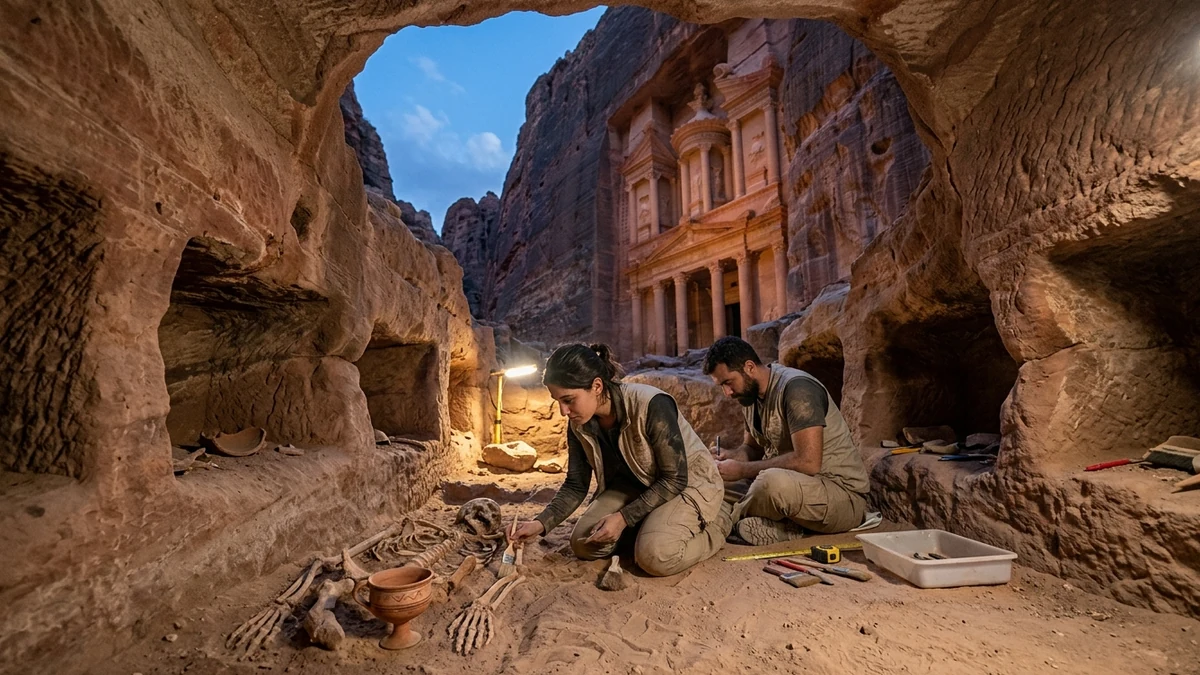
A joint Jordanian-American-British archaeological expedition has opened an intact, 2,000-year-old subterranean burial chamber directly beneath the monumental facade of Al-Khazneh (The Treasury) in Petra, southern Jordan, uncovering 12 complete, articulated human skeletons alongside grave offerings of bronze, iron, and fine pottery. The excavation inside the crypt cataloged as Tomb 62C, directed by archaeologist Dr. Pearce Paul Creasman, Executive Director of the American Center of Research (ACOR) in Amman, and geophysicist Professor Richard Bates of the University of St Andrews in Scotland, stunned the scientific community when one of the skeletons was found clutching a footed Nabataean ceramic vessel bearing an uncanny resemblance to the mythical "Holy Grail" immortalized on film at that exact monument. Beyond a cinematic coincidence, Optically Stimulated Luminescence (OSL) dating of the chamber's enclosing sediments placed the burials between the mid-1st century BC and the early 1st century AD (approximately 50 BC to 50 AD), finally solving the centuries-old mystery regarding the exact construction date of Petra's Treasury itself.
Situated between 4 and 6 meters beneath the outer courtyard on the left side of the 40-meter-high carved sandstone facade, the chamber remained hermetically shielded from looters for two millennia due to the partial collapse of sandstone ceiling slabs and the compact accumulation of alluvial silt carried by ancient flash floods rushing through the Siq gorge. The fieldwork was conducted under the direct authorization and supervision of the Department of Antiquities of Jordan (DoA) and the Petra Development and Tourism Region Authority (PDTRA), led by Chief Commissioner Dr. Fadi Bala'awi, with on-site documentary filming accompanied by explorer Josh Gates. Whereas the vast majority of the more than 600 rock-cut tombs across Petra were emptied in antiquity or disturbed by successive occupations, Tomb 62C preserved entire elite families of the Nabataean Kingdom in their original anatomical burial positions.
The simultaneous presence of men, women, and children surrounded by mineralized traces of burial shrouds, green copper oxidation stains on bones from bronze jewelry, and intact ritual ceramics makes this chamber the largest primary bioarchaeological assemblage ever discovered beneath Jordan's iconic landmark. Because pure carved bedrock cannot be directly dated via radiocarbon, archaeologists debated for over two hundred years which Nabataean monarch commissioned the carving of Al-Khazneh and what its primary function was. The physical fact that the subterranean walls of Tomb 62C were cut prior to or during the leveling of the grand facade's courtyard proves that the monument rose above an active royal necropolis at the height of King Aretas IV Philopatris (9 BC – 40 AD).
The Subterranean Secret Beneath Al-Khazneh: From the 2003 Prelude to Ground-Penetrating Radar (GPR)
The hidden history inside the foundations of Al-Khazneh first began to surface in the summer of 2003, when Jordanian archaeologists Dr. Suleiman Farajat and Sami Nawafleh of the Department of Antiquities of Jordan conducted preventive soundings beside the monument's left staircase ahead of tourist infrastructure upgrades. Roughly 4 to 6 meters below the modern gravel courtyard trodden by millions of annual visitors, the 2003 team discovered that the true base of the facade extended much deeper into the bedrock and housed four interconnected subterranean burial chambers collectively designated as Tomb 62. At that time, two of the subchambers were partially excavated through 2005, revealing incense altars, ossuaries with fragmented remains of 11 individuals, and traces of funerary banquets, yet one lateral doorway choked with rock rubble and compacted sand — subchamber Tomb 62C — remained sealed due to a lack of non-invasive geophysical imaging and structural stability concerns.
Twenty years later, Dr. Pearce Paul Creasman and geophysicist Professor Richard Bates proposed a high-resolution geophysical survey beneath the Treasury plaza to Jordanian authorities utilizing multi-frequency Ground-Penetrating Radar (GPR) and electromagnetic conductivity sensors. The mission's initial objective included mapping the subterranean network of Nabataean hydraulic channels and assessing drainage pathways for the violent seasonal flash floods that surge down the Wadi Musa canyon and through the narrow, 1.2-kilometer-long Siq gorge. Upon processing the three-dimensional reflection profiles of radio waves transmitted up to 8 meters underground, Bates identified sharp geometric anomalies to the left of the Corinthian portico that did not match natural geological strata of Nubian sandstone, indicating instead rock-cut architectural voids with right angles and internal partition walls.
Confronted with unmistakable evidence in the GPR tomograms that subchamber 62C held intact internal structures and stratified sedimentary fill, the Department of Antiquities of Jordan and the PDTRA approved a surgical excavation. The team removed tons of modern gravel and retaining slabs along the left edge of the Treasury courtyard until reopening the vertical access shaft leading down to the original 1st-century BC Hellenistic foundations. When archaeologists breached the seal of stone blocks and solidified silt at the entrance of Tomb 62C using endoscopic cameras and cool LED lighting, they encountered a burial chamber roughly 5 meters wide whose floor had never been disturbed by Bedouin treasure hunters or 19th-century Western explorers.
Inside Tomb 62C: The 12 Articulated Skeletons and Nabataean Funerary Architecture
Unlike the vast majority of monumental tombs in Petra — whose interiors typically present empty cubic halls stripped of human remains — Tomb 62C displayed an extraordinary internal architectural layout subdivided by low walls of dressed sandstone blocks forming rectangular compartments known as loculi (burial niches). As excavators carefully brushed away the upper layer of reddish sand that had seeped in over two millennia using fine brushes and dental picks, intact crania, aligned vertebral columns, rib cages, and long bones of 12 complete human skeletons began to emerge. The preservation of whole, articulated skeletons within the urban core of Petra is regarded by bioarchaeologists as an exceedingly rare phenomenon capable of filling one of the greatest scientific gaps concerning the physical demography of the Rose City's builders.
The Division into Loculi and the Mystery of Bone Preservation in Petra
The reason so few skeletons have survived intact in Petra lies in the destructive interplay between the porous geology of the local sandstone and the extreme hydrological regime of the Edom desert. Although average annual rainfall in the Petra basin is only about 150 millimeters, precipitation is concentrated in torrential winter storms that drive mineral-laden water through rock fissures, generating severe wet-dry cycles that pulverize bone collagen and bioapatite. Inside Tomb 62C, however, an ancient flood event occurring shortly after the crypt's active use deposited a thick, homogeneous blanket of fine alluvial silt and calcareous clay over the bodies, followed by a partial collapse of ceiling slabs that cut off oxygen circulation and stabilized internal temperature and humidity.
The internal stone partition walls of Tomb 62C acted as mechanical containment boxes that prevented the skeletons from being washed away or commingled by occasional rainwater seepage over subsequent centuries. Across multiple sectors of the chamber, archaeologists identified greenish copper carbonate staining impregnated directly onto finger phalanges, clavicles, and ribs, demonstrating prolonged contact with bronze fibulae, rings, and bracelets that slowly corroded against the bodies. Furthermore, microscopic impressions in the consolidated sediment surrounding the pelves and femora revealed mineralized traces of plant fibers and leather, indicating that the deceased were laid to rest wrapped in richly prepared burial shrouds prior to the sealing of each compartment.
Who Were the 12 Individuals Buried in the Sealed Chamber?
Preliminary osteological analyses conducted in the field and at laboratories in Amman indicated that the 12 skeletons comprise male and female adults alongside subadult individuals (children and adolescents), representing a collective familial or dynastic burial of supreme social status. The geographical placement of a tomb in the Nabataean world followed a strict spatial hierarchy: being interred at the monumental gateway of the capital city, at the exact spot where the sacred Siq canyon opens before the kingdom's grandest edifice, was an exclusive privilege of royalty or the highest priestly and mercantile aristocracy. While several skeletons exhibited pristine primary anatomical articulation — proving they were placed there shortly after death and never disturbed again — others showed signs of careful secondary bone rearrangement, a documented Nabataean funerary custom known from Semitic inscriptions in which successive generations cleared space inside loculi for new clan members.
Among the artifacts recovered alongside the 12 individuals were decorated terracotta oil lamps, unguentaria flasks used for aromatic myrrh and frankincense oils, oxidized iron nails and fasteners, and bronze coins minted within the Nabataean Kingdom. The absence of heavy military weaponry and the abundance of vessels linked to ritual libation reinforce the interpretation that the subterranean complex beneath Al-Khazneh served as a venue for ancestral veneration ceremonies conducted by torchlight. Every cranium and molar tooth collected under sterile protocols has become an intact biomolecular time capsule from the 1st century BC, preserving within its dentin and petrous temporal bone the genetic material long missing from histories of the ancient Near East.
When Life Imitates Art: The Nabataean Ceramic Chalice Shaped Like the "Holy Grail"
The most extraordinary moment of the excavation inside Tomb 62C unfolded when the team cleared the compact sediment around the articulated arm and hand of one of the central adult skeletons in the chamber. Positioned directly against the individual's bony fingers was the intact upper body and rim of a thin-walled fineware ceramic vessel featuring a finely wheel-turned lip and a tapered base that formed the unmistakable silhouette of a ritual chalice. Both Dr. Pearce Paul Creasman and television host Josh Gates, who was documenting the opening of the chamber on camera, were astonished by the visual and historical parallel: the authentic 2,000-year-old artifact shared nearly the exact shape of the humble terracotta cup chosen as the "Holy Grail" by Indiana Jones in the climactic scene of Indiana Jones and the Last Crusade (1989), directed by Steven Spielberg and filmed directly in front of the facade of Al-Khazneh.
Although it bears no religious connection to the medieval Christian legend of the Grail — as the burial took place decades before or right at the transition of the early Christian era within the polytheistic Arab-Nabataean culture that worshipped the god Dushara and the goddess Al-Uzza — the chalice from Tomb 62C is an authentic masterpiece of royal Petra pottery. Nabataean potters of the 1st century BC were renowned across the Mediterranean and Near Eastern worlds for mastering so-called "egg-shell ware," whose walls frequently measured between 1.5 and 3 millimeters in thickness, rivaling blown Roman glass and ancient porcelain in lightness and metallic resonance. Fired in high-temperature kilns around Wadi Musa using iron-oxide-rich clay quarried from the hills of Ayn Tina, the vessel displays the signature salmon-red hue and millimeter-precise wheel striations of royal Nabataean workshops.
In Nabataean funerary liturgy, chalices and drinking cups played a central role in the marzeah, the sacred symposium held in honor of the dead by noble brotherhoods and families inside the triclinia (banquet halls lined with stone benches) adjoining Petra's tombs. Living participants consumed wine and ritual foods in symbolic communion with their entombed ancestors, placing the deceased's personal drinking chalice directly into their hands or beside the body at the close of the ceremony to accompany them into eternity. Finding this ceramic chalice preserved uncrushed beneath four meters of rock and sand, still held by the skeleton of its owner two thousand years later, stands as tangible archaeological testimony to the spiritual devotion of Petra's original inhabitants.
Optically Stimulated Luminescence (OSL) Dating and the End of a Two-Millennium Enigma
For more than two centuries — ever since Swiss explorer Johann Ludwig Burckhardt reintroduced Petra to the Western world in 1812 — the monument of Al-Khazneh defied every attempt at precise scientific dating. Its popular name, "The Treasury" (Al-Khazneh in Arabic), arose from local folklore claiming that an Egyptian pharaoh had hidden his riches inside the massive stone urn carved atop the facade's second story (tholos), an urn whose surface still bears hundreds of bullet pockmarks fired by Bedouin tribesmen hoping to shatter the stone and release a cascade of gold coins. Because the facade was carved entirely from the top down out of the vertical sandstone cliff face and contained neither a surviving royal dedication inscription nor organic mortar in its Corinthian columns, art historians remained divided across stylistic estimates spanning more than two hundred years between 100 BC and 100 AD.
How Quartz Grain Physics Revealed the True Age of Petra's Treasury
To resolve this chronological impasse definitively, Creasman and Bates turned to Optically Stimulated Luminescence (OSL) dating, extracting sediment and mortar cores inside opaque metal tubes completely shielded from sunlight from the walls and floor strata of Tomb 62C. The physical method of OSL measures the time elapsed since microscopic grains of quartz and feldspar were last exposed to sunlight or intense heat: while buried in darkness, these crystals absorb low-level natural ionizing radiation emitted by uranium, thorium, and potassium-40 isotopes in the surrounding rock, trapping electrons within crystal lattice defects at a constant, measurable rate. When laboratory physicists stimulate those quartz grains with calibrated beams of blue or green light, the crystals emit a luminescence photon pulse whose intensity reveals, within a margin of a few decades, the exact period when the archaeological layer was sealed in darkness.
The combined results of OSL dating on the construction layers of Tomb 62C and radiocarbon (¹⁴C) analyses placed the construction and burials of the chamber squarely between the mid-1st century BC and the early 1st century AD (c. 50 BC – 50 AD). Because architectural stratigraphy demonstrates that the monumental courtyard and facade of Al-Khazneh were engineered and carved while respecting and incorporating the subterranean funerary complex of Tomb 62, this dating provides the first absolute physical anchor for the construction of Petra's Treasury itself. The findings confirm the historical hypothesis that Al-Khazneh was commissioned as a royal dynastic mausoleum and sanctuary during the golden reign of King Aretas IV Philopatris (9 BC – 40 AD) — or immediately during the transition from King Obodas III (30 BC – 9 BC) — when Petra reached its urban peak of roughly 30,000 inhabitants prior to its peaceful annexation by the Roman Empire under Emperor Trajan in 106 AD.
Comparative and Forensic Table: Archaeological Parameters of Tomb 62C Beneath Petra's Treasury
The physical, geophysical, bioarchaeological, and chronological parameters consolidated by the scientific expedition of ACOR, the University of St Andrews, and the Department of Antiquities of Jordan at Al-Khazneh bring together unprecedented quantitative indicators regarding the subterranean necropolis:
| Archaeological / Forensic Parameter | Confirmed Expedition Measurement / Data | Responsible Institution / Scientific Method | Historical Significance for the Nabataean Kingdom |
|---|---|---|---|
| Monument and Archaeological Site | Al-Khazneh (The Treasury), Subchamber Tomb 62C, Petra, Jordan | Department of Antiquities of Jordan (DoA) and PDTRA | Premier rock-cut monument at the exit of the Siq gorge (40 m high by 25 m wide) |
| Depth of Sealed Chamber | 4 to 6 meters beneath the current left outer courtyard level | Stratigraphic sounding and Ground-Penetrating Radar (GPR) | Proves that the original Nabataean plaza level lay meters below modern flood sediment |
| Scientific Excavation Leadership | Dr. Pearce Paul Creasman (ACOR) and Prof. Richard Bates (St Andrews) | American Center of Research (ACOR) and University of St Andrews | International collaboration supervised by Commissioner Dr. Fadi Bala'awi (PDTRA) |
| Adjacent Preliminary Discovery | Tomb 62 complex identified in 2003 (11 partial individuals) | Dr. Suleiman Farajat and Sami Nawafleh (DoA Jordan) | Revealed an underground funerary level predating or contemporaneous with the main facade |
| Total Skeletons in Tomb 62C | 12 complete human skeletons articulated (in situ) | Bioarchaeological excavation inside internal stone niches (loculi) | Largest assemblage of complete, intact skeletons ever recovered from a single chamber in Petra |
| Demographic Profile of the Buried | Male and female adults alongside subadults (children/adolescents) | Preliminary osteological and paleopathological analysis | Indicates a familial or dynastic burial of the highest royal or priestly Nabataean elite |
| Highlight Artifact ("Holy Grail") | Intact Nabataean ceramic chalice held by a skeleton's hand | Wheel-turned Nabataean fineware from the 1st century BC/AD | Authentic ritual funerary banquet (marzeah) cup matching the chalice from Indiana Jones |
| Other Grave Goods and Traces | Ceramic vessels, bronze and iron artifacts, copper stains, and shrouds | Laboratory conservation and sediment microscopy | Confirms that Tomb 62C was never looted after its sealing roughly 2,000 years ago |
| Absolute Dating of the Chamber | Mid-1st century BC to early 1st century AD (c. 50 BC – 50 AD) | Optically Stimulated Luminescence (OSL) and Radiocarbon (¹⁴C) | First direct physical proof of Al-Khazneh's construction era during the peak of King Aretas IV |
| Natural Sealing Mechanism | Infiltration of flash-flood alluvial silt and partial slab collapse | Geomorphological and geophysical modeling of the Wadi Musa basin | Protected the bones from thermal degradation and prevented intrusion by tomb looters |
The correlation across these parameters demonstrates that Al-Khazneh was not an isolated theatrical facade carved in a vacuum, but the monumental crowning edifice of a carefully engineered multigenerational funerary complex. The integration of Richard Bates's non-destructive geophysical imaging with Pearce Paul Creasman's stratigraphic excavation has established a new scientific protocol for investigating dozens of additional subterranean anomalies detected along Petra's main ceremonial corridor.
The Empire of Water in the Desert: Hydraulic Engineering, Frankincense, and Upcoming Ancient DNA Tests
Understanding the material and architectural wealth uncovered inside Tomb 62C requires examining how the Nabataean Kingdom transformed a hyper-arid canyon between the Dead Sea and the Red Sea into the wealthiest commercial hub of the ancient Middle East between the 4th century BC and 106 AD. Originating as nomadic tribes from northern Arabia, the Nabataeans monopolized the camel caravan routes transporting frankincense, myrrh, cinnamon, and spices from the kingdoms of Saba and Hadramawt (in modern Yemen and Oman) to the Mediterranean port of Gaza and the markets of Damascus, Alexandria, and Rome. The strategic secret of this mercantile empire lay in its peerless hydraulic engineering: Petra's engineers constructed more than 200 subterranean cisterns, flood-retention dams across canyons, sand-settling basins, and over 200 kilometers of interlocking terracotta pipelines sealed with waterproof mortar that supplied public fountains, thermal gardens, and orchards in the heart of the desert.
Ironically, it was the partial degradation of this millennia-old flood-control dam network after Petra's urban decline — worsened by the devastating earthquake of May 19, 363 AD — that allowed seasonal flash floods down Wadi Musa to bury the lower courtyard of Al-Khazneh beneath up to 6 meters of sand and gravel, hiding Tomb 62C from the eyes of the world. Today, the joint project of ACOR, the PDTRA, and the University of St Andrews uses these subterranean findings not only to recover Nabataean dynastic history, but also to rehabilitate the ancient rock-cut drainage channels and protect both the Treasury and visitors against modern flash floods intensified by climate extremes.
In the new laboratory phase following the opening of the chamber, the 12 skeletons from Tomb 62C are undergoing an exhaustive battery of biomolecular tests, including ancient DNA (aDNA) extraction from the petrous portion of the temporal bone, stable strontium (⁸⁷Sr/⁸⁶Sr) and oxygen (δ¹⁸O) isotope analyses of tooth enamel, and high-resolution computed tomography. Ancient DNA sequencing will reveal for the first time the exact biological kinship ties among the 12 individuals — confirming whether they belonged directly to the royal bloodline of Aretas IV and Queen Shaqilat — and will map the genetic ancestry of Petra's population relative to other Semitic populations of the Levant and the Arabian Peninsula. Meanwhile, the isotopic signatures locked into dental enamel during childhood will indicate whether all twelve grew up drinking water from the limestone springs of Wadi Musa or whether some hailed from distant outposts along the Incense Route such as Hegra (Mada'in Salih) in modern Saudi Arabia.
Frequently Asked Questions (FAQ)
Does the chalice found in Petra's secret tomb have any real historical connection to the Christian Holy Grail?
No, the chalice discovered inside Tomb 62C beneath the Al-Khazneh monument has no historical or theological connection to the medieval Christian relic of the Holy Grail, as it is an authentic ritual vessel of the Nabataean Kingdom dated between the mid-1st century BC and the early 1st century AD. The comparison to the "Holy Grail" became instant worldwide because the fineware ceramic vessel found intact beside the hand of one of the 12 skeletons displays a shape and proportions nearly identical to the prop chalice used in the climactic scene of Indiana Jones and the Last Crusade (1989), which was filmed directly at the facade of Petra's Treasury. In archaeological reality, the artifact was a high-craftsmanship drinking cup used during sacred Nabataean funerary banquets (marzeah), in which family members toasted in memory of the deceased before placing the vessel beside the body inside the sealed chamber.
Why is finding 12 complete skeletons in Petra considered such a rare event by scientists?
Although Petra contains more than 600 monumental tombs carved into its rose-red sandstone cliffs, almost all of those chambers were found empty by modern archaeologists due to two millennia of systematic looting, reuse of caves by pastoralists, and severe chemical weathering. The porous sandstone of the region absorbs moisture from seasonal winter storms and flash floods, creating sharp fluctuations in humidity and acidity that completely dissolve exposed human bones within a few centuries. Inside Tomb 62C, the rapid burial of the 12 individuals within stone compartments (loculi) beneath a dense layer of alluvial silt, combined with a slab collapse that sealed the chamber 4 to 6 meters underground, created an airtight microenvironment that preserved the articulated skeletons for 2,000 years.
How did the discovery of Tomb 62C solve the mystery of when Petra's Treasury was built?
Because the Al-Khazneh monument was carved entirely out of living sandstone bedrock — a geological formation hundreds of millions of years old that cannot be dated via radiocarbon — and lacks any surviving dedicatory inscription, archaeologists debated for two centuries which decade the facade was created. By excavating Tomb 62C beneath the monument's left courtyard, scientists collected sediment and mortar samples in total darkness and applied Optically Stimulated Luminescence (OSL) dating, which measures natural radiation accumulated inside quartz grains since their last exposure to sunlight. The results dated the subterranean chamber between 50 BC and 50 AD, physically proving that the grand facade of the Treasury was carved directly above this active necropolis during the economic golden age of Nabataean King Aretas IV Philopatris (9 BC – 40 AD).
Official References and Sources
For direct access to the archaeological reports, institutional geophysics press releases, and heritage conservation dossiers supporting this article, consult the official sources below:
- American Center of Research (ACOR Amman) — Official Archaeological Excavation and Heritage Preservation Reports in Petra, Jordan
- University of St Andrews — Ground-Penetrating Radar (GPR) Geophysical Research by Prof. Richard Bates at Al-Khazneh
- UNESCO World Heritage Centre — Official Heritage Dossier for the Petra Archaeological Site (Criteria I, III, and IV)
- Department of Antiquities of Jordan (DoA) — Institutional Archive and Archaeological Licensing of the Hashemite Kingdom of Jordan
- Smithsonian Magazine — Scientific Coverage of the 12 Skeletons and Ceramic Chalice Discovered Beneath Petra's Treasury