🌍 Your knowledge portal
ciencia-natureza

Animal Life Beneath the Ocean Floor: Nature Study Reveals Hidden Volcanic Crust Ecosystem

📅 2026-10-27⏱️ 11 min read📝
Animal Life Beneath the Ocean Floor: Nature Study Reveals Hidden Volcanic Crust Ecosystem
Animal Life Beneath the Ocean Floor: Nature Study Reveals Hidden Volcanic Crust Ecosystem — High-Fidelity Artistic Illustration created by artificial intelligence based on scientific research.
⚡

Quick Summary

Scientists discover a hidden ecosystem of animals living beneath the oceanic crust at hydrothermal vents 2,500 meters deep along the East Pacific Rise. For nearly half a century, ever since the pioneering discovery of hydrothermal vents by the research submersible Alvin at the Galápagos Rift in 1977, biological oceanography operated under a foundational assumption: animal life in the deep abyss existed strictly on top of the seafloor rock.

Key Takeaways:

  • Researchers from the University of Vienna and the Royal Netherlands Institute for Sea Research (NIOZ), aboard the R/V Falkor (too), used the deep-sea robotic vehicle ROV SuBastian to overturn basaltic lava shelves at 2,515 meters depth on the East Pacific Rise, documenting thriving animal communities beneath the rock.
  • The study published in the journal Nature Communications confirmed the presence of mature adult giant tubeworms (Riftia pachyptila and Oasisia), limpets (Lepetodrilus elevatus), and bristled scale worms living inside subseafloor volcanic cavities filled with hydrothermal fluids at 25°C.
  • The breakthrough solves a 50-year-old mystery regarding the dispersal of hydrothermal vent larvae, proving they travel through subseafloor cracks and volcanic channels while providing compelling empirical models for the search for extraterrestrial life within the subterranean oceans of moons like Europa and Enceladus.

📌 Groundbreaking Discovery: For the first time in the history of deep-sea exploration, marine scientists have verified the existence of an entire multicellular animal biome flourishing inside cavities and fissures beneath the ocean floor, at a depth of 2,515 meters along the East Pacific Rise.
🔬 Innovative Methodology: Operating aboard the research vessel R/V Falkor (too), scientists from the Schmidt Ocean Institute utilized the robotic submersible ROV SuBastian to overturn slabs of basaltic lava and deploy experimental mesh boxes across fractured seafloor shelves, exposing mature tubeworms and snails thriving on subterranean ceilings.
💡 Paradigm Shift & Global Impact: The study published in the prestigious journal Nature Communications resolves a nearly fifty-year-old riddle concerning larval migration through the subseafloor, proves the three-dimensional architecture of the benthic biosphere, and establishes formidable conservation arguments against the destructive onset of deep-sea seabed mining.

For nearly half a century, ever since the pioneering discovery of hydrothermal vents by the research submersible Alvin at the Galápagos Rift in 1977, biological oceanography operated under a foundational assumption: animal life in the deep abyss existed strictly on top of the seafloor rock. Standard textbooks taught that while majestic black smoker chimneys and exposed basalt fields hosted exotic multicellular ecosystems, the interior of the oceanic crust beneath was the exclusive realm of single-celled bacteria, sulfur-oxidizing archaea, and extremophilic viruses capable of withstanding intense thermal stress.

That long-standing scientific boundary has now been dismantled by an international research expedition led by marine biologist Dr. Monika Bright of the University of Vienna and benthic ecologist Dr. Sabine Gollner of the Royal Netherlands Institute for Sea Research (NIOZ). Conducting offshore operations across the East Pacific Rise at the hydrothermal vent field known as Tica (coordinates 9°50.4′ N, 104°17.5′ W), the scientific party deployed the Schmidt Ocean Institute's state-of-the-art research vessel, the R/V Falkor (too), to probe the volcanic crust of our planet.

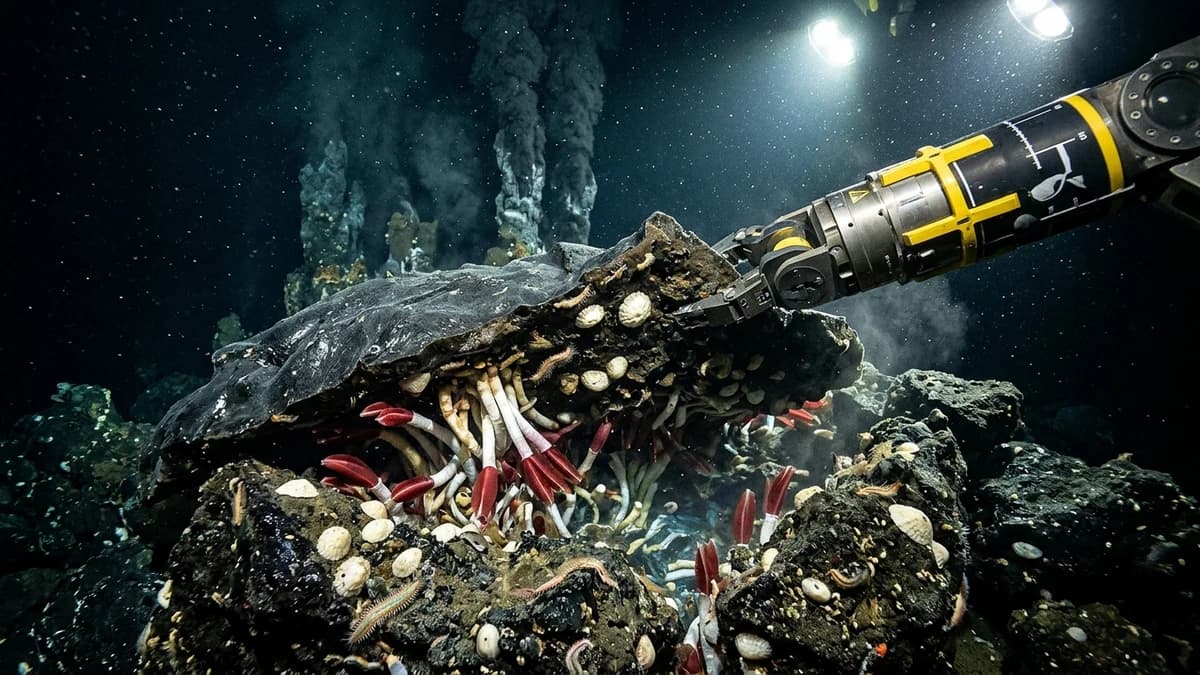
Using the dextrous, force-feedback robotic manipulator arms of the deep-sea submersible ROV SuBastian, researchers carefully wedged open and overturned heavy shelves of lobate basalt lava resting on the ocean floor. Beneath the dark volcanic rock, inside cavities where shimmering hydrothermal fluids circulate at temperate conditions between 18°C and 25°C, the team witnessed an extraordinary biological sight: flourishing colonies of giant tubeworms displaying vivid crimson plumes, white limpets adhering upside down to the ceiling, and scale worms navigating volcanic crevices.

The comprehensive investigation, entitled "Animal life in the shallow subseafloor crust at deep-sea hydrothermal vents" and published in Nature Communications, formally validates the existence of what researchers now designate as the subseafloor animal biosphere. This momentous finding demonstrates that hydrothermal vents are not isolated, two-dimensional biological oases perched atop the seafloor, but rather the visible skylights of an intricate, three-dimensional underworld of animal life winding through the subterranean basaltic crust of Earth.


The 47-Year-Old Enigma: Why Science Overlooked the Subterranean Ocean #

Exploring the abyssal depths has historically been constrained by the sheer technological challenge of operating under crushing hydrostatic pressures exceeding 250 atmospheres. When oceanographers marveled at dense thickets of giant tubeworms (Riftia pachyptila) reaching lengths of more than two meters around hydrothermal chimneys, observational efforts naturally concentrated on the dramatic surface spectacle. The seafloor of vitreous basalt was universally perceived as an impermeable barrier that marked the lower limit for animal colonization.

Yet, a persistent biogeographical puzzle troubled benthic ecologists for decades. Whenever volcanic eruptions swept across the East Pacific Rise, rivers of incandescent lava exceeding 1,100°C completely incinerated active vent fields, obliterating all exposed animal life and entombing the terrain beneath fresh basalt crust. Astonishingly, within mere months or a couple of years following such catastrophic events, robust colonies of adult tubeworms routinely reappeared, recolonizing the devastated sites with perplexing rapidity.

Conventional hypotheses argued that microscopic larvae drifted through ambient oceanic currents across the open water column, travelling vast distances through near-freezing 2°C abyssal waters until detecting thermal cues to settle. However, this theoretical model faced severe metabolic limitations: the larvae of species like Riftia pachyptila carry finite lipid reserves and have rarely been captured in significant densities by plankton nets towed above ocean ridges.

Dr. Monika Bright and her colleagues formulated a daring counter-hypothesis: what if vent larvae did not travel exclusively through open seawater, but migrated instead through the interconnected subsurface fissures of the volcanic crust itself? If cold ocean water naturally percolates into the crust to recharge hydrothermal circulation cells, drifting larvae could be drawn downward, travelling through subterranean conduits before surfacing at warm discharge vents. To verify this provocative theory, the team resolved to break open the seafloor.


High-Tech Oceanography: How the Falkor (too) and ROV SuBastian Opened the Crust #

Conducting surgical excavations 2,500 meters beneath the waves demanded unprecedented precision to avoid triggering structural collapses of delicate vent conduits. The 110-meter research vessel R/V Falkor (too), equipped with dynamic acoustic positioning systems, served as the operational mothership for the 30-day expedition. The primary instrument of deep-sea exploration was the four-ton electric submersible ROV SuBastian, rated to dive to depths of 4,500 meters with high-definition optical suites.

To access the subseafloor environment without destroying surrounding habitats, operators guided SuBastian's manipulator arms to identify shelves of hollow lobate basalt lava that had cooled over drained subterranean lava pools during prior volcanic events. By applying controlled leverage with hardened steel chisels, the robot lifted and tilted back basalt slabs ranging from 10 to 15 centimeters in thickness, exposing hidden subseafloor cavities measuring between 10 and 20 centimeters in clearance.

The moment SuBastian's 4K cameras relayed live footage from inside the volcanic chambers to the control room on the Falkor (too), scientists witnessed an astonishing revelation. Rather than barren rock or simple bacterial slime, the screens displayed bright clusters of tubeworm tubes projecting from the walls and hanging from the ceilings of the basalt cavities. Transparent, shimmering hydrothermal fluids pulsed through the chambers, reflecting the vehicle's LED floodlights against pristine crystalline mineral surfaces.

The scientific team also deployed specialized colonization experiments: custom-built silicone mesh boxes were sealed over drilled basalt apertures with marine adhesives. When ROV SuBastian returned to inspect the sites several days later, animals had actively migrated out of the subterranean crevices into the containment boxes, furnishing definitive proof that animal mobility occurs routinely within the crustal network.


Anatomy of the Underworld: Taxa, Physiological Adaptations, and Technical Metrics #

The fauna cataloged inside the volcanic crust represents specialized lineages uniquely adapted to extreme environmental gradients of temperature, hydrogen sulfide toxicity, and low oxygen. Dominant among the organisms uncovered in the Tica subseafloor cavities were tubeworms of the order Canalipalpata, notably mature adults and juveniles of Riftia pachyptila, alongside Oasisia alvinae and Oasisia jerichonana. The retrieval of specimens bearing rigid chitinous tubes up to 20 centimeters long with functional gonads proved that these animals do not simply fall into crevices, but mature and reproduce within the subterranean rock.

Accompanying the tubeworms were high concentrations of the limpet Lepetodrilus elevatus. These small, conical-shelled gastropods encrusted the internal basalt ceilings at densities reaching hundreds of individuals per square decimeter, grazing on thick mats of filamentous chemotrophic bacteria. The expedition also documented predatory polychaete scale worms of the genera Branchinotogluma and Peinaleopolynoe, swift carnivores whose iridescent sensory bristles provide tactile navigation throughout the sunless labyrinth.

The following technical table synthesizes the empirical parameters documented by the Nature Communications investigation comparing seafloor and subseafloor habitats:

Metric / Parameter Benthic Seafloor Surface Subseafloor Volcanic Crust Measurement Technique / Instrument Ecological Significance
Bathymetric Depth 2,515 meters (ocean floor) 2,515.1 to 2,515.5 meters (under basalt) ROV multibeam sonar & pressure sensors Establishes vertical boundaries of the multicellular niche.
Fluid Temperature 2°C (ambient) to >350°C (chimneys) 18°C to 25°C (temperate regime) Submersible thermocouple penetration probe Confirms thermal stability ideal for metabolic growth.
Dominant Tubeworm Taxa Giant Riftia pachyptila (>1.5 m) Riftia pachyptila (up to 20 cm) & Oasisia Suction sampling and microscopic lab inspection Proves complete reproductive cycles occur inside rock.
Gastropod & Limpet Fauna Lepetodrilus elevatus & Bathynerita Lepetodrilus elevatus & Cyaporcellio High-resolution macro photogrammetry Demonstrates active grazing on subterranean biofilms.
Primary Energy Source Chemosynthesis via exposed vent fluids Chemosynthesis via internal fluid recharge Gas chromatography and mass spectrometry Documents an autonomous subterranean food web.
Oxygen & Sulfide Balance High ambient O₂, localized toxic H₂S jets Balanced mixing of ambient O₂ and warm H₂S Micro-profiling electrochemical sensors Provides optimal chemical stoichiometry for endosymbionts.

Physiological investigations of recovered specimens revealed crucial biochemical adaptations. The blood of Riftia tubeworms contains giant extracellular hemoglobin molecules engineered to bind oxygen and toxic hydrogen sulfide simultaneously without poisoning cellular respiration. In the subseafloor environment, where hydrothermal fluid flow is diffuse and sheltered from turbulent surface vortexes, this adaptation allows organisms to fuel their internal symbiotic bacteria (Candidatus Endoriftia persephone) with exceptional metabolic efficiency.


The Subterranean Hydrothermal Highway: Resolving Larval Connectivity #

The most profound theoretical advance stemming from the work of Dr. Bright and Dr. Gollner concerns the resolution of larval dispersal dynamics across oceanic ridges. The oceanic crust in spreading centers consists of interconnected cooling fractures, drained lava channels, and collapsed lava tubes that create an extensive subterranean maze. Cold ambient seawater sinks through peripheral recharge zones, descends toward deeper magma chambers, and rises as warm, mineral-laden fluid through discharge fissures.

Hydrodynamic modelling based on ROV SuBastian's in situ measurements demonstrates that this subterranean circulation functions as a biological conveyor belt. Ciliated larvae released by subseafloor adults are not forced to endure high mortality from pelagic predators or sweep into hostile, freezing waters. Instead, they navigate through interconnected crustal channels, nourished by continuous hydrothermal flow.

This endobenthic dispersal model finally explains why newly formed hydrothermal vents are rapidly colonized following tectonic upheaval. Larvae already reside within the shallow crust directly beneath or adjacent to the new vents, primed to emerge and colonize the surface as soon as fresh discharge conduits open. The discovery recalibrates the ecological model: surface hydrothermal communities represent merely the upper canopy of a subterranean metropolis rooted in the oceanic crust.

Dr. Sabine Gollner stressed that these volcanic cavities also serve as essential biological refuges during environmental catastrophes. When surface chimneys collapse or vent flow shifts abruptly, the sheltered microclimate within the basalt chambers preserves genetic reservoirs that sustain populations across geological intervals.


Astrobiological Implications: Ocean Moons and the Search for Alien Life #

Beyond marine science, the findings published in Nature Communications have sparked deep interest across planetary science institutions, including NASA and the European Space Agency (ESA). For decades, astrobiologists have focused on the potential habitability of ocean moons in the outer Solar System, particularly Jupiter's moon Europa and Saturn's moon Enceladus. Both worlds possess global liquid water oceans hidden beneath thick ice shells, isolated from solar radiation for billions of years.

Skeptics previously argued that even if hydrothermal vents existed on the silicate seafloors of these distant moons, any potential life would remain restricted to simple single-celled biofilms. The empirical discovery that complex, multicellular animal life—equipped with vascular circulatory systems, hemoglobins, and protective shells—can flourish entirely within subterranean volcanic rock cavities without sunlight provides a compelling physical analog for life in extraterrestrial ocean worlds.

On moons like Enceladus, tidal dissipation generated by Saturn's gravitational pull maintains a warm, fractured rocky core where seawater interacts with igneous rock in hydrothermal circulation identical to the East Pacific Rise. If tubeworms and mollusks thrive inside volcanic rock on Earth relying exclusively on sulfur oxidation and geothermal heat, alien oceans possess the thermodynamic ingredients necessary to support complex multicellular biomes nestled deep within their seafloor crusts.

This insight arrives as NASA's Europa Clipper and ESA's JUICE spacecraft journey toward the Jovian system. Instruments designed to analyze water vapor plumes and ice grains vented through surface fractures will now look for biochemical signatures compatible not just with primitive microbes, but with complex ecosystems supported by volcanic hydrothermal cavities.


Deep-Sea Mining Alert: Irreversible Threat to the Subseafloor Biosphere #

While the discovery opens inspiring frontiers for evolutionary biology, it also sounds an urgent alarm regarding the imminent industrial exploitation of the deep sea. The International Seabed Authority (ISA) is currently formulating exploitation codes that could soon greenlight commercial seabed mining for seafloor massive sulfide (SMS) deposits in international waters. Multinational consortia seek to extract copper, gold, zinc, and rare earth elements concentrated around hydrothermal vent fields.

Environmental impact assessments previously submitted by mining advocates operated under the flawed premise that strip-mining the seabed would only disturb a thin veneer of surface fauna. The Nature Communications paper demolishes this assumption: grinding, dredging, or excavating basaltic crusts will obliterate the subterranean cavities, shatter internal hydrothermal circulation, and exterminate entire animal communities dwelling within the rock.

Dr. Monika Bright and prominent oceanographers have called for an immediate moratorium on deep-sea mining. Scientists warn that destroying subseafloor vent ecosystems could disrupt global marine biogeochemical cycles and trigger irreversible extinctions before humanity can even catalog this hidden biome. Protecting the three-dimensional integrity of our ocean floor is essential to preserving the vital balance of the planet.


Scientific Sources and Official References #

🏷️ Tags:

#animallifebeneathoceanfloorNatureCommunications#subseaflooroceaniccrustecosystemMonikaBrightSabineGollner#subsurfacetubewormsRiftiapachyptilaOasisia#ROVSuBastianFalkortooEastPacificRiseTicaventfield#hydrothermalcirculationsubterraneanbiosphereastrobiology#deepseaminingseabedprotectionoceaniccrust

📢 Gostou deste artigo?

Compartilhe com seus amigos e nos conte o que você achou nos comentários!

❓Frequently Asked Questions

By deploying the high-precision robotic arms of the ROV SuBastian to gently peel back shelves of lobate basalt lava along the East Pacific Rise, oceanographers uncovered subterranean volcanic cavities populated by active and mature animal communities. Inside these pitch-black chambers, bathed in shimmering hydrothermal fluids heated between 18°C and 25°C, researchers documented adult giant tubeworms of the species Riftia pachyptila measuring up to 20 centimeters with fully developed reproductive organs, alongside smaller Oasisia tubeworms and dense populations of limpets (Lepetodrilus elevatus) clinging upside down to the rock ceilings. Prior to this groundbreaking empirical observation, the global biological community universally assumed that the oceanic crust beneath hydrothermal vents supported only single-celled bacteria, archaea, and extremophilic viruses.
Animals inhabiting these subseafloor volcanic cavities survive entirely through microbial chemosynthesis, a biological pathway in which specialized bacteria oxidize hydrogen sulfide and other minerals dissolved in hydrothermal fluids to manufacture organic carbon without solar energy. Tubeworms belonging to the family Siboglinidae lack a mouth, gut, or digestive tract, depending exclusively on billions of endosymbiotic bacteria sheltered within a specialized vascularized organ known as the trophosome. The porous network of basalt fractures channels a continuous supply of ambient oceanic oxygen mixed with warm, sulfur-rich vent fluids, generating a sheltered microclimate protected from pelagic predators that enables colonies to complete their entire life cycles inside the rock.
The empirical proof that the benthic animal biosphere extends vertically into the oceanic crust demands an urgent regulatory reassessment of deep-sea polymetallic sulfide mining projects overseen by the International Seabed Authority. If commercial mining operators scrape, grind, or blast basalt crusts, the resulting destruction will not only devastate the visible seafloor surface but also obliterate subterranean animal ecosystems that interconnect active vent fields. For astrobiology, the discovery demonstrates that complex multicellular life can flourish inside subterranean oceanic crust cavities warmed purely by geothermal heat, reinforcing the probability of multicellular biomes thriving within the ice-covered oceans of planetary moons such as Europa and Enceladus.

Receba novidades!

Cadastre seu email e receba as melhores curiosidades toda semana.

🔒 Sem spam. Cancele quando quiser.

💬 Comentários (0)

Seja o primeiro a comentar! 👋

📚Related Articles

Covid-19 Years Later: Scientific Consensus on Long Covid Complications and Global Vaccine Impactciencia-natureza

Covid-19 Years Later: Scientific Consensus on Long Covid Complications and Global Vaccine Impact

Peer-reviewed data synthesizes long-term Long Covid pathology, global excess mortality audits, and real-world vaccination protection metrics years after pandemic onset.

⏱️8 minLer mais →
James Webb Reveals Host Galaxy of Farthest Fast Radio Burstciencia-natureza

James Webb Reveals Host Galaxy of Farthest Fast Radio Burst

The James Webb Space Telescope identifies the host galaxy of the most distant fast radio burst ever recorded, emitted 10 billion years ago.

⏱️6 minLer mais →
2026 Nobel Prize in Physics Reveals Secret of Cosmic Neutrinosciencia-natureza

2026 Nobel Prize in Physics Reveals Secret of Cosmic Neutrinos

Physicist Francis Halzen wins the 2026 Nobel Prize in Physics for leading the IceCube Observatory and detecting deep space ghost particles.

⏱️6 minLer mais →
2026 Nobel Prize in Chemistry Reveals Secret of Origin of Lifeciencia-natureza

2026 Nobel Prize in Chemistry Reveals Secret of Origin of Life

Scientists Henri Kagan and Kenso Soai win the 2026 Nobel Prize in Chemistry for solving the molecular homochirality enigma that birthed life.

⏱️6 minLer mais →
James Webb Telescope Reveals Secrets of Stellar Nursery NGC 7129ciencia-natureza

James Webb Telescope Reveals Secrets of Stellar Nursery NGC 7129

Unprecedented infrared imagery from James Webb pierces cosmic dust clouds to reveal protostars and stellar jets in nebula NGC 7129.

⏱️7 minLer mais →
Second-Generation Planet Candidate Accreting onto White Dwarf HS 0209+0832ciencia-natureza

Second-Generation Planet Candidate Accreting onto White Dwarf HS 0209+0832

Astronomers identify a suspected Jupiter-sized second-generation planet candidate accreting onto white dwarf HS 0209+0832, showing zinc and copper enrichment.

⏱️9 minLer mais →
Receba novidades no WhatsApp!