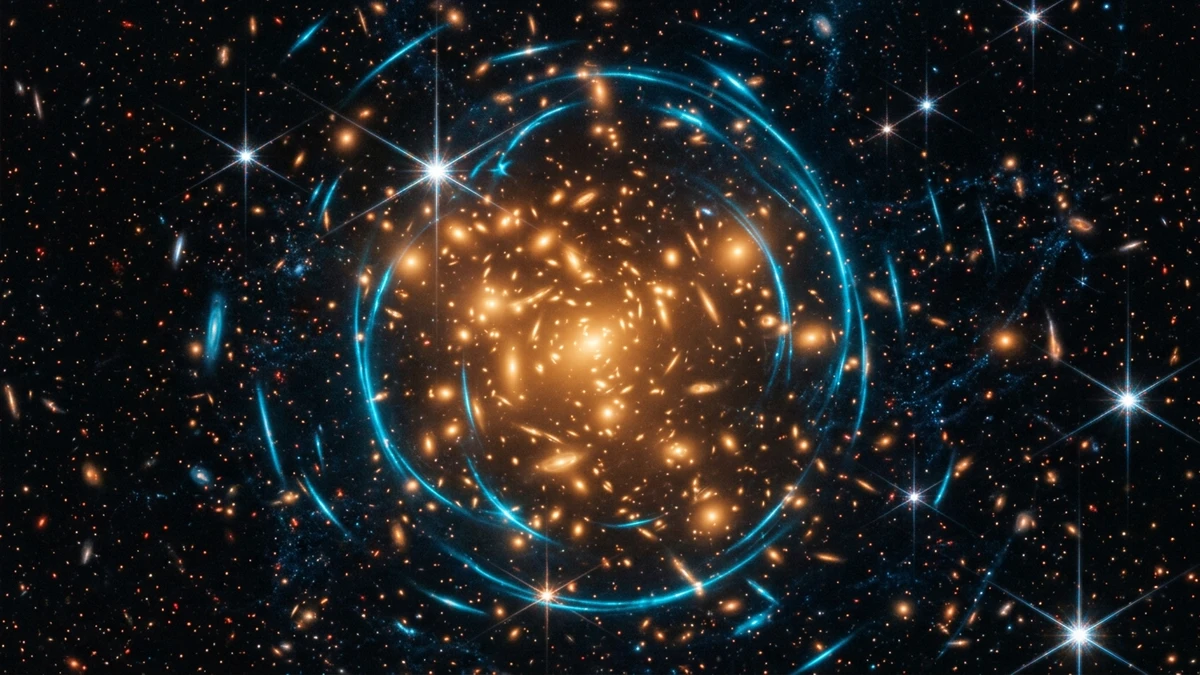
The James Webb Space Telescope has officially identified galaxy cluster XLSSC 122, located 10.4 billion light-years from Earth at a redshift of $z = 1.98$, as the most distant strong gravitational lens ever observed in astronomical history. The scientific milestone, published across a series of investigations in The Astrophysical Journal Letters by an international consortium of astrophysicists led by Kyle Finner, Zachary P. Scofield, and M. James Jee from Yonsei University and the University of California Davis, alongside researchers from the California Institute of Technology (Caltech), revealed striking, giant blue arcs of magnified and warped starlight curving around the cluster's core. High-resolution infrared imaging from Webb's Near-Infrared Camera (NIRCam) proves that XLSSC 122 harbors an extraordinarily compact and hyperdense dark matter halo exceeding two to three hundred trillion solar masses ($2\text{--}3 \times 10^{14},M_\odot$), directly challenging standard cosmological models that predicted such immense, mature cosmic structures should have required billions of additional years to assemble following the Big Bang.
In contemporary astrophysics, dark matter neither emits, reflects, nor absorbs electromagnetic radiation, interacting with the observable cosmos exclusively through gravitational forces. Accounting for roughly 85% of all matter in the universe, dark matter distributions across cosmological scales are primarily mapped using the phenomenon of strong gravitational lensing, predicted by Albert Einstein's General Theory of Relativity: when a colossal concentration of mass aligns directly between Earth and remote background galaxies, the severe curvature of spacetime bends, magnifies, and distorts the paths of traveling photons into luminous curved filaments known as Einstein arcs. Prior to Webb's deep infrared survey, virtually all confirmed strong lensing clusters were cataloged at relatively late cosmic epochs ($z < 1$), where cosmological structures had enjoyed ample cosmic time to agglomerate mass via hierarchical mergers.
XLSSC 122, by contrast, sits deep within the "cosmic noon" epoch, viewed as it existed when the universe was only 3.3 billion years old—less than one-quarter of its current age of 13.8 billion years. Initially discovered in X-ray surveys conducted by the European Space Agency's (ESA) XMM-Newton satellite and subsequently targeted at lower sensitivity by the Hubble Space Telescope, the cluster was recognized for harboring a reservoir of diffuse intergalactic gas heated to tens of millions of degrees. However, definitive confirmation of its extreme gravitational warping power required the infrared sensitivity and sharp spatial resolution of Webb's NIRCam filters (spanning 1.1 to 4.4 micrometers). Webb revealed pristine blue arcs wrapping tightly within ten arcseconds of the cluster core, testifying to a gravitational potential well vastly steeper and more concentrated than theoretical simulations predicted for that early epoch.
Astrophysical Parameters and Observational Metrics of XLSSC 122
The table below compiles key quantitative metrics obtained through JWST NIRCam observations, dark matter modeling through gravitational lensing reconstruction, and direct implications for cosmological physics.
| Astronomical Parameter | JWST Determined Value | Astrophysical and Cosmological Significance |
|---|---|---|
| Cluster Designation | XLSSC 122 (XMMXCS J021324.9-042048) | Massive, X-ray selected high-redshift galaxy cluster. |
| Cosmological Redshift ($z$) | $z = 1.98$ | Observed when the cosmos was merely 3.3 billion years old. |
| Lookback Distance | Approximately 10.4 billion light-years | Light travel time elapsed since photons departed the system. |
| Lensing Classification | Strong Gravitational Lens | Farthest known cluster to form giant, resolved Einstein arcs. |
| Total Virial Mass ($M_{200}$) | $(2.2 \pm 0.4) \times 10^{14},M_\odot$ | Monumental gravitational well dominated (>80%) by cold dark matter. |
| Core Concentration Radius | Under 200 kiloparsecs ($<650,000$ light-years) | Hyper-dense, highly concentrated early dark matter halo. |
| Intracluster Light (ICL) | Verified diffuse intergalactic starlight | Earliest evidence of tidal stripping and cluster galaxy cannibalism at $z \sim 2$. |
| Theoretical Challenge | Standard $\Lambda\text{CDM}$ Cosmological Model | Mature architecture assembling far faster than standard simulation predictions. |
By precisely mapping the deflection geometry of the giant blue arcs and combining them with weak lensing measurements across the outer periphery of the cluster, Kyle Finner's research team reconstructed the three-dimensional mass profile of the halo. The resulting density profile demonstrates that the core of XLSSC 122 is dramatically denser than typical clusters simulated under the standard $\Lambda\text{CDM}$ (Cold Dark Matter with Cosmological Constant) framework. Standard hierarchical assembly dictates that structure formation proceeds strictly bottom-up: primordial quantum density perturbations collapse into small dwarf structures first, which gradually merge over billions of years into giant galaxies, eventually clustering into immense virialized cosmic web nodes.
Under standard theoretical expectations, a dark matter halo exceeding two hundred trillion solar masses at $z \sim 2$ should be an unrelaxed, highly fragmented agglomeration caught in the midst of chaotic, violent assembly. In stark opposition to this expectation, Webb's NIRCam observations demonstrate that XLSSC 122 is already dominated by a cluster core of massive, quiescent elliptical galaxies whose dark matter subhalos have largely merged into a smooth, centrally concentrated potential well. This unexpected structural maturity indicates that primordial dark matter collapsed and condensed with extraordinary rapidness, outpacing cosmological growth rates derived from flagship supercomputer simulations such as Millennium and IllustrisTNG.
Further corroboration of this accelerated evolutionary pace stems from the detection of Intracluster Light (ICL). As detailed in companion findings led by astrophysicist Hyungjin Joo, ICL consists of a diffuse, ghostly ocean of unbound stars wandering within the intergalactic space of the cluster. These rogue stars were systematically stripped from their parent galaxies by tidal forces during historical galactic collisions and major mergers. Detecting a coherent reservoir of intracluster light at a lookback time exceeding ten billion years confirms that the central galaxies of XLSSC 122 had already endured hundreds of millions of years of intense galactic cannibalism prior to the epoch captured by Webb's detectors.
The theoretical ramifications of this discovery reverberate across modern astrophysics. To reconcile the presence of hypermassive, mature structures like XLSSC 122 during the cosmic noon epoch, theorists may need to revise critical cosmological parameters, including the primordial fluctuation amplitude ($\sigma_8$) or the fundamental physics governing dark matter self-interactions. If such concentrated dark matter cores prove prevalent in deep surveys, alternative models—such as Self-Interacting Dark Matter (SIDM) or early dark energy dynamics—will command rigorous investigation.
The unveiling of XLSSC 122 as the farthest known strong gravitational lens underscores the revolutionary capabilities of the James Webb Space Telescope. By leveraging this colossal cosmic magnifying glass sculpted by invisible dark matter, astronomers gain an unmatched observational probe into background galaxies inhabiting the earliest chapters of cosmic dawn, while simultaneously establishing a rigorous testing ground for the dark constituents that govern the universe.
Frequently Asked Questions About the JWST Discovery of XLSSC 122
What makes the galaxy cluster XLSSC 122 a historic milestone in observational astronomy?
XLSSC 122 holds the official world record as the most distant galaxy cluster ever confirmed to act as a strong gravitational lens. Situated 10.4 billion light-years away at a redshift of $z = 1.98$, it is observed when the universe was only 3.3 billion years old. The James Webb Space Telescope resolved luminous blue Einstein arcs formed by magnified background galaxies wrapped tightly around the cluster's core, establishing strong lensing capabilities at a cosmological epoch previously considered inaccessible for cluster-scale lenses.
Why does the concentrated dark matter core of XLSSC 122 challenge standard cosmological models?
The standard cosmological model ($\Lambda\text{CDM}$) predicts that massive cosmic structures assemble gradually through hierarchical mergers over billions of years. Massive dark matter halos exceeding two hundred trillion solar masses at $z \sim 2$ were expected to be loose, fragmented, and actively assembling. Instead, Webb revealed a smooth, hyper-concentrated dark matter core populated by mature, quiescent elliptical galaxies, proving that early dark matter collapsed and stabilized far faster than supercomputer simulations predict.
What is Intracluster Light (ICL) and how does it prove the cluster's extreme maturity?
Intracluster Light is a faint, diffuse glow of unbound stars drifting through the intergalactic space of a cluster. These stars were stripped from their home galaxies by tidal gravitational shears during prehistoric galactic collisions and cannibalism events. Detecting a well-established reservoir of intracluster light in XLSSC 122 at a lookback time of 10.4 billion years proves that the cluster had already undergone extensive dynamical evolution, merger activity, and relaxation during the early youth of the universe.
Authoritative References and Official Scientific Sources
- The Astrophysical Journal Letters — JWST Discovery of Strong Lensing from a Galaxy Cluster at Cosmic Noon: Giant Arcs and a Highly Concentrated Core of XLSSC 122 (Kyle Finner, Zachary P. Scofield, M. James Jee et al., 2026).
- The Astrophysical Journal Letters — An Active Galaxy Cluster Merger at Cosmic Noon Revealed by JWST Weak Lensing and Multiwavelength Probes (Scofield, Finner, Jee et al., 2026).
- The Astrophysical Journal Letters — Mature but Still Growing: JWST Detection of the Earliest Intracluster Light at z ~ 2 (Hyungjin Joo, M. James Jee, Kyle Finner et al., 2026).
- NASA / Space Telescope Science Institute (STScI) — Webb Reveals Distant Cosmic Lens and Unprecedented Dark Matter Core in XLSSC 122 (October 2026).
- European Space Agency (ESA) — XMM-Newton and JWST Insights into Massive Galaxy Clusters at High Redshift (2026).