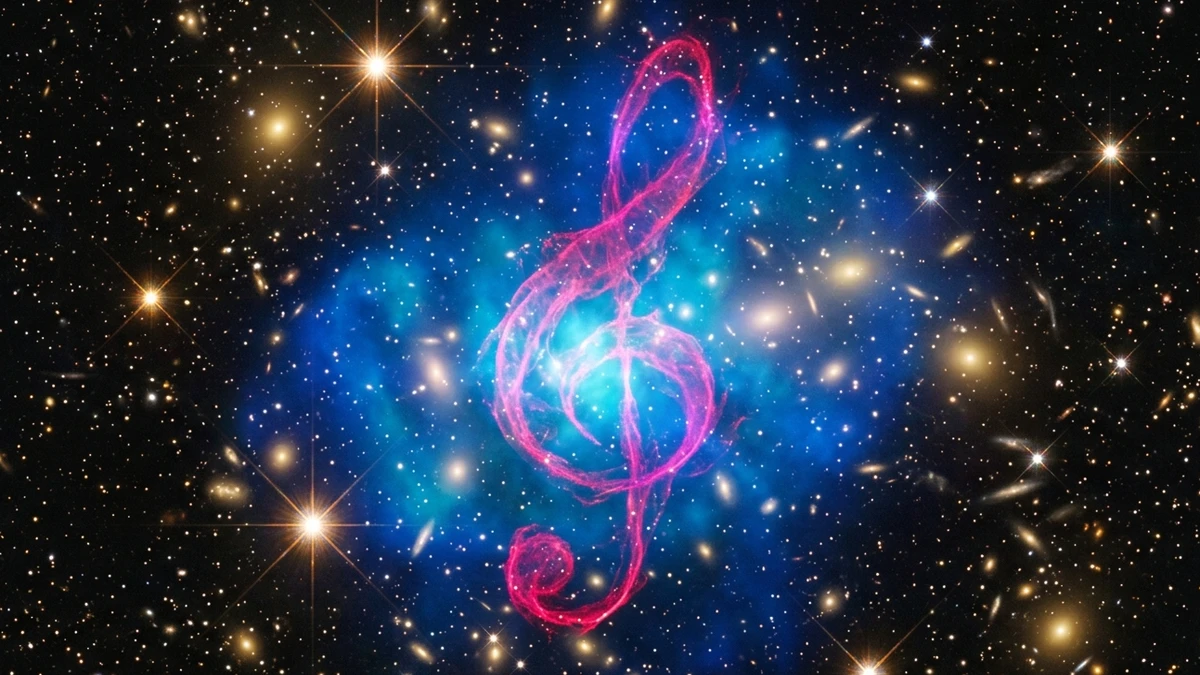
NASA's Chandra X-ray Observatory, operating in tandem with the European LOFAR radio interferometer and the SRG/eROSITA X-ray space telescope, has uncovered the origin of an enigmatic, 2.48-million-light-year cosmic structure whose looping filaments strikingly mirror the shape of a musical Treble Clef. Published in the peer-reviewed journal Astronomy & Astrophysics by an international research team led by astrophysicist Andrea Botteon of Italy's National Institute for Astrophysics (INAF), the study confirms that the object—officially cataloged as VLSS J0318.9+5755 and located 1.55 billion light-years from Earth ($z \approx 0.117$)—is a rare astrophysical "radio phoenix." Multi-wavelength observations prove that this colossal intergalactic sculpture emerged from a two-stage cataclysm: first, a violent eruption from a supermassive black hole roughly 200 million years ago blasted out a cloud of relativistic particles that subsequently cooled and went dark; second, a titanic collision between two merging galaxy clusters with a combined mass exceeding 500 trillion suns compressed and resurrected the dormant plasma.
For decades, the true identity of VLSS J0318.9+5755 remained concealed from astronomers due to a formidable observational barrier: the object sits in the northern constellation Camelopardalis, positioned almost directly behind the crowded equatorial plane of our own Milky Way galaxy. In observational astronomy, this band of the sky is designated the Zone of Avoidance, because dense curtains of interstellar dust, opaque molecular clouds, and millions of bright foreground stars absorb and scatter visible light arriving from the deep extragalactic universe. Because of its extremely low Galactic latitude and unusual low-frequency radio signature, early sky surveys erroneously classified the object as a candidate galactic pulsar—a rapidly spinning neutron star located inside the Milky Way.
To pierce through this thick interstellar screen, the consortium led by Andrea Botteon—bringing together scientists from INAF in Bologna, the Harvard-Smithsonian Center for Astrophysics, the Max Planck Institute for Extraterrestrial Physics, and the University of Bologna—leveraged electromagnetic wavelengths capable of traversing galactic dust without severe attenuation. While NASA's Chandra Observatory and the SRG/eROSITA space telescope captured high-energy X-ray photons, the LOFAR (Low-Frequency Array), uGMRT (upgraded Giant Metrewave Radio Telescope), and VLA (Very Large Array) radio interferometers mapped low-frequency synchrotron emissions, complemented by near-infrared imaging from the United Kingdom Infrared Telescope (UKIRT). This multi-instrument synergy revealed that the putative local pulsar was actually a sprawling filamentary radio structure embedded deep inside a colliding pair of massive galaxy clusters.
Astrophysical Parameters and Observational Metrics of the Treble Clef (VLSS J0318.9+5755)
Quantitative measurements derived from X-ray spectroscopy, multi-frequency radio interferometry, and infrared imaging established the physical scale, intracluster gas thermodynamics, and radiative age of the relativistic plasma forming the Treble Clef structure.
| Astronomical Parameter | Measured / Determined Value | Physical and Astrophysical Significance |
|---|---|---|
| Official Catalog Designation | VLSS J0318.9+5755 ("Treble Clef") | Extragalactic filamentary radio source initially detected at low frequencies. |
| Sky Location & Constellation | Camelopardalis — Zone of Avoidance | Positioned directly behind the dense dust and gas plane of the Milky Way. |
| Cosmological Redshift ($z$) | $z \approx 0.117$ | Spectral redshift confirmed via host cluster galaxies and X-ray emission. |
| Distance from Earth | Approximately 1.55 billion light-years | Light-travel distance corresponding to the merging galaxy cluster system. |
| Astrophysical Classification | Radio Phoenix | Fossil black hole plasma re-energized by galaxy cluster merger shockwaves. |
| Projected Linear Span | Roughly 760 kiloparsecs ($\sim 2.48$ million light-years) | Spanning more than twenty times the diameter of the Milky Way's stellar disk. |
| Individual Filament Width | Narrower than 8 kiloparsecs ($< 26,000$ light-years) | Thin, tightly collimated nonthermal magnetic ribbons shaped by turbulence. |
| Host Galaxy Cluster Mass | $5 \times 10^{14}$ to $6 \times 10^{14},M_\odot$ (500–600 trillion suns) | Massive binary galaxy cluster system caught in the midst of a violent merger. |
| X-Ray Intracluster Gas Temp. | Approximately $6,\text{keV}$ ($\sim 70$ million $^\circ\text{C}$) | Superheated intergalactic plasma mapped by Chandra and SRG/eROSITA. |
| Estimated Fossil Plasma Age | Between 190 and 200 million years | Time elapsed since the initial relativistic particle injection by the black hole. |
The physical mechanism that sculpted the Treble Clef represents one of the most dramatic particle-acceleration processes in high-energy astrophysics: the resurrection of fossil relativistic electrons in the intergalactic medium. During the opening act of this cosmic sequence, occurring approximately 190 to 200 million years ago, a supermassive black hole at the heart of an active cluster galaxy underwent a powerful outburst. As matter accreted onto the black hole, it launched collimated relativistic jets at near-light speeds, inflating a vast bubble of high-energy electrons and tangled magnetic fields into intergalactic space, offering a macroscopic counterpart to energetic phenomena investigated in distant cosmic radio bursts.
Over tens of millions of years, the black hole's fuel supply subsided and the relativistic jets switched off. The injected electrons progressively lost their kinetic energy through two relentless physical mechanisms: synchrotron radiation losses as they spiraled around magnetic field lines, and inverse-Compton scattering off photons from the cosmic microwave background. Stripped of their high-energy momentum, the electrons ceased emitting radio waves at standard observable frequencies, leaving behind a dark, ghostly reservoir—referred to by astrophysicists as "fossil plasma"—drifting silently inside the galaxy cluster.
The reawakening of this dormant cloud was triggered when two colossal galaxy clusters, carrying a combined mass of 500 to 600 trillion solar masses, slammed directly into one another. As demonstrated in recent cosmological studies of dark matter concentrations in distant galaxy clusters, galaxy clusters are the largest gravitationally bound structures in the universe, and their collisions release kinetic energies surpassed only by the Big Bang itself. As the two clusters merged, the tenuous intergalactic gas filling the space between galaxies was shock-heated to temperatures near 6 kiloelectronvolts (roughly 70 million degrees Celsius), glowing brightly in X-rays.
High-resolution spatial imaging from NASA's Chandra X-ray Observatory, processed by Botteon's team using specialized mathematical residual-filtering techniques to highlight subtle surface-brightness discontinuities, revealed an elongated, disturbed morphology in the blue X-ray gas. This structural signature proves that the cluster collision launched supersonic shock fronts and vigorous magnetohydrodynamic turbulence across the intracluster medium. When these sweeping shockwaves encountered the ancient bubble of fossil plasma left behind by the supermassive black hole, they adiabatically compressed the magnetized gas, amplifying the magnetic field strength and re-accelerating the aged electrons.
Driven by this violent shock compression, the ghost cloud ignited once more with synchrotron radiation, rising from its ashes as a luminous radio phoenix. The unmistakable silhouette of a musical treble clef—featuring a long, straight spine intersected by curved loops and hooks at either end—was forged by hydrodynamic shear and the twisting of magnetic flux tubes as the merger shockfront swept through the fossil bubble. Observations conducted with the LOFAR array at 144 megahertz and the uGMRT at 400 and 650 megahertz demonstrated that the entire structure spans 760 kiloparsecs (2.48 million light-years), while its individual filaments remain narrower than 8 kiloparsecs (26,000 light-years).
To trace how the re-energized electrons are distributed across the loops of the Treble Clef, the researchers constructed spatially resolved spectral index maps combining data from LOFAR, uGMRT, and the VLA. The radio emission exhibited an ultra-steep spectrum, an unmistakable diagnostic signature of an ancient electron population that experienced severe radiative aging prior to adiabatic compression. Furthermore, the team applied multi-component decomposition techniques based on the Radon transform to disentangle overlapping nonthermal filaments and measure surface-brightness profiles along each curve of the structure.
In NASA's official announcement, researchers noted that the visual similarity between VLSS J0318.9+5755 and the musical treble clef symbol is a striking example of cosmic pareidolia—the human psychological tendency to perceive familiar shapes in complex natural patterns. Scientifically, however, the razor-thin filaments forming the curves of the Treble Clef provide an exceptional natural laboratory for investigating how intergalactic magnetic fields resist turbulent dissipation. Understanding how these magnetic ribbons maintain structural coherence across millions of light-years illuminates how kinetic energy from cluster collisions is channeled into nonthermal radiation throughout the cosmic web.
The discovery led by INAF and the Chandra X-ray Observatory also establishes a powerful blueprint for exploring the Zone of Avoidance. For generations, extragalactic surveys largely bypassed the plane of the Milky Way due to severe optical extinction. The complete physical reconstruction of VLSS J0318.9+5755 demonstrates that pairing ultra-sensitive low-frequency radio interferometers (such as LOFAR and the upcoming Square Kilometre Array) with space-based X-ray observatories can uncover massive galaxy clusters and titanic cosmic collisions hiding directly behind the disk of our home galaxy.
Frequently Asked Questions About the Treble Clef Radio Phoenix Discovered by Chandra
What is the cosmic Treble Clef structure (VLSS J0318.9+5755) discovered by NASA?
The cosmic structure nicknamed the Treble Clef, officially cataloged as VLSS J0318.9+5755, is a colossal filamentary radio source located approximately 1.55 billion light-years from Earth in the northern constellation Camelopardalis. Stretching roughly 760 kiloparsecs across—equivalent to 2.48 million light-years from end to end—it belongs to a rare class of astrophysical phenomena known as a radio phoenix. Its looping filaments closely resemble the musical treble clef symbol, sculpted when intergalactic shockwaves compressed and twisted ancient magnetized plasma clouds originally ejected by a supermassive black hole.
Why did astronomers initially mistake this giant structure for a nearby pulsar?
VLSS J0318.9+5755 lies almost directly behind the dense equatorial disk of our own Milky Way galaxy, inside a heavily obscured sky region astronomers call the Zone of Avoidance, where thick curtains of interstellar dust, cold gas, and millions of foreground stars block optical light from distant galaxies. Because of its extremely low Galactic latitude and its ultra-steep low-frequency radio spectrum, early astronomical surveys misclassified the source as a candidate spinning pulsar residing within the Milky Way. Only by combining high-energy X-ray observations from NASA's Chandra observatory and the eROSITA telescope with high-resolution radio imaging from LOFAR could researchers pierce the galactic veil and prove it was a massive extragalactic collision.
How does a radio phoenix form during a collision between galaxy clusters?
A radio phoenix forms through a dramatic two-stage astrophysical sequence unfolding over hundreds of millions of years. During the first stage, a supermassive black hole at the core of an elliptical cluster galaxy erupts, blasting relativistic jets of electrons and magnetic fields that, after 190 to 200 million years of radiative cooling, fade into a dark, invisible fossil plasma cloud. During the second stage, a violent collision between two merging galaxy clusters totaling up to 600 trillion solar masses drives supersonic shockwaves through the intergalactic medium, adiabatically compressing the dormant fossil cloud, re-energizing the aged electrons, and igniting bright synchrotron radio emission anew.
Authoritative References and Official Scientific Sources
- Astronomy & Astrophysics (A&A) — The Treble Clef radio phoenix and its old nonthermal filaments (Andrea Botteon, Marisa Brienza, Kamlesh Rajpurohit, Natalia Lyskova, Eugene Churazov, Ildar Khabibullin, Thomas Pasini, Ewan O'Sullivan, Gianfranco Brunetti, Francesco de Gasperin, Emanuel De Rubeis, Fabio Gastaldello, and Franco Vazza, 2026).
- NASA / Chandra X-ray Center (Smithsonian Astrophysical Observatory) — Chandra Helps Put Together the Pieces of a 'Treble Clef' Galaxy Cluster Collision (October 2026).
- Istituto Nazionale di Astrofisica (INAF) — Radio Phoenix VLSS J0318.9+5755 Discovered Behind the Milky Way Plane (2026).
- ASTRON / LOFAR (Low-Frequency Array) — High-Resolution Low-Frequency Observations of Nonthermal Filaments in Merging Galaxy Clusters (2026).