The Royal Swedish Academy of Sciences announced the awarding of the 2026 Nobel Prize in Physics to physicist Francis Halzen for his decisive contributions to the development of the IceCube Neutrino Observatory. The landmark honor recognizes the researcher's pioneering leadership in transforming a cubic kilometer of deep Antarctic ice at the South Pole into an unprecedented astronomical detector. This revolutionary breakthrough allowed humanity to capture the first high-energy ghost particles originating from the most violent corners of the cosmos.
Since the theoretical formulation of neutrinos by physicist Wolfgang Pauli in the 1930s, detecting these subatomic particles remained one of modern physics's greatest challenges. Because they possess no electric charge and feature near-zero mass, neutrinos pass through entire planets and galaxies without interacting with ordinary matter. However, Halzen's visionary project demonstrated that the crystal-clear, ultra-pure ice of Antarctica could serve as the ideal medium to record rare molecular collisions triggered by these cosmic messengers.
Buried between one and a half to two and a half kilometers beneath the Antarctic surface, IceCube utilizes over five thousand digital optical modules suspended across eighty-six vertical cables. When an ultra-high-energy cosmic neutrino occasionally collides with an oxygen or hydrogen atomic nucleus in the ice, a secondary charged particle is emitted at extreme speeds. This reaction generates a bluish flash of Cherenkov radiation, which is captured and mapped with nanosecond precision by the polar facility's digital sensors.
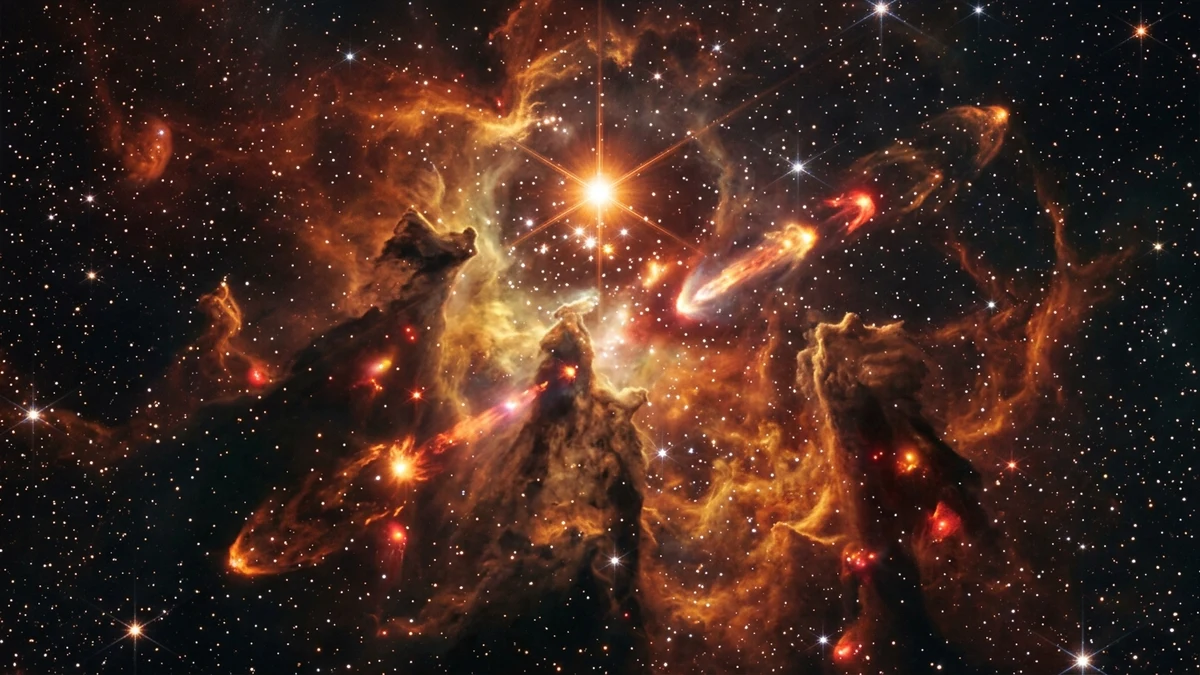
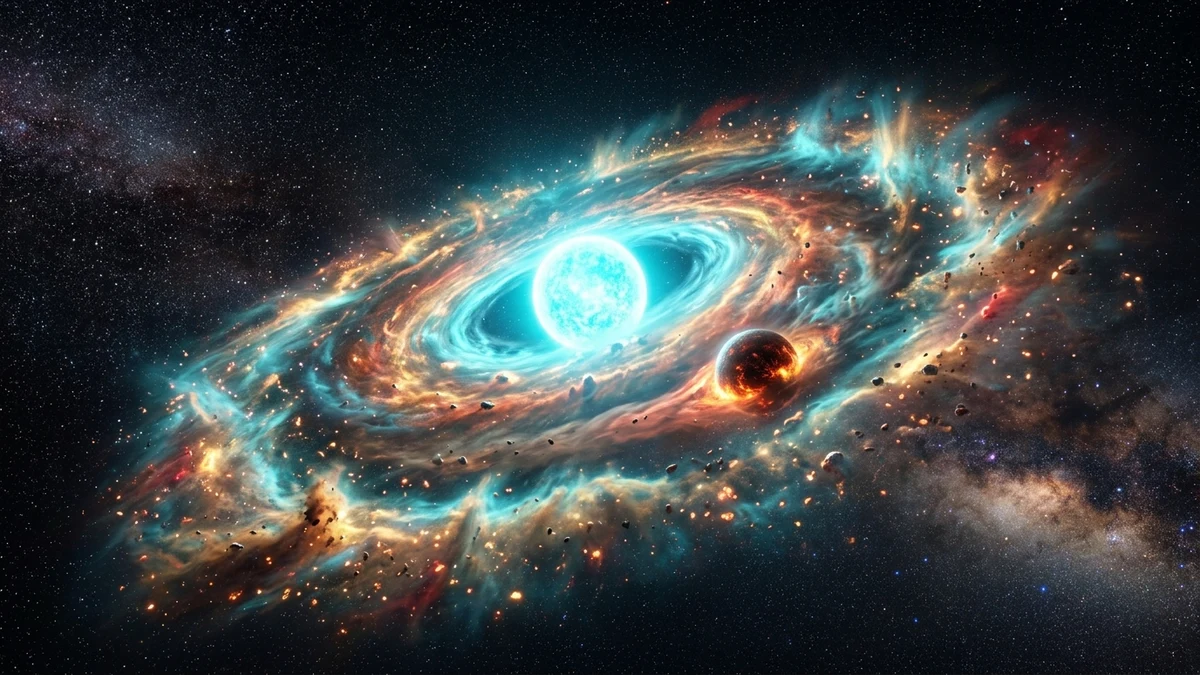
With the consolidation of IceCube observations, astrophysicists managed to trace the exact trajectory of neutrinos back to their origin sources in deep space. For the first time in astronomical history, scientists identified distant blazars and active supermassive black holes billions of light-years from Earth as the cosmos's natural particle accelerators. This achievement formally birthed multimessenger astronomy, uniting photon detection, gravitational waves, and neutrinos into a unified theoretical framework.
Scientific Data and Parameters of the 2026 Nobel Prize in Physics Discovery
To understand the technological scale and historical significance of this announcement presented by the Nobel Committee for Physics, consult the detailed information table below. The data summarizes the laureate's name, the observatory's technical parameters, and global astrophysics impacts. These measurements highlight how particle physics unlocked an unprecedented window to observe the high-energy universe.
| Scientific Parameter | Laureate Discovery Detail | Physics & Astrophysics Impact |
|---|---|---|
| 2026 Nobel Laureate | Francis Halzen (University of Wisconsin-Madison) | International recognition of IceCube project leadership. |
| Detector Volume | 1 Cubic Kilometer at the South Pole | Largest neutrino telescope ever constructed in human history. |
| Operational Depth | 1,500 to 2,500 Meters beneath Antarctica | Utilization of ice as natural shielding against cosmic rays. |
| Optical Modules (DOMs) | 5,160 Photomultiplier Sensors | Nanosecond mapping of blue Cherenkov radiation flashes. |
| Scientific Impact | Blazar and Black Hole Origin Identification | Definitive foundation of the multimessenger astronomy era. |
Applying neutrinos to modern astronomy resolves the historical dilemma of ultra-high-energy cosmic rays that puzzled physicists since the early twentieth century. Traditional cosmic rays composed of protons and atomic nuclei carry electric charge and are deflected by intergalactic magnetic fields during their spatial journey. In contrast, neutrinos travel in straight lines from their emitting source without suffering magnetic deflection or attenuation from surrounding dust or light.
Furthermore, data gathered by the Antarctic observatory enabled mapping the most extreme nuclear processes occurring inside colossal supernovae and near event horizons. When a massive star collapses, over ninety-nine percent of its gravitational energy is released as a colossal burst of neutrinos within seconds. Capturing these elusive signals provides physicists with a direct X-ray of dying stars' dense cores before visible light can escape the explosion.
The relevance of technology developed for IceCube extends far beyond theoretical astrophysics, driving extraordinary innovations in sensor engineering and massive data computing. Processing terabytes of real-time data under extreme polar isolation conditions required creating highly efficient artificial intelligence algorithms. These computational advances currently benefit medical imaging diagnostics and advanced industrial automation systems worldwide.
During the official ceremony in Stockholm, Nobel Committee representatives emphasized that experimental physics opened a fully transparent window into a previously invisible universe. Without sensors submerged in Antarctica's eternal ice, the cosmos's most violent phenomena would remain hidden behind thick clouds of interstellar matter. Science achieves a fundamental milestone in comprehending the mysteries of matter and energy.
New horizons opened by the prize also propel the IceCube-Gen2 expansion project, which will quadruple the volume of instrumented ice at the South Pole. This upcoming operational phase will detect neutrinos of even higher energies and map extremely faint cosmic sources with unmatched sensitivity. Researchers from dozens of countries actively collaborate to transform Antarctica into the central hub of contemporary space exploration.
The international scientific community celebrated Francis Halzen's selection as a tribute to intellectual audacity and long-term transnational scientific cooperation. Constructing a gigantic telescope immersed in Antarctic ice was initially considered an unrealizable utopia by many experts. Today, the persistent vision of the researcher and his team represents one of our time's greatest engineering and scientific triumphs.
In conclusion, the 2026 Nobel Prize in Physics illuminates with definitive clarity humanity's ability to transform Earth's most inhospitable environments into portals of cosmic discovery. Detecting high-energy neutrinos proves that the universe is an interconnected network of fascinating energetic events awaiting decoding. Humanity takes another decisive step forward in understanding its own position within the cosmos.
Frequently Asked Questions About the 2026 Nobel Prize in Physics and IceCube
What are neutrinos and why are they called the ghost particles of the universe?
Neutrinos are extremely abundant elementary subatomic particles in the cosmos that carry no electric charge and feature virtually zero mass. Due to this absence of charge and their weak interaction with nuclear forces, they pass through atoms, entire planets, and galaxies without colliding or being deflected by intergalactic magnetic fields. This extraordinary capacity to travel through ordinary matter in straight lines led the scientific community to nickname them ghost particles, making their detection one of experimental physics history's greatest challenges.
How does neutrino detection work in Antarctic ice at the IceCube Observatory?
The revolutionary IceCube Neutrino Observatory operates using one cubic kilometer of crystal-clear, ultra-pure ice located between 1,500 and 2,500 meters beneath the South Pole Antarctic station. When an ultra-high-energy cosmic neutrino rarely collides with an ice atomic nucleus, it produces a charged particle traveling faster than light in that dense medium. This movement generates a cone of bluish light known as Cherenkov radiation, which is immediately captured and recorded by over five thousand digital photomultiplier sensors suspended deep in the ice.
What is the impact of the 2026 Nobel Prize in Physics on modern multimessenger astronomy?
Awarding the 2026 Nobel Prize in Physics permanently solidifies the era of multimessenger astronomy by proving that neutrinos provide unprecedented data regarding the cosmos's most violent events. Unlike traditional light that can be blocked by stellar dust or cosmic rays deflected by magnetic fields, neutrinos point with mathematical precision directly back to their original sources like blazars and supermassive black holes. This technology allows astrophysicists to combine light signals, gravitational waves, and neutrinos to decode the universe with unprecedented depth.