An international team of astrophysicists used the James Webb Space Telescope to identify the host galaxy of the most distant fast radio burst in astronomical history. The ultra-energetic cosmic signal, cataloged as FRB 20240304B, traveled across intergalactic space for more than ten billion years before reaching terrestrial detectors. This monumental milestone more than doubles the previous distance record, confirming that this bright flash originated when the cosmos was only three billion years old.
Fast radio bursts are millisecond-long pulses that discharge in a tiny fraction of a second the same radiant energy our Sun emits over many days. Since their discovery in 2007, the physical nature and progenitors of these transient cosmic explosions have represented one of astrophysics' greatest mysteries. Pinpointing the celestial coordinates of these fleeting events has historically been hampered by their brief duration and limited radio array resolution.
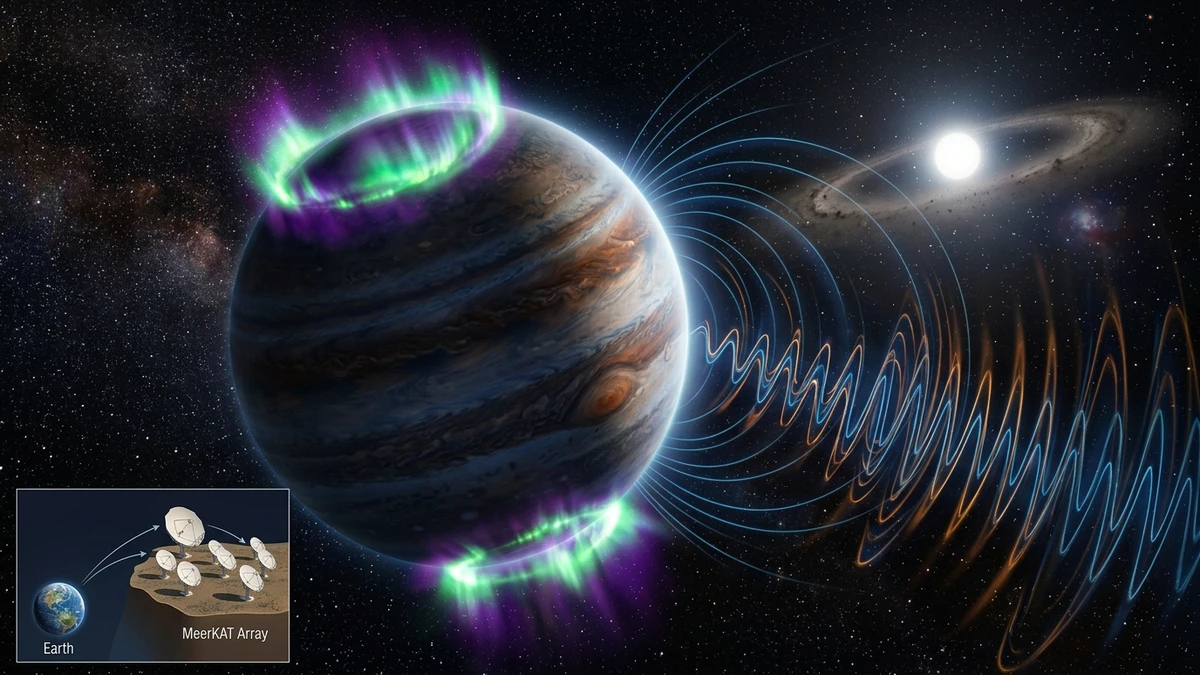
The radio transient was originally detected by the dish array of South Africa's MeerKAT telescope across the Karoo desert. By analyzing the temporal dispersion delay induced by intergalactic ionized gas, astronomers calculated an unprecedented cosmological redshift of 2.148. Following this initial detection, the infrared cameras and spectrographs aboard the James Webb Space Telescope were aimed with surgical precision toward the designated coordinates.
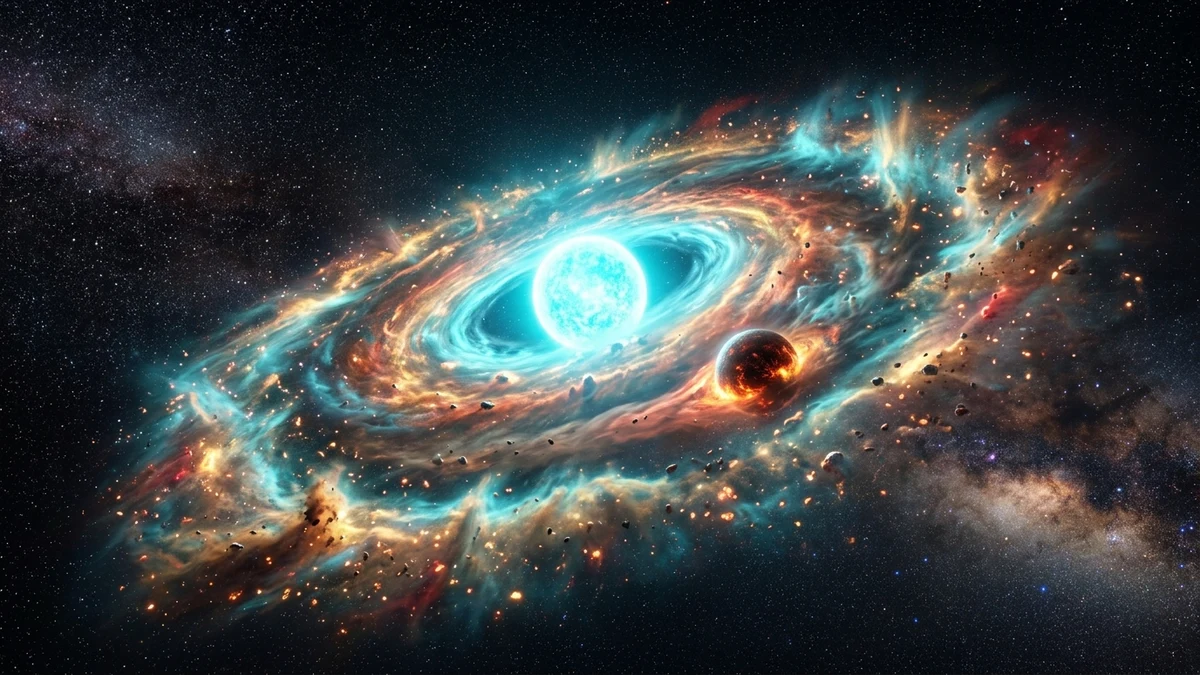
The exceptionally sensitive deep infrared imagery obtained by the observatory revealed a compact, young dwarf galaxy ablaze with intense starburst activity. In stark contrast to massive spiral galaxies in the local cosmic neighborhood, this primordial cradle possesses a mass one thousand times less than our Milky Way. This discovery provides definitive empirical clues regarding astrophysical engines capable of unleashing immense electromagnetic bursts during the cosmic dawn.
Scientific Data and Observational Parameters of Fast Radio Burst FRB 20240304B
To appreciate the methodological breadth and cosmic significance of this scientific breakthrough published in the journal Science, examine the data table below. These quantitative parameters synthesize the distance measurements, morphological characteristics of the host dwarf galaxy, and astronomical instrumentation utilized throughout the observation. These measurements demonstrate how multi-wavelength synergy continually pushes the boundaries of our knowledge regarding the ancient universe.
| Astrophysical Parameter | Observed Value / Measurement | Scientific Significance |
|---|---|---|
| Event Designation | FRB 20240304B | Official identifier of the most distant fast radio burst ever found. |
| Cosmological Redshift ($z$) | $z = 2.148$ | Confirms that the light traveled through space for over 10 billion years. |
| Cosmic Age at Emission | 3 Billion Years | Proof that intense radio outbursts occurred during early cosmic epochs. |
| Host Galaxy Morphology | Compact Star-Forming Dwarf Galaxy | Primordial environment characterized by low metallicity and rapid stellar birth. |
| Primary Observatories | MeerKAT (Radio) & James Webb (Infrared) | Essential technological synergy uniting ground-based arrays and space telescopes. |
Confirming a compact dwarf galaxy as the birthplace of FRB 20240304B directly challenges hypotheses suggesting that fast radio bursts arise from catastrophic neutron star binary mergers. Gravitational radiation orbital decay between compact binaries typically demands several billion years to trigger a coalescence event. Instead, the rampant star formation activity mapped across this tiny host galaxy overwhelmingly points toward the active presence of newborn magnetars.
Magnetars represent exceptionally dense stellar remnants endowed with the most formidable magnetic fields in the cosmos, measuring trillions of times stronger than Earth's magnetic shielding. These extreme celestial corpses are forged during violent core-collapse supernova explosions marking the demise of short-lived, massive stars. When the rigid crystalline crust of a magnetar undergoes immense mechanical fractures known as starquakes, magnetic field reconnections release blinding flares of coherent radio waves.
Detecting an active magnetar at such an extreme redshift also demonstrates that heavy chemical elements and structured magnetic fields organized far faster than classical models predicted. In the young universe, low chemical metallicity favored the condensation of hypermassive stars that rapidly terminated their lifecycles in super-energetic supernovae. Consequently, the cosmic population of extreme magnetars was considerably more numerous and dynamically violent during that remote period of cosmic history.
Beyond definitively resolving the mystery surrounding the source of these bursts, the radio beam of FRB 20240304B serves as an unparalleled probe of the intergalactic web. As the high-frequency radio waves traversed cosmic voids over ten billion light-years, they interacted with invisible, diffuse baryonic matter scattered throughout space. By measuring the plasma dispersion accumulated along this colossal trajectory, cosmologists successfully weighed normal matter that had eluded detection by conventional optical telescopes.
The seamless global coordination between the ground-based MeerKAT radio interferometer and the spaceborne James Webb observatory establishes a powerful operational standard for multi-messenger astronomy. While wide-field radio arrays sweep the heavens to intercept unpredictable transients, space telescopes deliver the high-resolution infrared vision required to probe deep into the cosmic abyss. Researchers from dozens of international institutions collaborated harmoniously to transform a fleeting millisecond pulse into a lasting atlas of high-energy physics.
In conclusion, pinpointing the remote birthplace of FRB 20240304B represents a resounding triumph for empirical science and humanity's quest to comprehend the ancient cosmos. Revealing that a single magnetic outburst from the universe's energetic youth can be deciphered with exquisite precision inspires astronomers worldwide. The ultimate frontiers of cosmic time and space continue to yield their deepest secrets before the transformative power of our most advanced instruments.
Frequently Asked Questions about the Discovery of the Farthest Fast Radio Burst
What is the FRB 20240304B signal and why is its detection considered a historic record in astronomy?
FRB 20240304B is an ultra-energetic fast radio burst initially captured by South Africa's MeerKAT radio telescope and subsequently investigated in deep space by the James Webb Space Telescope. Its detection shattered all previous cosmological distance records by confirming an unprecedented redshift of 2.148, which means the radio wavefront traversed cosmic space for over ten billion years. This astonishing measurement more than doubles the previous distance record, definitively proving that powerful transient radio bursts were actively occurring when our universe was only three billion years old.
What did the James Webb Space Telescope reveal about the host galaxy where the radio burst originated?
Extremely sensitive infrared observations conducted by the James Webb Space Telescope revealed that the host galaxy is a very compact, low-mass dwarf galaxy undergoing an intense burst of star formation. Unlike the massive spiral galaxies commonly associated with local bursts, this ancient cosmic cradle possesses approximately one thousand times less mass than our own Milky Way galaxy. This detailed morphological characterization was instrumental in ruling out slow binary mergers of ancient stars, pointing directly toward energetic stellar remnants born recently within the youthful cosmos.
Why does this landmark discovery strongly favor newborn magnetars as the true engines of fast radio bursts?
Pinpointing this energetic radio burst within a tiny dwarf galaxy dominated by rapid star formation confirms that the progenitor engine formed very rapidly following the supernova explosion of a massive star. Magnetars are young, highly magnetized neutron stars possessing magnetic fields trillions of times stronger than Earth's, which generate immense bursts of coherent radio waves during violent structural starquakes. This observational evidence effectively rules out theories requiring billions of years of orbital decay between colliding neutron stars, cementing magnetars as the primary engines driving cosmic bursts.