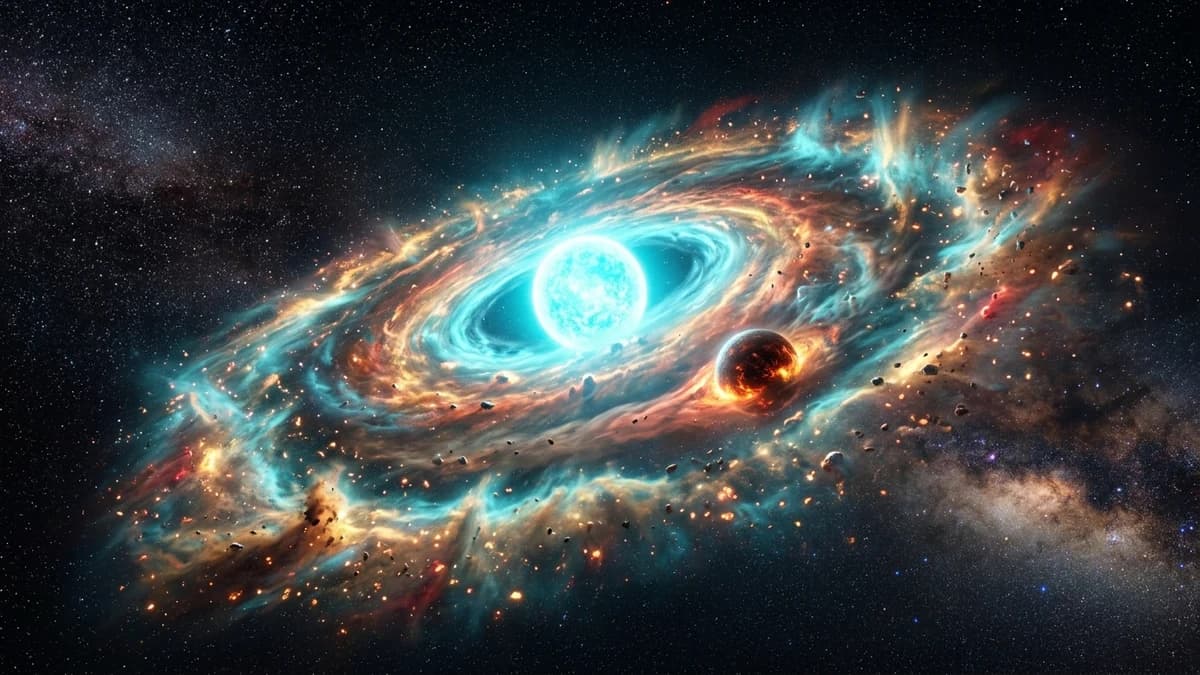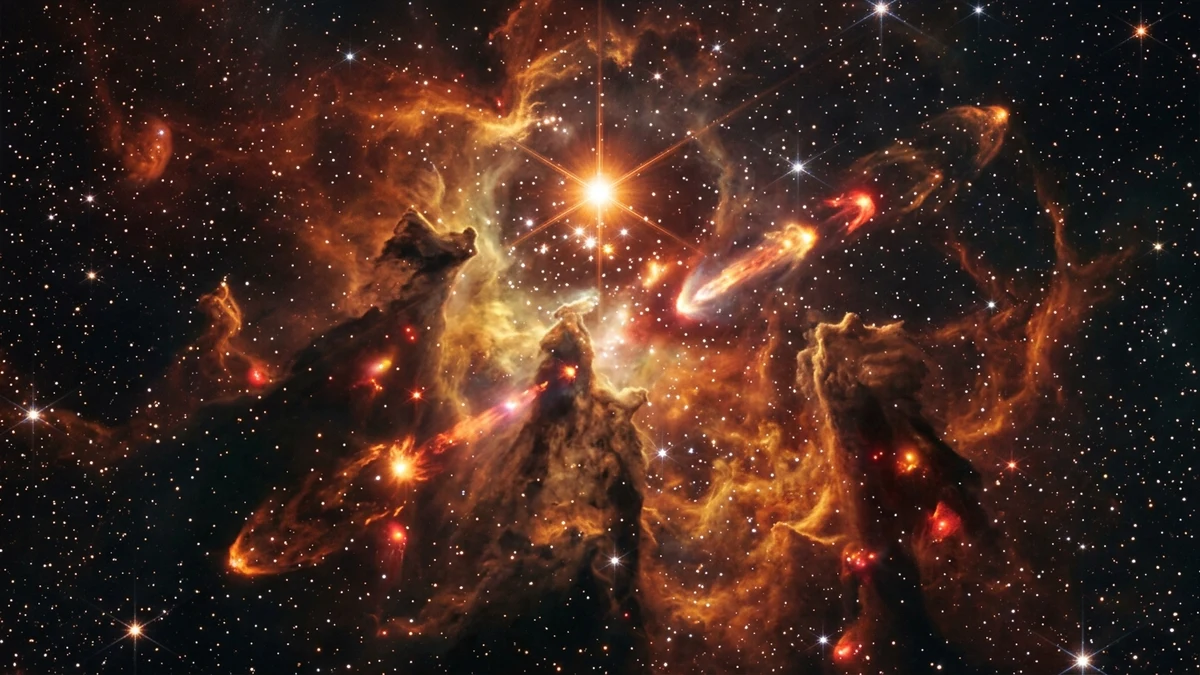
The James Webb Space Telescope has captured a high-resolution infrared view of the reflection nebula and stellar nursery NGC 7129, uncovering unprecedented details about the birth of new stars. The landmark image released jointly by NASA and the European Space Agency (ESA) pierces dense pillars of cosmic dust located 3,300 light-years from Earth in the constellation Cepheus. This historic observation exposes supersonic gaseous jets and dozens of protostars emerging from their primordial cocoons.
Stellar nurseries are dense, cold regions of the interstellar medium composed primarily of molecular hydrogen and silicate dust. As pockets of gas collapse under the pull of their own gravity, the central core heats up until nuclear fusion ignites at the heart of the new celestial body. However, thick dust blocks visible light emitted during these early stages, making infrared astronomy the definitive tool for unveiling stellar gestation.
The most prominent central star in the region, designated LkHα 234, plays a fundamental role in sculpting the visible structure of nebula NGC 7129. Intense ultraviolet radiation and violent stellar winds blown by LkHα 234 carve out a giant bubble at the center of the primordial cloud. This cavity exposes intricate filaments of heated dust that glow brightly at infrared wavelengths detected by Webb's NIRCam and MIRI cameras.
One of the most spectacular phenomena recorded in the new image is the presence of multiple Herbig-Haro objects driven by younger neighboring protostars. These objects are luminous knots of nebulosity created when jets of ionized gas ejected at hundreds of kilometers per second collide with the dense interstellar medium. James Webb's observations mapped the shock fronts of these supersonic jets with unmatched geometric precision in modern astrophysics.
Astronomical Parameters and Observational Data of NGC 7129
To appreciate the scientific relevance and technical details of the NGC 7129 nebula observations captured by James Webb, examine the comparative table detailed below. The cataloged data highlights the star-forming region's features, the instruments utilized, and the phenomena observed. Empirical measurements reveal how energy from newborn stars actively shapes the surrounding interstellar medium.
| Astronomical Parameter | Observed Value / Feature | Astrophysics Significance |
|---|---|---|
| Location & Distance | 3,300 Light-Years (Cepheus Constellation) | Provides a nearby laboratory for studying cluster formation. |
| Primary Central Star | LkHα 234 (Herbig Ae/Be Class) | Intermediate-mass young star carving out the nebular cavity. |
| Key Phenomena | Herbig-Haro Objects (HH 234A-C) | Mapping supersonic jets and shocks in ionized gas. |
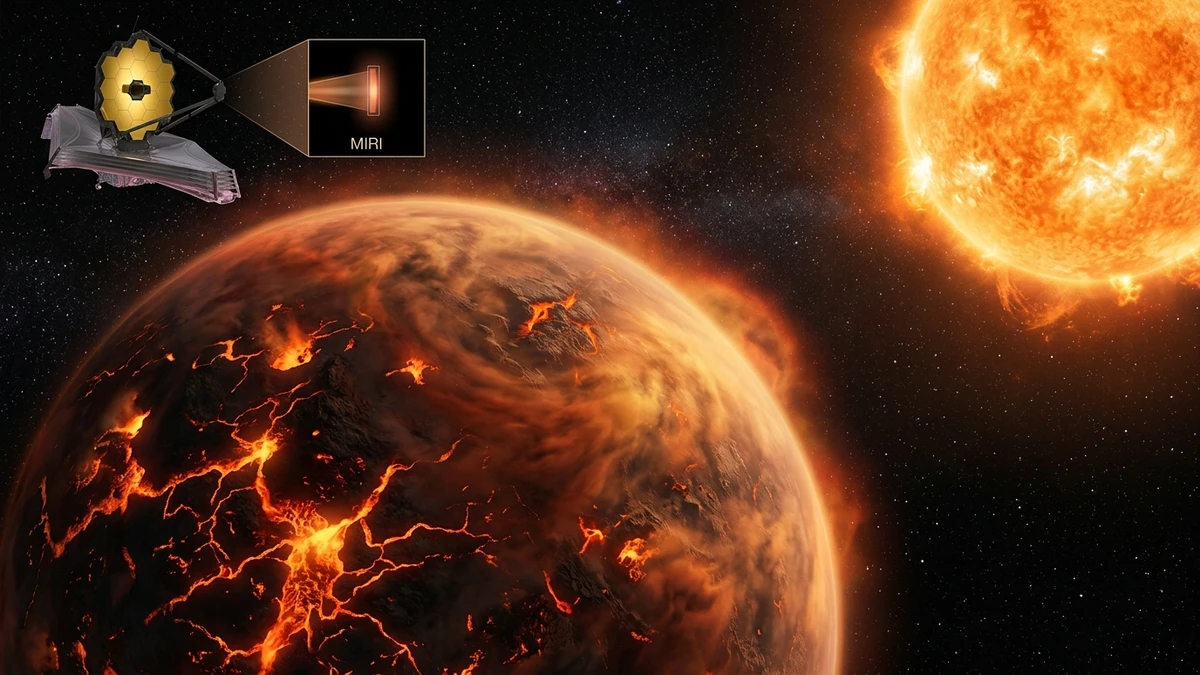
| Webb Instruments | NIRCam & MIRI (Infrared) | Pierces dark interstellar dust to reveal hidden protostars. |
| Estimated Cluster Age | Less Than 3 Million Years | Extremely young stage of stellar and planetary evolution. |
The unmatched sensitivity of James Webb's infrared sensors allowed astronomers to detect individual protoplanetary disks surrounding lower-mass protostars within NGC 7129. These disks contain the raw material consisting of rock, icy grains, and gas that will eventually give rise to secondary planetary systems. Mapping the survival of these structures in environments dominated by intense radiation is essential for understanding how Earth formed in the past.
Furthermore, spectroscopic data revealed the presence of polycyclic aromatic hydrocarbons and complex water-ice grains adhering to nebular dust grains. These life-precursor organic molecules are synthesized on dust grain surfaces and injected into the surrounding gas by stellar jet shocks. Cataloging these chemical compounds provides fundamental clues about the distribution of life-essential elements across the galaxy.
The dynamic interaction between the young star LkHα 234 and surrounding gas clouds triggers a process known as induced star formation. Compressive shock fronts generated by the central star's winds push neighboring nebular regions, increasing local density and triggering the collapse of new protostars. This chain effect demonstrates that the birth of one generation of stars actively seeds subsequent generations.
Astrophysicists compare the NGC 7129 nebula to a time capsule snapshot of how our own Solar System might have looked 4.6 billion years ago. The Sun was born in a similarly dense stellar cluster, surrounded by intermediate and high-mass neighbors that bathed the terrestrial protoplanetary disk in radiation. Studying the physics and chemistry of NGC 7129 makes it possible to reconstruct the first millions of years of Earth's history.
The image released by space agencies also highlights the striking contrast between visible-light and infrared observations. Where conventional optical telescopes saw only dark, opaque patches of muted dust, the James Webb reveals a vibrant tapestry in tones of gold, crimson, and blue. This transformative capability confirms the space observatory's role as the most powerful scientific instrument of the modern era.
The international team of scientists leading the observation program will continue analyzing NGC 7129 data over coming months. Future steps include kinematic mapping of gas jet velocities and studying mass accretion onto the youngest protostars. Combined, these data will help refine computer simulations of stellar cluster formation throughout the Milky Way.
In conclusion, the new images of stellar nursery NGC 7129 captured by the James Webb Space Telescope represent a magnificent leap forward in contemporary astronomy. The observation not only illuminates the violent and beautiful process of star birth, but also deepens our understanding of cosmic origins. The cosmos continues to reveal its deepest secrets under humanity's infrared gaze.
Frequently Asked Questions About Nebula NGC 7129 and James Webb Discoveries
What is nebula NGC 7129 and why is it so important to astronomers?
NGC 7129 is a reflection nebula and young stellar nursery located approximately 3,300 light-years from Earth in the constellation Cepheus. It harbors a cluster of newborn stars less than three million years old and acts as a privileged astronomical laboratory for studying intermediate-mass star formation across the universe. By observing NGC 7129 in detail, scientists can directly witness the violent and fascinating physical interaction between young stellar radiation and the surrounding dense interstellar medium.
How does the James Webb Space Telescope see through NGC 7129's dark dust?
James Webb utilizes cutting-edge technological instruments specifically designed to detect near and mid-infrared radiation, such as NIRCam and MIRI. Infrared wavelengths possess the fundamental physical property of passing through dark interstellar dust grains without being scattered or fully absorbed in the same restrictive manner as visible light. This allows the space observatory to look directly inside opaque clouds and clearly image hidden protostars that would remain completely invisible to conventional optical telescopes.
What are the Herbig-Haro objects observed in the NGC 7129 image?
Herbig-Haro objects are luminous and dynamic knots of nebulosity formed when high-velocity jets of ionized gas launched by newborn protostars collide with surrounding gas and dust. The supersonic impact creates thermal shock waves that heat the interstellar gas, causing it to glow brightly at specific infrared wavelengths. Mapping these spectacular objects enables astrophysicists to accurately measure the mass outflow rate and rotation axis orientation of forming stars.