🌍 Your knowledge portal
ciencia

The Face of the Denisovans Revealed: Nature Study Decodes Proteins from 200,000-Year-Old Fossils to Unmask the Ghost Human Lineage

📅 2026-10-23⏱️ 9 min read📝
⚡

Quick Summary

Investigative dossier on the landmark Nature study that decoded ancient collagen from the Xujiayao fossils in China, confirming the anatomical identity and facial reconstruction of the Denisovans, the brainy giants of ancient Asia. A historic scientific study published in the prestigious journal Nature has finally solved one of the greatest mysteries in contemporary paleoanthropology: what the Denisovans looked like.

Key Takeaways:

  • A landmark study published in the journal Nature, led by researchers Qiaomei Fu and Song Xing from the Chinese Academy of Sciences (IVPP), used mass spectrometry to extract collagen peptides from the Xujiayao fossils, confirming they belong to the Denisovan lineage.
  • For the first time in 16 years since their genetic discovery in 2010 in Siberia, science has connected Denisovan DNA to skeletal anatomy, revealing that Denisovans had a massive braincase of up to 1,700 cubic centimeters, a low forehead, and square eye sockets.
  • The discovery proves that Middle-to-Late Pleistocene fossils across East Asia, previously classified as enigmatic regional species, represent a widespread Denisovan population that dominated the Asian continent for over 150,000 years before the arrival of Homo sapiens.
The Face of the Denisovans Revealed: Nature Study Decodes Proteins from 200,000-Year-Old Fossils to Unmask the Ghost Human Lineage
The Face of the Denisovans Revealed: Nature Study Decodes Proteins from 200,000-Year-Old Fossils to Unmask the Ghost Human Lineage — High-Fidelity Artistic Illustration created by artificial intelligence based on scientific research.

A historic scientific study published in the prestigious journal Nature has finally solved one of the greatest mysteries in contemporary paleoanthropology: what the Denisovans looked like. Led by renowned molecular paleontologist Prof. Qiaomei Fu and physical anthropologist Prof. Song Xing, both from the Institute of Vertebrate Paleontology and Paleoanthropology (IVPP) at the Chinese Academy of Sciences (CAS), an international team of researchers applied high-resolution paleoproteomics to analyze the hominin fossil collection from Xujiayao, unearthed in the Nihewan Basin of northern China and dated to between 130,000 and 199,000 years ago. By extracting ancient collagen peptides preserved within the cranial bones, scientists identified an exclusive amino acid mutation that served as a molecular fingerprint, proving that the remains belong unquestionably to the Denisovan lineage — the enigmatic hominins previously known almost entirely from tiny Siberian DNA fragments —, enabling researchers to reconstruct for the first time the skeletal anatomy, colossal brain volume of 1,700 cubic centimeters, and facial features of this extinct human branch.
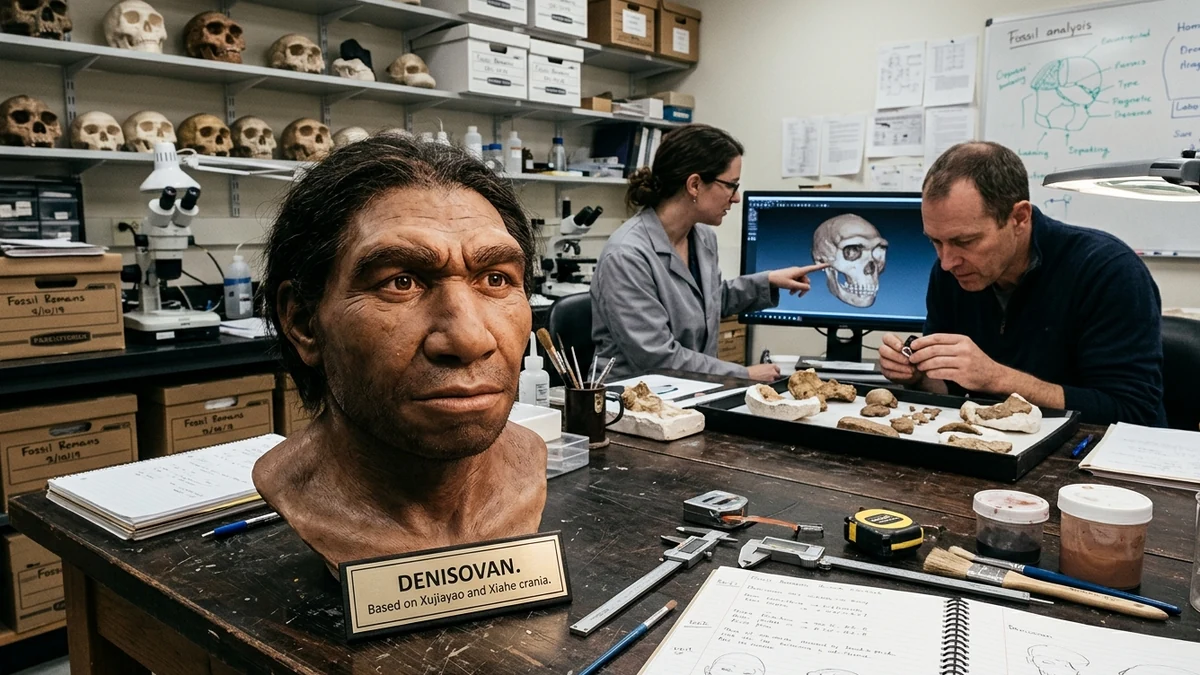
High-fidelity documentary illustration depicting the forensic facial reconstruction of the Denisovans and scientists in the paleoproteomics laboratory analyzing the Xujiayao skull and molecular data
Documentary illustrative recreation based on the study published in the journal Nature by the Chinese Academy of Sciences (IVPP / CAS): in the paleoproteomics laboratory, researchers analyze the forensic facial reconstruction of an adult Denisovan alongside fossil fragments of the Xujiayao cranium and peptide spectrometry on scientific monitors. (Image: Mundo Incrível / High-Fidelity Artistic Illustration)


The Enigma of the Ghost Lineage: 16 Years Without a Face on the Human Family Tree #

In 2010, when the team led by Swedish biologist Svante Pääbo (awarded the Nobel Prize in Physiology or Medicine in 2022) published the genome sequence extracted from a tiny 50,000-year-old child's finger bone found in Denisova Cave, located in the Altai Mountains of Siberia, human evolutionary history was turned upside down. That minuscule bone splinter belonged neither to modern humans (Homo sapiens) nor to Neanderthals (Homo neanderthalensis), but to a completely unknown third population of archaic hominins, informally named the Denisovans.

In the years that followed, population genetics yielded even more staggering revelations about these ancient inhabitants of Eurasia. Contemporary DNA proved that ancestors of modern Homo sapiens interbred extensively with Denisovans as they migrated across Asia, leaving a genetic legacy of 4% to 6% Denisovan ancestry in modern Indigenous peoples of New Guinea, Australia, and the Philippines, along with critical adaptive genetic variants, such as the EPAS1 gene that allows modern Tibetans to survive extreme hypoxia on the roof of the world.
Yet for sixteen long years, an exasperating contradiction lingered between genetics and traditional paleontology. The Denisovans were described as a "ghost lineage": they existed indisputably inside computers through terabytes of genetic sequencing data, but they were virtually absent from the physical fossil record. Apart from a few massive molar teeth and tiny fragments from Siberia, along with half of a fossilized jawbone found in Baishiya Karst Cave in Tibet (the famous Xiahe Mandible), no one knew what a Denisovan's head, gaze, nose, or facial expression looked like.


The Lost Xujiayao Collection and the Challenge of the Nihewan Basin #

The key to resolving this mystery was not hidden inside an inaccessible new excavation, but was waiting quietly inside the storage drawers of the anthropology museum in Beijing. Between 1976 and 1979, Chinese archaeologists excavated the site of Xujiayao, situated along the border between Shanxi and Hebei provinces in the renowned Nihewan Basin — a region rich in Pleistocene lacustrine sediments recognized as the cradle of northern Asian prehistory.

During those excavations, researchers recovered roughly twenty fossilized human bone specimens belonging to at least ten individuals, including large plates of parietal and occipital bones, fragments of the upper and lower jaws, and more than a dozen isolated teeth. Dated by electron spin resonance and uranium-series techniques to between 130,000 and 199,000 years ago, these remains displayed an anatomical combination so unique and unusual that it divided top paleoanthropologists for four decades.

Some anthropologists classified the Xujiayao fossils as late-surviving Homo erectus in East Asia; others viewed them as atypical eastern Neanderthals or an entirely new species, recently designated by some authors as Homo juluensis. The core problem stemmed from the fact that the temperate climate of central China degraded the ancient DNA inside the bones over almost two hundred millennia, preventing classical genetic sequencing methods from yielding readable sequences.


The Molecular Barcode: Paleoproteomics Decodes Fossil Collagen #

To bypass the irreversible degradation of ancient DNA caused by deep time and ambient warmth, Prof. Qiaomei Fu's team turned to the most promising frontier technology in prehistoric science: paleoproteomics. Structural proteins, such as bone collagen and dental enamel amelogenin, consist of tightly bonded amino acid chains that can endure up to ten times longer than fragile nucleic acid strands, preserving evolutionary mutations locked into their chemical backbone.

Operating inside ultra-sensitive cleanroom facilities at the IVPP in Beijing, scientists extracted microscopic fractions of protein from a parietal bone and a mandibular ramus from the Xujiayao assemblage, subjecting the samples to high-resolution liquid chromatography-tandem mass spectrometry (LC-MS/MS). Their goal was to map peptide sequences of the type I collagen alpha-2 chain (COL1A2), one of the primary structural building blocks of the vertebrate skeleton.

The result of this molecular screening delivered the most decisive evidence in modern paleoanthropology. The Xujiayao fossils carried a specific amino acid substitution at position 996 of the COL1A2 chain, where a lysine molecule appears in place of the arginine found in Neanderthals and modern humans. This precise substitution matches exactly the predicted genetic sequence for Denisovans documented in Siberian genomes and the Tibetan Xiahe mandible, acting as a biochemical barcode that erased any taxonomic ambiguity: the prehistoric inhabitants of Xujiayao were, anatomically and molecularly, Denisovans.

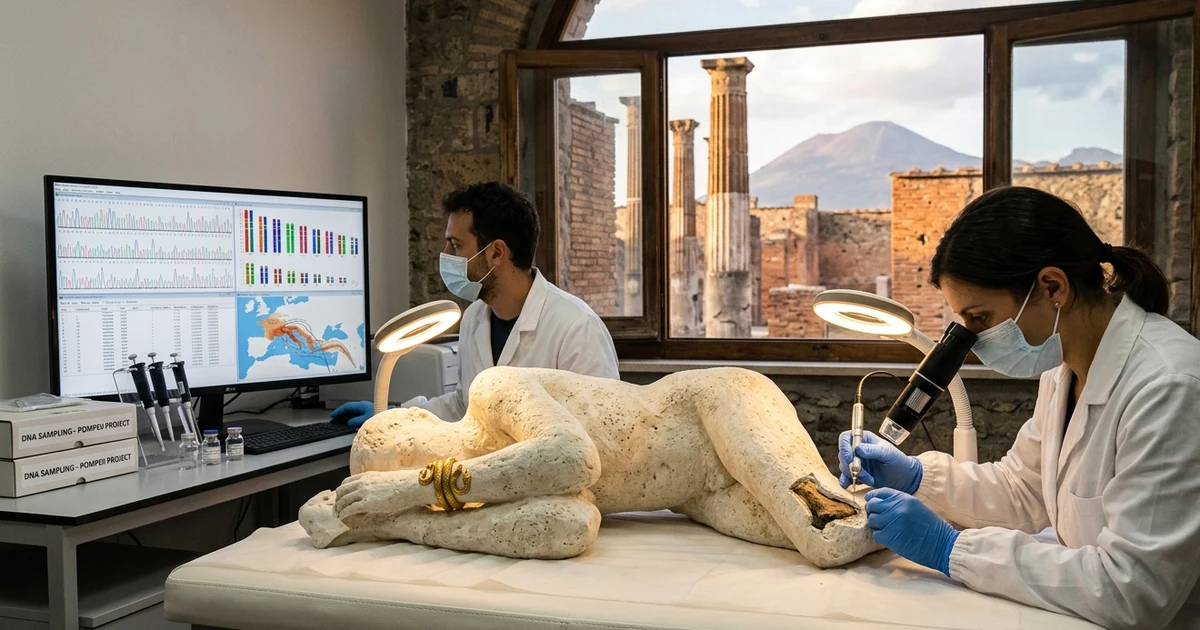
Much like how ancient DNA extracted from the plaster casts of Pompeii overturned more than two centuries of historical assumptions, the molecular barcode from Xujiayao rescued an entire lost population from obscurity and provided the empirical foundation required to reconstruct their physical appearance.


Anatomy of a Giant: A 1,700-ml Brain, Square Eye Sockets, and Massive Teeth #

With the biological identity of the fossils firmly confirmed, the team led by physical anthropologist Song Xing conducted a meticulous three-dimensional morphometric reconstruction, utilizing high-resolution computed tomography and geometric morphometric modeling to reassemble the cranial pieces of Xujiayao. The human being that emerged from this digital assembly astonished scientists with its imposing proportions and unique combination of physical traits.

1. A Colossal and Thick Cranial Vault #

The skull of the Xujiayao hominin stood out for its extraordinary skeletal robustness, possessing bone walls significantly thicker than those of modern humans and a broad, vaulted parietal arch. The most striking measurement was its cranial capacity, estimated at approximately 1,700 cubic centimeters (ml). This braincase volume places the Denisovans at the absolute peak of hominin cranial evolution, comfortably exceeding the average for modern Homo sapiens (roughly 1,350 to 1,400 ml) and matching the largest Neanderthal crania ever recorded in Europe.

2. Facial Architecture and Distinctive Square Eye Orbits #

Unlike classic European Neanderthals, who featured pronounced mid-facial projection and rounded eye sockets, the Xujiayao Denisovans exhibited flat, low cheekbones paired with a moderately elevated nasal bridge. The eyes were framed by distinctively wide, square-to-rectangular orbital openings, crowned by a thick, continuous supraorbital brow ridge that swept across the low, receding forehead, giving the face a broad, powerful, and commanding demeanor.

3. A Chinless Mandible and Specialized Primitive Dentition #

Analysis of the teeth and lower jaw fragments revealed molars of astonishing chewing surface dimensions, far larger than those of any modern human population, supported by exceptionally thick and complex roots. The mandible lacked the protruding triangular chin that uniquely characterizes our own species (Homo sapiens), adapted instead to absorb the immense mechanical forces required to process tough meats, frozen tubers, and fibrous vegetation during the harsh Pleistocene winters of northern Asia.


Technical Table: Anatomical, Molecular, and Archaeological Parameters of the Xujiayao Denisovans #

The table below consolidates the confirmed scientific specifications, chronological data, proteomic markers, and anatomical traits validated by the Nature study:

Technical / Biological Parameter Confirmed Scientific Specification Significance for Human Evolution
Reference Scientific Publication Journal Nature (October 2026), by Qiaomei Fu, Song Xing et al. Solves the premier anatomical enigma in modern paleoanthropology
Lead Research Institution IVPP / Chinese Academy of Sciences (CAS), Beijing, China Premier global center for Asian paleoproteomics and paleoanthropology
Fossil Site and Assemblage Xujiayao site, Nihewan Basin, Shanxi/Hebei border, northern China Collection excavated between 1976 and 1979 with over 20 human fossils
Radiometric and Geological Dating 130,000 to 199,000 years before present (Middle to Late Pleistocene) Confirms thriving Asian presence long before the expansion of modern humans
Decisive Molecular Marker Collagen peptide COL1A2 bearing a lysine substitution at position 996 Exclusive proteomic fingerprint of Denisovans (absent in Neanderthals/Sapiens)
Cranial Capacity and Brain Volume Estimated at ~1,700 cubic centimeters (ml) One of the largest brain volumes in the entire hominin fossil record
Orbital Morphology (Eye Sockets) Wide, distinctively square to rectangular eye orbits Key diagnostic facial marker distinguishing Denisovans from Neanderthals
Cranial Vault Architecture Low, thick-walled vault with broad parietal expansion Combines archaic cranial vault robustness with extreme encephalization
Mandibular and Dental Morphology Heavy jaw lacking a chin paired with gigantic molars Specialized masticatory adaptation for heavy wear in cold environments
Hominin Tree Taxonomic Impact Reclassifies specimens formerly named Homo juluensis as Denisovans Connects Siberian genetic data to a widespread East Asian fossil record

The Invisible Empire: How Denisovans Ruled Ancient Asia Before Homo sapiens #

The definitive identification of the Xujiayao skulls as Denisovans does not merely update comparative anatomy textbooks; it completely redraws the geopolitical and ecological map of Pleistocene Asia. Prior to this research, Denisovans were often envisioned as a small, isolated clan confined to the mountain valleys of Siberia and the Tibetan Plateau.

Today, the convergence of data from Xujiayao, the Xiahe mandible, the massive Harbin cranium (Homo longi), and other East Asian finds proves that the Denisovans formed a dominant, highly adaptable, and geographically widespread human population spanning thousands of kilometers, stretching from the boreal forests of Siberia and the frozen steppes of northern China to the high altitudes of the Himalayas and the tropical forests of Southeast Asia.

They were skilled hunters of Ice Age megafauna — including wild horses, woolly rhinoceroses, and giant deer —, manufactured sophisticated stone and bone tools, and developed extraordinary physiological and cerebral capacities to thrive in harsh environments where no other archaic human species had settled with such enduring success.

When the earliest bands of Homo sapiens expanded across Asia from Africa and the Near East roughly 60,000 years ago, they did not enter an empty continent or encounter primitive, small-brained hominins; instead, they met these intelligent, large-brained giants with broad faces and square eyes, sharing campsites, lithic toolkits, and genetic lineages that continue to shape the immune systems and metabolisms of billions of living people today.

Just as deep-sea robots recently uncovered the treasure and bronze artillery of the San José Galleon at 600 meters depth in the Caribbean and archaeologists located Pharaoh Thutmose II's Royal Tomb C4 in Luxor after more than a century of searching, the reconstruction of the Denisovan face demonstrates the power of modern science to resurrect chapters of our shared past that once seemed lost forever. More than a hundred millennia after the Xujiayao hominin drew his final breath in the Nihewan Basin, molecular chemistry and forensic precision have finally returned the gaze of humanity's most enigmatic cousin.


Official References and Sources #

  • Nature: Fu, Q., Xing, S. et al. — "Paleoproteomic identification of Denisovan hominin remains from the Middle–Late Pleistocene of Xujiayao, northern China" (nature.com).
  • Institute of Vertebrate Paleontology and Paleoanthropology (IVPP) — Chinese Academy of Sciences (CAS): Mass spectrometry reports and cranial morphometric database of the Xujiayao collection (ivpp.cas.cn).
  • Max Planck Institute for Evolutionary Anthropology (MPI-EVA): Comparative database of Pleistocene hominin proteomes and paleogenomes (eva.mpg.de).

🏷️ Tags:

#DenisovanfacerevealedNaturestudy#XujiayaofossilspaleoproteomicsQiaomeiFu#Denisovancranialcapacity1700ml#Denisovanfacialreconstructionsquareeyesockets#HomojuluensisNihewanBasinChina#humanevolutionNeanderthalsHomosapiens

📢 Gostou deste artigo?

Compartilhe com seus amigos e nos conte o que você achou nos comentários!

❓Frequently Asked Questions

Ever since geneticist Svante Pääbo and his team sequenced the genome of a tiny juvenile pinky finger bone recovered from Denisova Cave in Siberia in 2010, the Denisovans became one of the most perplexing puzzles in modern science. We knew from ancient DNA that they interbred with Neanderthals and left up to 6% of their genetic heritage in modern Indigenous peoples of Oceania, as well as the high-altitude adaptation gene in Tibetans, yet for 16 years virtually no substantial skeletal remains existed to show what they looked like. Without skulls or skeletons tied directly to their genetic profile, the Denisovans remained a digital ghost population clearly visible in computers, while their facial features, brain size, and physical appearance remained completely unknown to science.
Because ancient DNA degrades rapidly in the warmer and more humid climates of temperate Asia, scientists at the Institute of Vertebrate Paleontology and Paleoanthropology (IVPP) turned to cutting-edge paleoproteomics, which analyzes amino acid sequences in ancient proteins that survive far longer than genetic material. By extracting collagen peptides from the alpha-2 chain (COL1A2) of a parietal bone and a mandibular ramus from the Xujiayao collection, the team identified a specific amino acid substitution at position 996 (a lysine-bearing variant) shared exclusively by all known Denisovans and absent in Neanderthals and modern Homo sapiens. This irrefutable chemical fingerprint served as a molecular barcode proving that those massive crania from northern China belonged directly to the Denisovan human lineage.
Morphometric analysis of the Xujiayao cranial and jaw bones revealed an imposing anatomy characterized by a very thick and low cranial vault paired with a colossal braincase estimated at approximately 1,700 cubic centimeters, comfortably surpassing modern Homo sapiens averages and most Neanderthals. The face exhibited a low, sloping forehead, a continuous and prominent brow ridge sweeping across the eyes, flat cheekbones, and distinctively wide, square eye sockets that imparted a singular, commanding gaze. The mandible was extremely robust and completely lacked a protruding chin, housing massive, simplified molars and premolars adapted for chewing tough diets across the cold tundras and steppes of ancient East Asia.

Receba novidades!

Cadastre seu email e receba as melhores curiosidades toda semana.

🔒 Sem spam. Cancele quando quiser.

💬 Comentários (0)

Seja o primeiro a comentar! 👋

📚Related Articles

The Silver Scroll Beneath the Skeleton's Chin: X-Rays Unroll 1,800-Year-Old Christian Inscription That Rewrites History in Germanyhistoria

The Silver Scroll Beneath the Skeleton's Chin: X-Rays Unroll 1,800-Year-Old Christian Inscription That Rewrites History in Germany

High-resolution Micro-CT scanning at LEIZA digitally unrolls a 3.5 cm silver foil amulet found beneath a Roman skeleton's chin in Frankfurt, revealing 18 lines of 3rd-century Christian Latin that push

⏱️22 minLer mais →
The 'Mother' of the Golden Bracelet Was a Man: Ancient DNA from Pompeii's Plaster Casts Upends 250 Years of Historyhistoria

The 'Mother' of the Golden Bracelet Was a Man: Ancient DNA from Pompeii's Plaster Casts Upends 250 Years of History

Unprecedented genetic sequencing of bone fragments inside 14 historic plaster casts in Pompeii reveals that the iconic 'mother' holding a child on her hip was an unrelated adult man, while the 'two si

⏱️16 minLer mais →
Valeriana: PhD Student Discovers Lost Maya Megacity on Page 16 of Google with 6,674 Structures in Mexicohistoria

Valeriana: PhD Student Discovers Lost Maya Megacity on Page 16 of Google with 6,674 Structures in Mexico

Archaeological LiDAR reanalysis of overlooked forest carbon data reveals Valeriana, a monumental Maya metropolis with pyramids and a ballcourt hidden beneath Campeche's jungle.

⏱️11 minLer mais →
Laser Drones Reveal Two Lost Silk Road Metropolises at 2,200 Meters Altitude in Uzbekistanhistoria

Laser Drones Reveal Two Lost Silk Road Metropolises at 2,200 Meters Altitude in Uzbekistan

First-ever drone LiDAR scanning in Central Asia's Malguzar Mountains uncovers Tugunbulak, a 120-hectare industrial fortress that forged steel for the Silk Road, alongside its sister city Tashbulak.

⏱️13 minLer mais →
Noah's Ark at Durupınar: What Geological Core Samples and Soil Dating Reveal Near Mount Araratmisterios

Noah's Ark at Durupınar: What Geological Core Samples and Soil Dating Reveal Near Mount Ararat

Geophysical core drillings and 5,500 BC sediment dating at the Durupınar formation distinguish eroded syncline bedrock geology from ancient biblical Ark hypotheses.

⏱️14 minLer mais →
Chandra Telescope Unveils 'Treble Clef' Radio Phoenix Ignited by Massive Cosmic Collisionciencia-natureza

Chandra Telescope Unveils 'Treble Clef' Radio Phoenix Ignited by Massive Cosmic Collision

NASA's Chandra and LOFAR map VLSS J0318.9+5755, a 2.48-million-light-year fossil radio structure shaped like a treble clef reaccelerated by shockfronts.

⏱️8 minLer mais →
Receba novidades no WhatsApp!