The Royal Swedish Academy of Sciences awarded the 2026 Nobel Prize in Chemistry to scientists Henri Kagan and Kenso Soai for unraveling asymmetric organic synthesis and non-linear autocatalysis. This landmark revelation explains how primordial matter broke molecular symmetry to select exclusively left-handed amino acids and right-handed sugars at the dawn of life. This monumental discovery solves one of the deepest and most enduring enigmas in evolutionary biology and contemporary astrobiology.
Since the fundamental experiments conducted by Louis Pasteur in the 19th century, scientists have been intrigued by the so-called homochirality of living matter. In traditional inorganic chemistry, any reaction produces strictly identical quantities of "left-handed" and "right-handed" molecules in a perfectly symmetric racemic mixture. However, all proteins in every living organism on Earth utilize solely left-oriented amino acids, while DNA and RNA depend exclusively on right-oriented sugars.
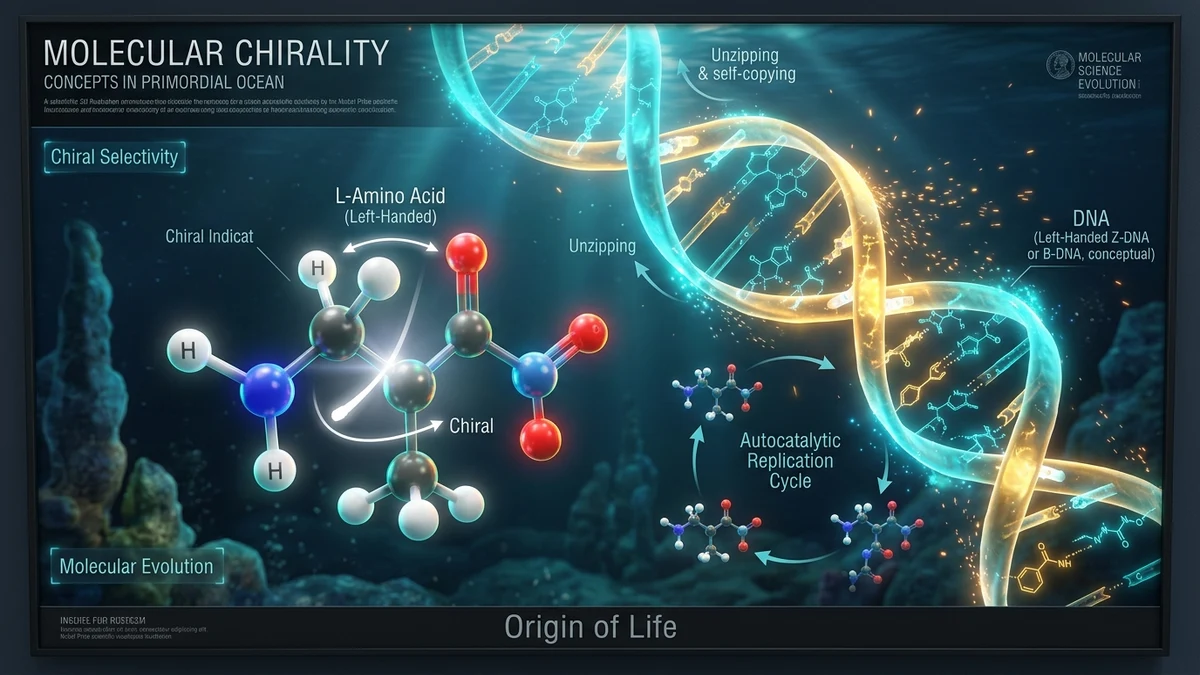
The revolutionary investigations led by Henri Kagan demonstrated for the first time that catalysts with extremely low initial enantiomeric excess can dramatically amplify the production of a single mirror image type. Through complex non-linear effects, a tiny random asymmetry triggers a massive imbalance in the chemical reaction. This theoretical mechanism provided the mathematical foundation for understanding how a minuscule fluctuation in primordial oceans could determine the geometry of terrestrial biology.
Complementing this breakthrough, Kenso Soai discovered the famous "Soai Reaction," the first practical example of self-replicating asymmetric autocatalysis. In this extraordinary process, the reaction product itself acts as a highly efficient catalyst to produce more copies of itself with the identical chiral orientation. As the cycle proceeds, the mixture rapidly achieves an enantiomeric purity near one hundred percent without requiring prior biological intervention.
Scientific Data and Discovery Parameters of the 2026 Nobel Prize in Chemistry
To appreciate the methodological scope and historical importance of this announcement by the Swedish Nobel Committee, review the detailed informative table below. The data summarizes the laureates' names, fundamental chemical concepts, and impacts on global astrobiology. Empirical measurements demonstrate how synthetic chemistry unlocked the initial trigger that made molecular life viable on Earth.
| Scientific Parameter | Laureate Discovery Detail | Science & Astrobiology Impact |
|---|---|---|
| 2026 Nobel Laureates | Henri Kagan (France) & Kenso Soai (Japan) | International recognition of the homochirality enigma. |
| Kagan Mechanism | Non-Linear Effect Amplification | Explains how tiny imbalances yield total chiral purity. |
| Soai Reaction | Self-Replicating Asymmetric Autocatalysis | Demonstrates chemical replication without living enzymes. |
| Astrobiology Application | Primitive Molecule Natural Selection | Sets parameters for seeking life signatures on exoplanets. |
| Pharmaceutical Impact | Industrial Pure Drug Synthesis | Prevents side effects from mirrored isomers in pharmaceuticals. |
Applying these principles to the search for extraterrestrial life redefines operational parameters for space missions conducted by NASA and the European Space Agency. Previously, the presence of organic molecules on meteorites was viewed with skepticism due to the difficulty of distinguishing abiotic processes from genuine biological activity. With new non-linear autocatalysis models, astronomers possess a rigorous quantitative criterion to identify whether samples collected on Mars or icy moons passed life's threshold.
Furthermore, astrophysicists emphasize that circularly polarized ultraviolet radiation emitted by neutron stars and star-forming nebulae may have provided the initial spark for chiral asymmetry. When dust grains containing simple organic compounds were irradiated by this cosmic light in deep space, a slight majority of left-handed amino acids was preserved. Upon falling to early Earth's oceans via comet impacts, the Soai Reaction amplified this tiny advantage into complete homogeneity.
The relevance of asymmetric synthesis extends far beyond fundamental science, generating colossal impacts across modern global pharmaceutical manufacturing. Many synthetically produced drugs contain mirror-image forms where one isomer cures a disease while its mirror twin can be inert or highly toxic. The catalytic tools developed by Kagan and Soai enable the production of pure pharmacological compounds with unprecedented efficiency and absolute safety.
During the official ceremony in Stockholm, Nobel Committee representatives emphasized that organic chemistry has finally filled the missing link between inanimate matter and the first living cell. Without non-linear chirality amplification, RNA and DNA could never form stable double-helix structures capable of storing genetic code. Life as we know it is a direct consequence of this inevitable molecular asymmetry.
The new findings also open fascinating prospects for creating self-replicating synthetic materials and artificial chemical networks with molecular intelligence. Materials engineers are already using asymmetric autocatalysis to develop smart polymers capable of self-repairing when damaged. This breakthrough promises to revolutionize regenerative medicine and the fabrication of next-generation biotechnological components.
The international scientific community celebrated the choice of winners as a tribute to the perseverance of long-term basic research. Kagan's theories and the Soai Reaction took decades to be fully understood and integrated into modern astrobiological models. Today, the unified knowledge regarding homochirality represents one of humanity's greatest intellectual triumphs over nature's mysteries.
In conclusion, the 2026 Nobel Prize in Chemistry illuminates with definitive clarity the chemical bridge that transformed a lifeless rocky planet into a vibrant, conscious world. The discovery proves that the laws of physics and chemistry possess an intrinsic tendency toward generating complexity and self-organized order in the cosmos. Humanity takes another decisive step forward in understanding its own cosmic origin.
Frequently Asked Questions About the 2026 Nobel Prize in Chemistry and the Origin of Life
What exactly is homochirality and why is it considered essential for the existence of life?
Homochirality is the fundamental biological property whereby all essential building blocks of life possess a single "mirrored" spatial orientation, acting essentially like left or right hands. Across all kingdoms of nature, every living protein on Earth utilizes solely left-handed (L) amino acids, while structural DNA and RNA molecules rely exclusively on right-handed (D) sugars. Without this extremely strict chiral uniformity across cell structures, complex molecular chains could never fold into functional three-dimensional shapes nor form the stable double-helix structure required to store and transmit biological genetic code.
How do the Soai Reaction and non-linear effects explain life's emergence without biological intervention?
The groundbreaking Soai Reaction experimentally demonstrated that a relatively simple inorganic chemical reaction can act as a highly precise self-replicating autocatalytic process within primordial oceans. Whenever a microscopic initial difference exists between left-handed and right-handed molecules, the non-linear catalytic effects discovered by Henri Kagan cause the slightly majority enantiomer to exponentially catalyze its own production. This continuous dynamic chemical cycle rapidly amplifies a minuscule asymmetry of just one percent into complete one hundred percent chiral purity within a remarkably short geological timeframe.
How does this 2026 Nobel Prize discovery assist in the search for extraterrestrial life on other planets?
This landmark scientific discovery provides astrobiologists at NASA and ESA with an infallible quantitative criterion for identifying authentic molecular biosignatures in space exploration samples. Rather than searching merely for generic organic molecules that can form through common abiotic processes, planetary scientists now actively look for extreme amplified enantiomeric imbalances caused by autocatalysis. Detecting amino acids or sugars exhibiting high chiral purity on Mars or within the icy moons of Jupiter and Saturn will serve as definitive empirical proof of advanced pre-biotic processes beyond Earth.