🌍 Your knowledge portal
historia

The Lost Tomb of Pharaoh Thutmose II in Luxor: The First Royal Tomb Discovery Since Tutankhamun and the Mystery of the Second Chamber

📅 2026-10-21⏱️ 14 min read📝
⚡

Quick Summary

Investigative dossier on the discovery of Pharaoh Thutmose II's Tomb C4 in Luxor by the University of Cambridge and the Egyptian Ministry of Antiquities, the first royal pharaonic tomb found since Tutankhamun. A joint Anglo-Egyptian archaeological mission led by Egyptologist Dr. Piers Litherland, field director of the New Kingdom Research Foundation (NKRF) affiliated with the McDonald Institute for Archaeological Research at the University of Cambridge, in partnership with the Supreme Council of Antiquities of the Egyptian Ministry of Tourism and Antiquities, has confirmed the discovery of the lost royal tomb of Pharaoh Thutmose II (Aakheperenre Djehutymes, who reigned c.

Key Takeaways:

  • An Anglo-Egyptian archaeological mission led by Dr. Piers Litherland (University of Cambridge / NKRF) and the Egyptian Ministry of Tourism and Antiquities identified Tomb C4 in the Western Wadis of Luxor as the original royal sepulcher of Pharaoh Thutmose II (c. 1493–1479 BCE).
  • It is the first royal tomb of an Egyptian Pharaoh discovered in more than a century since Howard Carter opened Tutankhamun's tomb in November 1922, solving the mystery of the last missing royal tomb of the 18th Dynasty.
  • Alabaster jar shards bearing the cartouches of Thutmose II and Queen Hatshepsut, a blue-painted ceiling with yellow stars, and scenes from the Book of the Amduat prove the tomb was evacuated in antiquity after a flash flood and point toward a second undisturbed tomb beneath 23 meters of limestone.
The Lost Tomb of Pharaoh Thutmose II in Luxor: The First Royal Tomb Discovery Since Tutankhamun and the Mystery of the Second Chamber
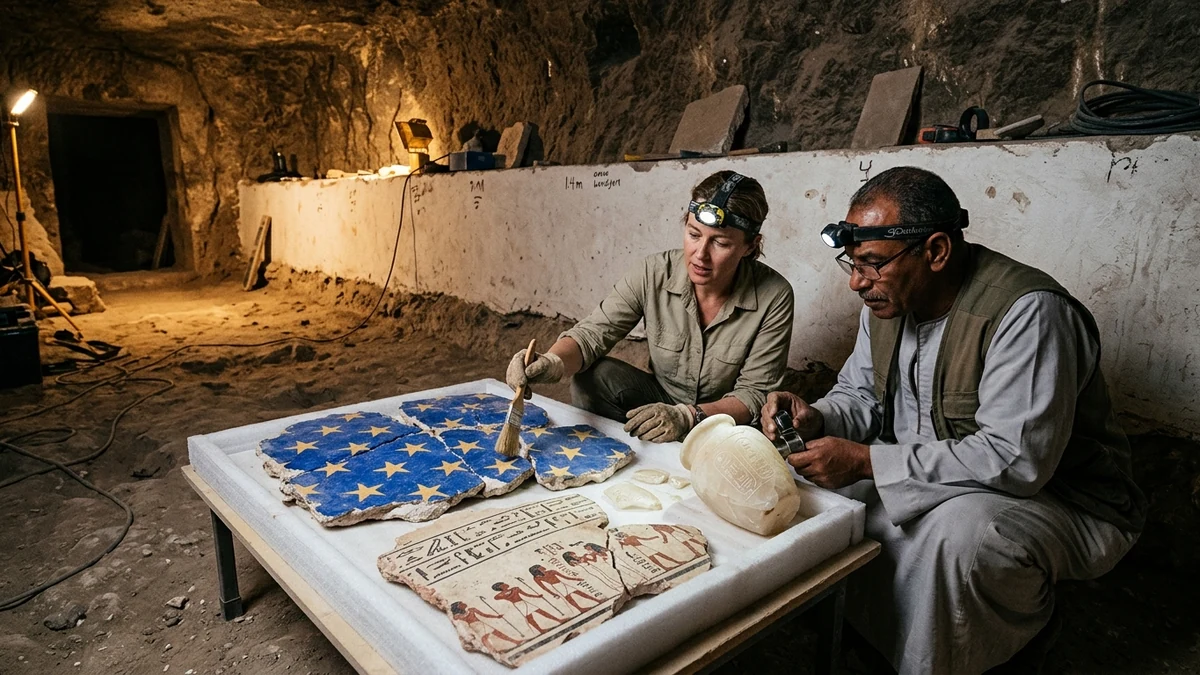
The Lost Tomb of Pharaoh Thutmose II in Luxor: The First Royal Tomb Discovery Since Tutankhamun and the Mystery of the Second Chamber — High-Fidelity Artistic Illustration created by artificial intelligence based on scientific research.

A joint Anglo-Egyptian archaeological mission led by Egyptologist Dr. Piers Litherland, field director of the New Kingdom Research Foundation (NKRF) affiliated with the McDonald Institute for Archaeological Research at the University of Cambridge, in partnership with the Supreme Council of Antiquities of the Egyptian Ministry of Tourism and Antiquities, has confirmed the discovery of the lost royal tomb of Pharaoh Thutmose II (Aakheperenre Djehutymes, who reigned c. 1493–1479 BCE) in the Western Wadis of Luxor. Cataloged under the designation Tomb C4 (in the Wadi C gorge, approximately 2.4 kilometers west of the Valley of the Kings), the subterranean monument represents the first royal tomb of a Pharaoh discovered in Egypt since Howard Carter uncovered the sepulcher of Tutankhamun on November 4, 1922, ending a historical hiatus of more than a century. The identification of the last missing royal tomb of the 18th Dynasty — confirmed through the recovery of lapis-lazuli blue starry ceilings, mural scenes from the Book of the Amduat, and alabaster vessel fragments engraved with the cartouches of Thutmose II and his wife and successor, the female Pharaoh Hatshepsut — further revealed that a catastrophic flash flood six years after the funeral forced ancient Egyptian priests to evacuate the entire royal burial into a secret second tomb, which archaeologists are now tracking beneath a 23-meter-high artificial pile of limestone and ash in the Theban desert.

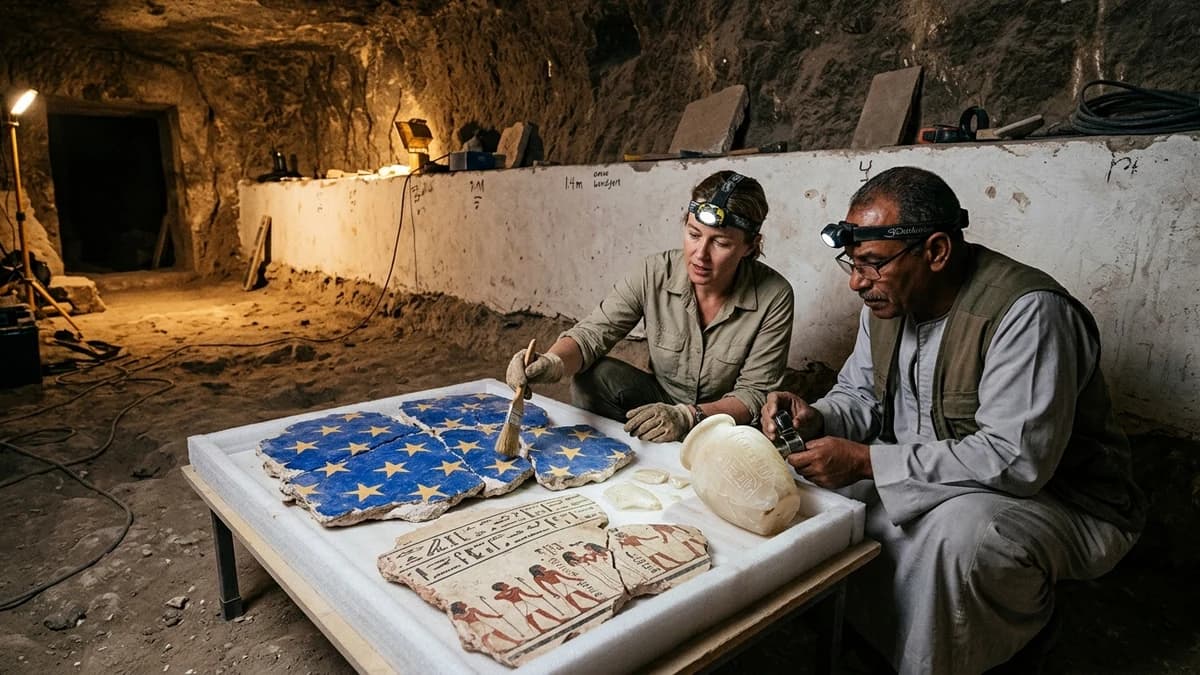
High-fidelity documentary illustration depicting archaeologists inside the rock-cut burial chamber of Pharaoh Thutmose II's Tomb C4 in the Western Wadis of Luxor, examining blue ceiling fragments with yellow stars, inscriptions from the Book of the Amduat, and alabaster jars with royal cartouches
Documentary illustrative recreation based on official archaeological records from the NKRF / University of Cambridge mission and the Egyptian Ministry of Tourism and Antiquities: inside the limestone burial chamber of Tomb C4 in Luxor (with the white-plastered secondary rescue corridor elevated 1.4 m in the background), researchers analyze fragments of the blue ceiling with yellow stars, painted passages from the Book of the Amduat, and alabaster vessels bearing the royal cartouches of Thutmose II and Hatshepsut. (Image: Mundo Incrível / High-Fidelity Artistic Illustration)


For more than a hundred years following the legendary discovery of Tutankhamun (KV62) by Howard Carter and Lord Carnarvon in 1922, one monumental question haunted every generation of Egyptologists working on the west bank of the Nile River in ancient Thebes (modern Luxor): where was Pharaoh Thutmose II buried? As the fourth ruler of the powerful 18th Dynasty — the era that inaugurated the New Kingdom (c. 1550–1069 BCE) and transformed Egypt into the military and architectural superpower of the Eastern Mediterranean — Thutmose II occupied a pivotal genealogical position in pharaonic history. He was the son of the great conqueror Thutmose I and the secondary queen Mutnofret, the half-brother and husband of the celebrated woman who would become Pharaoh, Hatshepsut, the father of Egypt's greatest military strategist, Thutmose III, and the direct royal ancestor of the bloodline that culminated in Amenhotep III, Akhenaten, and Tutankhamun.

Despite his dynastic importance, the original sepulcher of Thutmose II was the only royal tomb of the entire 18th Dynasty that had never been found. Throughout the twentieth century, French, British, American, and Egyptian expeditions concentrated their searches almost exclusively inside the Valley of the Kings (Wadi el-Muluk), operating under the assumption that every monarch between Thutmose I and Tutankhamun had been interred within that famous rocky gorge. Several uninscribed or unfinished tombs — such as KV42 in the Valley of the Kings or WN A in Bab el-Maallaka — were speculatively proposed as candidates for Thutmose II's burial, yet none ever yielded a single epigraphic inscription or funerary artifact proving the king's presence.

Unlocking this 3,500-year-old mystery required leaving the Valley of the Kings behind and exploring a far more hostile, remote, and arid landscape located approximately 2.4 kilometers (1.5 miles) to the west: the network of desert canyons known as the Western Wadis, south of the Dra' Abu el-Naga necropolis and west of the mortuary temple of Deir el-Bahari. Since 2013, the joint mission of the New Kingdom Research Foundation (NKRF) — led in the field by British Egyptologist Dr. Piers Litherland, an affiliated researcher at the McDonald Institute of the University of Cambridge — and the Supreme Council of Antiquities of Egypt, under the operational leadership of Mohamed Abdel-Badi, has systematically mapped these forgotten gorges. Until now, scholarly consensus held that the Western Wadis served exclusively as a secondary cemetery for royal wives and princesses of the early 18th Dynasty, never for a reigning Pharaoh.


From Queen's Grave to Pharaoh's Sepulcher: Excavating Tomb C4 in Wadi C #

The historical turning point began in October 2022, when the Anglo-Egyptian team located the buried entrance and descending passage of a rock-cut hypogeum in the steep slopes of the Wadi C gorge, technically designated Tomb C4 (or Wadi C-4). The immediate geographical surroundings initially reinforced the traditional hypothesis that the monument belonged to a royal consort. That was because the entrance to Tomb C4 lay close to the cliff-cut tomb prepared for Queen Hatshepsut while she still held only the title of Great Royal Wife (before ascending the throne as Pharaoh and constructing her second royal tomb, KV20, in the Valley of the Kings) and very near the burial place of the three foreign wives of King Thutmose III.

However, penetrating the interior of Tomb C4 proved to be an extreme archaeological engineering challenge that required nearly two and a half years of continuous manual excavation. The entrance corridor and subterranean chambers were completely choked from floor to ceiling by a petrified mass of limestone gravel, dried mud compacted like concrete, and massive collapsed ceiling slabs deposited by violent flash floods over millennia. Egyptian and British workers and engineers had to shore up the unstable bedrock centimeter by centimeter while removing tons of alluvial rubble and sieving every basket of sediment in search of microscopic archaeological fragments.

When archaeologists finally reached the structural core of the hypogeum, they realized that the internal architecture did not match the modest layout of queens' tombs, displaying instead a royal left-hand bent-axis plan ("L"-shaped axis) characteristic of early New Kingdom Pharaohs. The underground complex featured an entrance staircase, a main descending corridor, a ritual well shaft, and a royal burial chamber measuring approximately 5.3 by 5.2 meters, with a height of 3.4 meters. Much like the subsurface investigations that uncovered the secret tomb with skeletons and the Nabataean chalice beneath the Treasury of Petra, it was forensic patience in sorting millimeter-sized fragments mixed into the flood sediment that transformed an apparently devastated cavern into the greatest Egyptological discovery of the twenty-first century.


The Three Irrefutable Forensic Proofs: The Sky of Nut, the Amduat, and Hatshepsut's Jars #

Scientific confirmation that Tomb C4 belonged unequivocally to Pharaoh Thutmose II did not come from an intact monumental wall relief, but from the meticulous reconstruction of three categories of material and epigraphic evidence rescued from the burial chamber debris. As emphasized by Dr. Mohamed Ismail Khaled, Secretary-General of the Supreme Council of Antiquities of Egypt, each of these clues acted as a royal fingerprint that eliminated any possibility of the tomb belonging to a noble or a queen consort.

1. The Celestial Blue Ceiling with Five-Pointed Yellow Stars #

While clearing the floor of the main burial chamber, Litherland and Abdel-Badi's team collected hundreds of fragments of mortar and fine plaster that had fallen from the rock ceiling. These fragments displayed a vibrant layer of deep blue pigment (Egyptian blue / synthetic lapis lazuli) studded with meticulously painted yellow five-pointed stars. In 18th Dynasty Theban funerary iconography, a starry ceiling over a night-blue background — symbolizing the cosmic body of the sky goddess Nut embracing the sovereign for eternal rebirth — was an exclusive prerogative of the tombs of reigning kings.

2. Cursive Hieroglyphs and Underworld Scenes from the Book of the Amduat #

Shortly thereafter, fine sieving revealed wall plaster fragments painted with a yellowish background imitating an ancient papyrus scroll, upon which royal scribes had traced columns of cursive hieroglyphs in black and red ink accompanied by stick-figure depictions of deities and solar barques. Philological analysis confirmed that these passages belonged to the Book of the Amduat ("That Which Is in the Afterlife"), the most sacred cosmogonic text of the New Kingdom, which charts the nocturnal voyage of the sun god Ra (and the soul of the deceased Pharaoh) through the 12 hours of the night in the underworld of Osiris before rebirth at dawn. During the era of Thutmose II, the Amduat was strictly forbidden to anyone outside the anointed monarch.

3. Alabaster Vessels Bearing the Cartouches of Thutmose II and Hatshepsut #

The definitive documentary proof that named the tomb's owner emerged in the form of dozens of shards of ritual Egyptian alabaster (translucent calcite) ointment vessels, originally used to hold sacred embalming oils and perfumes. Engraved into the polished white stone were intact hieroglyphic inscriptions bearing the royal cartouche of Thutmose II (Aakheperenre), explicitly designated as the "Osiris King" (an epithet reserved exclusively for the deceased and deified Pharaoh). Alongside the cartouche of the late king, the vessels bore the royal signature of the ruler who presided over his funeral rites: "His Great Royal Wife, his beloved sister, Hatshepsut".

The recovery of these stone vessel fragments holds incalculable historical value for an additional reason: they are the very first funerary objects of Thutmose II ever found in the entire history of world archaeology. Prior to this discovery inside Tomb C4, no museum on Earth — neither in Cairo, nor in London, Paris, or New York — possessed even a single canopic jar, shabti figurine, or burial equipment fragment originating from this Pharaoh's interment.


Anatomy of an Ancient Disaster: The Hidden Waterfall and the Rescue Corridor at 1.4 Meters #

If Tomb C4 was carved and decorated for the sacred burial of Thutmose II by direct order of his wife Hatshepsut, why did archaeologists not find the royal quartzite sarcophagus, gilded shrines, or the Pharaoh's mummy inside the chamber? The answer revealed by the Anglo-Egyptian mission's forensic stratigraphy is even more fascinating than ordinary looting by ancient tomb robbers: the tomb was not plundered in antiquity, but officially evacuated through an emergency rescue operation carried out by the ancient Egyptian priests themselves following a natural disaster.

By analyzing the geomorphology of the Wadi C gorge, Dr. Piers Litherland discovered that Thutmose II's royal architects committed a catastrophic geological miscalculation. Unaware of the rare hydrological regime of century-scale desert flash storms in Thebes, the stonemasons excavated the entrance and axis of Tomb C4 directly beneath the plunge pool of an ancient dry waterfall that drained a vast catchment basin atop the limestone plateau. Moreover, the host bedrock at that point in the wadi was friable and Riddled with natural fissures.

Stratigraphic evidence demonstrates that approximately six years after the funeral of Thutmose II (during Hatshepsut's regency), an extreme torrential storm struck the Theban mountains. The dry waterfall awakened with torrential fury, pouring thousands of liters of muddy water and boulders directly down the descending corridor of Tomb C4. The flood submerged the burial chamber, triggered the partial collapse of the starry ceiling, and threatened to destroy the Pharaoh's embalmed body and his sacred treasures forever.

Confronted with this desecrating catastrophe, Hatshepsut's royal administration executed an emergency engineering operation whose physical traces remain preserved in the rock to this day. To bypass the original corridor blocked by flood debris and fallen slabs, royal workmen excavated a second parallel extraction corridor coated in smooth white plaster, whose floor was elevated exactly 1.4 meters above the original floor of the burial chamber. Through this elevated rescue gallery, priests entered the flooded chamber, systematically dismantled the royal burial assemblage — leaving behind only the shards of alabaster jars that had shattered during the flood or transport — and extracted the mummy of Thutmose II to safety.


Technical Table: Archaeological and Architectural Parameters of Thutmose II's Royal Tomb C4 #

The table below consolidates all physical measurements, chronological coordinates, epigraphic evidence, and institutional data verified by the Anglo-Egyptian mission in Luxor:

Technical / Historical Parameter Confirmed Scientific and Archaeological Specification Significance for World Egyptology
Official Tomb Designation Tomb C4 (Wadi C-4) Last missing royal tomb of the entire 18th Dynasty of Egypt
Geographical Location Wadi C gorge in the Western Wadis, Luxor (ancient Thebes), Egypt Situated ~2.4 km (1.5 miles) west of the Valley of the Kings
Identified Sovereign Pharaoh Thutmose II (Aakheperenre Djehutymes), 4th King of the 18th Dynasty Son of Thutmose I; husband of Hatshepsut; father of Thutmose III; ancestor of Tutankhamun
Estimated Reign Period c. 1493 – 1479 BCE (New Kingdom, 15th Century BCE) Crucial dynastic transition preceding the female reign of Hatshepsut
Historical Discovery Milestone First royal pharaonic tomb discovered in 103 years (since Tutankhamun KV62 on Nov 4, 1922) Ends more than a century without locating any new original Pharaoh's sepulcher
Responsible Scientific Mission New Kingdom Research Foundation (NKRF) (University of Cambridge) & Egyptian Ministry of Antiquities Field direction by Dr. Piers Litherland and Mohamed Abdel-Badi
Subterranean Architecture Royal left-hand bent-axis plan, with entrance staircase, descending corridor, and ritual well shaft Burial chamber measuring ~5.3 m × 5.2 m × 3.4 m in height
Secondary Rescue Corridor White-plastered extraction gallery carved 1.4 meters above the burial chamber floor Built by ancient priests to evacuate the tomb after a flash flood (~6 years after burial)
Material and Epigraphic Proofs 1. Blue ceiling with yellow stars; 2. Walls with the Book of the Amduat; 3. Inscribed alabaster vessels Cartouches of the "Osiris King Thutmose II" and "Great Royal Wife Hatshepsut"
The "Second Tomb" Target Man-made mountain 23 meters high of limestone flakes, ash, and plaster nearby Probable site where Hatshepsut reburied Thutmose II and his intact treasure

The Mystery of Mummy DB320 and the Hunt for the Undisturbed Second Tomb Beneath 23 Meters of Rock #

The discovery that Thutmose II's original sepulcher was emptied by 18th Dynasty priests just six years after his death has reopened one of the fiercest forensic and anthropological debates in modern Egyptology: where are the true body and funerary treasure of Thutmose II today? The traditional textbook answer pointed to the famous Royal Cache of Deir el-Bahari (Tomb DB320 / TT320), discovered in 1881, where 21st Dynasty priests hid dozens of royal mummies — including Thutmose III, Seti I, and Ramesses II — to protect them from tomb robbers.

Inside the DB320 cache, nineteenth-century archaeologists found a reused coffin containing a wrapped mummy bearing a 21st Dynasty linen docket identifying it as Thutmose II (cataloged today under code CG 61066 at the National Museum of Egyptian Civilization in Cairo). When anatomist Grafton Elliot Smith unwrapped that mummy in 1886 and subsequently examined it, anatomical and radiographic analyses revealed the body of a man estimated at 30 to 40 years of age, with skin marked by severe lesions and signs of chronic illness.

In recent years, however, several Egyptologists and bioarchaeologists — including Dr. Piers Litherland's own team — have seriously questioned whether mummy CG 61066 from Deir el-Bahari is genuinely Thutmose II. Historical and chronological records suggest that Thutmose II ascended the throne as a teenager and died very young, well before reaching age 30, and 21st Dynasty priests are known to have mislabeled several mummies when hastily rewrapping them centuries later. Just as ancient DNA sequencing on Pompeii's plaster casts overturned two centuries of assumptions, proof that Tomb C4 was sealed beneath meters of petrified mud since the 18th Dynasty raises an explosive question: if 21st Dynasty priests could never enter the flooded Tomb C4, where did they obtain the DB320 mummy — or do the true Thutmose II and his entire royal treasure still rest undisturbed inside the second tomb built by Hatshepsut?

This is far more than theoretical speculation. Just a short distance away within the Western Wadis complex, Dr. Litherland's team identified a colossal topographic feature that had been mistaken for decades for a natural rockfall: a 23-meter-high artificial mound constructed entirely by human hands, composed of thousands of tons of limestone flakes, ash, mud, and plaster fragments deliberately layered against the base of the cliff.

According to Litherland, in 18th Dynasty funerary engineering, monumental artificial coverings of rubble and stone chippings were deposited specifically to conceal and armor the entrance of a royal tomb against both future flash floods and human eyes. Because this 23-meter man-made mountain requires careful top-down manual removal to prevent rockslides, the Anglo-Egyptian mission has already begun dismantling it layer by layer. Should this hypothesis be confirmed in upcoming excavation seasons, humanity may witness the opening of a potentially undisturbed second royal tomb of Thutmose II, preserving the funerary furniture and treasures that Hatshepsut rescued from the floodwaters 3,500 years ago.


How the Discovery Rewrites the History of Thutmose I, Hatshepsut, and the Valley of the Kings #

Regardless of what awaits beneath the 23-meter artificial mound, the identification of Tomb C4 in the Western Wadis has already triggered a scientific earthquake in our understanding of how the royal necropolises of the New Kingdom originated. As stated by Egypt's Minister of Tourism and Antiquities, Sherif Fathy, and detailed by Dr. Piers Litherland in interviews with the international scientific press and the University of Cambridge, the find compels historians to rewrite the origin of the Valley of the Kings itself.

  1. The Western Wadis were the true Royal Necropolis of the early Thutmosids: Prior to this discovery, scholars believed that Thutmose I (father of Thutmose II and Hatshepsut) was the first Pharaoh buried in the Valley of the Kings (in tombs KV20 or KV38). Finding the monumental tomb of Thutmose II in Wadi C — surrounded by Hatshepsut's first tomb — proves that the early 18th Dynasty royal family established its primary necropolis in the Western Wadis, and that Thutmose I's original sepulcher was almost certainly excavated in this same area before his body was later transferred by Thutmose III to the Valley of the Kings.
  2. The real reason for the permanent move to the Valley of the Kings: The hydrological disaster suffered by Tomb C4 explains why Hatshepsut, upon assuming the throne as full Pharaoh, abandoned the Western Wadis and ordered the excavation of tomb KV20 in the Valley of the Kings. Having witnessed the destruction of her husband's burial chamber by the hidden waterfall six years after his funeral, Hatshepsut recognized the geological vulnerability of those canyons and relocated the royal necropolis to the more sheltered basin of the Valley of the Kings.
  3. Hatshepsut's funerary loyalty to Thutmose II: For decades, older historiography portrayed Hatshepsut as a ruthless usurper who disregarded her husband's memory. The presence of the alabaster jars inside Tomb C4 jointly engraved with the names of the "Osiris King Thutmose II" and "His Great Royal Wife Hatshepsut", combined with the massive engineering operation she commanded to rescue her husband's body from the flooded tomb, proves that Hatshepsut faithfully honored her sacred duties to guarantee Thutmose II's immortality.

Much like the monumental excavation of the subterranean wooden palace of King Kaolie of Chu at Wuwangdun Tomb No. 1 in China, the identification of Tomb C4 in Luxor demonstrates that the soil of great ancient civilizations still holds entire chapters capable of overturning century-old dogmas. More than a century after Howard Carter's lantern illuminated the gold of Tutankhamun, the desert of Thebes once again whispers the name of a lost Pharaoh — and promises to reveal, beneath 23 meters of limestone, the final act of antiquity's greatest royal rescue.


Official References and Sources #

  • Egyptian Ministry of Tourism and Antiquities / Supreme Council of Antiquities (SCA): Official Press Release by Minister Sherif Fathy and Secretary-General Dr. Mohamed Ismail Khaled on the discovery of the Tomb of King Thutmose II (Tomb C4) in the Western Wadis of Luxor (mota.gov.eg).
  • University of Cambridge — McDonald Institute for Archaeological Research & New Kingdom Research Foundation (NKRF): Field reports of the Anglo-Egyptian mission in the Western Wadis led by Dr. Piers Litherland and Mohamed Abdel-Badi (cam.ac.uk).
  • Antiquity / Egyptian Archaeology (Egypt Exploration Society): Architectural and epigraphic documentation of the early 18th Dynasty royal necropolises in Western Thebes (antiquity.ac.uk).

🏷️ Tags:

#PharaohThutmoseIItombLuxor#firstroyaltombsinceTutankhamun1922#PiersLitherlandNewKingdomResearchFoundation#TombC4WesternWadisThebes#QueenPharaohHatshepsutalabasterjars#BookoftheAmduatblueceilingyellowstars

📢 Gostou deste artigo?

Compartilhe com seus amigos e nos conte o que você achou nos comentários!

❓Frequently Asked Questions

The traditional textbook answer pointed to the famous Royal Cache of Deir el-Bahari (Tomb DB320 / TT320), discovered in 1881, where 21st Dynasty priests hid dozens of royal mummies — including Thutmose III, Seti I, and Ramesses II — to protect them from tomb robbers.

Receba novidades!

Cadastre seu email e receba as melhores curiosidades toda semana.

🔒 Sem spam. Cancele quando quiser.

💬 Comentários (0)

Seja o primeiro a comentar! 👋

📚Related Articles

Valeriana: PhD Student Discovers Lost Maya Megacity on Page 16 of Google with 6,674 Structures in Mexicohistoria

Valeriana: PhD Student Discovers Lost Maya Megacity on Page 16 of Google with 6,674 Structures in Mexico

Archaeological LiDAR reanalysis of overlooked forest carbon data reveals Valeriana, a monumental Maya metropolis with pyramids and a ballcourt hidden beneath Campeche's jungle.

⏱️11 minLer mais →
Laser Drones Reveal Two Lost Silk Road Metropolises at 2,200 Meters Altitude in Uzbekistanhistoria

Laser Drones Reveal Two Lost Silk Road Metropolises at 2,200 Meters Altitude in Uzbekistan

First-ever drone LiDAR scanning in Central Asia's Malguzar Mountains uncovers Tugunbulak, a 120-hectare industrial fortress that forged steel for the Silk Road, alongside its sister city Tashbulak.

⏱️13 minLer mais →
Secret Tomb Beneath Petra's Treasury Reveals 12 Skeletons & 'Holy Grail' Chalice Sealed for 2,000 Yearshistoria

Secret Tomb Beneath Petra's Treasury Reveals 12 Skeletons & 'Holy Grail' Chalice Sealed for 2,000 Years

ACOR and St Andrews archaeologists unearth an untouched burial chamber beneath Al-Khazneh in Petra, containing 12 Nabataean skeletons and intact ceremonial pottery.

⏱️16 minLer mais →
Monumental Blocks of the Lighthouse of Alexandria Recovered from the Seabedhistoria

Monumental Blocks of the Lighthouse of Alexandria Recovered from the Seabed

The international PHAROS initiative rescued granite blocks from the ancient world wonder. Discover the details of this unprecedented archaeological operation.

⏱️27 minLer mais →
Roman Imperial Baths Discovered in Maximinus Daza's Palace in Serbiahistoria

Roman Imperial Baths Discovered in Maximinus Daza's Palace in Serbia

Archaeologists in Serbia discovered a lavish 4th-century imperial bath complex in the palace of Maximinus Daza, revealing secrets of ancient Roman architecture.

⏱️14 minLer mais →
1,200-Year-Old Mummified Hairless Dog Found in Peruhistoria

1,200-Year-Old Mummified Hairless Dog Found in Peru

Archaeologists in Peru unearth a 1,200-year-old mummified hairless dog at a pre-Inca site, revealing the spiritual bond between humans and dogs.

⏱️13 minLer mais →
Receba novidades no WhatsApp!