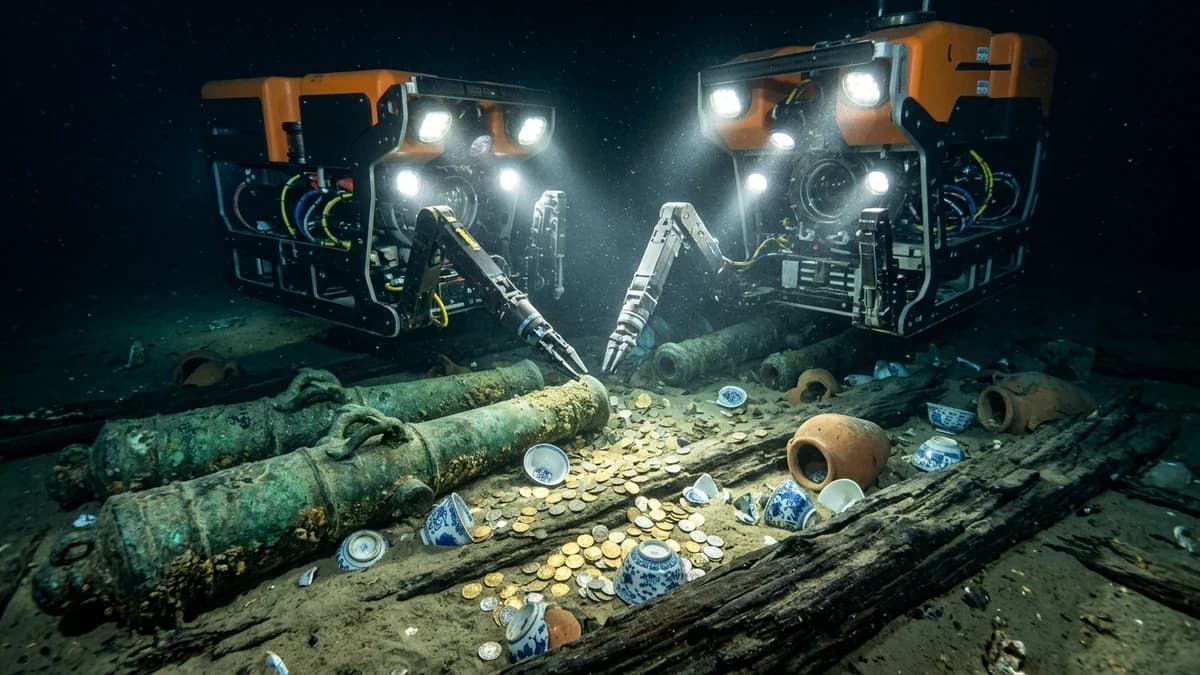
At 600 meters depth in the icy darkness of the Caribbean Sea, roughly 16 nautical miles off the coast of Cartagena de Indias, a state scientific mission coordinated by the Colombian Institute of Anthropology and History (ICANH), the General Maritime Directorate (DIMAR), and the Colombian Navy (ARC) has achieved the most anticipated milestone in world underwater archaeology: definitive numismatic verification via 3D photogrammetry and the first robotic recovery of physical artifacts from the legendary Spanish Galleon San José, universally known as the "Holy Grail of Shipwrecks". In a peer-reviewed study published in the scientific journal Antiquity (Cambridge University Press), led by marine archaeologist Daniela Vargas Ariza (Almirante Padilla Naval Cadet School and ICANH), sub-millimeter imagery captured by the Saab Seaeye Lynx remotely operated vehicle (ROV) deployed from the oceanographic vessel ARC Caribe deciphered gold and silver coins (macuquinas) struck at the Royal Mint of Lima in the year 1707 under assayer Francisco de Hurtado ("H"), sealing the identity of the 64-gun flagship that exploded on June 8, 1708, carrying 200 tons of gold, silver, and emeralds (cargo today valued between $17 billion and $20 billion USD), while the physical recovery phase of the project "Hacia el Corazón del Galeón San José" brought to the surface a two-ton bronze cannon cast in Seville, three macuquina coins, and an intact imperial Chinese porcelain cup from the Kangxi period.
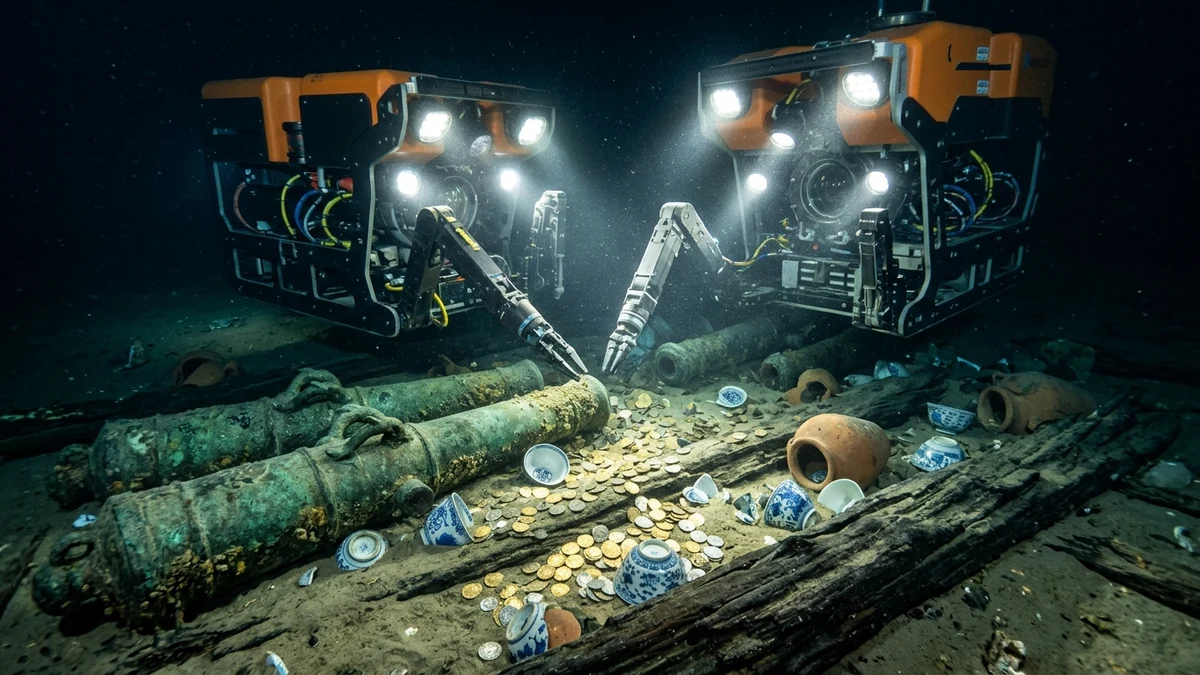
Documentary illustrative recreation based on oceanographic and photogrammetric records from the Colombian Navy (ARC / DIMAR), ICANH, and the study published in the journal Antiquity: at 600 meters depth in the Caribbean Sea, the floodlights and stereo cameras of the Saab Seaeye Lynx ROV underwater robot illuminate an 18th-century bronze naval cannon with dolphin lifting handles, macuquina coins minted in Lima in 1707, and intact Kangxi Chinese porcelain cups on the seabed of the San José Galleon. (Image: Mundo Incrível / High-Fidelity Artistic Illustration)
The Day the Sea Swallowed an Empire: The Battle of Barú on June 8, 1708
To understand why the San José holds the title of the greatest sunken treasure in human history, one must return to dusk on June 8, 1708, at the height of the War of the Spanish Succession (1701–1714). In that continental struggle for the throne of Madrid, the Bourbon monarch King Philip V of Spain depended desperately on gold and silver shipments from South American colonies to finance his armies allied with France against the British-led Grand Alliance. Due to the English naval blockade in the Atlantic, the famous Tierra Firme Fleet (Flota de Tierra Firme) had been delayed for six long years without being able to transport the accumulated taxes of the Viceroyalty of Peru.
Constructed in 1698 at the royal shipyards of Mapil in Usurbil (Basque Country, Spain) by master shipwright Pedro de Aróstegui, the San José was a formidable three-masted flagship (Capitana) displacing over a thousand tons and armed with 64 bronze cannons, accompanied by her sister ship, the vice-flagship San Joaquín. Under the command of General José Fernández de Santillán, Count of Casa Alegre, the San José departed the trade fair of Portobelo, Panama, on May 28, 1708, escorted by a fleet of 14 merchant vessels and warships bound for the fortified walls of Cartagena de Indias, in modern-day Colombia.