🌍 Your knowledge portal
historia

The 9-Chamber Underground Timber Palace: Archaeologists Unseal the Largest Chu Royal Tomb in 2,200 Years

📅 2026-10-20⏱️ 12 min read📝
⚡

Quick Summary

Archaeologists reveal the largest Chu burial complex in Huainan: a 20-meter vertical shaft, 9-chamber timber palace, and an 88 cm bronze ding cauldron. In the heart of eastern China's Anhui Province, an interdisciplinary team of archaeologists has exposed the subterranean core of the most spectacular royal burial monument ever unearthed from the late Warring States period.

Key Takeaways:

  • The scientific excavation of Wuwangdun Tomb No. 1 in Huainan (Anhui) has unearthed the largest and most complex nine-chamber timber funerary palace (guoshi) from the ancient State of Chu, dating back to the 3rd century BCE.
  • Identified as the mausoleum of Xiong Yuan (King Kaolie of Chu, died 238 BCE), the 51-meter-wide and 20-meter-deep vertical shaft preserved over 10,000 artifacts, including the largest Chu bronze ding cauldron ever recorded (mouth diameter over 88 cm) and 2-meter-long se zithers.
  • Nearly 1,000 ink-written Chinese characters inscribed on the chamber beams provide the first in situ construction blueprint and spatial inventory of a late Warring States royal palace, corroborating the poetic descriptions of the Chu Ci.
The 9-Chamber Underground Timber Palace: Archaeologists Unseal the Largest Chu Royal Tomb in 2,200 Years
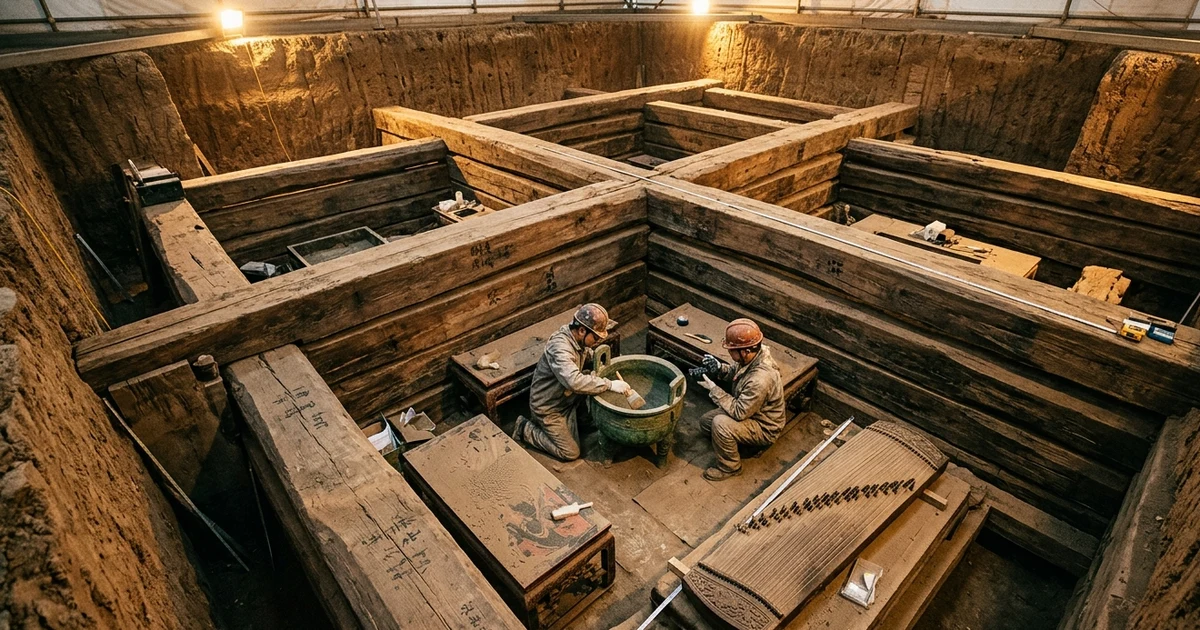
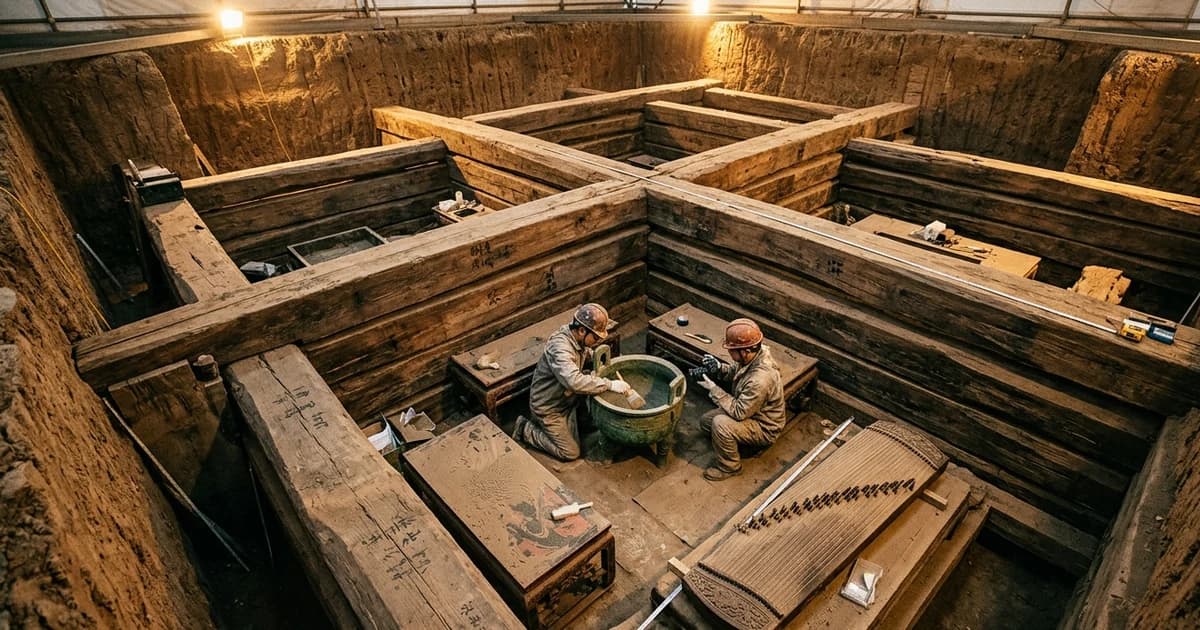
The 9-Chamber Underground Timber Palace: Archaeologists Unseal the Largest Chu Royal Tomb in 2,200 Years — High-Fidelity Artistic Illustration created by artificial intelligence based on scientific research.

The 9-Chamber Underground Timber Palace: Archaeologists Unseal the Largest Chu Royal Tomb in 2,200 Years

Archaeological documentary excavation of Wuwangdun Tomb No. 1 in Huainan, revealing the 9-chamber timber palace of King Kaolie of Chu
High-fidelity artistic illustration created by artificial intelligence based on scientific research.

In the heart of eastern China's Anhui Province, an interdisciplinary team of archaeologists has exposed the subterranean core of the most spectacular royal burial monument ever unearthed from the late Warring States period. Known as Wuwangdun Tomb No. 1, this monumental square burial shaft measures 51 meters across at the surface and plunges 20 meters vertically into the earth beneath an earthen mound 14 meters high. The tomb has been definitively identified as the subterranean palace of Xiong Yuan, King Kaolie of the ancient Chu State (who reigned from 262 to 238 BCE). Spanning an expansive cemetery enclosure of approximately 1.5 million square meters surrounded by moats, chariot pits, and sacrificial trenches, the site preserves a colossal cross-shaped timber chamber (guoshi) divided into nine distinct rooms assembled from massive cypress and nanmu timbers, safeguarding over 10,000 precious artifacts that include the largest bronze cauldron ever discovered in Chu archaeology and ritual stringed zithers exceeding two meters in length.

Conducted under the joint auspices of China's National Cultural Heritage Administration (NCHA) and the Anhui Provincial Institute of Cultural Relics and Archaeology, the excavation resolves key historical puzzles recorded in Sima Qian's Records of the Grand Historian (Shiji). By cataloging nearly one thousand ancient Chinese characters handwritten in black ink across the massive ceiling planks, epigraphers have deciphered the first in situ structural blueprint and functional inventory of an underground Chu royal palace. This monumental discovery not only resurrects the apex of late Chu civilization before its conquest by Qin Shi Huang in 223–221 BCE, but also pioneers cutting-edge conservation protocols in controlled low-oxygen environments to safeguard waterlogged ancient wood, fragile lacquerware, and organic textiles that have defied decay for more than twenty-two centuries.


The Exodus to Shouchun and the Twilight of the Warring States #

To fully grasp the political and symbolic weight buried beneath Wuwangdun, one must look back to the volatile third century BCE, when China was engulfed in the relentless conflicts of the Warring States period (475–221 BCE). The State of Chu was an ancient southern powerhouse celebrated for its lush cultural aesthetic, rich shamanic spirituality, passionate lyric poetry, and sophisticated bronze and lacquer craftsmanship, holding dominion over the fertile valleys of the Yangtze and Huai rivers. However, the aggressive militaristic rise of the western State of Qin, galvanized by harsh Legalist administrative reforms and legendary generals such as Bai Qi, systematically eroded Chu territory and forced its royal court into retreat.

In 241 BCE, with Qin legions menacing the temporary Chu capital at Chen (modern Huaiyang in Henan Province), King Kaolie of Chu made a fateful strategic maneuver. Counseled by his Prime Minister, Huang Xie (celebrated in historical annals as Lord Chunshen, one of the famous Four Lords of the Warring States), the king relocated the royal court, ancestral shrines, and military elite eastward to Shouchun, in what is now Huainan, Anhui Province. Protected by a natural web of rivers, lakes, and wetlands, Shouchun was envisioned as an impregnable stronghold from which Chu could rebuild its economic reserves and rally eastern alliances against Qin aggression.

When King Kaolie passed away in 238 BCE after a twenty-four-year reign of fierce geopolitical maneuvering, the Chu aristocracy spared no resource in constructing a subterranean resting place worthy of his royal lineage. Aware that their kingdom stood on the brink of existential peril—a prophecy realized just fifteen years later in 223 BCE when Qin forces sacked Shouchun and executed the last Chu monarch—the royal builders sealed within Wuwangdun the highest artistic, ritual, and musical accomplishments of their civilization.


Engineering the Invisible: The Cross-Shaped Timber Palace and 9 Chambers #

The architectural design of Wuwangdun Tomb No. 1 demonstrates astounding structural engineering and timeless mastery of ancient Chinese mortise-and-tenon woodworking. Within a massive stepped vertical pit measuring 51 meters by 51 meters at the rim and descending 20 meters into the bedrock and clay, ancient artisans constructed the guoshi, the heavy timber palace that enclosed the king's nested coffins.

The floor plan of the guoshi is strictly cruciform, partitioned into nine distinct chambers:

  1. Central Chamber (Zhongshi): The most sacred chamber at the exact center of the complex, designated exclusively for the multi-layered lacquered royal coffins (guan) containing King Kaolie's bodily remains.
  2. Four Cardinal Chambers (North, South, East, and West): Expansive rectangular halls arranged around the central chamber, used to store sovereign ritual bronzes, musical instruments, banquet tableware, and dismantled ceremonial chariots.
  3. Four Corner Chambers (Northeast, Northwest, Southeast, and Southwest): Supplementary compartments allocated for storage jars, fine ceramics, culinary provisions, organic offerings, and ritual utensils.

The entire nine-room underground complex was framed with colossal trunks of ancient cypress and prized nanmu hardwood (Phoebe zhennan), renowned for its extraordinary density and natural insect-repelling aromatic oils. The longest structural beams exceed eight meters in length and weigh several tons, interlocking seamlessly through sophisticated mortise-and-tenon joinery without the use of a single metallic nail.

To safeguard the timber palace from groundwater seepage and atmospheric rot, the builders executed a multi-tiered sealing system. Atop the primary ceiling beams, they laid four successive tiers of thick wooden cover planks. Over these planks, they poured a dense layer of charcoal several feet thick to absorb residual humidity. Finally, the entire pit was capped by an impermeable barrier of blue clay (qinggaoni), an extraordinarily sticky, dense sediment that formed an airtight seal, starving microbial decomposers of oxygen and preserving the wood and lacquer for over 2,200 years.


The Largest Bronze Ding of the Ancient World and Vessels of Supreme Sovereignty #

In the political theology of ancient China, cast bronze was not merely utilitarian metalwork; it was the ultimate physical embodiment of cosmic legitimacy and dynastic power. Under the sacred sumptuary rites inherited from the Zhou dynasty, the number of tripod cauldrons (ding) and food containers (gui) permitted in sacrifice and state banquets strictly reflected the occupant's station in the cosmic order: common nobles were granted three or five, feudal lords used seven, and only the supreme ruler—the Son of Heaven (Tianzi) or sovereign kings of equal status—could claim the paramount set of nine ding and eight gui.

In the East Chamber of Wuwangdun, archaeologists uncovered this complete royal set of nine ding and eight gui, providing incontrovertible material proof of the king's supreme status. Among these masterpieces, one bronze vessel captured global headlines: a colossal bronze ding tripod cauldron whose mouth diameter exceeds 88 centimeters.

This monumental bronze surpasses in scale and sculptural execution the celebrated Zhuke Ding (the famed Chu giant cauldron excavated in the 1930s with an 87-centimeter mouth), establishing the new world record as the largest bronze ding ever unearthed from an ancient Chu tomb. The cauldron's bulging belly is adorned with dynamic cast reliefs of the mythic Taotie motif, featuring bulging eyes, curling horns, and protective patterns designed to ward off malevolent spiritual forces, supported by three columnar legs crowned with dragon heads and flanked by two heavy vertical handles designed for lifting beams during royal banquets.

Beyond the sacrificial cauldrons, the side chambers yielded an array of bronze wine vessels (hu and zun), ceremonial ladles, and ablution basins (pan). Many of these vessels still contained traces of ancient food and herbal residues, which are currently undergoing mass spectrometry and paleobotanical testing to reconstruct royal culinary recipes and ceremonial elixirs from over twenty-two centuries ago.


Anatomy of Evidence and Archaeological Parameters of Wuwangdun #

The following table synthesizes the primary physical measurements, stratigraphic data, and technical metrics officially documented by NCHA archaeologists at Wuwangdun Tomb No. 1:

Technical / Stratigraphic Parameter Official Archaeological Measurement Historical & Scientific Significance
Occupant Identification Xiong Yuan (King Kaolie of Chu) Sovereign of Chu (262–238 BCE), buried in 238 BCE.
Burial Shaft Dimensions 51 m x 51 m (mouth) x 20 m (vertical depth) Largest stepped vertical shaft tomb of the Warring States period.
Mound Height ~14 meters original height (base >100 m) Monumental earthen tumulus that survived erosion for 2,200 years.
Mausoleum Enclosure Area ~1,500,000 m² (150 hectares) Moated royal cemetery containing chariot pits and companion burials.
Chamber Architecture Cruciform 9-chamber timber palace (guoshi) Maximum royal hierarchical configuration with mortise-and-tenon joints.
Structural Timber Species Cypress and Nanmu (Phoebe zhennan) Noble decay-resistant timbers with beams exceeding 8 meters in length.
Largest Bronze Ding Dimension Mouth diameter > 88 centimeters Largest ritual bronze tripod cauldron ever unearthed from a Chu site.
Se Zithers Unearthed Length exceeding 2.0 meters Longest ancient stringed instruments discovered intact in the world.
Ink Inscriptions on Timbers Approximately 1,000 Chinese characters First in situ assembly manual and functional inventory of a Chu palace.

The Sound of the Songs of Chu: 2-Meter Zithers and Magical Instruments #

No aspect of Chu culture has enchanted posterity more than its passionate devotion to music, rhythmic dance, and evocative poetry. In the masterworks of Qu Yuan, the revered Chu statesman and poet credited with the Songs of Chu (Chu Ci), ancient verses paint vivid scenes of lavish ceremonies where the rhythmic resonance of drums, the luminous toll of bronze chimes, and the sweeping notes of monumental zithers beckoned sky spirits and ancestral deities down to sacred groves.

Prior to the excavation of Wuwangdun, modern scholars debated whether these descriptions reflected historical palace ceremonies or artistic exaggeration. The opening of the West and South chambers provided the ultimate empirical answer. From the anaerobic silt, conservators recovered the most breathtaking assemblage of ancient musical instruments ever found in Asia: dozens of stringed se zithers (a prestigious ancestral court instrument related to the guzheng), whose lengths exceed an astonishing two meters.

Carved from resonant hollowed timbers and lacquered in lustrous black and cinnabar-red finishes, these colossal zithers retain their movable bridges, fossilized silk string fragments, and terminal tuning pegs adorned with carved phoenix heads and stylized cloud scrolls. Flanking the zithers lay multi-pipe free-reed mouth organs known as sheng and yu, their slender bamboo pipes set into lacquered wooden wind chests preserved in near-pristine condition.

Archaeologists also recovered the massive lacquered timber support frames that once held carillons of bronze chime-bells (bianzhong) and stone chime-chimes (bianqing). The bases of these crossbeams feature dynamic three-dimensional sculptures of crouching tigers surmounted by entwined winged dragons and sweeping phoenixes, illustrating the distinctive shamanic aesthetic of Chu, where music operated as a harmonic bridge linking the earthly king to celestial realms.


Nearly 1,000 Characters in Ink: The Blueprint Written on Chamber Beams #

While the bronze cauldrons and lacquered instruments dazzle the eye, the most scientifically transformative discovery for philologists and epigraphers lies on the structural timbers themselves. During the delicate cleaning and 3D digital scanning of the chamber ceiling planks, researchers uncovered roughly one thousand Chinese characters brushed in indelible black ink across the wood surfaces.

Far from being abstract mythological prayers or funerary laments, these inscriptions represent the practical, on-site construction notes and inventory records penned by master carpenters and court quartermasters. Written in the distinctive regional Chu script—a flowing, calligraphic variant of the Great Seal script (dazhuan):

  • Structural Placement Codes: Notations such as "East Chamber — Beam Four" or "South Room — Rear Plank", accompanied by numerical marks and alignment lines, instructed laborers on the exact sequence for slotting the heavy timbers into place within the muddy shaft.
  • Room Function Designations: Labels confirm the dedicated palace roles of each chamber, identifying specific rooms reserved for "meats and banquets," "wine vessels and dinnerware," "instruments of musical harmony," and "weapons and chariot tackle."
  • Funerary Inventory Records: Several planks list quantitative registers of weapons, silk fabrics, and containers deposited into the vaults, allowing archaeologists to compare the written manifest against the surviving physical contents.

This vast ink archive forms the largest collection of Warring States written wooden records ever found in an unlooted royal tomb, offering an unparalleled empirical foundation for the study of historical linguistics, ancient civil engineering, and pre-imperial royal burial rites prior to the standardized script mandated by the Qin Empire.


High-Tech Conservation in Controlled Atmosphere and the Legacy of Chu #

Excavating waterlogged 2,200-year-old organic timber structures presents extreme conservation challenges. When water-saturated wood is abruptly exposed to dry, oxygenated ambient air, rapid capillary evaporation causes microscopic cell walls to collapse, causing timbers to warp, crack, and turn to dust in a matter of hours.

To prevent this catastrophe, Chinese cultural heritage authorities constructed a sealed, state-of-the-art climate-controlled laboratory directly over the burial pit. The facility maintains ambient relative humidity above 90% and utilizes nitrogen-gas displacement systems to create low-oxygen working chambers, preventing oxidation during the lifting of artifacts. As each timber beam is extracted, it is wrapped in sterile moistened geotextiles and transferred to stabilization tanks filled with polyethylene glycol (PEG) solutions and biological biocides.

In late December 2025, the extraordinary fruits of this excavation and conservation effort culminated in a landmark exhibition titled "Echoes of King Kaolie: Archaeological Discoveries from the Wuwangdun Tomb No. 1" at the prestigious National Museum of China in Beijing. The public display of polished bronzes, cinnabar-lacquered banquet tables, and inscribed timbers offered contemporary audiences an intimate glimpse into the lost splendor of Chu civilization.

Wuwangdun is more than an astonishing archaeological hoard; it is the monumental epitaph of pre-imperial classical China. Beneath the soil of Huainan, King Kaolie of Chu ensured that, even as his kingdom fell to the fires of Qin conquest, his underground timber palace would endure across two millennia to bear witness to the timeless majesty of his people.


Frequently Asked Questions about the Wuwangdun Royal Tomb #

Who was buried in the monumental Wuwangdun Tomb No. 1 in Huainan? #

Archaeological, architectural, and epigraphic evidence consolidated by the National Cultural Heritage Administration of China (NCHA) confirms that Wuwangdun Tomb No. 1 is the royal mausoleum of Xiong Yuan, historically titled King Kaolie of Chu, who ruled from 262 to 238 BCE during the twilight of the Warring States period. He was the pivotal monarch who in 241 BCE orchestrated the strategic relocation of the Chu capital eastward to Shouchun (modern Huainan, Anhui Province) to escape the relentless military expansion of the rival Qin State. The burial complex at Wuwangdun stands as the final monumental architectural achievement of the Chu monarchy before the kingdom fell to Qin armies in 223 BCE.

Why is the nine-chamber timber structure at Wuwangdun considered architecturally unique? #

The subterranean wooden chamber complex at Wuwangdun, known in Chinese archaeology as the guoshi, exhibits an extraordinary cross-shaped floor plan comprising a central burial chamber that housed the king's nested lacquered coffins, enveloped by eight specialized side rooms to form a nine-chamber layout. Built entirely from colossal cypress and precious nanmu timber logs measuring over eight meters in length, the structure was assembled with sophisticated mortise-and-tenon joints without a single metal nail. Sealed beneath four layers of heavy wooden lid planks and protected by thick beds of charcoal and airtight blue clay (qinggaoni) that prevented water and oxygen ingress, the timber palace survived intact for over twenty-two centuries.

What is the historical significance of the bronze ding cauldron and musical instruments found inside? #

The bronze assemblage retrieved from Wuwangdun includes the supreme ritual set prescribed by ancient Zhou dynasty sumptuary laws, featuring nine bronze tripod cauldrons (ding) and eight food vessels (gui), a ceremonial privilege strictly restricted to the Son of Heaven and sovereign kings. Among them is a colossal bronze ding with a mouth diameter exceeding 88 centimeters, officially recognized as the largest bronze cauldron ever unearthed from a Chu site. Furthermore, the recovery of dozens of impeccably preserved musical instruments, including stringed se zithers exceeding two meters in length and bamboo sheng and yu mouth organs, provides the first tangible physical proof of the magnificent musical and ritual traditions celebrated in the classical poetry of the Chu Ci (Songs of Chu).


Sources and Scientific References #

  • National Cultural Heritage Administration of China (NCHA): Official Archaeological Excavation Report on Wuwangdun Tomb No. 1 in Huainan, Anhui Province (2024–2025). Released via the Huainan Municipal Government Portal and NCHA Official Publications.
  • National Museum of China (Beijing): Exhibition Monograph and Artifact Catalogue: "Echoes of King Kaolie: Archaeological Discoveries from the Wuwangdun Tomb No. 1" (December 2025). chnmuseum.cn.
  • Anhui Provincial Institute of Cultural Relics and Archaeology: Gong Xicheng et al., Structural Analysis and Conservation of the 9-Chamber Timber Palace at Wuwangdun (Published in cooperation with Cultural Relics Press, Beijing, 2025).
  • Columbia University East Asian Archaeology & History Research: Research reports on late Chu administrative geography, Shouchun royal tombs, and King Kaolie's reign (Columbia Early China Seminars, 2025).
  • Sima Qian (司马迁): Records of the Grand Historian (Shiji), sections on the Hereditary House of Chu (楚世家) and the Biography of Lord Chunshen (春申君列传).
  • China Daily & Global Times Scientific Reports: Detailed documentary coverage of the 88 cm bronze ding cauldron, 2-meter se zithers, and low-oxygen preservation laboratory technology.

🏷️ Tags:

#Wuwangduntomb#KingKaolieofChu#HuainanAnhuiarchaeology#9-chambertimberpalace#bronzedingcauldron#sezitherChuCi#WarringStatesPeriod#Chinesearchaeology

📢 Gostou deste artigo?

Compartilhe com seus amigos e nos conte o que você achou nos comentários!

❓Frequently Asked Questions

Archaeological, architectural, and epigraphic evidence consolidated by the National Cultural Heritage Administration of China (NCHA) confirms that Wuwangdun Tomb No. 1 is the royal mausoleum of Xiong Yuan, historically titled King Kaolie of Chu, who ruled from 262 to 238 BCE during the twilight of the Warring States period. He was the pivotal monarch who in 241 BCE orchestrated the strategic relocation of the Chu capital eastward to Shouchun (modern Huainan, Anhui Province) to escape the relentless military expansion of the rival Qin State. The burial complex at Wuwangdun stands as the final monumental architectural achievement of the Chu monarchy before the kingdom fell to Qin armies in 223 BCE.
The subterranean wooden chamber complex at Wuwangdun, known in Chinese archaeology as the guoshi, exhibits an extraordinary cross-shaped floor plan comprising a central burial chamber that housed the king's nested lacquered coffins, enveloped by eight specialized side rooms to form a nine-chamber layout. Built entirely from colossal cypress and precious nanmu timber logs measuring over eight meters in length, the structure was assembled with sophisticated mortise-and-tenon joints without a single metal nail. Sealed beneath four layers of heavy wooden lid planks and protected by thick beds of charcoal and airtight blue clay (qinggaoni) that prevented water and oxygen ingress, the timber palace survived intact for over twenty-two centuries.
The bronze assemblage retrieved from Wuwangdun includes the supreme ritual set prescribed by ancient Zhou dynasty sumptuary laws, featuring nine bronze tripod cauldrons (ding) and eight food vessels (gui), a ceremonial privilege strictly restricted to the Son of Heaven and sovereign kings. Among them is a colossal bronze ding with a mouth diameter exceeding 88 centimeters, officially recognized as the largest bronze cauldron ever unearthed from a Chu site. Furthermore, the recovery of dozens of impeccably preserved musical instruments, including stringed se zithers exceeding two meters in length and bamboo sheng and yu mouth organs, provides the first tangible physical proof of the magnificent musical and ritual traditions celebrated in the classical poetry of the Chu Ci (Songs of Chu). ---

Receba novidades!

Cadastre seu email e receba as melhores curiosidades toda semana.

🔒 Sem spam. Cancele quando quiser.

💬 Comentários (0)

Seja o primeiro a comentar! 👋

📚Related Articles

Laser Drones Reveal Two Lost Silk Road Metropolises at 2,200 Meters Altitude in Uzbekistanhistoria

Laser Drones Reveal Two Lost Silk Road Metropolises at 2,200 Meters Altitude in Uzbekistan

First-ever drone LiDAR scanning in Central Asia's Malguzar Mountains uncovers Tugunbulak, a 120-hectare industrial fortress that forged steel for the Silk Road, alongside its sister city Tashbulak.

⏱️13 minLer mais →
Secret Tomb Beneath Petra's Treasury Reveals 12 Skeletons & 'Holy Grail' Chalice Sealed for 2,000 Yearshistoria

Secret Tomb Beneath Petra's Treasury Reveals 12 Skeletons & 'Holy Grail' Chalice Sealed for 2,000 Years

ACOR and St Andrews archaeologists unearth an untouched burial chamber beneath Al-Khazneh in Petra, containing 12 Nabataean skeletons and intact ceremonial pottery.

⏱️16 minLer mais →
Monumental Blocks of the Lighthouse of Alexandria Recovered from the Seabedhistoria

Monumental Blocks of the Lighthouse of Alexandria Recovered from the Seabed

The international PHAROS initiative rescued granite blocks from the ancient world wonder. Discover the details of this unprecedented archaeological operation.

⏱️27 minLer mais →
Roman Imperial Baths Discovered in Maximinus Daza's Palace in Serbiahistoria

Roman Imperial Baths Discovered in Maximinus Daza's Palace in Serbia

Archaeologists in Serbia discovered a lavish 4th-century imperial bath complex in the palace of Maximinus Daza, revealing secrets of ancient Roman architecture.

⏱️14 minLer mais →
1,200-Year-Old Mummified Hairless Dog Found in Peruhistoria

1,200-Year-Old Mummified Hairless Dog Found in Peru

Archaeologists in Peru unearth a 1,200-year-old mummified hairless dog at a pre-Inca site, revealing the spiritual bond between humans and dogs.

⏱️13 minLer mais →
Archaeological Discovery: 1,300-Year-Old Viking Dress Fragments Reveal Nordic Luxuryhistoria

Archaeological Discovery: 1,300-Year-Old Viking Dress Fragments Reveal Nordic Luxury

Archaeologists in Denmark uncover rare fragments of a 1,300-year-old Viking dress with silver threads, revealing secrets of early Nordic fashion and social hierarchy.

⏱️8 minLer mais →
Receba novidades no WhatsApp!