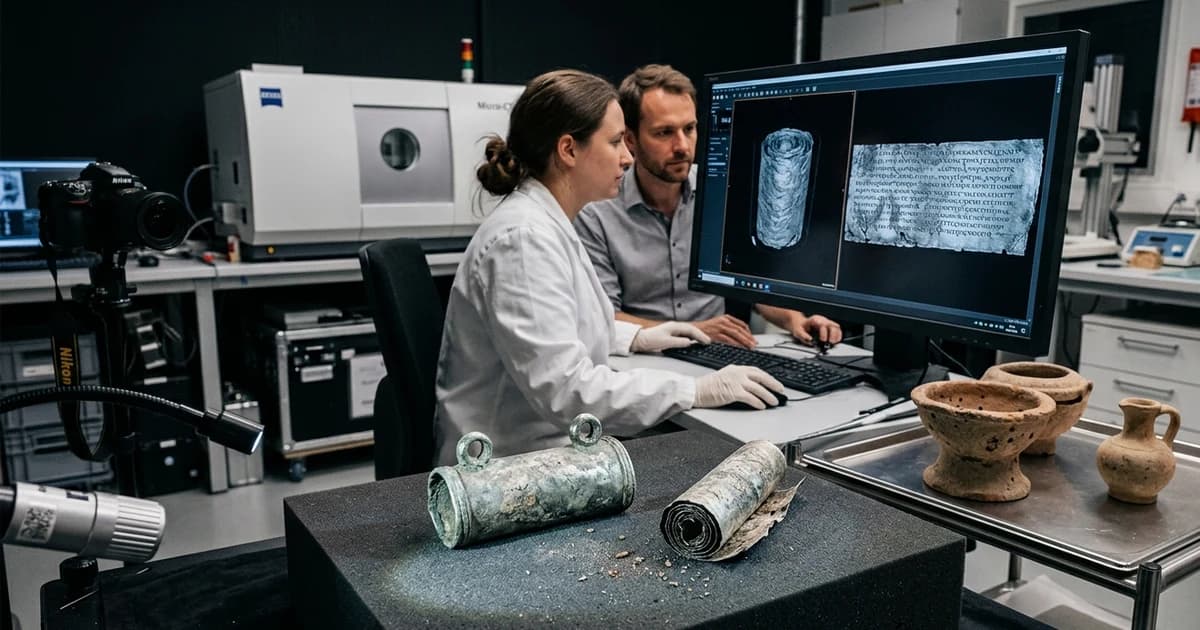
The exact anatomical position of the metallic cylinder beneath the chin, combined with the presence of two small lateral suspension loops (eyelets) soldered along one long side of the capsule, left no doubt regarding its original function in life. The man of Grave 134 wore the object suspended around his neck on a leather cord or fabric ribbon, keeping it resting against his upper chest as a phylactery, the ancient term for portable amulets housing sacred texts or protective formulas against disease, misfortune, and malevolent forces. What no one imagined during the 2018 excavation was that the interior of that 35-millimeter capsule held a document capable of altering textbooks on the history of Western Christianity.
Transferred after excavation to the restoration laboratories of the Archaeological Museum Frankfurt, directed by Wolfgang David, the tiny silver cylinder underwent initial microscopic and radiographic inspections in 2019. Preliminary examinations revealed that the outer protective capsule enclosed an extremely thin silver sheet (lamella), rolled tightly multiple times upon itself like a miniature metallic scroll. Even more importantly, along the visible edges and in early X-ray shadows, conservators noticed geometric strokes proving that the inner silver foil had been incised with letters before being rolled up nearly two millennia ago.
However, initial excitement immediately ran into an insurmountable physical barrier for traditional conservation methods. During the roughly 1,800 years it remained buried under the pressure of damp sediment in Frankfurt-Praunheim, the silver foil — whose thickness resembled household aluminum foil — suffered severe intergranular corrosion, surface calcification, and multiple crushing folds. Any attempt to physically unroll the sheet with needles or chemical solvents would cause the oxidized metal to shatter instantaneously into hundreds of illegible micro-fragments, destroying the hidden text forever.
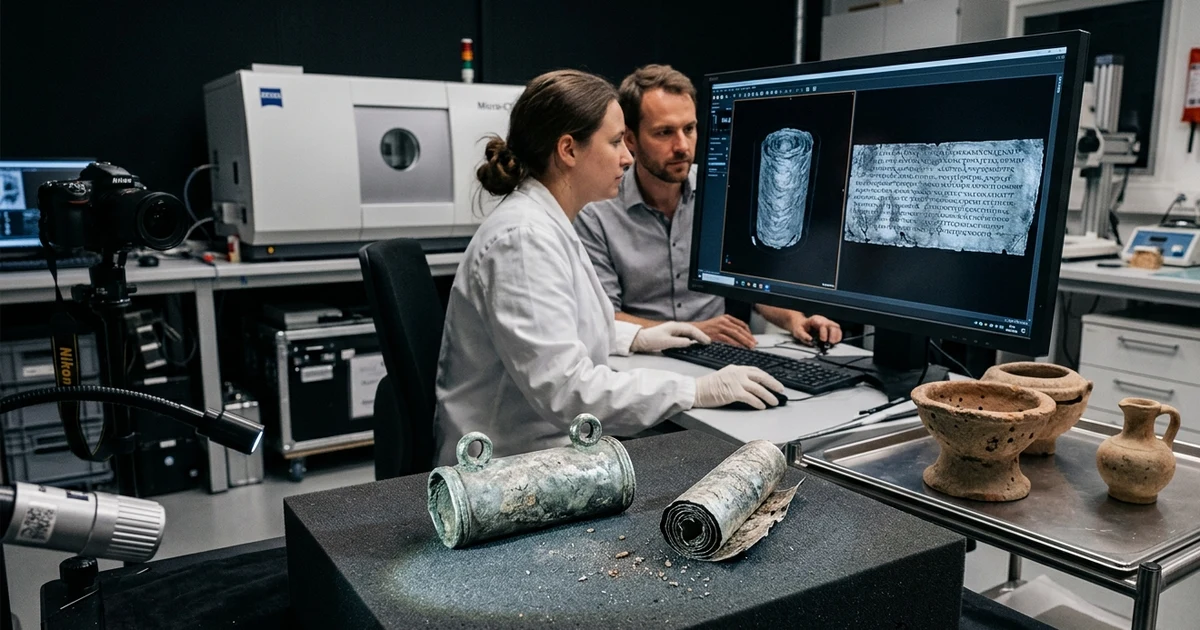
For five years, the artifact waited until non-destructive imaging technology achieved the micrometric resolution required to digitally separate layers of oxidized metal fused together. The scientific breakthrough occurred in May 2024, when the Archaeological Museum Frankfurt partnered with the Imaging and 3D Scanning Laboratory (IMPALA) at the Leibniz Center for Archaeology (LEIZA), located in the neighboring city of Mainz. Under the leadership of scientist Ivan Calandra, a specialist in archaeological microscopy and tomography, the silver roll was positioned inside an ultra-high-resolution industrial X-ray computed tomography scanner (Micro-CT).
Unlike conventional hospital CT machines, the Micro-CT system at LEIZA emits high-energy X-ray beams focused at the micrometer scale while the object rotates 360 degrees with sub-millimeter precision, capturing thousands of radiographic projections from every angle. By processing those projections through volumetric reconstruction algorithms, the computer generated a three-dimensional matrix of voxels (volumetric pixels) mapping every density variation across the corroded silver foil, including the microscopic grooves where a Roman scribe had pressed a sharp metal stylus (stilus) centuries ago. Just as airborne LiDAR laser mapping unveiled the lost Maya megacity of Valeriana beneath the Mexican jungle, the X-ray beams pierced through the metallic folds without touching a single atom of the original artifact.
Even with the three-dimensional volume reconstructed inside the computer, reading the text still required overcoming a formidable mathematical challenge: because the silver foil was spirally wound, crumpled in the middle, and cracked along the edges, the engraved letters appeared superimposed across multiple curved layers. To solve this problem, Ivan Calandra and the digital modeling specialists at LEIZA sliced the 3D model of the rolled foil into individual surface segments (virtual segments), tracing the exact curvature of each turn of the metallic spiral. Next, they applied geometric flattening algorithms (virtual flattening or virtual unrolling) to digitally stretch each curved slice into a two-dimensional flat plane.
When all virtual segments were aligned and digitally stitched together like an ultra-high-precision jigsaw puzzle, the complete image of the unrolled silver sheet emerged before the scientists' eyes, measuring approximately 9.1 centimeters in length by 3.5 centimeters in width. Across the silvery-gray surface rendered by the computer stood 18 horizontal lines of cursive writing engraved with remarkable density from top to bottom. The flattened digital image was then handed over to Professor Markus Scholz, Chair of Archaeology and Coinage of the Roman Provinces at Goethe University Frankfurt, who embarked on months of detective work to decipher the 1,800-year-old code letter by letter.
The paleographic reading of the Frankfurt Silver Inscription required close collaboration between Markus Scholz and international church historians, liturgical theologians, and biblical scholars — including Harald Buchinger (University of Regensburg), Santiago Guijarro (Pontifical University of Salamanca), Piotr Kubasiak, and Eckhard Nordhofen. The first obstacle confronting Scholz lay in the nature of the handwriting: the text was not engraved in the symmetrical, square uppercase letters (capitalis monumentalis) seen on Roman triumphal arches or official stone monuments, but rather in older Roman Latin cursive, the rapid everyday script used in commercial letters, wall graffiti like those at Pompeii, and lead curse tablets (defixiones). Moreover, because visual access was strictly limited to digital tomography, the epigrapher could not examine under raking light the physical entry and exit direction of the stylus tip in the metal, having instead to deduce each letter's stroke order from the depth of the virtual grooves.
As words emerged from the 18 lines, Scholz realized he was facing three simultaneous historical surprises. The first was the language: nearly all protective amulets from Late Antiquity ever recovered by archaeologists were written in Greek, Hebrew, or Aramaic, whereas the Frankfurt sheet was composed entirely in sophisticated Latin, with Greek liturgical terms transliterated into the Latin alphabet. The second was the material: while pagan curses were scratched onto cheap lead sheets and everyday amulets used perishable papyrus or parchment, the choice of pure silver reflected the high spiritual value attached to divine protection, with no other Christian silver amulet known before the fifth century. The third and greatest surprise was the content: from beginning to end, the text was a fervent Christian prayer of Pauline character, without a single concession to Roman polytheism or syncretic magic.
Based on the epigraphic reconstruction by Markus Scholz and the detailed philological edition published by Santiago Guijarro in the journal Isidorianum (34/1, 2025, p. 38), as documented in the scholarly synthesis of the Frankfurt Silver Inscription, the 18 lines engraved across the 9.1-centimeter foil divide into four linked theological movements. Below is the complete line-by-line Latin transcription (preserving the sacred abbreviations nomina sacra I͞H X͞P with overlines for Iesus Christus), paired with its direct English translation:
- Line 1: In nomine sancti Titī. — "In the name(?) of Saint Titus."
- Line 2: Agios, agios, agios. — "Holy, holy, holy!" (from Greek ἅγιος, transliterated into Latin letters)
- Line 3: In nomine I͞H X͞P Dei f(ilii), — "In the name of Jesus Christ, Son of God!"
- Line 4: mundi dominus, — "The Lord of the world,"
- Line 5: viribus omnibus — "with all [his] might,"
- Line 6: incursionibus oponit. — "opposes all attacks [or incursions]."
- Line 7: Deus valetudinibus — "God, against diseases,"
- Line 8: salvis accessum — "grants access to well-being [healing/safety]"
- Line 9: praestat. Haec salus tueat[ur] — "provides. May this salvation [this amulet] protect"
- Line 10: hominem, qui se — "the man who himself"
- Line 11: dedit voluntati — "surrendered to the will"
- Line 12: Domini I͞H X͞P ti Dei f(ilii). — "of the Lord Jesus Christ, Son of God."
- Line 13: Quoniam I͞H X͞Po — "For before Jesus Christ"
- Line 14: omnes genua flec- — "all knees shall bend-"
- Line 15: tent, caelestes, — "those of the heavens,"
- Line 16: terrestres et — "those of the earth and"
- Line 17: inferi, et omnis lin- — "those underneath [subterranean], and every ton-"
- Line 18: gua confiteatur. — "gue shall confess [Jesus Christ]."
Each of the four sections composing those 18 lines contains elements never before attested so early in Christian archaeology. In lines 1 and 2, the text opens by invoking Saint Titus (In nomine sancti Titī), the renowned disciple, coworker, and envoy of the Apostle Paul to the churches of Corinth, Dalmatia, and the island of Crete (mentioned in 2 Corinthians, Galatians, 2 Timothy, and recipient of the Epistle to Titus). Because the practice of invoking patron saints as intercessors only spread widely across Christendom during the fourth and fifth centuries, finding the name of Saint Titus heading a mid-third-century amulet demonstrates an early devotion tied directly to Pauline apostolic memory.
Immediately in line 2 appears the threefold acclamation Agios, agios, agios ("Holy, holy, holy!"), known in Christian liturgy by its Greek name Trisagion or in Latin as the Sanctus, inspired by the song of the seraphim in Isaiah 6:3 and the heavenly creatures in Revelation 4:8. Until the Frankfurt discovery, liturgical historians — as highlighted by Harald Buchinger in Heiliger Dienst (78/4, 2025, pp. 304–306) — dated the formal incorporation of the Trisagion into Christian worship only from the fourth century, and its appearance on protective amulets only from the fifth century. The fact that the Nida scribe wrote the Greek word hagios three times using Latin letters (agios) suggests he heard this acclamation chanted orally during his community's worship gatherings in the third century, advancing the material record of Christian liturgy by more than a hundred years.
In lines 3 through 12, the invocation addresses Jesus Christ exclusively through extraordinary visual and political language. Three times in the text, the scribe employs nomina sacra ("sacred names"): instead of spelling out the name of Jesus in Latin, he draws the Greek letters I͞H X͞P (Iota-Eta Chi-Rho, sacred shorthand for the Greek names Iesous Christos) crowned by a horizontal overline of reverence, combining them with the Latin abbreviation Dei f(ilii) (Son of God) — the exact visual counterpart to the imperial abbreviation (DF = Divi filius) stamped on Roman coins to proclaim emperors the sons of deified rulers! By declaring in line 4 that Jesus is the mundi dominus ("Lord of the world"), the Christian on the Germanic frontier quietly asserted that supreme sovereignty over the cosmos, over hostile attacks (incursionibus), and over illnesses (valetudinibus) belonged to Christ, not to the Caesar in Rome.
Finally, in lines 13 through 18, the amulet transcribes the conclusion of the famous Christological Hymn from Paul's Epistle to the Philippians (2:10–11). Not only is this the oldest physical quotation of the New Testament ever discovered north of the Alps, but it is also a priceless witness to the history of the Latin Bible prior to Saint Jerome's Vulgate (Vetus Latina). The author introduces the quotation with the causal conjunction quoniam ("because / since", equivalent to the biblical formula "for it is written") rather than the final conjunction ut ("so that"), and turns the biblical singular "every knee" (omne genu) into the emphatic plural "all knees shall bend" (omnes genua flectent), underscoring that all celestial, earthly, and subterranean powers are subject to Christ's protective authority.
To consolidate the material, chronological, technological, and philological evidence documented by the Archaeological Museum Frankfurt, the Leibniz Center for Archaeology (LEIZA), and Goethe University Frankfurt, the technical table below summarizes all verified parameters of the discovery:
| Investigated Parameter / Dimension |
Verified Empirical Data and Measurements |
Historical, Forensic, and Epigraphic Significance |
| Discovery Site and Context |
Roman necropolis on Heilmannstraße, in Frankfurt-Praunheim (ancient Roman city of Nida, civitas Taunensium, province of Germania Superior). |
Excavated in 2017–2018 under Andrea Hampel (Denkmalamt Frankfurt) across ~500 m² containing 127 graves (113 inhumations and only 14 cremations). |
| Individual and Grave (Grab 134) |
Adult male skeleton (35 to 45 years old), buried in supine position with the amulet nestled directly beneath his chin. |
The sub-mandibular position and lateral eyelets prove the capsule was worn around the neck on a cord as a protective phylactery until burial. |
| Secure Archaeological Dating |
Between 230 and 260 AD (museum range 230–270 AD); absolute upper boundary (terminus ante quem) at the abandonment of Nida in 275/280 AD. |
Established by in situ grave goods (terracotta incense burner and baked clay pitcher); pushes Christianity north of the Alps back by 50 to 100 years. |
| Physical Artifact Dimensions |
Cylindrical silver capsule measuring 3.5 cm (35 mm) in length; inner silver foil (lamella) measuring ~9.1 cm x 3.5 cm when unrolled. |
Wafer-thin metallic foil severely oxidized and creased after 1,800 years; the use of precious silver (rather than lead or papyrus) highlights its saving purpose. |
| Non-Destructive Reading Technology |
High-Resolution Computed Tomography (Micro-CT) + 3D virtual flattening (virtual unrolling) in May 2024 at the IMPALA / LEIZA lab (Mainz). |
Led by Ivan Calandra; sliced the 3D roll into virtual segments and mathematically flattened them without touching the brittle physical foil. |
| Epigraphy, Script, and Language |
18 lines in older Roman Latin cursive (older Roman cursive), deciphered by Prof. Dr. Markus Scholz (Goethe University Frankfurt). |
Written entirely in Latin (extremely rare in 3rd-century amulets, which are almost always Greek), blending upper- and lowercase letters of a literate milieu. |
| Liturgical Formulas & Nomina Sacra |
Invocation of Saint Titus (line 1), transliterated Trisagion (Agios, agios, agios, line 2), and three occurrences of I͞H X͞P with Dei f(ilii) and mundi dominus. |
Earliest record of the Trisagion on an amulet (previously known only from the 5th century) and sacred Greek ideograms paired with titles challenging imperial cult. |
| New Testament Biblical Quotation |
Archaic Latin transcription (Vetus Latina) of Paul's Epistle to the Philippians 2:10–11 in lines 13 to 18 (Quoniam I͞H X͞Po omnes genua flectent...). |
Oldest physical witness to the New Testament north of the Alps; proves early circulation of Latin translations of Paul's letters on the Germanic frontier. |
To grasp the human courage and historiographical impact represented by the man of Grave 134, one must place the window of 230 to 270 of the Common Era within the political and legal landscape of the Roman Empire. Unlike the fourth century — when Emperor Constantine converted and transformed the Church into a state-sponsored institution — the mid-third century witnessed the first systematic, empire-wide imperial persecutions against Christians across Roman territory. In 250 of the Common Era, Emperor Decius issued his famous edict requiring all free inhabitants of the empire to appear before local commissions to perform public sacrifices to the Roman gods and burn incense before the imperial image in exchange for an official certificate (libellus), under penalty of imprisonment, torture, or death.
Just a few years later, between 257 and 258 of the Common Era, Emperor Valerian intensified repression with two new edicts prohibiting Christian assemblies, confiscating cemeteries, and ordering the summary execution of clergy and forfeiture of property for Roman citizens who refused state worship. Living in Nida, a town born from military garrisons along the strategic Limes Germanicus frontier where loyalty to the emperor was tested daily amid Germanic incursions, made open adherence to Christianity particularly perilous. Despite that risk, the man buried on Heilmannstraße not only rejected the protective pagan syncretism that could have served as social camouflage, but had engraved in silver that the true "Lord of the world" (mundi dominus) was Jesus Christ, Son of God, before whom "all knees shall bend".
Until the revelation of the Frankfurt amulet, most historians of ancient religion assumed that protective amulets worn by Christians prior to the fourth century were almost inevitably syncretic. In Greco-Roman Egypt, Syria, and Asia Minor, metallic lamellae and magical papyri from this era routinely listed the name of Jesus alongside Jupiter, Mithras, Hecate, Abraham, Moses, archangels, and cryptic magical words (voces magicae such as Abrasax or Sabaoth), functioning as a "multi-deity spiritual insurance policy" in which the bearer invoked every conceivable supernatural power to cure a fever or ward off the evil eye.
The Frankfurt Silver Inscription breaks sharply with that model by presenting a pure, orthodox, and strictly Pauline Christology in the middle of the third century. As the analyses by Markus Scholz and Santiago Guijarro demonstrate, the author of the Nida text appealed to no pagan spirit and no cabbalistic formula; instead, he structured the petition for healing and protection as a confession of faith grounded in the believer's ethical submission to the will of Christ (qui se dedit voluntati Domini) and in the cosmic authority proclaimed by Sacred Scripture. It stands as a concrete example of those scripture-based Christian phylacteries that the Church Fathers themselves would later tolerate as legitimate expressions of popular piety, in contrast to magical incantations condemned by church councils.
Another historical puzzle illuminated by the foil from Grave 134 concerns the routes by which Christianity reached the Rhine and Main river frontiers prior to the Constantinian era. The combination of the opening invocation to Saint Titus (Paul's companion in the Eastern Mediterranean missions) with the Trisagion transliterated from Greek (Agios, agios, agios), the Greek nomina sacra (I͞H X͞P), and an archaic Latin translation of Philippians 2:10–11 offers valuable clues about the cultural identity of Nida's Christian community. The presence of Greek sacred abbreviations drawn as visual ideograms inside a Latin text proves that the scribe had direct visual familiarity with Christian manuscripts circulating in communal worship.
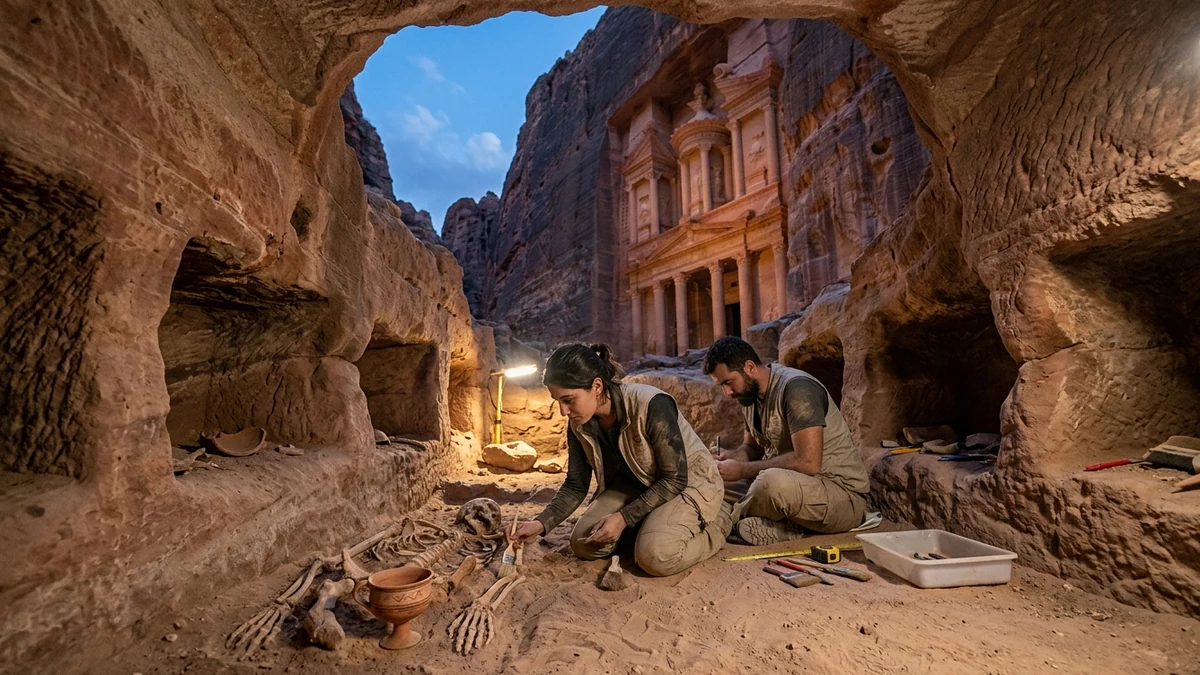
At the same time, the Latin translation of Philippians 2:10–11 engraved on the silver differs from both the later fourth-century Vulgate and known versions of the Vetus Latina, displaying stylistic parallels with mid-third-century Latin Christian writers such as Novatian in Rome (around 250) and North African communities around Carthage (where Paul's letters had already been translated into Latin by the late second century, as attested by the Acts of the Scillitan Martyrs of 180). Just as archaeological discoveries in the subterranean tomb beneath the Treasury of Petra revealed unexpected commercial and ritual links across the ancient world, the Frankfurt amulet proves that the military and riverine highways connecting the Mediterranean, the Rhône valley (Lyon), and the Rhine frontier carried not only soldiers, wine, and pottery, but also Latin manuscripts of Paul's epistles and liturgical hymns to the farthest reaches of Upper Germania.
The public announcement of the decipherment of the Frankfurt Silver Inscription galvanized the European scientific community and German cultural authorities. At the official press presentation held in Frankfurt am Main, Mayor Mike Josef, Head of Culture and Science Ina Hartwig, Archaeological Museum Frankfurt Director Wolfgang David, LEIZA imaging head Ivan Calandra, and Professor Markus Scholz hailed the find as an international scientific sensation that transforms our understanding of European religious history. For Markus Scholz, the moment when the words "sancti Titi" and "Agios, agios, agios" became legible on the flattened digital mesh marked the pinnacle of his career as an epigrapher: after weeks of trying to decipher lines that initially looked like just another syncretic or pagan frontier amulet, he realized he was looking at a purely Christian text written nearly a century earlier than expected.
The triumph of the joint operation between Frankfurt and Mainz cements a new era for forensic archaeology and digital epigraphy. Across the vaults of archaeological museums throughout Europe, the Middle East, and North Africa lie hundreds of tiny rolled sheets of silver, gold, bronze, and lead (lamellae and defixiones) excavated during the nineteenth and twentieth centuries that could never be opened because they were too mineralized and brittle. The methodology of Micro-CT combined with virtual 3D mesh flattening refined by the IMPALA laboratory at LEIZA — alongside parallel advances in X-ray and artificial intelligence reading of the carbonized Herculaneum papyri — paves the way for dozens of other silent metallic scrolls to be read without suffering any physical damage.
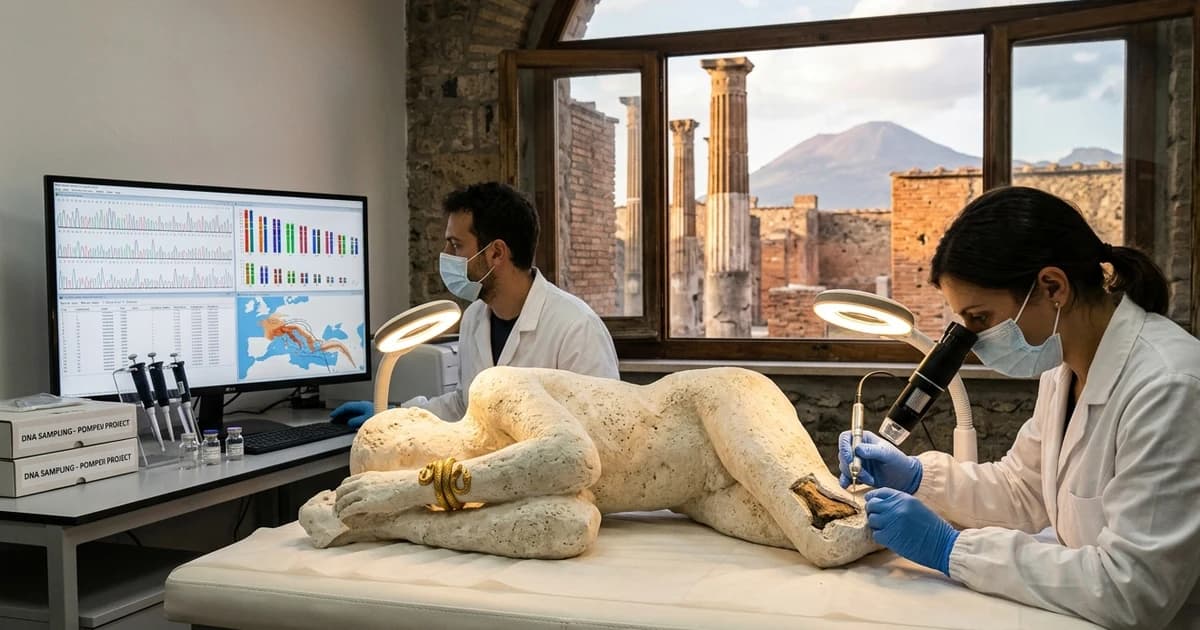
While the original 3.5-centimeter amulet and an enlarged model of its unrolled foil join the permanent exhibition of the Archaeological Museum Frankfurt, new bioarchaeological analyses continue on the human remains from the Heilmannstraße necropolis. Researchers are now investigating, through stable strontium and oxygen isotope analyses of dental enamel and potential ancient DNA extraction, whether the man of Grave 134 was born locally in Upper Germania or migrated from another province of the Roman Empire carrying the tiny silver cylinder with him. Whatever his geographic origin, the stylus-engraved message he took beneath his chin to the grave eighteen centuries ago outlasted the fall of Nida, survived the collapse of Rome, and emerged under twenty-first-century X-ray beams to change history.
Prior to the decipherment of the silver foil recovered from Grave 134 in Frankfurt-Praunheim, all indisputable archaeological, epigraphic, and material evidence of Christian communities north of the Alpine range dated only from the fourth century of the Common Era, particularly after the imperial decriminalization enacted by the Edict of Milan in 313. The stratigraphic and ceramic dating of the Nida burial between the years 230 and 260 (with an absolute upper boundary marked by the abandonment of the town in 275–280) pushes documented Christian presence on the Germanic frontier back by 50 to 100 years. Furthermore, the inscription proves that an adult man professed an exclusively Christocentric faith and possessed Latin translations of Pauline epistles at a time when being identified as a Christian in the Roman Empire could lead to confiscation of property or execution.
The inner silver sheet possessed a microscopic thickness comparable to household aluminum foil and had remained tightly rolled, creased, and oxidized in damp soil for nearly eighteen centuries, meaning any mechanical attempt to unroll it with forceps would have caused irreversible fragmentation. To overcome this physical barrier, the team led by Ivan Calandra at the Imaging Laboratory of the Leibniz Center for Archaeology (LEIZA) in Mainz subjected the artifact to ultra-high-resolution X-ray computed tomography (Micro-CT) in May 2024. Researchers reconstructed a three-dimensional volumetric model of the metallic layers and applied virtual flattening algorithms segment by segment, generating an unrolled 9.1-centimeter digital mesh on which Professor Markus Scholz identified the microscopic grooves left by the Roman stylus.
The 18-line inscription written in Roman Latin cursive is divided into four devotional sections that astonished historians and theologians by their complete absence of pagan syncretism: it opens with an invocation of Saint Titus (disciple and companion of the Apostle Paul) followed by the transliterated Greek acclamation "Agios, agios, agios" ("Holy, holy, holy!"), which constitutes the earliest material occurrence of the Trisagion hymn on a Christian amulet. Next, the inscription invokes Jesus Christ as the Son of God and "Lord of the world" (mundi dominus) using sacred Greek abbreviations (nomina sacra I͞H X͞P) to ward off attacks and illnesses, asking that salvation protect the wearer who has surrendered himself to the divine will. The document concludes by quoting verses 10 and 11 of chapter 2 of Paul's Epistle to the Philippians ("for before Jesus Christ all knees shall bend: the heavenly, the earthly, and the subterranean, and every tongue shall confess"), representing the oldest physical New Testament fragment in Latin ever unearthed north of the Alps.
Official Scientific Sources and References: