🌍 Your knowledge portal
historia

Herculaneum Scrolls Deciphered by AI: 3D X-Ray Tomography Unveils Lost Texts

📅 2026-11-05⏱️ 12 min read📝
Herculaneum Scrolls Deciphered by AI: 3D X-Ray Tomography Unveils Lost Texts
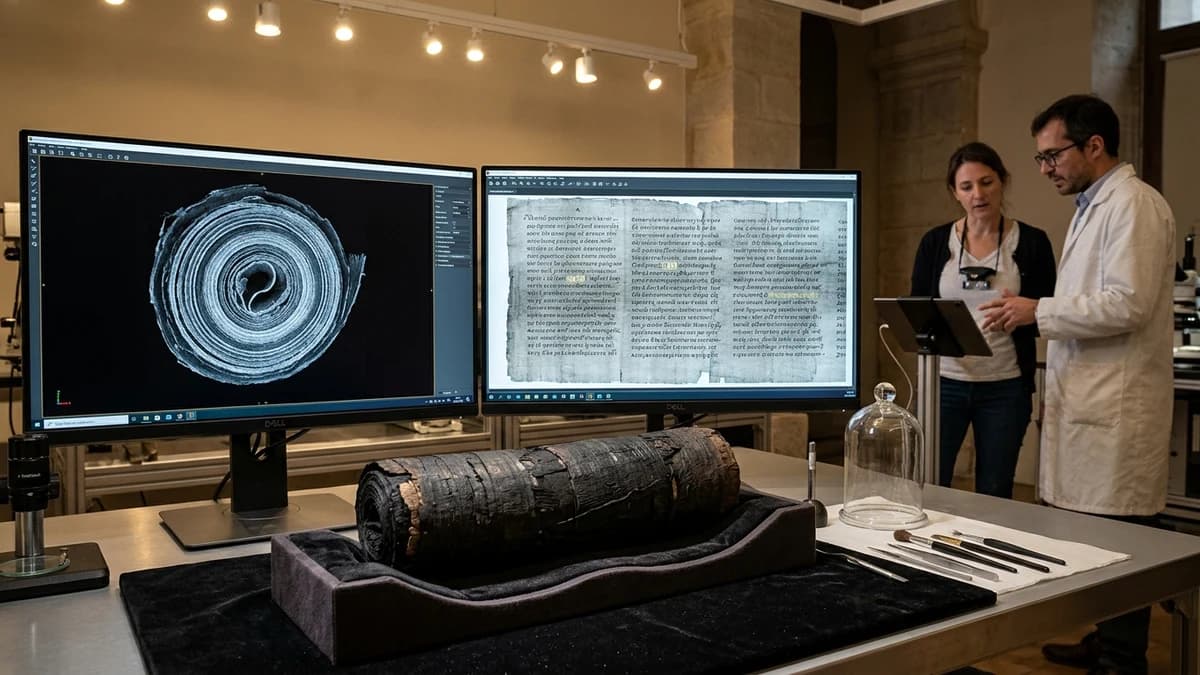
Herculaneum Scrolls Deciphered by AI: 3D X-Ray Tomography Unveils Lost Texts — High-Fidelity Artistic Illustration created by artificial intelligence based on scientific research.
⚡

Quick Summary

Artificial intelligence and synchrotron X-ray tomography read charred Herculaneum scrolls for the first time, unveiling ancient philosophy sealed for 2,000 years. One of the greatest scientific breakthroughs of the twenty-first century has officially opened a transformative new chapter in world archaeology and classical philology.

Key Takeaways:

  • In the autumn of 79 AD, the catastrophic eruption of Mount Vesuvius sealed the fate of the Roman settlements of Pompeii, Herculaneum, and Stabiae.
  • The historical rediscoveries began between 1752 and 1754, when well-diggers in the service of King Charles VII of Naples bored exploratory shafts and narrow subterranean galleries blindly into the volcanic rock.
  • The conceptual revolution began in the early 2000s when American computer scientist Dr. W. Brent Seales proposed an audaciously radical vision: using computed X-ray tomography to generate a comprehensive three-dimensional…

One of the greatest scientific breakthroughs of the twenty-first century has officially opened a transformative new chapter in world archaeology and classical philology. For the first time in nearly two millennia, researchers have successfully read entire passages preserved inside the world-renowned Herculaneum Scrolls — hundreds of carbonized rolls that were buried by the catastrophic eruption of Mount Vesuvius in 79 AD and turned into petrified cylinders of charcoal. This landmark achievement, published in the prestigious scientific journal Nature and spearheaded by the global Vesuvius Challenge, harnessed a groundbreaking synergy between 3D synchrotron micro-computed tomography and deep learning neural architectures.

The discovery unveiled continuous columns of ancient Greek philosophical prose composed by the Epicurean philosopher Philodemus of Gadara, who resided in the opulent Villa dei Papiri. This monumental Roman maritime palace, which belonged to Lucius Calpurnius Piso Caesoninus — father-in-law to Julius Caesar —, housed the only complete classical library from antiquity that survived intact into the modern era. For over 250 years following their initial excavation in the eighteenth century, any physical attempt to mechanically unroll the fragile carbonized manuscripts resulted in catastrophic destruction, reducing irreplaceable cultural heritage into unreadable black dust.

This historic impasse was finally overcome through the pioneering method of virtual unrolling, conceived by Professor W. Brent Seales at the University of Kentucky (EduceLab). Combined with massive volumetric datasets captured at the British synchrotron facility Diamond Light Source and open-source software solutions engineered by young computer scientists worldwide, the technology segmented the microscopic wraps of the papyrus and isolated carbon ink invisible to human eyes. This historic triumph establishes a viable pathway to read more than 800 unopened scrolls resting in Italy and France, holding the promise of tripling our surviving corpus of ancient Greek and Latin literature.

📌 Key Investigation Takeaways #

  • • The only intact library from classical antiquity: The Villa dei Papiri at Herculaneum preserved hundreds of papyrus rolls under 20 meters of volcanic ash at over 320 °C.
  • • The Vesuvius Challenge innovation: A global computational contest awarded over $1,000,000 to independent research teams that built machine learning tools to read sealed scrolls.
  • • Synchrotron tomography at Diamond Light Source: Ultra-brilliant X-ray beams scanned entire carbonized scrolls at a sub-cellular resolution of 7.91 micrometers per voxel.
  • • Artificial Intelligence detects invisible ink: Deep convolutional neural networks recognized microscopic surface crackle patterns left by ancient soot ink.
  • • Lost philosophical treatise recovered: Philodemus’s previously unknown essay exploring music, sensory pleasures, and an epistemological critique of scarcity.

The Cataclysm of 79 AD and the Buried Library of Herculaneum #

In the autumn of 79 AD, the catastrophic eruption of Mount Vesuvius sealed the fate of the Roman settlements of Pompeii, Herculaneum, and Stabiae. While Pompeii was smothered by an overwhelming downpour of pumice pebbles and ash that collapsed structural roofs and entombed fleeing citizens beneath debris, neighboring Herculaneum underwent a profoundly distinct and vastly more intense geophysical phenomenon. The coastal town was struck head-on by multiple pyroclastic surges — superheated density currents of incandescent gases and volcanic particulate matter traveling at hurricane velocities between 320 °C and 500 °C.

Perched along the scenic Bay of Naples stood the palatial Villa dei Papiri, an extraordinary luxury estate stretching over 250 meters in length, complete with columned peristyles, expansive reflecting pools, and an incomparable gallery of bronze and marble statuary. Situated deep within the villa’s interior was the scholarly working library of Philodemus of Gadara, a Syrian Epicurean philosopher patronized by elite Roman politicians. As the searing pyroclastic surges engulfed the rooms, the complete absence of free atmospheric oxygen prevented the organic papyrus rolls from catching fire or bursting into open flames.

Instead of burning to smoke and ash, the plant fibers underwent instantaneous flash-pyrolysis. The oppressive subterranean heat and the crushing overburden of twenty meters of consolidated volcanic tuff mineralized the cellulose structure, converting the rolled manuscripts into petrified, fragile cylindrical rolls of pure carbon. This catastrophic flash-burial created the ultimate historical time capsule: it safely enclosed the only extensive classical library to survive from antiquity without succumbing to medieval decay, moisture, pest damage, or wartime pillaging.


Two Centuries of Destructive Physical Methods and the Curse of Charcoal #

The historical rediscoveries began between 1752 and 1754, when well-diggers in the service of King Charles VII of Naples bored exploratory shafts and narrow subterranean galleries blindly into the volcanic rock. Upon finding hundreds of small, blackened cylindrical objects stacked on rotting wooden shelves, the excavators initially mistook them for discarded chunks of firewood or charcoal briquettes, throwing many into spoil heaps before realizing they were inscribed book scrolls.

Over the ensuing two centuries, attempts to inspect the interiors of these fragile artifacts resulted in a tragic series of destructive failures. Neapolitan conservators initially attempted to slice the rolls lengthwise with razor blades, peeling brittle external layers that disintegrated into unrecoverable soot. In 1756, the Camaldolese monk and sculptor Antonio Piaggio engineered a delicate mechanical unrolling frame equipped with weights, pulleys, and silk cords attached to the papyrus edges with gum glue. Although Piaggio’s device unrolled dozens of rolls over grueling years of labor, the tension inevitably tore delicate internal layers and resulted in extensive textual loss.

Throughout the nineteenth century, chemists exposed the brittle rolls to harsh chemical vapors of chlorine, mercury fumes, and boiling steam, frequently dissolving the vegetal matrix into useless pulp. In the late twentieth century, the Oslo method introduced chemical softening baths, but mechanical fragility remained a permanent hazard. Consequently, more than 800 completely unopened scrolls remained archived in the vaults of the Biblioteca Nazionale di Napoli and the Institut de France in Paris as inaccessible treasures — relics housing lost masterworks of classical thought that could not be read without risking total annihilation.


The Non-Invasive Revolution: From Particle Synchrotrons to Virtual Unrolling #

The conceptual revolution began in the early 2000s when American computer scientist Dr. W. Brent Seales proposed an audaciously radical vision: using computed X-ray tomography to generate a comprehensive three-dimensional digital replica of the intact scrolls, subsequently unwrapping the papyrus entirely within software without physical handling.

Seales celebrated a major milestone in 2015 with the virtual unrolling of the charred En-Gedi scroll found along the Dead Sea in Israel, revealing passages from the Book of Leviticus. However, the Herculaneum scrolls presented a substantially greater technical hurdle. While the scribes of En-Gedi wrote with dense iron-gall and metallic mineral inks that glowed brilliantly under X-rays, the scribes of Herculaneum used organic ink formulated from pure lampblack, charcoal soot, water, and gum arabic.

Because this ancient soot ink was chemically identical in density to the carbonized papyrus itself, both materials exhibited identical X-ray attenuation coefficients in standard laboratory scanners, rendering the writing invisible. To overcome this fundamental physical obstacle, Brent Seales transported two unopened scrolls from the Institut de France (PHerc.Paris. 3 and 4) to the Diamond Light Source particle synchrotron in Oxfordshire, United Kingdom.

At the British synchrotron facility, electrons orbiting at relativistic velocities produce concentrated X-ray beams millions of times brighter than standard medical equipment. This intense beamline allowed researchers to scan the petrified rolls at an unprecedented spatial resolution of 7.91 micrometers per voxel. The resulting datasets encompassed tens of terabytes of volumetric slices, documenting every minute vascular fiber, air void, and geometric deformation across dozens of compressed concentric papyrus layers.


The Vesuvius Challenge: Uniting Computer Vision and Deep Learning #

Despite obtaining petabytes of pristine synchrotron scan data, the sheer geometric complexity of the compressed layers made manual segmentation and ink identification practically impossible for a single research lab. In March 2023, tech entrepreneur Nat Friedman, former CEO of GitHub, joined forces with investor Daniel Gross and Professor Brent Seales to establish the Vesuvius Challenge.

The initiative deployed an open-science competitive framework, uploading massive volumetric CT datasets to public cloud storage and offering over $1,000,000 in cash prizes to global computer vision engineers, mathematicians, and machine learning researchers who could solve two core problems:

  1. Volumetric Geometric Segmentation: Developing algorithmic pipelines to trace and extract continuous 3D papyrus sheets as flattened digital meshes from the crushed interior.
  2. Artificial Intelligence Ink Detection: Training neural networks to classify the presence of carbon ink on digital sheets based on microscopic textural cues imperceptible to human vision.

The first major breakthrough emerged in summer 2023 when physicist Casey Handmer identified that magnified CT slices exhibited a subtle surface texture in inked areas, which he termed "crackle." Inspired by this discovery, 21-year-old computer science undergraduate Luke Farritor at the University of Nebraska-Lincoln trained a deep neural network to identify these crackle patterns on segmented sheets.

In October 2023, Farritor's model successfully isolated the first readable ancient Greek word inside a sealed scroll: ΠΟΡΦΥΡΑC (porphyras), meaning "purple" or "purple-dyed cloth." Simultaneously, Egyptian machine learning doctoral candidate in Berlin, Youssef Nader, developed an independent convolutional neural architecture that extracted the identical term with exceptional clarity.

For the definitive Grand Prize stage, which required deciphering four distinct passages of at least 140 legible characters verified by professional papyrologists, Farritor and Nader formed an alliance with Julian Schilliger, a robotics student at ETH Zurich. Schilliger resolved the pipeline's primary operational bottleneck by creating ThaumatoAnakalyptor, an automated 3D mesh segmentation algorithm that traced convoluted papyrus layers dozens of times faster than existing manual tools.


Technical Comparison: Recovery Methodologies for the Herculaneum Scrolls #

Technical Dimension Mechanical Frame Extraction (Piaggio, 1756) Chemical Dissolution Baths (19th/20th Century) AI-Driven Virtual Unrolling (Vesuvius Challenge, 2024–2026)
Physical Specimen Integrity Severe destruction; 30% to 50% permanent loss of fiber. Critical damage; fiber dissolution and sticky degradation. 100% non-invasive; zero physical touch or structural strain.
Imaging / Radiation Source Ambient visible light during mechanical peeling. Superficial optical microscopy and shallow UV light. High-flux Synchrotron X-rays (Diamond Light Source).
Spatial Scan Resolution Undefined (manual macroscopic physical unrolling). Surface-level micrometer range on exposed faces. Volumetric 3D microtomography at 7.91 micrometers/voxel.
Ink Detection Mechanism Visible contrast to the naked human eye on surface. Fluorescent optical response under UV wavelengths. Deep learning models detecting subtle surface morphology.
Recoverable Text Output Severely truncated columns with extensive voids. Disarticulated fragments with lost spatial context. Continuous textual columns exceeding 85% decipherability.
Processing Velocity Months to years to partially unroll a single roll. Weeks per chemical cycle with catastrophic failure risk. Thousands of characters segmented and decoded in hours.
Future Preservation Status Fragmented relics prone to progressive degradation. Permanent chemical contamination and alteration. The scroll remains indefinitely intact for future generations.

The Rescued Text: Philodemus’s Unknown Treatise on Pleasure and Senses #

The synergistic combination of Julian Schilliger’s automated segmentation and the neural detection pipelines engineered by Youssef Nader and Luke Farritor delivered the historic Grand Prize submission. The neural models decoded more than 2,000 ancient Greek characters arrayed across multiple immaculate columns, enabling an international panel of papyrological scholars to provide authoritative transcriptions.

The recovered text from scroll PHerc.Paris. 4 has been formally authenticated as a previously unknown philosophical treatise composed by Philodemus of Gadara, likely belonging to his extensive works on ethics, virtues, and sensory perception. The scribal hand is refined and disciplined, characteristic of high-status professional book production in the first century BC. Rather than banal administrative records or merchant accounts, the text presents an intellectual disquisition on Epicurean ethics, addressing the pursuit of tranquility (ataraxia), the nature of pleasure (hedone), and the physiological mechanics of hearing, sight, and taste.

In one of the most provocative passages deciphered from the roll, Philodemus takes aim at rival philosophical traditions — likely Stoic or Academic thinkers — who posited that pleasures derived from scarce goods possess superior ontological worth compared to those derived from common things. Philodemus systematically dismantling this view, arguing that scarcity or abundance in no way impacts the intrinsic intensity of natural pleasure experienced by the sentient mind. The satisfaction of basic hunger through simple sustenance, he asserts, offers identical genuine repose to that gained from opulent banquets.

Elsewhere in the scroll, Philodemus explores musical acoustics and melodic perception. Harmonizing with his known masterwork On Music, he reiterates that melody does not possess mystical or inherent moral power to reform the human soul independently, functioning instead as a corporeal aesthetic stimulus whose appreciation depends upon perceptual clarity and sensory equilibrium. This rescued masterpiece illuminates the vibrant philosophical life of the Roman late republic, showing that the Villa dei Papiri operated as a dynamic intellectual center before being preserved under volcanic ash.


The Horizon of Classical Archaeology: Seeking the Latin Library #

The historic triumph of deciphering the Herculaneum Scrolls via artificial intelligence extends far beyond the reclamation of an individual Epicurean treatise. It provides an empirical blueprint that proves computational tomography and deep learning can recover texts once deemed permanently lost to physical entropy. The Vesuvius Challenge consortium has already launched expanded initiatives aimed at accelerating full-roll autonomous segmentation to decode 85% of the text across four complete scrolls.

However, the prospect that most electrifies classical scholars lies deep beneath the unexcavated terraces of Herculaneum. Eighteenth-century exploration tunnels surveyed only a fraction of the sprawling Villa dei Papiri. In antiquity, prestigious Roman aristocratic libraries were invariably configured as dual facilities: an archive dedicated to Greek literature and a parallel hall reserved strictly for the Latin library.

Every manuscript unrolled and deciphered thus far from Herculaneum belongs to Philodemus’s specialized Greek philosophical collection. This indicates that the corresponding Latin library, housing the works of Rome's greatest poets, jurists, and historians, remains buried in unopened subterranean chambers of the palatial villa. Scholars speculate that these unexcavated rooms may preserve lost masterpieces of Ennius, missing political histories of Livy, lost early poems of Virgil, or vanished speeches of Cicero.

With empirical confirmation that modern computer science can non-invasively read these ancient treasures without disturbing their fragile physical remains, international pressure has intensified on the Italian Ministry of Culture and UNESCO to resume systematic scientific excavations at Herculaneum. Mount Vesuvius, long mourned as an agent of catastrophic annihilation, stands revealed as history’s most extraordinary guardian, preserving ancient literary heritage for our digital age.

🏷️ Tags:

#HerculaneumscrollsAI#VesuviusChallengeartificialintelligence#charredpapyriVesuvius#BrentSealesEduceLab#3DtomographyDiamondLightSource#PhilodemusofGadaralosttexts#virtualunrolling#classicalarchaeologyancientGreek

📢 Gostou deste artigo?

Compartilhe com seus amigos e nos conte o que você achou nos comentários!

❓Frequently Asked Questions

The decipherment of the charred Herculaneum scrolls combined high-resolution synchrotron X-ray computed tomography with advanced deep learning computer vision architectures. Initially, the Diamond Light Source particle accelerator scanned the intact rolls in three dimensions at a microscopic resolution of nearly 8 micrometers per voxel. Next, geometric vision algorithms traced the deformed spiral structure of the compressed sheets in a process known as virtual unrolling. Finally, convolutional neural networks were trained to detect subtle surface morphology variations left by ancient carbon-based ink, revealing ancient Greek letters hidden deep inside the petrified charcoal.
The first substantial recovered passages belong to the Epicurean philosophical tradition and have been attributed with high scholarly confidence to Philodemus of Gadara, resident philosopher of the Villa dei Papiri. The rescued work examines the epistemology of the senses and the nature of pleasure, investigating how sensory stimuli such as music, visual arts, and fine dining contribute to the tranquil state of the mind. Philodemus critically argues that the scarcity or abundance of material goods does not alter the intrinsic quality of pleasure experienced, directly countering Stoic dogmas with sophisticated analyses on moderation and harmony.
During the catastrophic eruption of Mount Vesuvius in 79 AD, pyroclastic surges engulfed the ancient library at temperatures exceeding 320 degrees Celsius in an oxygen-deprived environment, turning the organic papyrus into fragile, petrified charcoal. Historical attempts at physical unrolling during the eighteenth and nineteenth centuries caused dozens of invaluable manuscripts to disintegrate into irreparable dust or detach into tiny fragmented scraps. Because Roman scribes wrote with carbon-based ink made of lampblack and soot, its radiodensity was identical to the charred papyrus itself, rendering it invisible to conventional X-rays and requiring neural algorithms to detect.

Receba novidades!

Cadastre seu email e receba as melhores curiosidades toda semana.

🔒 Sem spam. Cancele quando quiser.

💬 Comentários (0)

Seja o primeiro a comentar! 👋

📚Related Articles

2,500-Year-Old Lost Cities Revealed by Laser in the Amazon: Science Study Rewrites Human Historyhistoria

2,500-Year-Old Lost Cities Revealed by Laser in the Amazon: Science Study Rewrites Human History

Airborne LiDAR mapping and CNRS excavations in the Upano Valley reveal the oldest and densest pre-Hispanic urban garden network in the Amazon rainforest.

⏱️9 minLer mais →
The Oldest Solar Observatory Outside the Maya Area: INAH Confirms 2,500-Year-Old Complex in Tetelihtichistoria

The Oldest Solar Observatory Outside the Maya Area: INAH Confirms 2,500-Year-Old Complex in Tetelihtic

Investigative report on INAH's confirmation of a 2,500-year-old Group E solar observatory in Puebla, the oldest documented outside the Maya world.

⏱️12 minLer mais →
The Oldest Home in the Americas: Science Study Reveals 13,800-Year-Old Camp and First Dogs in Alaskahistoria

The Oldest Home in the Americas: Science Study Reveals 13,800-Year-Old Camp and First Dogs in Alaska

Investigative report on the Science Advances study uncovering the oldest confirmed dwelling structure in the Americas, Ice Age sewing needles, and early domesticated dogs at Shég′ Xdaltth′í′, Alaska.

⏱️7 minLer mais →
The 'Holy Grail of Shipwrecks' at 600 Meters: Deep-Sea Robot Recovers 1707 Gold, Bronze Cannon, and Chinese Porcelain from the San José Galleonhistoria

The 'Holy Grail of Shipwrecks' at 600 Meters: Deep-Sea Robot Recovers 1707 Gold, Bronze Cannon, and Chinese Porcelain from the San José Galleon

Investigative dossier on the 600-meter robotic expedition to the San José Galleon in the Colombian Caribbean, the Antiquity study on 1707 macuquina coins, and the recovery of the first bronze cannon,

⏱️13 minLer mais →
The Lost Tomb of Pharaoh Thutmose II in Luxor: The First Royal Tomb Discovery Since Tutankhamun and the Mystery of the Second Chamberhistoria

The Lost Tomb of Pharaoh Thutmose II in Luxor: The First Royal Tomb Discovery Since Tutankhamun and the Mystery of the Second Chamber

Investigative dossier on the discovery of Pharaoh Thutmose II's Tomb C4 in Luxor by the University of Cambridge and the Egyptian Ministry of Antiquities, the first royal pharaonic tomb found since Tut

⏱️14 minLer mais →
The 9-Chamber Underground Timber Palace: Archaeologists Unseal the Largest Chu Royal Tomb in 2,200 Yearshistoria

The 9-Chamber Underground Timber Palace: Archaeologists Unseal the Largest Chu Royal Tomb in 2,200 Years

Scientific excavation of the Wuwangdun tomb in Huainan reveals a colossal 9-chamber subterranean wooden palace, an 88 cm bronze ding cauldron, and 2-meter zithers belonging to King Kaolie of Chu.

⏱️12 minLer mais →
Receba novidades no WhatsApp!