🌍 Your knowledge portal
historia

World's Oldest Cave Art: Nature Study Reveals 51,200-Year-Old Narrative Painting in Sulawesi

📅 2026-11-04⏱️ 9 min read📝
World's Oldest Cave Art: Nature Study Reveals 51,200-Year-Old Narrative Painting in Sulawesi
World's Oldest Cave Art: Nature Study Reveals 51,200-Year-Old Narrative Painting in Sulawesi — High-Fidelity Artistic Illustration created by artificial intelligence based on scientific research.
⚡

Quick Summary

Scientists discover in Leang Karampuang cave the oldest narrative storytelling scene and figurative art in human history, predating Europe by nearly 20,000 years. An international team of archaeologists, geochemists, and rock art specialists has announced the discovery of the oldest figurative and narrative cave art ever documented in human history.

Key Takeaways:

  • The cognitive capacity to conceive, articulate, and record narrative mythologies represents the definitive evolutionary boundary separating Homo sapiens from all other living species.
  • Dating prehistoric rock art with absolute scientific rigor has historically represented one of archaeology's most persistent obstacles.
  • The artistic composition preserved upon the ceiling and inclined limestone wall of Leang Karampuang measures 136 centimeters wide by 54 centimeters high, executed with deliberate strokes of dark mineral ochre rich in natural…

An international team of archaeologists, geochemists, and rock art specialists has announced the discovery of the oldest figurative and narrative cave art ever documented in human history. The prehistoric masterpiece, painted in mineral red ochre upon the limestone walls of Leang Karampuang cave in the Maros-Pangkep karst region of South Sulawesi, Indonesia, has been dated to at least 51,200 years old. The research, published as the cover article in the scientific journal Nature, fundamentally upends the established timeline of human cognitive evolution, symbolic imagination, and the birth of visual storytelling.

The panel features a dynamic composition depicting three anthropomorphic figures interacting with an adult Sulawesi warty pig (Sus celebensis), forming what researchers categorize as the oldest "picture story" in the global fossil record. Until recently, orthodox Western scholarship placed the genesis of narrative art within European Ice Age sanctuaries like Chauvet and Lascaux in France or El Castillo in Spain, where the oldest figurative depictions date to approximately 36,000 to 40,000 years ago. The Sulawesi discovery predates the European canon by more than fifteen millennia, decisively shifting the evolutionary center of symbolic culture toward tropical Southeast Asia.

This groundbreaking chronological confirmation was made possible by an innovative dating method combining laser-ablation sampling with uranium-series decay spectrometry (LA-U-series). Jointly developed by researchers from Griffith University, Indonesia's National Research and Innovation Agency (BRIN - Badan Riset dan Inovasi Nasional), and Southern Cross University, this non-destructive technology enabled scientists to analyze micro-layers of calcium carbonate deposited over the pigment without harming the ancient artwork.


The Anthropological Enigma: When Did We Become Storytellers? #

The cognitive capacity to conceive, articulate, and record narrative mythologies represents the definitive evolutionary boundary separating Homo sapiens from all other living species. While abstract geometric incisions and engraved shells dating to earlier periods have been recovered across Africa and Eurasia, narrative art requires a vastly more complex neurological framework. It demands the ability to arrange sequential events across temporal dimensions, establish intentional agency between distinct beings, and project metaphorical constructs beyond immediate physical reality.

For decades, archaeological orthodoxy taught that this creative spark ignited late within the frigid steppes of Upper Paleolithic Europe. Known widely as the "Creative Explosion," this eurocentric model hypothesized that only populations navigating the environmental stresses of the last glacial maximum in Europe possessed the social complexity needed to produce narrative scenes of hunting and shamanism. The successive discoveries across Sulawesi's limestone labyrinths, initiated in 2014 and crowned by Leang Karampuang, have systematically demolished that single-origin hypothesis.

The humans who inhabited the karst towers of Maros-Pangkep fifty-one thousand years ago were consummate masters of visual communication. By composing an intentional tableau where multiple characters engage in shared action, these prehistoric artists demonstrated that oral folklore and mythology were already integral cultural pillars. They utilized cave walls as sacred galleries to transmit ancestral legends, initiation rites, and cosmological traditions across successive generations.

These early storytellers lived in Wallacea, a unique biogeographical zone composed of oceanic islands separated by deep maritime trenches that never connected to continental Asia or Australia. Reaching Sulawesi and continuing their maritime dispersal toward Sahul (the combined landmass of Australia and New Guinea) required seafaring craft capable of open-ocean crossings more than 65,000 years ago. The art of Leang Karampuang proves that these early voyagers possessed a fully developed, deeply sophisticated symbolic culture.


The Forensic Technology: Laser-Ablation Uranium-Series Imaging (LA-U-series) #

Dating prehistoric rock art with absolute scientific rigor has historically represented one of archaeology's most persistent obstacles. Because red ochre pigments consist of inorganic iron oxides lacking organic carbon, conventional radiocarbon dating cannot determine the age of the paint itself. Furthermore, previous uranium-series methods required mechanical sampling using dental drills, a destructive process that frequently blended calcite layers formed at vastly different geologic intervals.

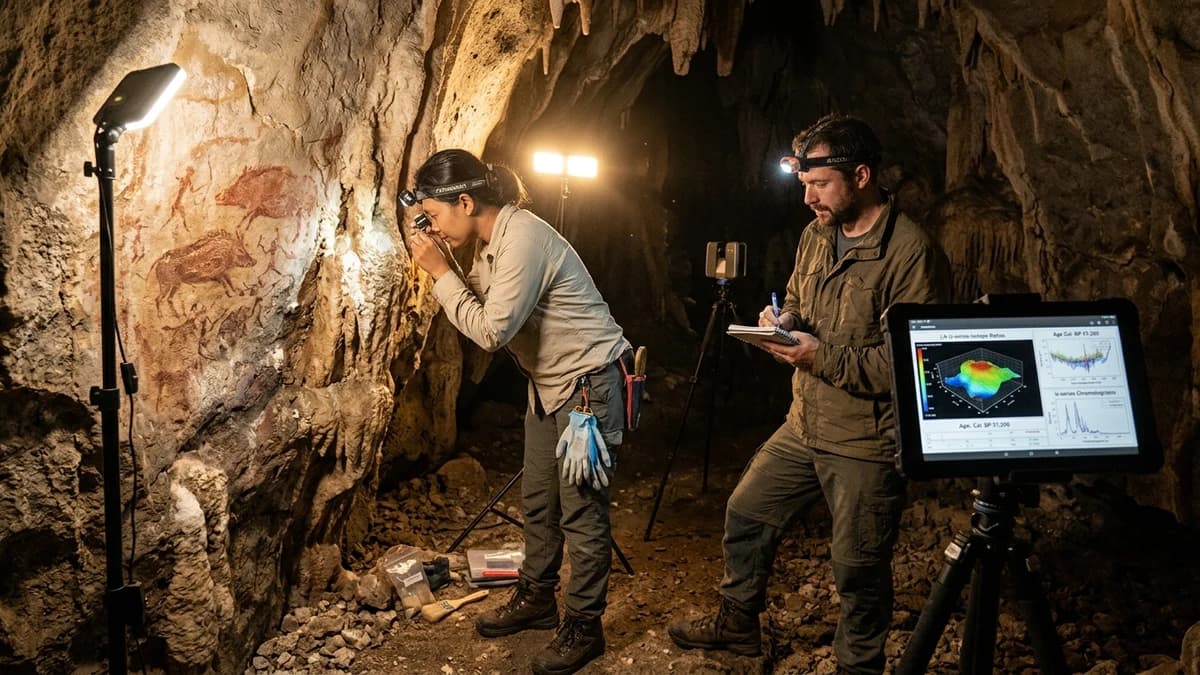
To resolve these analytical limitations, the research team led by Professor Maxime Aubert and geochemist Renaud Joannes-Boyau perfected the laser-ablation inductively coupled plasma mass spectrometry technique (LA-U-series). Rather than removing physical rock fragments, the instrument directs microscopic ultraviolet laser pulses across ultra-thin calcium carbonate skins—commonly termed "cave popcorn" or coralloid speleothems—that gradually accumulated over the pigment through centuries of mineral-laden water seepage.

The laser ablates sub-micron particles along a continuous cross-sectional scan extending from the outer mineral surface down to the precise pigment interface. An inert helium gas stream carries the vaporized material into a high-precision mass spectrometer, measuring isotopic concentrations of uranium-234 and its radioactive daughter isotope, thorium-230. Because uranium dissolves in groundwater and becomes trapped in calcite as it crystallizes, whereas thorium remains insoluble, the accumulated thorium-230 provides an unalterable atomic clock determining the minimum age of the underlying art.

Applying this micro-scale isotopic mapping at Leang Karampuang identified the deepest calcite layer resting directly upon the red ochre paint. The atomic decay calculations yielded a minimum age of 51,200 years, with statistical probability distributions extending back to 53,500 years ago. This exceptional spatial resolution eliminated risks of cross-contamination or geochemical leaching, establishing an unshakeable empirical foundation that withstood rigorous peer review in Nature.


Complete Anatomy of the Narrative Scene and Evidence #

The artistic composition preserved upon the ceiling and inclined limestone wall of Leang Karampuang measures 136 centimeters wide by 54 centimeters high, executed with deliberate strokes of dark mineral ochre rich in natural hematite. The spatial layout deliberately departs from isolated animal representations, weaving the depicted figures into a unified narrative tableau capturing dramatic tension and ceremonial significance.

The focal point of the artwork is a life-sized rendering of an adult Sulawesi warty pig (Sus celebensis), an endemic wild suid that served as a cornerstone of human subsistence throughout the Late Pleistocene. Depicted in profile, the animal features four distinct limbs, an arched spine with bristled contours, a substantial cranium, and a slightly parted mouth. Two circular raised markings upon its snout replicate the cartilaginous facial warts characteristic of mature male specimens defending territory.

Three anthropomorphic figures interact with the central creature across choreographed positions:

  1. The Frontal Figure: Positioned directly before the pig's snout, this human silhouette holds an elongated pointed shaft or staff with both arms extended, appearing to confront or guide the animal's path at close range.
  2. The Dorsal Figure: Situated directly above the pig's back, this figure appears inverted or acrobatically suspended, extending upper limbs toward the animal's head in an apparent act of physical mastery, shamanic contact, or ceremonial leaping.
  3. The Avian Therianthrope: Positioned behind the animal, this figure combines a human torso and limbs with a stylized bird-like head or beaked ceremonial mask. The explicit presence of therianthropy—hybrid entities blending animal and human traits—provides definitive evidence of organized spiritual beliefs and totemic shamanism dating back over five hundred centuries.

The application of the new LA-U-series method also enabled the team to re-examine the nearby site of Leang Bulu' Sipong 4. In 2019, that hunting scene had been dated to 43,900 years using bulk drilling. The new laser-ablation protocol recalibrated its minimum age to at least 48,000 years, proving that the Maros-Pangkep cave art was not an isolated episode, but rather a long-lived artistic tradition spanning multiple millennia.


Technical Comparison Table: The World's Oldest Rock Art Sites #

Forensic & Archaeological Parameter Leang Karampuang (Sulawesi, Indonesia) Leang Bulu' Sipong 4 (Sulawesi, Indonesia) Chauvet Cave (Ardèche, France) Lascaux Cave (Dordogne, France)
Minimum Confirmed Age 51,200 years BP (calibrated minimum) 48,000 years BP (recalibrated in 2024) ~36,000 to 37,000 years BP ~17,000 to 21,000 years BP
Artistic Classification Narrative figurative & therianthropic scene Complex hunting scene with therianthropes Figurative megafauna wall panels Monumental hunting and aurochs friezes
Central Depicted Subject Warty pig (Sus celebensis) & 3 humans Dwarf buffalo (Bubalus) & wild suids Woolly rhinos, cave lions, and horses Wild bulls (aurochs), stags, and horses
Presence of Therianthropy Yes (avian-headed human hybrid figure) Yes (eight distinct therianthrope hunters) Partial (human figure with bison head) Rare (bird-headed human shaft figure)
Primary Dating Method LA-U-series (laser ablation on calcite) LA-U-series (laser ablation on calcite) Radiocarbon (AMS) on charcoal pigment Radiocarbon (AMS) & stratigraphy
Pigment Composition Mineral red ochre (hematite-rich) Mineral red ochre (hematite-rich) Charcoal black and hematite red ochre Iron and manganese oxides with charcoal
Biogeographic Context Homo sapiens maritime Wallacean dispersal Wallacean island hunter-gatherer tradition Upper Paleolithic Europe (Aurignacian) Upper Paleolithic Europe (Magdalenian)
Scientific Journal Nature (Oktaviana et al.) Nature (Aubert et al.) Comptes Rendus Palevol / CNRS French Ministry of Culture archives

The Route to Sahul and Cognitive Modernity Across Wallacea #

Discovering that Earth's oldest narrative art was created in Southeast Asia reshapes our understanding of early human migration routes. Departing the African continent over 70,000 years ago, modern human groups traversing the Indian Ocean coastline encountered the vast continental shelf of Sunda—which connected the Malay Peninsula, Sumatra, Java, and Borneo—offering fertile terrestrial and coastal ecosystems.

To expand eastward beyond Borneo, however, early humans confronted the formidable biogeographical barrier of Wallace's Line. The islands of Sulawesi, Flores, and Timor remained separated from continental shelves by oceanic straits characterized by treacherous marine currents. Crossing these deep channels necessitated deliberate watercraft construction and maritime coordination. The art of Leang Karampuang proves that the mariners who navigated these waterways possessed fully modern intellectual and symbolic capacities.

The therianthropic imagery in Sulawesi reveals striking conceptual parallels with the Dreamtime mythologies of Australian First Nations peoples. Genomic evidence indicates that the populations who painted Leang Karampuang 51,200 years ago were closely related to the maritime pioneers who reached Sahul approximately 65,000 years ago. The ochre narratives of Sulawesi likely represent the earliest surviving manifestations of an enduring cosmological framework shared across Australasia.

This perspective displaces Europe from its traditional pedestal as the sole birthplace of symbolic culture. Rather than being an isolated crucible of human imagination, Europe's Paleolithic art reflects a regional manifestation of a universal cognitive capacity already flourishing across the tropical archipelagos of Southeast Asia tens of thousands of years earlier.


Expedition Behind-the-Scenes and Urgent Conservation Efforts #

The documentation of Leang Karampuang represents the culmination of more than a decade of fieldwork across the Maros-Pangkep karst, spearheaded by Indonesian archaeologist Dr. Adhi Agus Oktaviana. The landscape is characterized by imposing limestone towers rising dramatically above surrounding rice paddies, concealing hundreds of remote cave entrances accessible only by scaling slick rock cliffs under equatorial heat and humidity.

During field surveys in 2021, Oktaviana's team identified the ochre panel partially veiled by mineral deposits. Recognizing the severe damage caused by conventional sampling, the team secured the site and partnered with laser-ablation specialists at Southern Cross University. Over two years of cleanroom validation ensured that the isotopic measurements met the exacting standards of Nature.

Despite this scientific victory, researchers warn of an acute conservation crisis threatening these irreplaceable records of human heritage. Over recent decades, the expansion of industrial limestone quarries and cement manufacturing across South Sulawesi has generated structural vibrations and particulate contamination. Furthermore, climate change has amplified alternating cycles of extreme drought and torrential monsoon rains, accelerating the crystallization of mineral salts upon cave walls.

This process of salt haloclasty expands microscopically beneath the paint, causing the 51,200-year-old ochre flakes to peel and disintegrate into dust. In response, the Indonesian government and UNESCO have initiated emergency monitoring programs, installing microclimatic environmental sensors and digitizing decorated panels using high-density 3D LiDAR scanners. Preserving Leang Karampuang ensures that humanity's earliest written chapter of imagination remains legible for future generations.

🏷️ Tags:

#worldoldestcaveart#Sulawesirockart51200years#LeangKarampuangMarosPangkep#Naturenarrativeartstudy#SuscelebensisSulawesiwartypig#AdhiAgusOktavianaBRIN#MaximeAubertGriffithUniversity#laserablationuraniumseriesLA-U-series

📢 Gostou deste artigo?

Compartilhe com seus amigos e nos conte o que você achou nos comentários!

❓Frequently Asked Questions

The rock art of Leang Karampuang is a red ochre painting discovered within a limestone cave in South Sulawesi, Indonesia, illustrating a wild warty pig and three interacting human figures. The site holds immense global significance as the oldest reliably dated figurative cave art and visual narrative in human history, dating to at least 51,200 years ago. Its discovery confirms that humanity's ability to communicate complex stories through pictures emerged tens of thousands of years earlier than previously assumed, rewriting the evolutionary history of human cognition.
The painting was dated using an advanced technique called laser-ablation uranium-series imaging (LA-U-series). Rather than physically scraping pigment from the cave wall, researchers fired microscopic laser pulses to sample sub-micron layers of calcium carbonate that naturally formed over the paint. The apparatus measured the radioactive decay ratio between uranium-234 and thorium-230, providing an accurate geological clock with minimal error margins while leaving the underlying artistic heritage completely undamaged.
Therianthropes are artistic depictions that blend human anatomy with physical attributes of animals, such as bird beaks, animal claws, or tails. In Leang Karampuang, one of the three figures displays distinctive zoomorphic avian characteristics, mirroring similar depictions found in nearby caves like Leang Bulu' Sipong 4. These hybrid beings demonstrate that early hunter-gatherers in Sulawesi engaged in sophisticated religious abstraction, totemic belief systems, and shamanism, conceptualizing mythological entities beyond physical reality.
The narrative cave art discovered inside Leang Karampuang cave has been dated to at least 51,200 years old, setting an undisputed global record for figurative storytelling art in human evolutionary history. To achieve this unprecedented chronological accuracy without destroying the painting, scientists utilized cutting-edge laser-ablation inductively coupled plasma mass spectrometry paired with uranium-series dating (LA-U-series). The laser vaporized microscopic sub-millimeter layers of calcium carbonate formed over the red ochre pigment, measuring the precise decay ratio between uranium-234 and thorium-230 without damaging the underlying artwork.
The red mineral ochre panel depicts an intricately choreographed narrative composition measuring approximately 136 centimeters wide by 54 centimeters high, dominated by a life-sized representation of a Sulawesi warty pig (Sus celebensis). Surrounding the wild boar, which is drawn with an open mouth and distinctive facial warts, three smaller anthropomorphic figures interact directly with the creature from different spatial angles. One human figure holds a pointed shaft towards the pig's snout, another hovers above its back, and a third displays therianthropic traits with an avian head.
For more than a century, mainstream archaeological textbooks asserted that the cognitive explosion of symbolic thought and visual storytelling emerged during Ice Age Europe between 35,000 and 40,000 years ago in iconic caverns like Chauvet and Lascaux. The rigorous dating of Leang Karampuang proves that modern hunter-gatherers across Island Southeast Asia mastered complex symbolic myth-making and narrative folklore at least 15,000 years before European figurative art began. This demonstrates that narrative visual language was an integral part of the cognitive toolkit carried by early Homo sapiens migrating towards Australia.

Receba novidades!

Cadastre seu email e receba as melhores curiosidades toda semana.

🔒 Sem spam. Cancele quando quiser.

💬 Comentários (0)

Seja o primeiro a comentar! 👋

📚Related Articles

The Oldest Solar Observatory Outside the Maya Area: INAH Confirms 2,500-Year-Old Complex in Tetelihtichistoria

The Oldest Solar Observatory Outside the Maya Area: INAH Confirms 2,500-Year-Old Complex in Tetelihtic

Investigative report on INAH's confirmation of a 2,500-year-old Group E solar observatory in Puebla, the oldest documented outside the Maya world.

⏱️12 minLer mais →
The Oldest Home in the Americas: Science Study Reveals 13,800-Year-Old Camp and First Dogs in Alaskahistoria

The Oldest Home in the Americas: Science Study Reveals 13,800-Year-Old Camp and First Dogs in Alaska

Investigative report on the Science Advances study uncovering the oldest confirmed dwelling structure in the Americas, Ice Age sewing needles, and early domesticated dogs at Shég′ Xdaltth′í′, Alaska.

⏱️7 minLer mais →
The 'Holy Grail of Shipwrecks' at 600 Meters: Deep-Sea Robot Recovers 1707 Gold, Bronze Cannon, and Chinese Porcelain from the San José Galleonhistoria

The 'Holy Grail of Shipwrecks' at 600 Meters: Deep-Sea Robot Recovers 1707 Gold, Bronze Cannon, and Chinese Porcelain from the San José Galleon

Investigative dossier on the 600-meter robotic expedition to the San José Galleon in the Colombian Caribbean, the Antiquity study on 1707 macuquina coins, and the recovery of the first bronze cannon,

⏱️13 minLer mais →
The Lost Tomb of Pharaoh Thutmose II in Luxor: The First Royal Tomb Discovery Since Tutankhamun and the Mystery of the Second Chamberhistoria

The Lost Tomb of Pharaoh Thutmose II in Luxor: The First Royal Tomb Discovery Since Tutankhamun and the Mystery of the Second Chamber

Investigative dossier on the discovery of Pharaoh Thutmose II's Tomb C4 in Luxor by the University of Cambridge and the Egyptian Ministry of Antiquities, the first royal pharaonic tomb found since Tut

⏱️14 minLer mais →
The 9-Chamber Underground Timber Palace: Archaeologists Unseal the Largest Chu Royal Tomb in 2,200 Yearshistoria

The 9-Chamber Underground Timber Palace: Archaeologists Unseal the Largest Chu Royal Tomb in 2,200 Years

Scientific excavation of the Wuwangdun tomb in Huainan reveals a colossal 9-chamber subterranean wooden palace, an 88 cm bronze ding cauldron, and 2-meter zithers belonging to King Kaolie of Chu.

⏱️12 minLer mais →
The Silver Scroll Beneath the Skeleton's Chin: X-Rays Unroll 1,800-Year-Old Christian Inscription That Rewrites History in Germanyhistoria

The Silver Scroll Beneath the Skeleton's Chin: X-Rays Unroll 1,800-Year-Old Christian Inscription That Rewrites History in Germany

High-resolution Micro-CT scanning at LEIZA digitally unrolls a 3.5 cm silver foil amulet found beneath a Roman skeleton's chin in Frankfurt, revealing 18 lines of 3rd-century Christian Latin that push

⏱️22 minLer mais →
Receba novidades no WhatsApp!