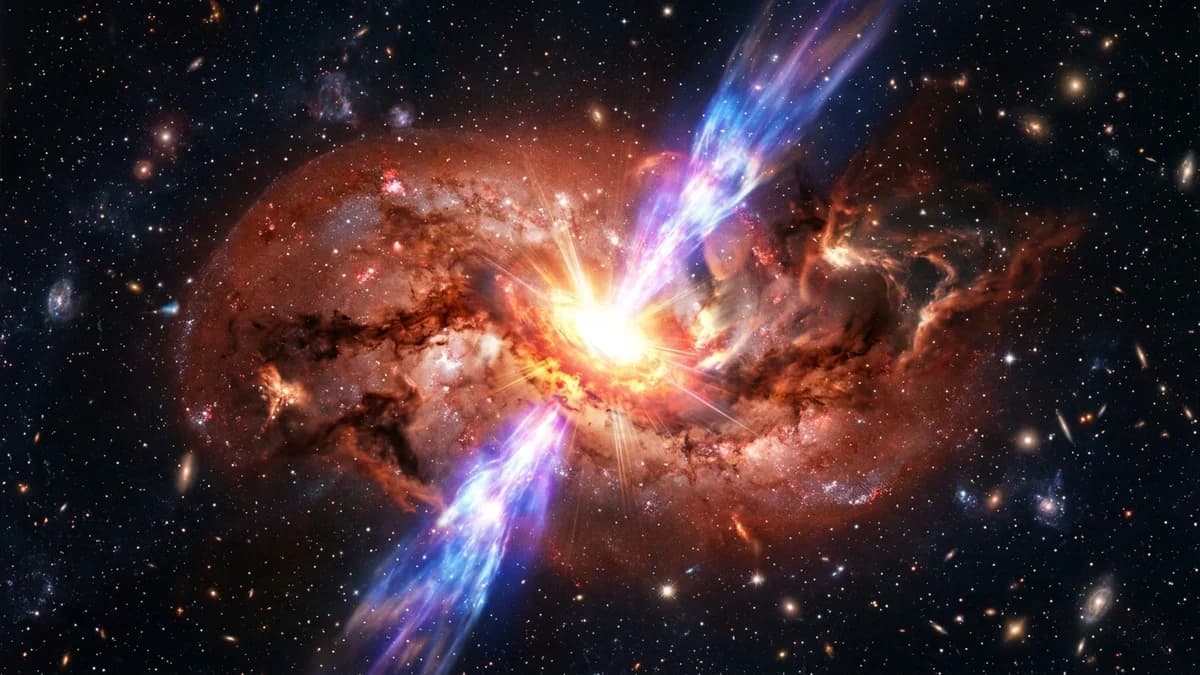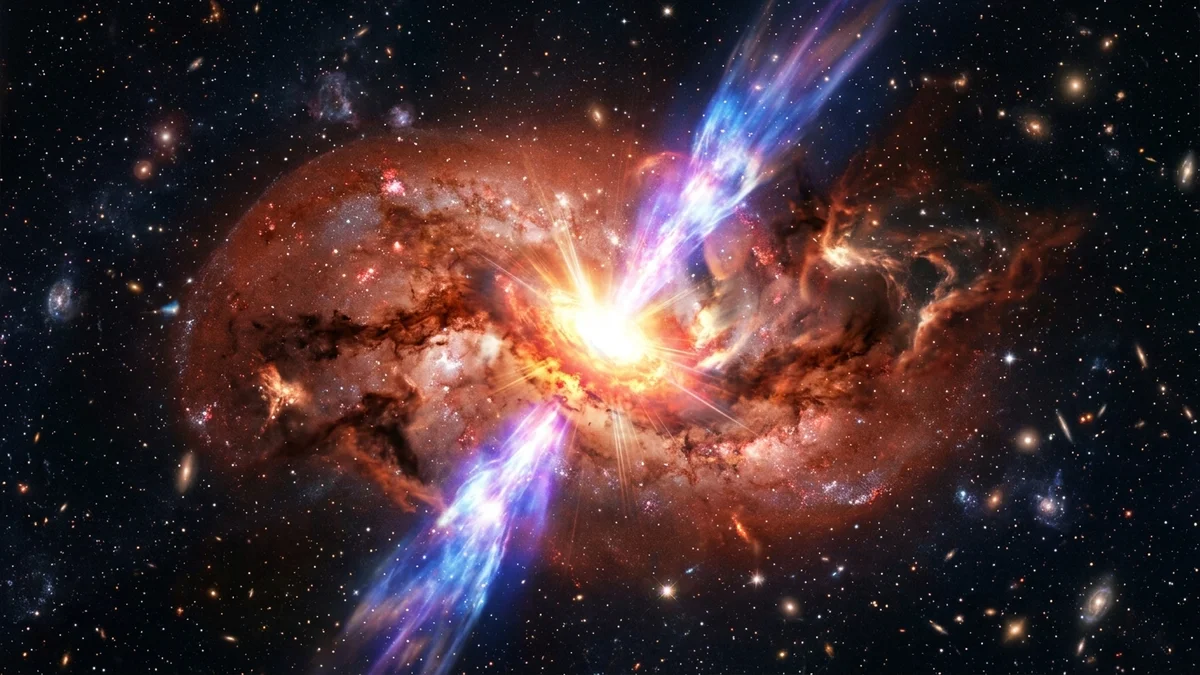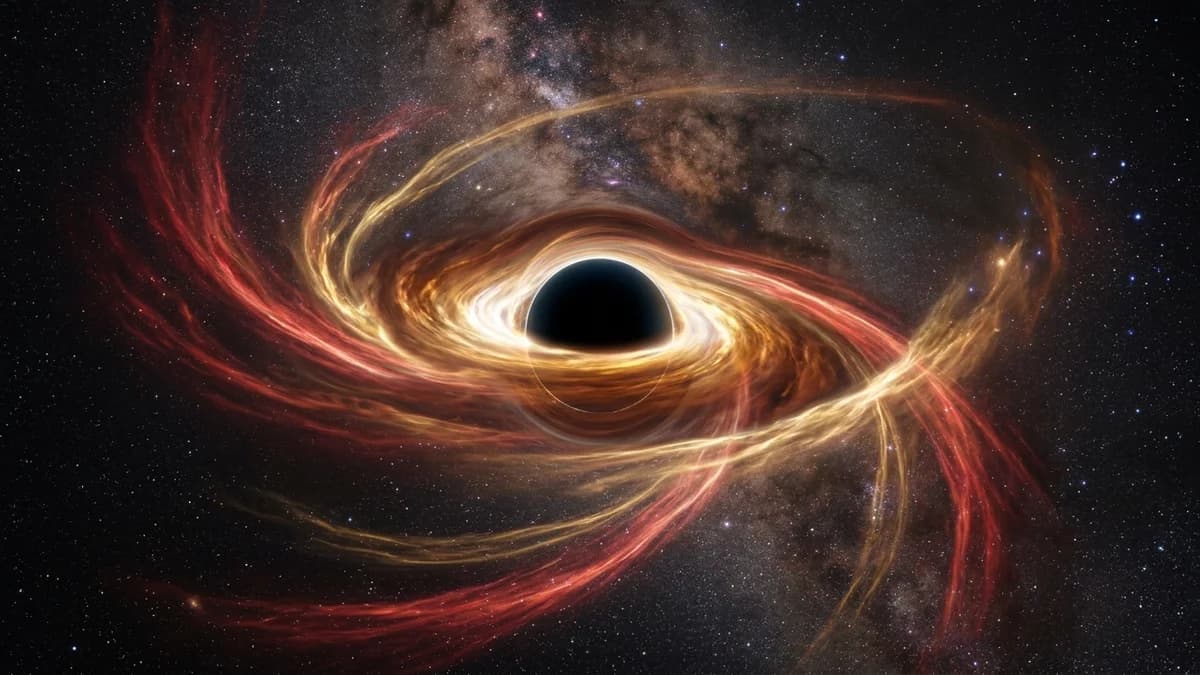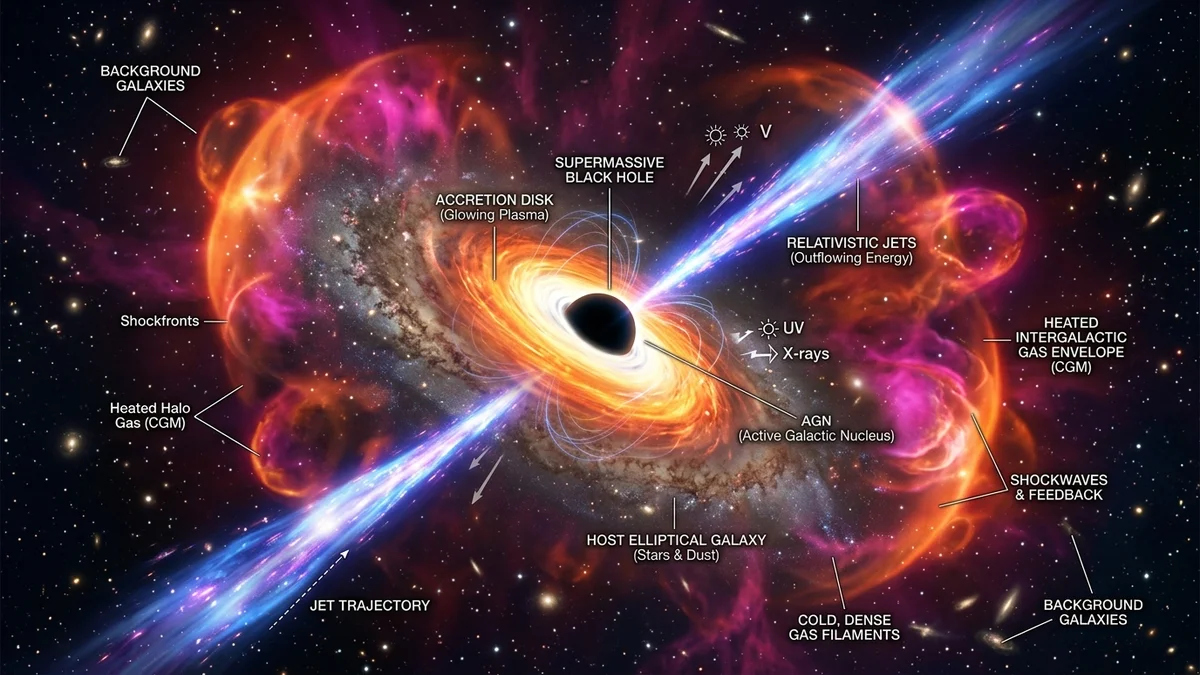
The response manifests as electromagnetic plasma jets traveling at speeds close to the speed of light. These colossal plumes collide with the surrounding cold gas, transferring kinetic energy and raising the temperature instantly. This heating halts the fall of matter into the black hole, closing the gravitational feeding valve until the gas cools again. The feedback loop ensures that the galaxy remains in a permanent state of stellar infertility.
Analysis of these thermal shockwaves reveals that the mechanical energy of the jets is distributed remarkably efficiently. Instead of simply piercing the gas, the plumes create magnetic cavitation bubbles that agitate and mix the entire galactic halo. This continuous agitation process prevents the existence of cold pockets where smaller stars could be born in isolation. The table below compares the main physical properties of the "Red Potato" galaxy with those of typical active star-forming spiral galaxies such as our own Milky Way, highlighting the critical cosmic differences.
These magnetic bubbles also emit high-frequency radio waves that can be observed using radio interferometer arrays. The synchronization of radio signals with thermal X-ray data allows astronomers to calculate the exact magnetic field strength inside the galactic halo. This interdisciplinary approach combines high-energy plasma physics with observational radio astronomy to solve the mystery of galactic death.
| Astrophysical Feature |
Red Potato Galaxy |
Typical Spiral Galaxy (Milky Way) |
Impact on the Stellar Cycle |
| Geometric Shape |
Elliptical and Irregular (Potato Shape) |
Symmetric Spiral Disk with Arms |
Irregular shape indicates ancient galactic mergers |
| Central Gas Temp |
10,000,000°C (Superheated in X-rays) |
-260°C to 100°C (Cold Molecular Clouds) |
Superheated gas prevents gravitational fusion |
| Star Formation Rate |
Practically Zero (Fully Blocked) |
1 to 3 solar masses per year |
Absence of short-lived young blue stars |
| Stellar Population |
Dominance of Old Red Stars |
Mixed Population (Blue and Red Stars) |
Red color indicates aged galaxy |
| Black Hole Activity |
Intermittent with Thermal Feedback Jets |
Quiescent with Low Matter Accretion |
Active feedback keeps gas hot for billions of years |
The continuous blockade of star formation in the "Red Potato" galaxy offers a unique window to study the end of the life cycle of galaxies. The loss of the capacity to generate new stars is known in astronomy as the galactic quenching process. By analyzing X-ray signatures and optical spectra, scientists can estimate how long ago the galaxy entered this dormant phase. In the case of the "Red Potato," it is estimated that star formation has been deactivated for more than four billion years.
The efficiency of this thermal blockade surprises scientists due to its stability over geological time. Even after mergers with smaller hydrogen-rich cold galaxies, the black hole manages to neutralize the new material quickly. The energy dissipated by the jets consumes and heats the captured matter before it can stabilize into cold molecular clouds. The study of this dynamic system helps validate the laws of energy conservation and magnetohydrodynamics in extreme cosmic environments.
These high-precision observations reinforce the importance of studying active galactic nuclei for general cosmology. The discoveries prove that black holes are not just destroyers of matter, but important structural regulators of the observable universe. The physics of the "Red Potato" galaxy will continue to serve as the main reference model for deciphering the evolution of elliptical galaxies across space.