Mystery on Venus: Giant Concentric Ring Structures Detected in the Upper Atmosphere

The atmosphere of the planet Venus has just revealed a mystery that challenges classical theories of planetary dynamics. Scientists from international astronomical consortia have identified giant concentric ring patterns extending for thousands of kilometers in the planet's upper cloud layer. This structure was detected through new high-resolution spectroscopic analyses obtained by active space probes. The discovery intrigues astronomers due to the regularity and colossal scale of the observed geometric shapes.
This atmospheric phenomenon is directly related to the propagation of atmospheric gravity waves on a scale never before recorded. The waves are generated by the impact of fast-moving winds against mountain ranges deep on the Venusian surface. As they rise through the dense gas layer, these disturbances expand and form compression fronts visible under ultraviolet light. Scientists suggest that this mechanism is primarily responsible for accelerating the rotation of Venus's atmosphere itself.
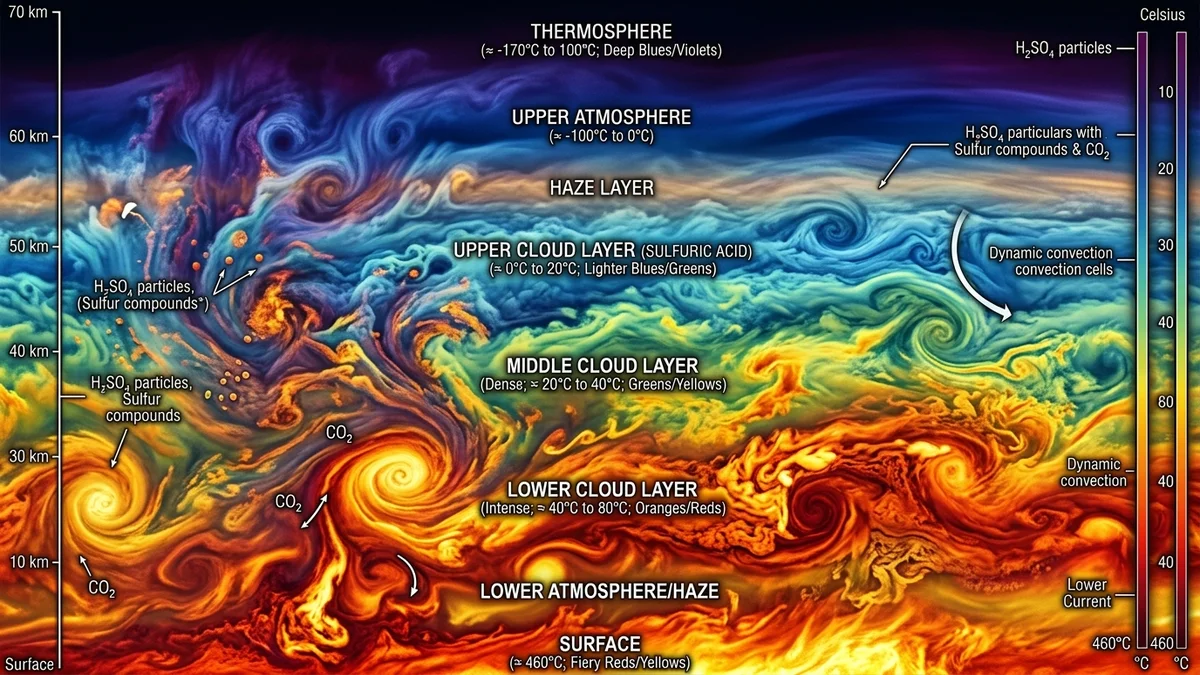
Detecting such well-defined concentric rings offers a unique opportunity to study the planet's internal layers without landing on its hostile ground. Venus has crushing surface pressures and temperatures exceeding 460 degrees Celsius, which destroy space probes within minutes of operation. Understanding the upper atmospheric circulation is essential for tracing the evolutionary history of our closest planetary neighbor. The research complements scientific efforts applied to mapping other extrasolar planets, such as thermal analyses of the atmosphere of the exoplanet LHS 1140b in search of water vapor.