🌍 Your knowledge portal
Science and Nature

Enigma Under the Crust: Juno Probe Reveals Jupiter's Moon Io is Much Hotter Than Estimated

📅 2026-07-27⏱️ 6 min read📝
⚡

Quick Summary

New data from NASA's Juno spacecraft reveal that the moon Io is dramatically hotter beneath the surface than models predicted. Jupiter's volcanic satellite, Io, has just become the center of a major revision in planetary astrophysics.

Key Takeaways:

  • The Juno spacecraft performed close passes at distances of only 1,500 kilometers from Io's rugged surface to obtain this unprecedented data.
  • Although Io is dotted with rugged sulfur mountains and colossal volcanoes, scientists have encountered plains displaying impressive smoothness.
  • Tidal heating in Io represents one of the most fascinating orbital dynamics of modern astrophysics.
Enigma Under the Crust: Juno Probe Reveals Jupiter's Moon Io is Much Hotter Than Estimated
Enigma Under the Crust: Juno Probe Reveals Jupiter's Moon Io is Much Hotter Than Estimated — High-Fidelity Artistic Illustration created by artificial intelligence based on scientific research.

Enigma Under the Crust: Juno Probe Reveals Jupiter's Moon Io is Much Hotter Than Estimated

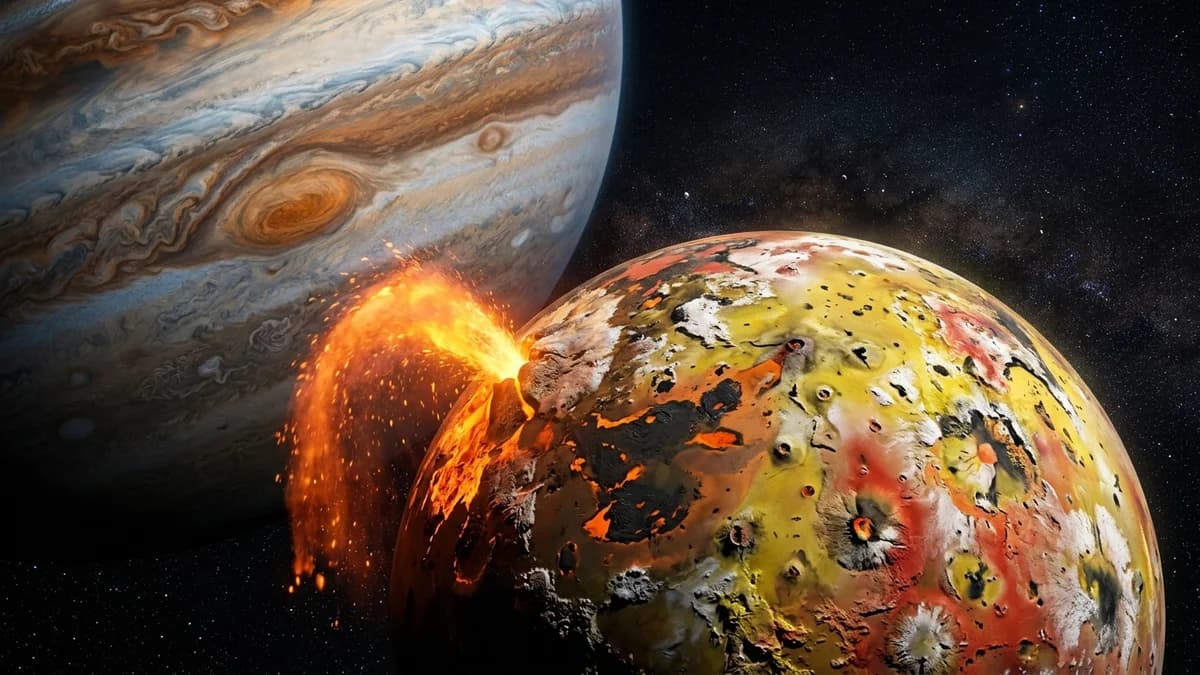
Scientific representation of Io in orbit around Jupiter with bright volcanic plumes

Jupiter's volcanic satellite, Io, has just become the center of a major revision in planetary astrophysics. New flyby data captured by the thermal sensors of the Juno spacecraft revealed that Io's interior is substantially hotter than previous theoretical models indicated. The onboard infrared sensors recorded continuous energy flows that exceed thermal equilibrium predictions by an impressive margin. This discovery points to the existence of much more intense internal frictional dynamics occurring beneath the surface of the celestial body.

This high-resolution information was processed by scientific teams at NASA's Jet Propulsion Laboratory (JPL). The research indicates that Io's mantle harbors colossal temperatures capable of maintaining a vast global ocean of molten rock in constant boiling. Detailed thermal mapping revealed hot spots distributed homogeneously, even in regions far from the main known volcanoes. Scientists celebrate the data, stating that the Juno probe is radically changing our understanding of the physics of gravitational tides.

These severe thermal interactions in the satellites of gas giants are fundamental to understanding the evolution of complex planetary systems. The discoveries on Io help astronomers model the heat of similar worlds outside our Solar System, refining the thermal signatures of distant rocky exoplanets. The dynamics of Io also serve as an important comparative laboratory for the study of other icy moons that harbor liquid water oceans under their crusts. This research complements the monitoring history of this satellite, which had already been documented in the past by the New Horizons probe during its flyby toward Pluto.
The Dynamic Crust and the Juno Spacecraft Flybys #

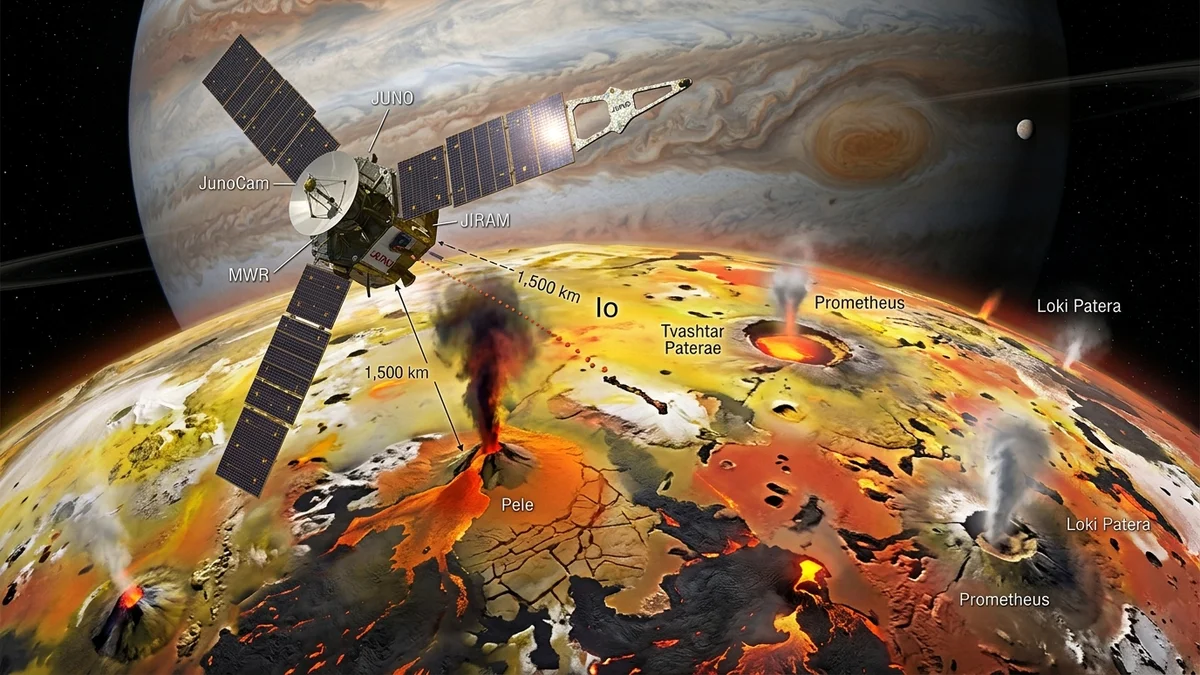
The Juno spacecraft performed close passes at distances of only 1,500 kilometers from Io's rugged surface to obtain this unprecedented data. This dangerous proximity required precise maneuvers from space navigation teams due to the intense radiation present in Jupiter's magnetic belt. The onboard infrared sensors successfully mapped the temperature of giant volcanoes like Pele and Loki Patera with detail never obtained before. The results show that the calderas expel silicate lava at temperatures exceeding 1,200 degrees Celsius.

Scientific illustration of the Juno spacecraft flying over the active volcanic calderas of Io

Spectroscopic analysis revealed subtle variations in the thermal emission behavior of these calderas during Io's orbital winter. The constant gravitational friction caused by the resonant orbits of Europa and Ganymede stretches and compresses Io in an endless cycle. This mechanical stress generates colossal physical deformations that create heat through internal friction of the upper mantle rocks. The Juno probe confirmed that this tidal flexing distributes energy much more deeply than expected.

Simulations based on these new thermal measurements suggest the presence of a global network of underground channels that facilitate magma transit. These volcanic ducts prevent the complete cooling of the crust, ensuring a constant flow of heat toward the thin surface. The discovery challenges traditional models that predicted the thermal isolation of the calderas. The dynamic behavior of Io will continue to be a primary focus for astrophysicists planning scientific mapping missions with the help of the new Roman Telescope late in the decade.

These thermal observations also help scientists refine their understanding of the intense electrical currents generated by Io's movement through Jupiter's magnetosphere. The volcano-driven plasma torus creates an electromagnetic pathway carrying millions of amperes between the moon and the giant planet's poles. This massive interaction generates powerful radio emissions that are continuously analyzed by ground-based radio telescopes.


The Mystery of Io's Inexplicably Smooth Plains #

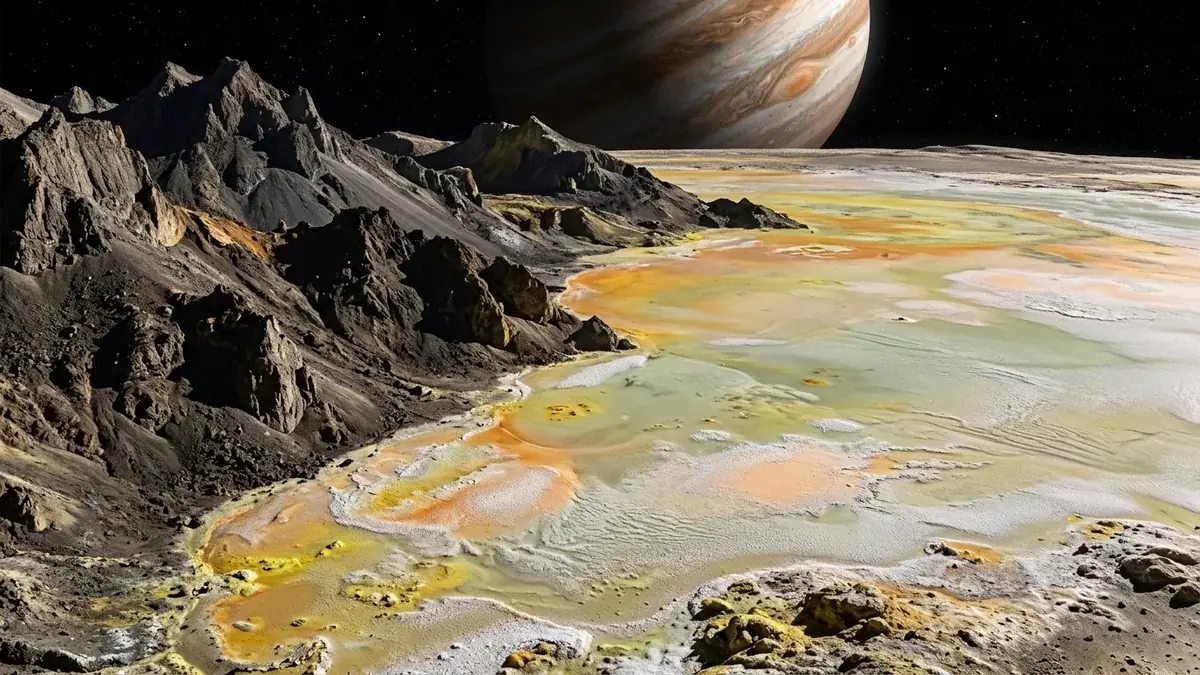
Although Io is dotted with rugged sulfur mountains and colossal volcanoes, scientists have encountered plains displaying impressive smoothness. New topographic maps indicate that these plains have almost no impact marks from meteorites, unlike neighboring moons such as Callisto. Rejuvenation of the ground is common on Venus and Mars, but on Io, this process occurs at an overwhelming speed. Active volcanism covers old marks of dust and debris within a few years of geological activity.

Io landscape displaying the sharp contrast between volcanic mountains and flat sulfur plains

The deposition of frozen sulfur dioxide acts as a natural paving agent that fills depressions in the terrain. Sulfur expelled by volcanic plumes condenses in the thin, freezing atmosphere, falling back to the surface as colorful chemical snow. This continuous precipitation accumulates meters of material per century, leveling large territorial areas and covering deep craters. Scientists study how Jupiter's gravity influences the flow and distribution of this molecular paving.

Furthermore, flows of superheated silicate lava travel great distances over the frozen crust before solidifying. This fluid lava behaves similarly to liquid water on Earth, carving smooth channels and leveled basalt plateaus. The integration of volatile sulfur flows and thick basaltic lava creates a dynamic landscape that constantly changes its appearance.

Additionally, the rapid freezing of sulfur dioxide in areas of thermal shadow creates localized microclimates where the terrain is altered daily. This constant gaseous condensation prevents the accumulation of dark meteoritic dust that typically covers other rocky worlds and moons. The visual purity of these plains reflects Io's geological youth and the strength of its super-active basaltic volcanism. The table below summarizes the main physical differences between the volcanism observed on Io and the volcanic eruptions occurring on Earth.


Comparative Table: Volcanism on Io versus Volcanism on Earth #

Volcanic Parameter Moon Io (Jupiter) Planet Earth Scientific Impact
Internal Heat Source Gravitational Tidal Heating Radioactive Decay & Primordial Heat Tidal mechanism is continuous and more dynamic
Lava Composition Rich in Silicates with Abundant Sulfur Mostly Silicate and Basalt Sulfur on Io generates yellow and red colors
Plume Height 100 to 500 kilometers (in vacuum) 10 to 50 kilometers (stratosphere limit) Low gravity on Io allows space plumes
Number of Volcanoes Over 400 active volcanoes About 50 active volcanoes at the same time Frequency of soil renewal is much higher
Magma Temperature Up to 1,300°C (ultra-high temperatures) Around 800°C to 1,200°C Internal temperature indicates more fluid mantle

Tidal Heating and the Geological Destiny of the Moon #

Tidal heating in Io represents one of the most fascinating orbital dynamics of modern astrophysics. The Laplace resonance, which aligns the orbits of Io, Europa, and Ganymede in a 4:2:1 ratio, is the perpetual gravitational engine of this system. Each time Europa passes Io, gravity pulls the moon slightly out of its stable circular orbit. This constant disturbance deforms the rocky structure of Io, generating heat by internal friction without interruption.

This heating mechanism should keep Io geologically active for another few billion years before the tides decay. However, the continuous rate of degassing through the volcanoes expels tons of material into space every second. This material forms a plasma torus of sulfur and oxygen around Jupiter, influencing the magnetic climate of the entire moon system. Data from the Juno probe help track how this ionic wind travels along the lines of the Jovian magnetic shield.

The geological destiny of Io is closely linked to this gradual loss of volatile mass and the slow orbital retreat of the Galilean moons. The physics behind this process serves as the primary model for studying superheated extrasolar worlds that orbit very close to their parent stars. The ongoing exploration of Io provides crucial answers about the past and future of dynamic worlds across the Milky Way.

These gravity-induced thermal balances also influence the potential habitability of neighboring Europa. By injecting heat into the Jovian system, Io's dynamic gravitational interactions contribute indirectly to maintaining Europa's subsurface liquid ocean. Understanding the interplay between Io's dry heat and Europa's hidden waters remains a key objective for upcoming missions like ESA's JUICE.

JIRAM 4.8-Micron Thermal Radiometry and Laplace Orbital Resonance Dissipation in Io #

High-resolution 4.8-micron infrared spectrograms captured by the Jovian Infrared Auroral Mapper (JIRAM) aboard NASA's Juno spacecraft demonstrate that the 4:2:1 Laplace orbital resonance linking Io, Europa, and Ganymede dissipates tens of terawatts of tidal friction within a global asthenospheric magma ocean, driving widespread conductive heat flow through Io's smooth plains even outside active paterae calderas.


Scientific References and Further Reading #

  • For official information on the Juno mission and Jupiter exploration, visit NASA Science.
  • Details on the studies of Jovian volcanic moons are available on the Jet Propulsion Laboratory (JPL) portal.
  • The scientific paper detailing Io's internal heat equations was published in the academic journal Science.

🏷️ Tags:

#Io#Jupiter#JunoSpacecraft#IoVolcanoes#Astronomy#SpaceExploration#NASA

📢 Gostou deste artigo?

Compartilhe com seus amigos e nos conte o que você achou nos comentários!

Receba novidades!

Cadastre seu email e receba as melhores curiosidades toda semana.

🔒 Sem spam. Cancele quando quiser.

💬 Comentários (0)

Seja o primeiro a comentar! 👋

📚Related Articles

The Enigma of Giant Moons: How Jupiter's Magnetic Field Saved Its Moons Unlike SaturnScience and Nature

The Enigma of Giant Moons: How Jupiter's Magnetic Field Saved Its Moons Unlike Saturn

A new astrophysical study reveals why Jupiter kept several giant moons, while Saturn lost its own, leaving Titan as the sole survivor.

⏱️6 minLer mais →
The Mystery of the 'Red Potato' Galaxy: How a Black Hole Prevents Star FormationScience and Nature

The Mystery of the 'Red Potato' Galaxy: How a Black Hole Prevents Star Formation

Astronomers unravel the mystery of the 'Red Potato' galaxy. Its supermassive black hole prevents the formation of new stars.

⏱️6 minLer mais →
The Enigma of Metallicity: Supercomputers Solve the Mystery of 'Missing Silver' in the SunScience and Nature

The Enigma of Metallicity: Supercomputers Solve the Mystery of 'Missing Silver' in the Sun

Scientists use supercomputers to solve the enigma of the Sun's 'missing silver'. Learn about the new metallicity simulation.

⏱️6 minLer mais →
Euclid Discovers the Universe's Oldest QuasarsScience and Nature

Euclid Discovers the Universe's Oldest Quasars

The Euclid space telescope has discovered 31 of the oldest quasars in the Universe. This historic discovery challenges current models of black hole growth.

⏱️6 minLer mais →
Aphelion 2026: Earth at Its Furthest Point from the Sun — The Real Science Behind the Phenomenon and the End of Extreme Cold MythsScience and Nature

Aphelion 2026: Earth at Its Furthest Point from the Sun — The Real Science Behind the Phenomenon and the End of Extreme Cold Myths

On July 6, 2026, Earth reached its aphelion, the furthest point from the Sun. Learn the science behind the phenomenon and the truth about extreme cold rumors.

⏱️7 minLer mais →
Jupiter vs Saturn: Magnetic Fields and MoonsScience and Nature

Jupiter vs Saturn: Magnetic Fields and Moons

A Kyoto University study published in Nature Astronomy in April 2026 reveals why Jupiter formed 4 giant moons while Saturn produced only one: Titan. Learn more.

⏱️11 minLer mais →
Receba novidades no WhatsApp!