15 Moon Facts That Will Surprise You
The Moon is there every night — so familiar that we forget how extraordinary it is. It's the only celestial body humanity has physically visited, and yet it holds secrets that surprise even veteran scientists.
From footprints that will remain for millions of years to the fact that it's slowly drifting away from us, our natural satellite is a world of extremes, mysteries, and cosmic coincidences that seem almost impossible.
1. Astronaut Footprints Will Last Millions of Years
The footprints left by Neil Armstrong and Buzz Aldrin in the Sea of Tranquility on July 20, 1969, are still there — and will remain for at least 10-100 million years.
The reason is simple: the Moon has no atmosphere. No wind, no rain, no water erosion, no significant tectonic activity. The only thing that can alter the lunar surface is micrometeorite impacts — and those hit any specific point with extremely low frequency.
Historical irony: the American flag planted during Apollo 11 probably fell over (Buzz Aldrin reported that the exhaust jet from the module knocked it down during liftoff). Images from the LRO probe (2012) confirmed that the flags from missions 12, 14, 15, 16, and 17 are still standing, but Apollo 11's doesn't appear. Additionally, over 50 years of unfiltered ultraviolet radiation has likely bleached all the flags completely — they're white, not red, white, and blue.
But the footprints remain. Possibly humanity's most enduring legacy.
2. The Moon Is Drifting Away — And Days Are Getting Longer
The Moon moves away from Earth at a rate of 3.8 centimeters per year — and we know this with millimetric precision thanks to laser retroreflectors left by the Apollo missions. Scientists on Earth fire laser pulses that reflect off these mirrors, and measuring the round-trip time allows calculating the distance with less than 1 millimeter error.
The mechanism: tidal forces slowly transfer Earth's rotational energy to the Moon's orbit. The Moon gains angular momentum and rises to a higher orbit; Earth loses rotation and spins more slowly.
The consequences are profound: Earth's days are getting longer — 1.7 milliseconds per century. Seems small, but it accumulates: 620 million years ago, a day was only 21 hours. Billions of years from now, a day will be 47 hours. And total solar eclipses — which depend on the Moon having nearly identical apparent size to the Sun — will eventually cease to exist.
3. "Dark Side of the Moon" Is a Myth (But the Name Stuck)
Pink Floyd's legendary album (1973) popularized the expression "dark side of the Moon," but it's scientifically incorrect. What exists is the far side — the face we never see from Earth because of synchronous rotation (the Moon takes exactly the same time to rotate on its own axis as it does to orbit Earth).
This far side receives as much sunlight as the visible side. It's not dark — it's simply hidden from our view.
Humanity saw the far side for the first time in 1959, when the Soviet probe Luna 3 photographed it. The surprise: it's drastically different. While the visible side has large "seas" (dark basalt plains), the far side is almost entirely covered in craters, with very few seas. The likely explanation is that the far side's crust is thicker, making the volcanism that formed the seas on the visible side more difficult.
In 2019, China made history by landing the Chang'e 4 probe on the far side — the first ever.
4. The Moon Has Quakes (And They Last Much Longer)
The Moon is seismically active. Seismographs left by the Apollo missions (1969-1972) detected four types of "moonquakes":
Deep: At approximately 700 km depth, caused by Earth's tidal forces. Weak but frequent (around 700 per year).
Shallow: The most dangerous — up to 5.5 on the Richter scale. The cause is still not fully understood.
Thermal: Caused by the expansion and contraction of the crust when transitioning from brutal sunlight (127°C / 261°F) to freezing shadow (-173°C / -279°F).
Impacts: Meteorites hitting the surface.
The crucial difference: on Earth, earthquakes last seconds to minutes. On the Moon, a moonquake can last more than 10 minutes — the Moon "rings like a bell" because of the absence of water in its interior (water absorbs vibrations; the dry Moon doesn't).
5. There Are Billions of Tons of Water on the Moon
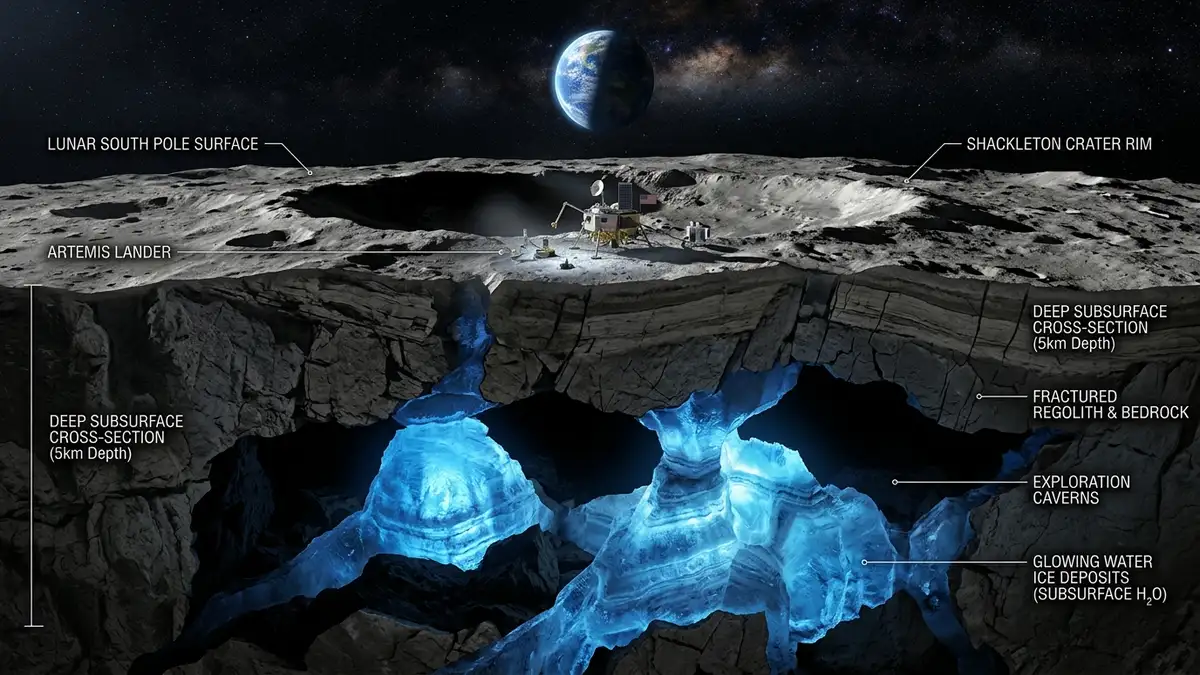
In 2009, NASA's LCROSS mission definitively confirmed the presence of water ice in permanently shadowed craters at the lunar poles. These craters never receive sunlight — temperatures can drop to -248°C (-414°F), cold enough to preserve ice for billions of years.
Recent estimates suggest the poles contain billions of tons of ice — potentially enough to sustain a lunar colony for centuries. The water can be used for drinking, growing plants, and decomposed into hydrogen and oxygen for rocket fuel.
In 2020, the SOFIA telescope (an observatory aboard a Boeing 747) detected water molecules on the sunlit lunar surface — in the Clavius crater, visible from Earth. The concentration is extremely low (100-400 ppm), but it proved that water exists even outside the shadowed craters.
6. Without the Moon, Earth Would Be Uninhabitable
The Moon stabilizes Earth's axial tilt at 23.5 degrees — the tilt responsible for the seasons. Without the Moon, computer models show that Earth's axis would vary chaotically between 0° and 85° over millions of years.
At 0° tilt, there would be no seasons. At 85°, the poles would receive direct sunlight for half the year while the equator froze. Winds of 300+ km/h (186+ mph) would dominate the atmosphere. The climate would be so unstable that the evolution of complex life would be unlikely.
Additionally, without the Moon's gravitational influence, Earth would spin much faster — days would be 6-8 hours long. This would mean extremely strong winds and completely different biological cycles.
7. The Moon Was Born from an Apocalyptic Collision
The most accepted theory for the Moon's origin — the Giant Impact Hypothesis — describes an event of cosmic violence difficult to imagine: approximately 4.5 billion years ago, a Mars-sized protoplanet called Theia collided with the young Earth.
The impact was so violent it vaporized significant portions of both bodies. The debris was launched into orbit around Earth and, within a few thousand years, gravitationally accumulated to form the Moon.
The evidence is strong: the Moon's oxygen isotopes are virtually identical to Earth's (indicating shared origin), the Moon has a proportionally much smaller iron core than Earth (Theia donated mainly rocky mantle material), and computer simulations reproduce the scenario consistently.
8. Lunar Mountains and Giant Craters
The Moon has extreme topography. Mons Huygens, the tallest mountain, stands at 5,500 meters — shorter than Everest (8,849m), but considering the Moon has 1/6 of Earth's gravity, much larger structures are possible without collapsing.
The South Pole-Aitken Basin, on the far side, is the largest known impact crater in the solar system: 2,500 km in diameter and 8 km deep. For scale: the entire continental United States from coast to coast is about 4,500 km. The basin covers more than half that distance.
9. Temperature Variation of 300°C (540°F)
Without an atmosphere to distribute heat, the Moon experiences the most dramatic thermal extremes in the inner solar system: +127°C (261°F) under direct sunlight (hotter than boiling water) and -173°C (-279°F) in shadows and during the 14-Earth-day lunar night.
This 300°C variation happens over a lunar "day" of 29.5 Earth days. Any equipment or structure on the Moon must withstand this brutal thermal cycling — a formidable engineering challenge for future bases.
10. On the Moon, the Sky Is Always Black
Without an atmosphere to scatter sunlight (the effect that creates the blue sky on Earth), the lunar sky is permanently black — even during the day, with the Sun shining intensely. Stars are visible 24 hours (though difficult to see when the Sun is above the horizon due to direct glare).
Earth appears in the lunar sky as a bluish, brilliant disk, 4 times larger than the Moon appears to us, making a complete rotation every 24 hours. It is, without a doubt, the most spectacular possible view of our planet.
11. Astronomical Coincidence: Perfect Eclipses
The Moon is 400 times smaller than the Sun, but it's 400 times closer. Result: the two have virtually the same apparent size in the sky (approximately 0.5 degrees). This allows perfect total solar eclipses, where the Moon covers the solar disk with millimetric precision, revealing the solar corona.
No other planet in the solar system has this coincidence. And it's temporary: since the Moon moves away 3.8 cm/year, in approximately 600 million years it will be too small to cover the Sun. Total eclipses will cease to exist. We live in the right cosmic window to witness them.
12. On the Moon, You'd Jump 6 Times Higher
Lunar gravity is 1/6 of Earth's (1.62 m/s² versus 9.8 m/s²). A 50 cm jump on Earth would become a 3-meter leap on the Moon. Your mass stays the same (inertia doesn't change), but your weight drops to approximately 1/6.
Apollo astronauts discovered in practice that moving on the Moon is surprisingly difficult: low gravity makes body control unstable. The technique that worked best was a "kangaroo hop," not normal walking. Several fell — fortunately the suits were resistant.
13. The Moon Has an "Atmosphere" (Technically)
The Moon possesses an exosphere — a layer of gas so thin it's 100 trillion times less dense than Earth's atmosphere. It's practically a vacuum, but not completely.
This exosphere contains traces of helium, neon, argon, sodium, and potassium — from solar wind, rock outgassing, and meteorite impacts. It's so rarefied that individual molecules rarely interact with each other.
Consequences: no protection against cosmic radiation, no sound propagation, no weather. An absolutely hostile environment for unprotected living beings.
14. The Moon Controls the Tides (And Shaped Life on Earth)
Lunar gravity pulls on Earth's oceans, creating two "tidal bulges" — one on the side closest to the Moon and another on the opposite side (due to inertia). As Earth rotates beneath these bulges, each coastal point experiences two high tides and two low tides per day.
When Moon and Sun align (new moon and full moon), tides are maximum — spring tides. When they're perpendicular (first and third quarter), tides are minimum — neap tides.
The biological impact is profound: the intertidal zone — the coastal strip between high and low tide — is one of the most biodiverse ecosystems on the planet. Many biologists believe the transition of life from oceans to dry land began precisely in these zones, pushed by the tides.
15. The Moon Isn't Gray — It Has Colors We Can't See
Seen with the naked eye, the Moon appears uniformly gray. But photographs with enhanced saturation reveal a subtle rainbow: blues (titanium oxides), oranges (iron oxides), browns (iron-rich basalt). Each color indicates different mineral composition.
The uniform gray appearance is caused by regolith — a 5-10 meter layer of dust created by billions of years of micrometeorite impacts that pulverized the surface. This dust covers everything like snow covers a landscape, uniformizing the color.
Curiosity: lunar dust is extremely abrasive and toxic. Since there's no erosion (wind/water), the grains are angular like microscopic glass shards, not rounded like beach sand. Apollo astronauts reported that the dust damaged suits, stuck to everything, and irritated lungs — a serious problem for future extended stays.
The Lunar Future: Artemis Program and Beyond
Humanity is returning to the Moon. NASA's Artemis program plans to land the first astronauts since 1972 — including the first woman and the first person of color on the lunar surface.
Long-term objectives: A permanent lunar base at the south pole (Artemis Base Camp), telescopes on the far side (no terrestrial radio interference), mining Helium-3 (fuel for future nuclear fusion), and using the Moon as a "stepping stone" to Mars (low gravity makes launches much more efficient).
The challenges are formidable: radiation, toxic dust, extreme temperatures, psychological isolation, and immense costs. But the presence of water at the poles changes the equation — transforming the Moon from a visit destination into a permanent outpost has become viable.
Frequently Asked Questions
How many people have been to the Moon?
12 people walked on the lunar surface, all from NASA, between 1969 and 1972 (Apollo 11, 12, 14, 15, 16, and 17). All were American men. The Artemis program aims to diversify that list.
Can the Moon fall to Earth?
No. The Moon is moving away, not closer. Even if it stopped moving, its orbital momentum would keep it in orbit.
Why does the Moon look bigger on the horizon?
It's an optical illusion called the "Moon illusion." The actual size doesn't change — the brain interprets it as larger when there are reference objects (buildings, trees) on the horizon.
Sources: NASA (Apollo Archives, LCROSS, LRO), ESA, Williams J.G. et al. "Lunar laser ranging tests of the equivalence principle" (2012), Wieczorek M.A. "The constitution and structure of the lunar interior" (Reviews in Mineralogy, 2006). Updated January 2026.
Read also: