🌍 Your knowledge portal
Science and Nature

James Webb Telescope Shatters Cosmic Record by Detecting JADES-GS-z14-0, the Most Distant Galaxy in the Universe
📅 2026-09-14⏱️ 6 min read📝
James Webb Telescope Shatters Cosmic Record by Detecting JADES-GS-z14-0, the Most Distant Galaxy in the Universe
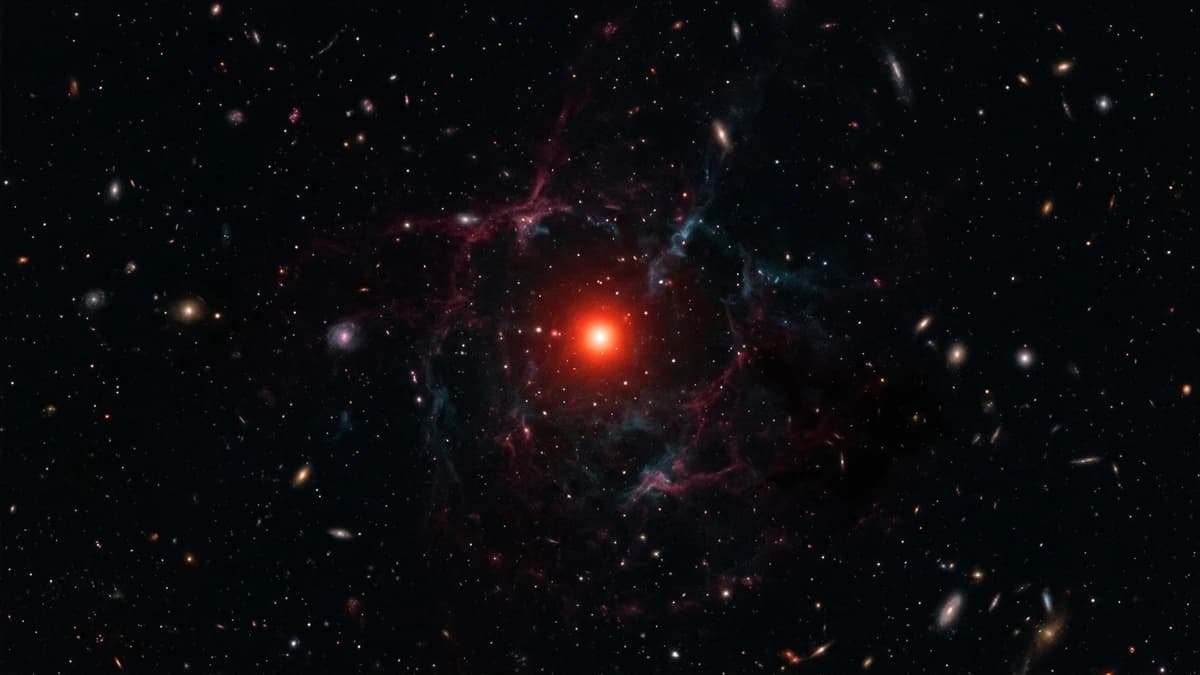
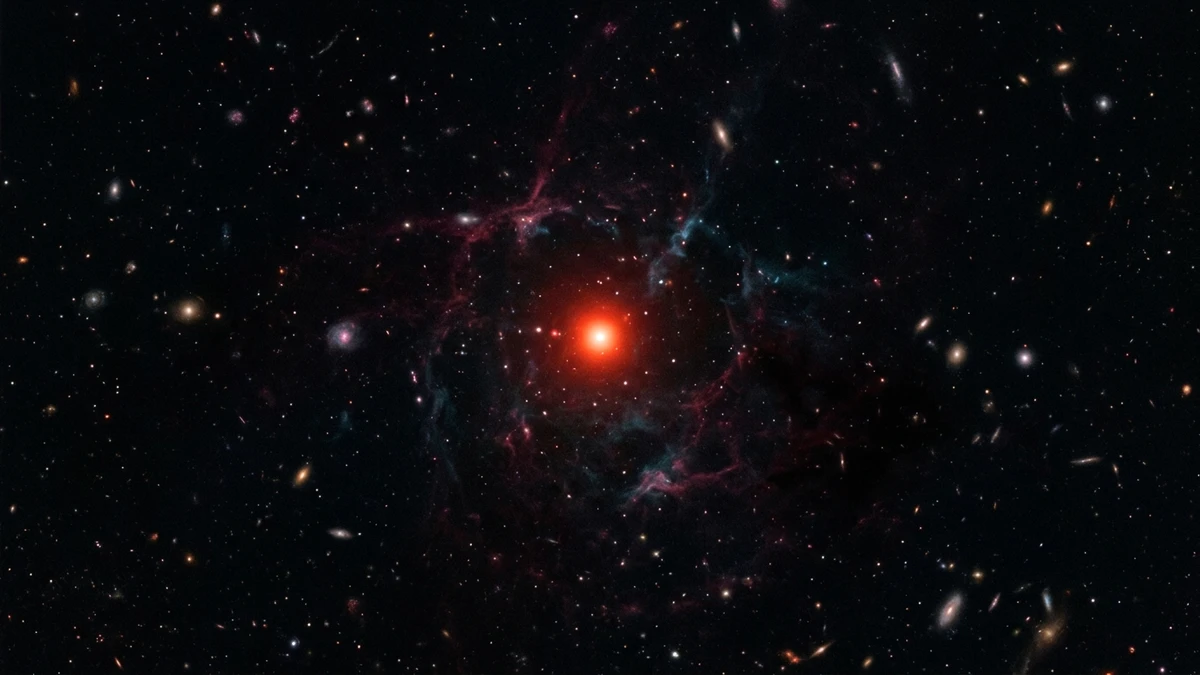
James Webb Telescope Shatters Cosmic Record by Detecting JADES-GS-z14-0, the Most Distant Galaxy in the Universe — High-Fidelity Artistic Illustration created by artificial intelligence based on scientific research.
⚡

Quick Summary

With a historic redshift z=14.32 and unexpected luminosity 290 million years after the Big Bang, the galaxy reveals oxygen and challenges modern astrophysics. An international astrophysics collaboration has officially confirmed the most distant galaxy ever identified by human civilization in the deep cosmos.

Key Takeaways:

  • Determining the extraordinary distance to JADES-GS-z14-0 required the unprecedented analytical capability of the NIRSpec instrument, built in partnership with the European Space Agency.
  • The primary aspect that truly astonished researchers was not merely the record distance, but rather the immense intrinsic luminosity exhibited by JADES-GS-z14-0.
  • To rigorously investigate the elemental composition of this cosmic relic, international research teams directed the powerful antennas of the European Southern Observatory (ESO / ALMA) in Chile.

James Webb Telescope Shatters Cosmic Record by Detecting JADES-GS-z14-0, the Most Distant Galaxy in the Universe

Scientific illustration of primordial galaxy JADES-GS-z14-0 observed by the James Webb Space Telescope during the cosmic dawn

An international astrophysics collaboration has officially confirmed the most distant galaxy ever identified by human civilization in the deep cosmos. Utilizing the ultra-sensitive near-infrared instruments aboard NASA's James Webb Space Telescope, researchers spectroscopically verified that galaxy JADES-GS-z14-0 shone just 290 million years after the birth of the universe in the Big Bang. This historical scientific achievement redefines the observable cosmic horizon and offers an unprecedented observational window into the earliest stages of the cosmic dawn.

The groundbreaking discovery establishes an absolute milestone across observational astronomy by surpassing every previous cosmological distance record known to researchers. Rather than detecting a faint and nebulous smudge, the space observatory revealed an intensely luminous stellar system characterized by surprisingly complex physical structures. The infrared light captured by the telescope traveled through the cosmic vacuum for more than 13.5 billion years before reaching the gold-plated mirrors of the observatory.

The scientific impact of this confirmation is reverberating across astronomical research institutions worldwide while provoking intense theoretical reflection regarding primordial structures. The undeniable existence of such a radiant object so shortly after the cosmic beginning challenges current theoretical simulations that predicted only tiny, diffuse gas clouds. Cosmologists must now revise the opening chapters of stellar evolution to explain how the universe assembled substantial organized mass in such a compressed timeframe.
Spectroscopic Confirmation of Redshift z=14.32 and the Cosmic Dawn #

Determining the extraordinary distance to JADES-GS-z14-0 required the unprecedented analytical capability of the NIRSpec instrument, built in partnership with the European Space Agency. The spectrograph dispersed incoming radiation into distinct constituent wavelengths, revealing with rigorous mathematical accuracy a record-setting cosmological redshift of z=14.32. This extreme spectral shift demonstrates that continuous cosmic expansion has stretched the original ultraviolet emission from early stars into infrared wavelengths completely invisible to human eyes.

Primordial Cosmic Object Spectroscopic Redshift (z) Post-Big Bang Epoch (Million Years) Estimated Physical Diameter (Light-Years) Detected Heavy Chemical Elements
JADES-GS-z14-0 14.32 ~290 million ~1,600 light-years Ionized Oxygen [O III] and Hydrogen
JADES-GS-z14-1 14.01 ~305 million ~1,100 light-years Primordial Hydrogen and Helium
GLASS-z12 12.11 ~350 million ~2,000 light-years Neutral Carbon and Hydrogen
GN-z11 (Hubble/JWST) 10.60 ~400 million ~2,500 light-years Nitrogen, Carbon, and Oxygen
ZS7 Merger (JWST 2026) 3.08 ~740 million ~8,500 light-years Iron, Silicon, Oxygen, and Carbon

These spectroscopic results have effectively dismantled any lingering theoretical skepticism regarding the physical nature and precise chronological placement of this remarkable galaxy. Many candidate distant galaxies identified previously through standard photometric filtering techniques ultimately turned out to be closer objects obscured by thick layers of reddish cosmic dust. In the case of JADES-GS-z14-0, the exceptionally clean spectral signatures provided definitive statistical certainty that astronomers are witnessing the primordial heart of the cosmic dawn.

This remote epoch, commonly termed the era of cosmic reionization, marks the pivotal moment when radiation from first-generation stars began dissipating the pervasive fog of neutral hydrogen gas. Astronomers have long strived to comprehend how this sweeping energetic transition progressed throughout the opening hundreds of millions of cosmic years. Confirming that robust galactic systems were already operating vigorously during this pioneering period demonstrates that cosmic reionization occurred far more swiftly and dynamically than previously assumed.

The Puzzle of Excessive Luminosity: Unexpected Stellar Populations #

The primary aspect that truly astonished researchers was not merely the record distance, but rather the immense intrinsic luminosity exhibited by JADES-GS-z14-0. Standard computational simulations modeling early cosmic structure formation postulated that galaxies existing 290 million years post-Big Bang would be faint, fragile, and exceptionally faint. Instead, the radiant output measured from this primordial system is dozens of times brighter than conventional cosmological paradigms could comfortably accommodate.

Comprehensive spectroscopic analyses have confirmed that this intense radiation is not emitted by an energetic quasar driven by an actively feeding supermassive central black hole. The notable absence of characteristic high-energy X-ray signatures combined with the spatial distribution of light indicates that emission originates directly from hundreds of millions of massive stars. This dense stellar reservoir possesses a combined gravitational mass equivalent to several hundred million times the mass of our own Sun.

The verified presence of so many massive stars implies that early star formation rates were extraordinarily vigorous and uninterrupted across the nascent universe. This phenomenon challenges orthodox theoretical frameworks governing gas cooling and gravitational fragmentation within juvenile dark matter halos. Theoretical astrophysicists are actively debating whether initial stellar populations possessed exotic chemical compositions capable of boosting radiative efficiency without violating fundamental thermodynamic principles.

Oxygen Detection by ALMA and the Collapse of Theoretical Models #

To rigorously investigate the elemental composition of this cosmic relic, international research teams directed the powerful antennas of the European Southern Observatory (ESO / ALMA) in Chile. High-precision millimeter-wave measurements detected the unmistakable presence of ionized oxygen gas thriving within JADES-GS-z14-0. This chemical discovery represents a profound scientific revolution because oxygen is a heavy element entirely absent from primordial Big Bang nucleosynthesis.

During the initial moments of universal creation, cosmic nucleosynthesis produced almost exclusively hydrogen, helium, and negligible trace amounts of lithium. Every single atom of oxygen existing across the cosmos requires massive stellar progenitors to complete their lifecycle and detonate as catastrophic supernovas. Identifying detectable concentrations of oxygen within just 290 million years proves that multiple consecutive cycles of stellar birth and death had already concluded in this region.

Modern theoretical astrophysics faces the pressing imperative to explain how multiple stellar generations could forge heavy elements and enrich the interstellar medium so rapidly. Classical evolutionary models estimated that at least 500 to 700 million years were necessary to synthesize observable quantities of secondary chemical elements. Discovering rich oxygen so early in universal history is conceptually comparable to discovering sophisticated stone architectural ruins where researchers only anticipated rudimentary clay tools.

How JADES-GS-z14-0 Reshapes Primordial Cosmic History #

The empirical confirmation of JADES-GS-z14-0 fundamentally reshapes core foundations of contemporary cosmological evolution and overturns assumptions maintained for several decades. Rather than witnessing a slow, hesitant beginning, the birth of radiant structures throughout the early universe appears to have been explosive and remarkably widespread. This emerging paradigm indicates that dense gravitational seeds began collapsing and accreting surrounding matter substantially earlier than astronomers had previously calculated.

The physical scale of the galaxy, extending across an estimated diameter of more than 1,600 light-years, proves that it is not an ephemeral or point-like structure. It represents a spatially resolved galactic entity possessing a dense central core and proto-galactic spiral filaments undergoing rapid morphological growth. This substantial spatial footprint confirms that the gravitational accretion of dark matter and primordial gas operated with remarkably superior efficiency in the early universe.

Theoretical bridges connecting these findings to discoveries of ancient black holes, such as the supermassive black hole merger in galaxy ZS7, acquire renewed explanatory power. If radiant galaxies rich in heavy chemical elements were already thriving at extreme cosmological redshifts, the emergence of early active galactic nuclei fits naturally into a cohesive evolutionary tapestry. The primordial universe reveals itself not as an empty, dark void, but as an energetic forge of complex chemistry and stellar light.

The Future of Deep Observations and New Astronomical Horizons #

The discovery of JADES-GS-z14-0 does not represent an endpoint, but rather inaugurates an exciting new frontier across modern observational astrophysics. The James Webb Space Telescope will sustain its deep-field exploration campaigns, systematically probing increasingly distant corridors of the primordial night sky. Cosmologists anticipate that additional objects situated at even higher redshifts, potentially exceeding z=15 or z=16, will be uncovered throughout upcoming cycles of scientific investigation.

Spectroscopic datasets harvested from this discovery now provide an indispensable empirical benchmark to calibrate the next generation of giant ground-based telescopes currently under construction worldwide. Colossal observatories, such as the Extremely Large Telescope in Chile and the Giant Magellan Telescope, will leverage these measurements to map gas kinematics with breathtaking spatial resolution. Harmonizing space-based infrared observatories with cutting-edge ground-based optical systems will unveil the most intimate secrets of the cosmic dawn.

Human knowledge has attained a philosophical depth that mere decades ago seemed permanently restricted to speculative science fiction narratives. By unraveling the ancient light emitted by JADES-GS-z14-0, our civilization contemplates the first radiant embers that pierced the primordial darkness of the cosmos. This remarkable scientific triumph proves that relentless intellectual curiosity combined with visionary engineering can illuminate the deepest questions concerning our cosmic origins.

🏷️ Tags:

#jameswebbjades-gs-z14-0#mostdistantgalaxyuniverse#redshift14.32#earlyuniverseoxygen#astronomy2026#jwstspacetelescope#bigbangcosmology

📢 Gostou deste artigo?

Compartilhe com seus amigos e nos conte o que você achou nos comentários!

❓Frequently Asked Questions

Confirmation of the extraordinary cosmic distance to JADES-GS-z14-0 was achieved through the near-infrared spectrograph NIRSpec, which precisely measured a record-breaking cosmological redshift of z=14.32. This pivotal measurement demonstrates that electromagnetic radiation emitted by this primordial galaxy traveled across expanding cosmic space for more than thirteen billion years before reaching the gold-plated mirrors of the observatory. Direct spectroscopic verification eliminates earlier photometric ambiguities, firmly establishing this early stellar system as the most distant and ancient confirmed galactic structure cataloged in modern astronomical history.
The clear detection of ionized oxygen in a galaxy existing merely two hundred and ninety million years after the Big Bang profoundly challenges conventional cosmological timelines established by theoretical models. Standard stellar evolution paradigms predicted that the early universe was populated almost entirely by pristine primordial hydrogen and helium, requiring longer cosmic epochs to synthesize heavy elements inside stellar furnaces. Abundant oxygen proves that entire early generations of massive stars were born, forged matter, and died in violent supernovas with startling rapidity across the cosmic dawn.
Unlike mature spiral systems found throughout our local contemporary cosmos, JADES-GS-z14-0 displays an extraordinarily compact stellar concentration spanning an estimated physical diameter of approximately sixteen hundred light-years across space. Its astonishing luminosity does not originate from an actively feeding supermassive central black hole, but rather from the intense simultaneous nuclear fusion of hundreds of millions of massive young stars. Furthermore, the primordial galaxy shines fiercely in intrinsic ultraviolet wavelengths that have been dramatically stretched into deep infrared spectral bands by accelerated cosmological spacetime expansion over cosmic epochs.

Receba novidades!

Cadastre seu email e receba as melhores curiosidades toda semana.

🔒 Sem spam. Cancele quando quiser.

💬 Comentários (0)

Seja o primeiro a comentar! 👋

📚Related Articles

NASA’s "Big Bang": The Risky Command That Saved Voyager 2 in Interstellar SpaceScience and Nature

NASA’s "Big Bang": The Risky Command That Saved Voyager 2 in Interstellar Space

Discover how NASA engineers performed an emergency electrical maneuver to extend Voyager 2's lifespan 20 billion km from Earth.

⏱️6 minLer mais →
Cosmic Collision: SpaceX Falcon 9 Rocket Stage Impacts the Moon and Creates a New CraterScience and Nature

Cosmic Collision: SpaceX Falcon 9 Rocket Stage Impacts the Moon and Creates a New Crater

A spent second stage of a Falcon 9 rocket collided with the lunar surface near the Einstein and Bell craters, creating a fresh 25-meter crater and providing unprecedented scientific data.

⏱️6 minLer mais →
Invisible Giant: Wandering Black Hole Caught Devouring Star in Deep SpaceScience and Nature

Invisible Giant: Wandering Black Hole Caught Devouring Star in Deep Space

Astronomers have detected a wandering supermassive black hole located 30,000 light-years from the center of its galaxy, caught devouring a star in a rare tidal disruption event.

⏱️6 minLer mais →
Hidden Treasures: Scientists Use Seismic Waves to Map Ice Beneath the Moon's SoilScience and Nature

Hidden Treasures: Scientists Use Seismic Waves to Map Ice Beneath the Moon's Soil

A new scientific technique utilizing the propagation of seismic waves allowed mapping large reservoirs of water ice hidden beneath the Moon's south pole subsurface.

⏱️5 minLer mais →
Centennial Encounter: Comet Tempel 2 Makes Its Closest Approach to Earth in 100 YearsScience and Nature

Centennial Encounter: Comet Tempel 2 Makes Its Closest Approach to Earth in 100 Years

The periodic comet 10P/Tempel 2 makes its closest approach to Earth in a century in early August 2026, mobilizing astronomers worldwide.

⏱️5 minLer mais →
Extraterrestrial Geometry: Curiosity Discovers Honeycomb Pattern on Mars SoilScience and Nature

Extraterrestrial Geometry: Curiosity Discovers Honeycomb Pattern on Mars Soil

Fossilized hexagonal mud fractures identified by NASA's Curiosity at Gale Crater provide direct evidence of cyclical wet and dry seasons on ancient Mars.

⏱️6 minLer mais →
Receba novidades no WhatsApp!