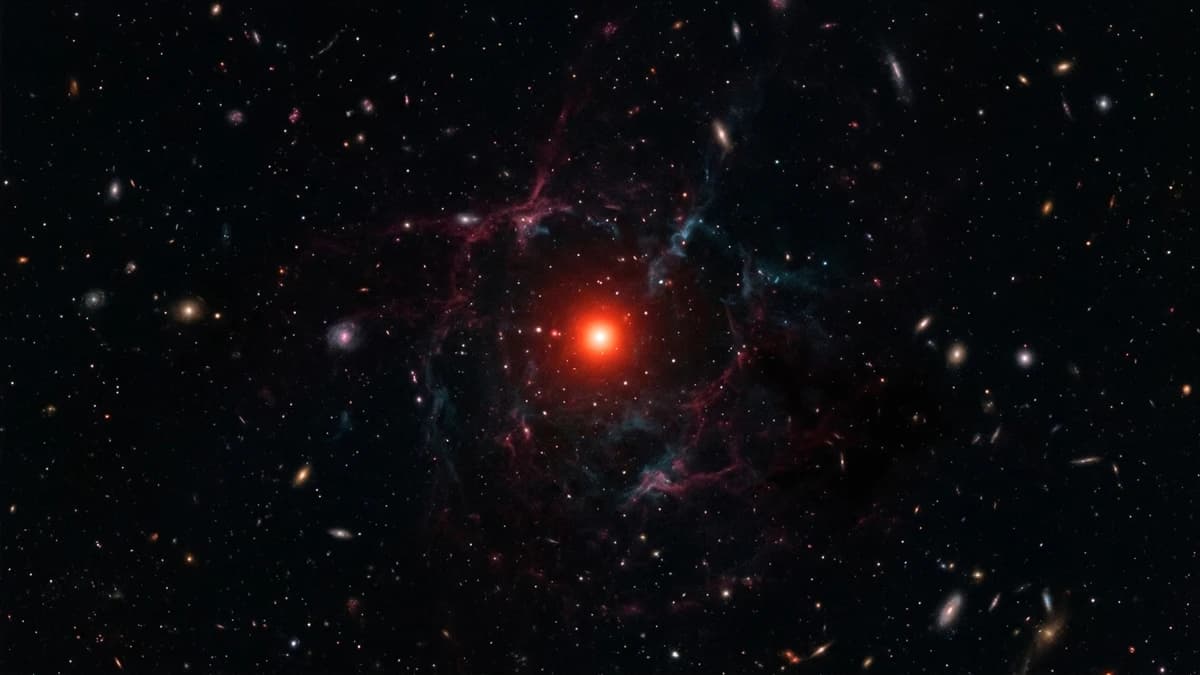
Humanity has just taken another giant leap in the search for life beyond Earth. In January 2026, an international team of astronomers led by the University of Southern Queensland (UniSQ) in Australia announced the discovery of a fascinating exoplanet: HD 137010 b. This distant world, located approximately 146 light-years from our planet, possesses characteristics that make it one of the most promising candidates in the search for extraterrestrial life.
What makes this discovery so special? HD 137010 b is practically the same size as Earth — only 6% larger — and orbits a Sun-like star in a period of approximately 355 days. Even more impressive: scientists estimate there is a 50% probability that this planet is located in the habitable zone of its star, that region where conditions may allow liquid water to exist on the surface.
What We Know About HD 137010 b
Physical Characteristics of the Exoplanet
HD 137010 b represents an extraordinary discovery in the field of astronomy. According to the study published in The Astrophysical Journal Letters in January 2026, this exoplanet has dimensions remarkably similar to Earth's, placing it in a special category of worlds that could potentially harbor life.
The planet was detected using archived data from NASA's Kepler Space Telescope K2 mission, originally collected in 2017. The meticulous analysis of this data, led by researcher Alexander Venner from UniSQ, revealed a world with the following characteristics:
Size and Mass:
- Radius approximately 6% larger than Earth's
- Classified as a rocky (terrestrial) planet
- Density compatible with Earth-like composition
Orbit and Period:
- Orbital period of approximately 355 Earth days
- Orbits around a solar-type star (HD 137010)
- Distance from host star compatible with the habitable zone
Estimated Temperature:
- Estimated surface temperature around -70°C (-94°F)
- Conditions similar to those found on Mars
- Possibility of milder temperatures with a denser atmosphere
The Host Star: HD 137010
The star HD 137010, around which our protagonist orbits, is a solar-type star located in the constellation Libra. This star possesses characteristics that make it particularly interesting for the search for habitable planets.
The star has mass and luminosity comparable to our Sun, meaning the habitable zone around it is at a similar distance to what Earth maintains from the Sun. This is crucial because it allows planets in this region to receive an adequate amount of stellar energy to maintain water in liquid state — an ingredient considered essential for life as we know it.
The Habitable Zone: Between Hope and Caution
What Is the Habitable Zone?
The habitable zone, often called the "Goldilocks zone" (in reference to the fairy tale where the porridge temperature was "not too hot, not too cold, but just right"), is the region around a star where temperature conditions allow liquid water to exist on a planet's surface.
For HD 137010 b, calculations indicate a 50% probability that the planet is within this critical zone. This uncertainty exists because the exact determination of an exoplanet's orbit from transit data (when the planet passes in front of its star) has inherent margins of error.
The Temperature Challenge
Even while potentially being in the habitable zone, HD 137010 b faces a significant challenge: its estimated surface temperature is approximately -70°C. To put this in perspective, this temperature is colder than any inhabited place on Earth and approaches conditions found on Mars.
However, scientists maintain cautious optimism. As the research team explained: "If HD 137010 b has an atmosphere similar to Earth's or Mars's, it would likely be colder than Antarctica. However, a denser atmosphere could warm the planet enough to allow liquid water, which could create a favorable environment for life."
The Role of Atmosphere
A planet's atmosphere serves as a decisive factor in determining its surface conditions. The greenhouse effect — the same phenomenon causing global warming on Earth — can significantly raise a planet's temperature.
Consider the following examples in our own Solar System:
Venus: Despite being farther from the Sun than Mercury, Venus is the hottest planet in the Solar System due to its dense carbon dioxide atmosphere, which creates an extreme greenhouse effect, raising surface temperature to about 465°C.
Mars: With a very thin atmosphere, Mars cannot retain heat efficiently, resulting in average temperatures of -60°C, despite being on the outer edge of the Sun's habitable zone.
Earth: Our atmosphere, with its balanced mix of gases, maintains an average global temperature of approximately 15°C, allowing abundant liquid water to exist.
If HD 137010 b possesses a substantial atmosphere with greenhouse gases, its surface temperatures could be significantly milder than initial estimates suggest.
How the Discovery Was Made
The Legacy of the Kepler Telescope
The discovery of HD 137010 b is another triumph for NASA's Kepler Space Telescope, even years after the end of its operational mission. Launched in 2009, Kepler revolutionized our understanding of the universe by discovering thousands of exoplanets using the transit method.
The transit method works as follows: when a planet passes in front of its host star (from our point of view), it blocks a small fraction of starlight. By measuring these periodic decreases in stellar brightness, astronomers can infer the presence of a planet and calculate its size and orbital period.
The K2 mission, an extension of Kepler's original mission after a failure in its gyroscopes, continued observing different regions of the sky until 2018. Data collected during this phase continues to yield important discoveries, as demonstrated by the case of HD 137010 b.
Data Analysis
The team led by Alexander Venner used advanced data analysis techniques to identify HD 137010 b's signal in Kepler's archives. The process involved:
- Noise filtering: Removal of brightness variations caused by the star's own activity
- Transit identification: Detection of periodic decreases consistent with a planet's passage
- Statistical validation: Confirmation that the signal is not a false positive caused by other phenomena
- Planetary characterization: Calculation of the planet's physical properties from transit data
HD 137010 b in Context: Comparison with Other Exoplanets
The Best Candidates for Habitable Planets
HD 137010 b joins a growing list of exoplanets considered potentially habitable. Let's compare its characteristics with other notable candidates:
Proxima Centauri b:
- Distance: 4.2 light-years (the closest exoplanet to Earth)
- Size: Approximately 1.17 times Earth's mass
- Orbital period: 11.2 days
- Challenges: Orbits a red dwarf with intense flare activity
TRAPPIST-1e:
- Distance: 40 light-years
- Size: 0.92 times Earth's radius
- Orbital period: 6.1 days
- Challenges: System with seven planets, possible tidal locking
Kepler-442b:
- Distance: 112 light-years
- Size: 1.34 times Earth's radius
- Orbital period: 112 days
- Advantages: High probability of being in the habitable zone
HD 137010 b:
- Distance: 146 light-years
- Size: 1.06 times Earth's radius
- Orbital period: 355 days
- Advantages: Earth-like orbit, solar-type star
What Makes HD 137010 b Special
Among all known potentially habitable exoplanets, HD 137010 b stands out for several reasons:
Solar-type host star: Unlike many habitable exoplanets that orbit red dwarfs (smaller and cooler stars than the Sun), HD 137010 b orbits a star similar to our Sun. This is significant because red dwarfs frequently emit intense radiation flares that can be harmful to life.
Earth-like orbital period: With a year of approximately 355 days, HD 137010 b has an orbit remarkably similar to Earth's. This suggests the planet receives a comparable amount of stellar energy to what our planet receives from the Sun.
Terrestrial size: With only 6% more radius than Earth, HD 137010 b is one of the most similar exoplanets in size to our planet ever discovered in the habitable zone of a solar-type star.
The Future of Exploration: Telescopes and Missions
Pandora Telescope: The New Atmosphere Hunter
In a notable temporal coincidence, NASA launched the Pandora Space Telescope on January 11, 2026, just weeks before the announcement of HD 137010 b's discovery. This mission was specifically designed to study the atmospheres of transiting exoplanets.
Pandora has impressive characteristics:
- Primary mirror: 45 cm diameter
- Instruments: Visible photometer and near-infrared spectrograph
- Orbit: Sun-synchronous low Earth orbit at 600 km altitude
- Mission duration: 1 year of planned science operations
- Targets: 20 confirmed exoplanets, each observed over 10 complete transit cycles
Pandora will be able to distinguish between genuine atmospheric signals from exoplanets and "contamination" caused by host star activity — a problem that has hindered atmospheric characterization of distant worlds.
Future Missions
Beyond Pandora, several other missions are scheduled to expand our ability to study exoplanets:
PLATO (ESA) - Launch: December 2026:
- Objective: Detect and characterize rocky planets around solar-type stars
- Capability: Observe approximately 200,000 stars
- Focus: Planets in the habitable zone with potential to harbor life
Roman Space Telescope (NASA) - Launch: October 2026:
- Objective: Search for exoplanets using multiple methods
- Expectation: Discover approximately 2,500 new planets
- Capability: Direct imaging of giant exoplanets
TOLIMAN - Launch: Late 2026:
- Objective: Detect exoplanets in the Alpha Centauri system using astrometry
- Focus: Earth's closest stellar neighbors
The James Webb Space Telescope
JWST, launched in 2021, remains our most powerful tool for studying exoplanet atmospheres. Although HD 137010 b is relatively distant (146 light-years), JWST could potentially detect atmospheric signals if the planet transits its star favorably.
Scientists are particularly interested in detecting:
- Water vapor: Indicator of potential habitability
- Carbon dioxide: Common in planetary atmospheres
- Methane: Possible biosignature (can be produced by life)
- Oxygen/Ozone: Strong indicators of biological activity
Implications for the Search for Extraterrestrial Life
What Are We Looking For?
The discovery of HD 137010 b reignites fundamental questions about the existence of life beyond Earth. But what exactly are scientists looking for when searching for signs of life on exoplanets?
Atmospheric biosignatures: Gases like oxygen, ozone, and methane in combinations that would be difficult to explain without the presence of life. On Earth, for example, atmospheric oxygen is almost entirely produced by photosynthesis.
Technosignatures: Signals that would indicate the presence of technological civilizations, such as artificial radio emissions, industrial atmospheric pollution, or detectable artificial structures.
Habitable conditions: Even without directly detecting life, confirming that a planet has adequate conditions (liquid water, stable atmosphere, moderate temperature) would be an important step.
Detection Challenges
Detecting life on a planet 146 light-years away presents monumental challenges:
Distance: Light from HD 137010 b takes 146 years to reach us. Any signal we detect today was emitted when our great-grandparents were still young.
Resolution: Even our best telescopes cannot see exoplanets as more than points of light. All information must be extracted indirectly, through analysis of starlight filtered by the planetary atmosphere.
Noise: The signals we seek are extremely weak and can easily be masked by stellar activity, instrumental interference, or other phenomena.
The Drake Equation Revisited
The discovery of planets like HD 137010 b allows us to refine our estimates about the prevalence of life in the universe. The famous Drake Equation, proposed by astronomer Frank Drake in 1961, attempts to estimate the number of technological civilizations in our galaxy.
With each new potentially habitable exoplanet discovered, we gain more data to feed this equation. Currently, we estimate that billions of planets exist in the habitable zone in our galaxy alone — a number that makes it statistically unlikely that Earth is the only world with life.
Frequently Asked Questions (FAQ)
Can HD 137010 b have life?
It's possible, but we don't know yet. The planet is potentially in its star's habitable zone, but its estimated temperature of -70°C would be challenging for life as we know it. A denser atmosphere could create more favorable conditions.
How long would it take to reach HD 137010 b?
With current technology, a trip to HD 137010 b would take millions of years. Even traveling at the speed of light (impossible with current physics), the journey would take 146 years.
How did scientists discover this planet?
HD 137010 b was discovered using data from the Kepler Space Telescope through the transit method, which detects the decrease in a star's brightness when a planet passes in front of it.
Why is this planet important?
HD 137010 b is special because it has a size similar to Earth, orbits a solar-type star, and has an orbital period of 355 days — characteristics that make it one of the most Earth-like exoplanets ever discovered.
Can we see HD 137010 b directly?
Not with current technology. The planet is detected indirectly through its effect on its host star's light. Future telescopes may eventually achieve direct images.
Conclusion: A New Chapter in Astronomy
The discovery of HD 137010 b marks another exciting chapter in the history of human space exploration. This distant world, with its intriguing similarities to Earth, reminds us that the universe is full of possibilities.
Although we cannot yet claim that HD 137010 b harbors life — or even that it has adequate conditions for it — its discovery represents a significant advance in our search for answers to one of humanity's most profound questions: are we alone in the universe?
With the launch of new missions like Pandora, PLATO, and the Roman Space Telescope, we are entering a golden age of exoplanet astronomy. In the coming years, we may finally have the tools necessary to detect signs of life on distant worlds — and HD 137010 b will certainly be among the priority targets.
The journey continues, and each discovery brings us a little closer to answering the question that has fascinated humanity since our ancestors first looked at the stars: is there anyone out there?
Sources: The Astrophysical Journal Letters (January 2026), University of Southern Queensland, NASA Kepler Mission, NASA Pandora Mission. Content updated January 29, 2026.