This new empirical perspective solidifies the hypothesis that heavy black hole seeds, formed by the direct collapse of pristine gas clouds, populated the primordial cosmos. The investigation aligns seamlessly with recent astrophysical studies on the first stellar-mass black hole discovered in Omega Centauri and gravitational evolution mechanisms. The early universe reveals itself as an arena of dynamic transformations occurring far more rapidly than previously assumed.
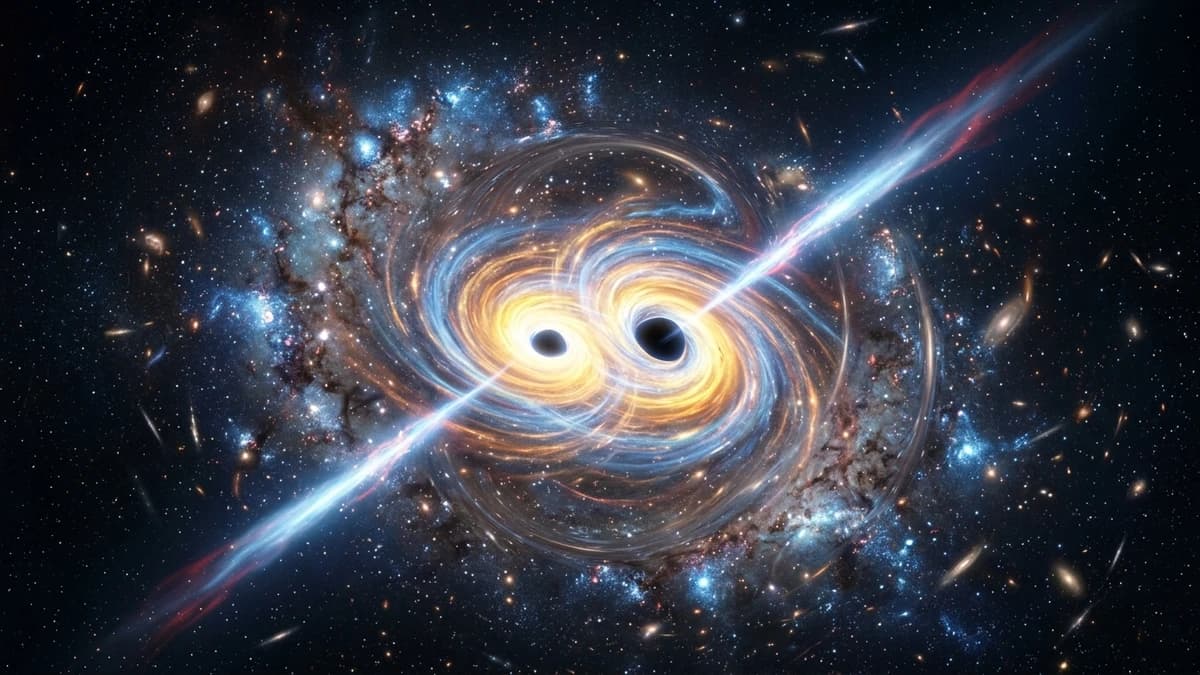
As the two black holes in galaxy ZS7 spiral inward toward final contact, they relentlessly warp the surrounding fabric of spacetime. This violent orbital dance generates ultra-low-frequency gravitational waves propagating outward across the cosmos at the speed of light. These invisible ripples carry pristine, unscattered information regarding the fundamental physics of gravity in extreme regimes.
Current ground-based interferometers like LIGO and Virgo are engineered for higher frequencies and cannot detect the coalescence of such colossal supermassive bodies. However, ESA's planned spaceborne LISA observatory, slated for operation early next decade, will be exquisitely tuned to detect these primordial gravitational murmurs. Measurements gathered by James Webb furnish the precise targets and spatial density rates required to calibrate LISA's observational models.
Decoding the gravitational waveform emitted during final coalescence will allow physicists to test Albert Einstein's General Theory of Relativity to its absolute mathematical limits. Data from ZS7 proves that cosmic targets sought by gravitational wave theorists indeed existed in abundance near the dawn of time. The convergence between electromagnetic astronomy and gravitational multi-messenger astrophysics reaches its most promising frontier.
The colossal energy unleashed by viscous friction in the accretion disks and relativistic plasma jets generated by both black holes profoundly impacts the entire host galaxy. Supersonic plasma winds sweep through the interstellar medium, expelling cold molecular hydrogen clouds beyond the galactic gravitational boundary. This cataclysmic feedback mechanism overheats remaining ambient gas to millions of degrees Celsius.
While this cosmic feeding frenzy fuels black hole growth, it simultaneously starves the host galaxy by abruptly terminating active star formation. Deprived of cold, dense gas reservoirs capable of gravitational collapse, the progenitor galaxy is forced into a premature transition toward a quiescent, dormant state. The discovery demonstrates that supermassive black holes are not mere passive inhabitants of galactic cores, but the dominant architects shaping their evolutionary destinies.