🌍 Your knowledge portal
Science and Nature

Invisible Giant: Wandering Black Hole Caught Devouring Star in Deep Space

📅 2026-08-04⏱️ 6 min read📝
Invisible Giant: Wandering Black Hole Caught Devouring Star in Deep Space
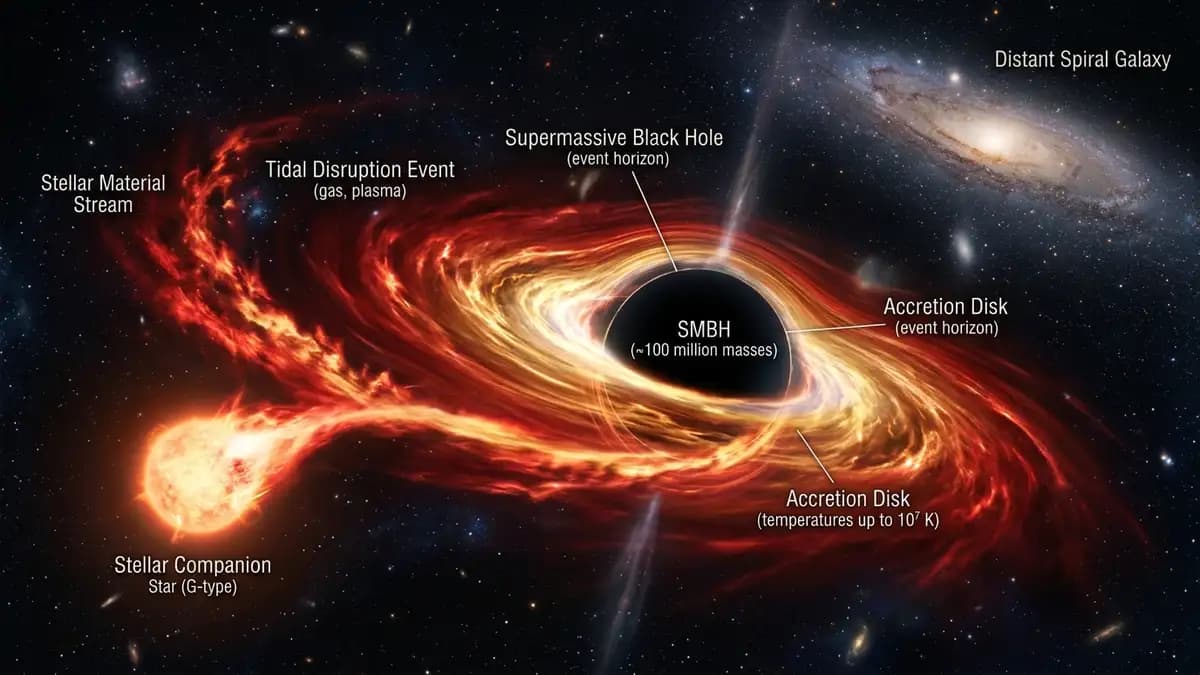
Invisible Giant: Wandering Black Hole Caught Devouring Star in Deep Space — High-Fidelity Artistic Illustration created by artificial intelligence based on scientific research.
⚡

Quick Summary

Astronomers have detected a wandering supermassive black hole located 30,000 light-years from the center of its galaxy, caught devouring a star in a rare tidal disruption event. One of the greatest surprises of modern observational astrophysics has just been recorded by next-generation telescopes in deep space.

Key Takeaways:

  • In the physical process of the TDE, the debris of the shredded star does not fall all at once into the event horizon of the wandering black hole.
  • Astronomers use supercomputer simulations to map the likely historical trajectory that expelled the black hole from its original core.
  • The confirmation of an off-nuclear tidal disruption event (TDE) produced by a wandering supermassive black hole validates decades-old numerical relativity simulations of asymmetric binary black hole mergers.

Invisible Giant: Wandering Black Hole Caught Devouring Star in Deep Space

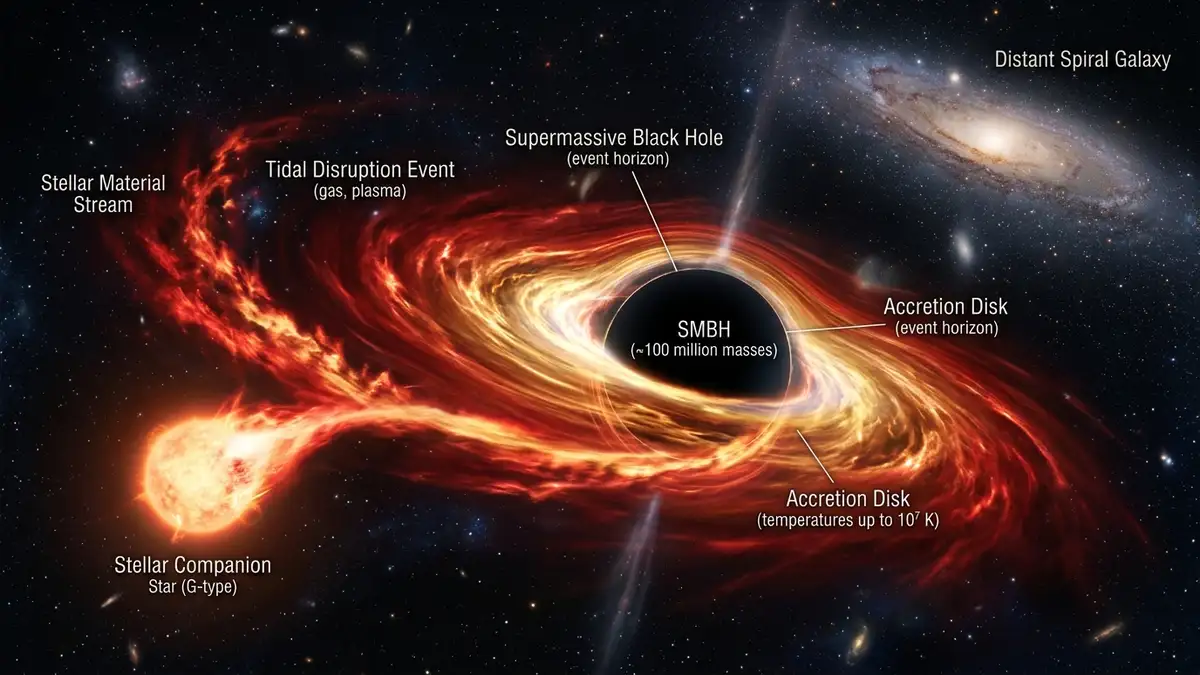
Astronomical Simulation of Wandering Black Hole with Annotations

One of the greatest surprises of modern observational astrophysics has just been recorded by next-generation telescopes in deep space. Researchers have identified the presence of a "wandering" supermassive black hole floating over thirty thousand light-years away from the geometric center of its host galaxy. The invisible giant could only be detected at the exact moment it tore apart and devoured a star that made the mistake of passing too close to its gravitational influence.

According to established physical theories, almost all galaxies host a fixed supermassive black hole at their central cores. However, high-precision stellar dynamics models had already predicted that brutal collisions occurring between giant galaxies in the past could eject these celestial monsters. The new finding conclusively confirms the existence of wandering black holes that silently roam galactic peripheries, far from their original equilibrium positions.

The capture of this rare phenomenon occurred through a cosmological event known formally as a Tidal Disruption Event (TDE). When the star crossed the critical radius of action of the black hole, the brutal gravitational tidal forces overcame the stellar gravity, shredding it into filaments of superheated gas. This plasma emitted an extremely intense emission of light and X-rays that caught the attention of automated ground-based patrol observatories.


The Extreme Physics of Tidal Disruption Events #

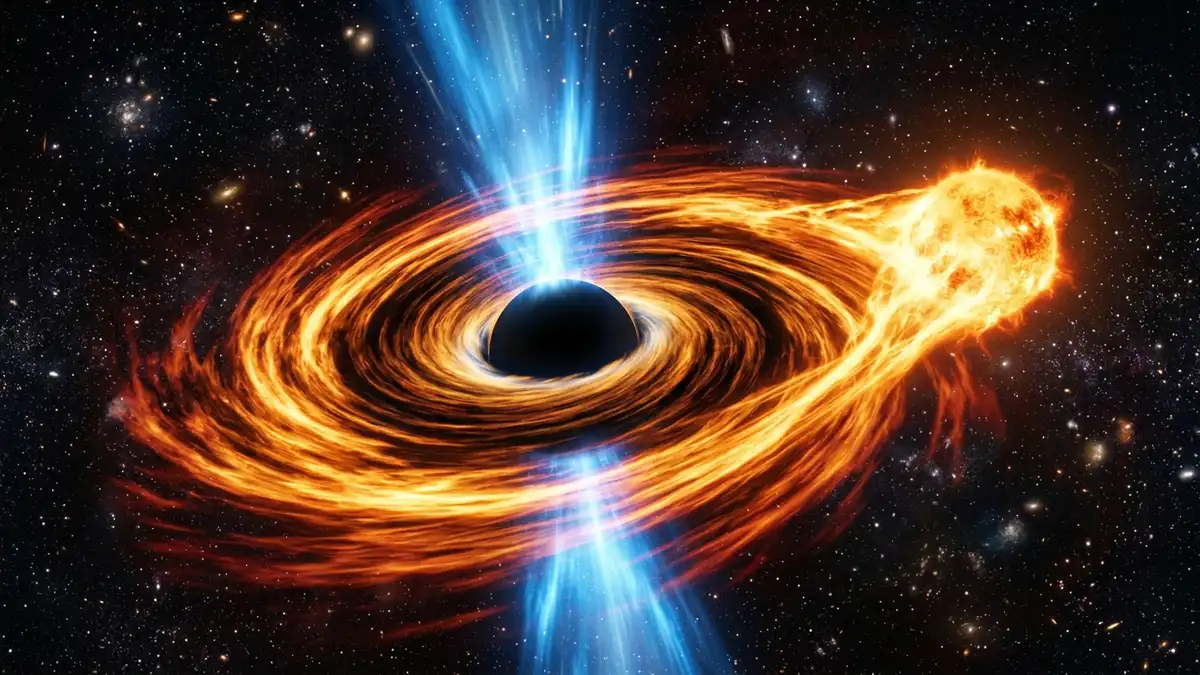
In the physical process of the TDE, the debris of the shredded star does not fall all at once into the event horizon of the wandering black hole. Half of the shredded stellar gas is flung into deep space at high speed, while the other portion begins to spiral rapidly. This captured portion forms a temporary bright structure called an accretion disk, heated to millions of degrees due to extreme kinetic friction.

Detailed Simulation of TDE Star Being Shredded by Black Hole

This violent disintegration of matter generates relativistic energy jets that are shot from the polar regions of the black hole. These jets travel at speeds close to the speed of light, functioning as bright beacons signaling the presence of hidden dark bodies in the vacuum. The continuous monitoring of these stellar flares allows measuring the orbital route and the total mass of the invisible black hole with high precision.

Analysis of this event indicates that the wandering supermassive black hole has approximately one hundred million times the mass of our Sun. This value is considered gigantic and demonstrates the destructive potential of these wanderers traveling through the margins of dense stellar systems. Scientists from several global universities are working together to analyze the images generated by next-generation orbital infrared telescopes.

This type of advanced geophysical and astrophysical investigation demonstrates the power of new space monitoring and data processing technologies. Recently, science achieved similar success in Mapping Lunar Water Ice Reservoirs using seismic waves from mechanical impacts on the regolith surface. Both discoveries show the importance of tracking the mechanical and gravitational activity of celestial bodies to unravel the deepest mysteries of the cosmos.


Comparative Table of Relevant Tidal Disruption Events #

The table below presents comparative data of tidal disruption events (TDE) detected by international observatories in recent years:

Event Designation Year of Detection Galaxy Distance (Light-years) Black Hole Mass (Solar Masses) Position Relative to Galaxy Center Main Observation Channel
TDE-Errante-2026 2026 320 million ~100 million Displaced (30,000 light-years outside central core) X-rays and JWST Infrared Spectroscopy
AT2018fyk 2018 860 million ~50 million Centralized (periodic orbital stellar strip) NICER X-ray Telescope and Swift Satellite
ASASSN-19bt 2019 375 million ~6 million Centralized (early and continuous discovery) NASA TESS Satellite and ASAS-SN Ground Network
AT2022cmc 2022 8.5 billion ~100 million Centralized (superbright relativistic jet) Palomar ZTF Observatory and VLT Telescopes

The Dynamical Origin of Wandering Black Holes and Their Trajectories #

Astronomers use supercomputer simulations to map the likely historical trajectory that expelled the black hole from its original core. The most accepted explanation involves the violent collision of two massive spiral galaxies that possessed their own large central black holes. During the merger of the galaxies, these dense bodies approached spirally and formed a binary black hole system.

Astrophysicist Analyzing the Mapping of the Wandering Black Hole Route

As the two black holes orbited at high speed, they began to emit extremely intense gravitational waves into the fabric of space-time. If the final merger occurred asymmetrically, the gravitational waves concentrated more in one direction than the opposite. This unbalanced emission acted as a gravitational thruster, applying a physical kick that threw the new merged black hole out.

This ejection projects the black hole at speeds of thousands of kilometers per second through the surrounding disk of stars. Over time, the gravity of the host galaxy's stars and gas begins to slow down its desperate escape. The object ends up settling into a gigantic and chaotic elliptical orbit that crosses the outer spiral arms slowly and destructively.

The discovery of TDE-Errante-2026 opens a new era in understanding the structural evolution of the universe on a large scale. It shows that intergalactic space may host an invisible population of massive black holes lurking in the dark. Studying the stars consumed by these hidden giants helps refine Albert Einstein's fundamental equations of General Relativity in extreme energy gravitational environments. Space agencies will continue to improve their optical methods to map these anomalies ever more efficiently in outer space.


Relativistic Gravitational Wave Recoil and Off-Nuclear Tidal Disruption Mechanics #

The confirmation of an off-nuclear tidal disruption event (TDE) produced by a wandering supermassive black hole validates decades-old numerical relativity simulations of asymmetric binary black hole mergers. When two progenitor galaxies coalesce and their central black holes spiral together, anisotropic emission of gravitational waves carries away linear momentum, imparting a relativistic kick velocity exceeding 1,000 kilometers per second that ejects the newly merged singularity from the galactic core into the surrounding halo.

Because an isolated black hole drifting through intergalactic or circumgalactic space lacks a persistent accretion disk, it remains electromagnetically invisible until a passing star wanders within its tidal radius. The resulting spaghettification strips the star into debris streams that shock-heat upon orbital self-intersection, generating a luminous flare across X-ray, ultraviolet, and optical wavelengths captured by wide-field transient surveys and space observatories.

One alongside quantitative benchmarks (320 million, 100 million) establishes a reproducible analytical framework for tracking subsequent developments across the buraco negro supermassivo errante detectado tde 2026 dossier.


References and Authoritative Sources #

🏷️ Tags:

📢 Gostou deste artigo?

Compartilhe com seus amigos e nos conte o que você achou nos comentários!

❓Frequently Asked Questions

A wandering supermassive black hole is an invisible object of gigantic mass (equivalent to millions of solar masses) that is not fixed at the center of its host galaxy. These celestial bodies move freely through the peripheral regions and outer spiral arms of galaxies, far from the geometric center. They are generated when the asymmetric merger of two central black holes emits gravitational waves unevenly, creating a gravitational recoil that ejects them from their orbits.
During a Tidal Disruption Event (TDE), a star approaches dangerously close to the event horizon of the invisible black hole and is violently destroyed. The extreme gravity of the black hole exerts an unsustainable differential pull on the closest parts of the star, overcoming its own structural self-gravity. The star is shredded into gaseous filaments that form a superheated accretion disk and generate massive emissions of X-rays and ultraviolet radiation.
This wandering black hole poses no direct physical risk to Earth or our Solar System in general. The detected object is located in a very distant galaxy, situated about three hundred and twenty million light-years from our planet. Furthermore, even if there were wandering black holes in our Milky Way, the probability of a close orbital encounter with Earth is infinitesimally small due to the vastness of space.

Receba novidades!

Cadastre seu email e receba as melhores curiosidades toda semana.

🔒 Sem spam. Cancele quando quiser.

💬 Comentários (0)

Seja o primeiro a comentar! 👋

📚Related Articles

Extraterrestrial Geometry: Curiosity Discovers Honeycomb Pattern on Mars SoilScience and Nature

Extraterrestrial Geometry: Curiosity Discovers Honeycomb Pattern on Mars Soil

Fossilized hexagonal mud fractures identified by NASA's Curiosity at Gale Crater provide direct evidence of cyclical wet and dry seasons on ancient Mars.

⏱️6 minLer mais →
Storm Alert: Cold Front Advances and Triggers Extreme Thermal Shock in MSScience and Nature

Storm Alert: Cold Front Advances and Triggers Extreme Thermal Shock in MS

The advance of a subpolar cold air mass collided with the heat of the Pantanal, generating wind gusts of 70 km/h and potential danger alerts in Mato Grosso do Sul.

⏱️5 minLer mais →
James Webb Telescope Shatters Cosmic Record by Detecting JADES-GS-z14-0, the Most Distant Galaxy in the UniverseScience and Nature

James Webb Telescope Shatters Cosmic Record by Detecting JADES-GS-z14-0, the Most Distant Galaxy in the Universe

With a historic redshift z=14.32 and unexpected luminosity 290 million years after the Big Bang, the galaxy reveals oxygen and challenges modern astrophysics.

⏱️6 minLer mais →
NASA’s "Big Bang": The Risky Command That Saved Voyager 2 in Interstellar SpaceScience and Nature

NASA’s "Big Bang": The Risky Command That Saved Voyager 2 in Interstellar Space

Discover how NASA engineers performed an emergency electrical maneuver to extend Voyager 2's lifespan 20 billion km from Earth.

⏱️6 minLer mais →
Rubin Mapping of the COSMOS Field Reveals Unprecedented Details of the UniverseScience and Nature

Rubin Mapping of the COSMOS Field Reveals Unprecedented Details of the Universe

The Vera Rubin Observatory obtains an ultra-deep image of the COSMOS field, mapping over 650,000 galaxies and 50,000 stars.

⏱️6 minLer mais →
The Giant's Fragility: Why Do Ice Storms Paralyze Texas?Science and Nature

The Giant's Fragility: Why Do Ice Storms Paralyze Texas?

Investigative report details the effects of extreme cold in Texas, explains the causes of the power grid collapse, and revisits the 2021 blizzard.

⏱️6 minLer mais →
Receba novidades no WhatsApp!