🌍 Your knowledge portal
Science and Nature

Centennial Encounter: Comet Tempel 2 Makes Its Closest Approach to Earth in 100 Years
📅 2026-08-02⏱️ 5 min read📝
Centennial Encounter: Comet Tempel 2 Makes Its Closest Approach to Earth in 100 Years
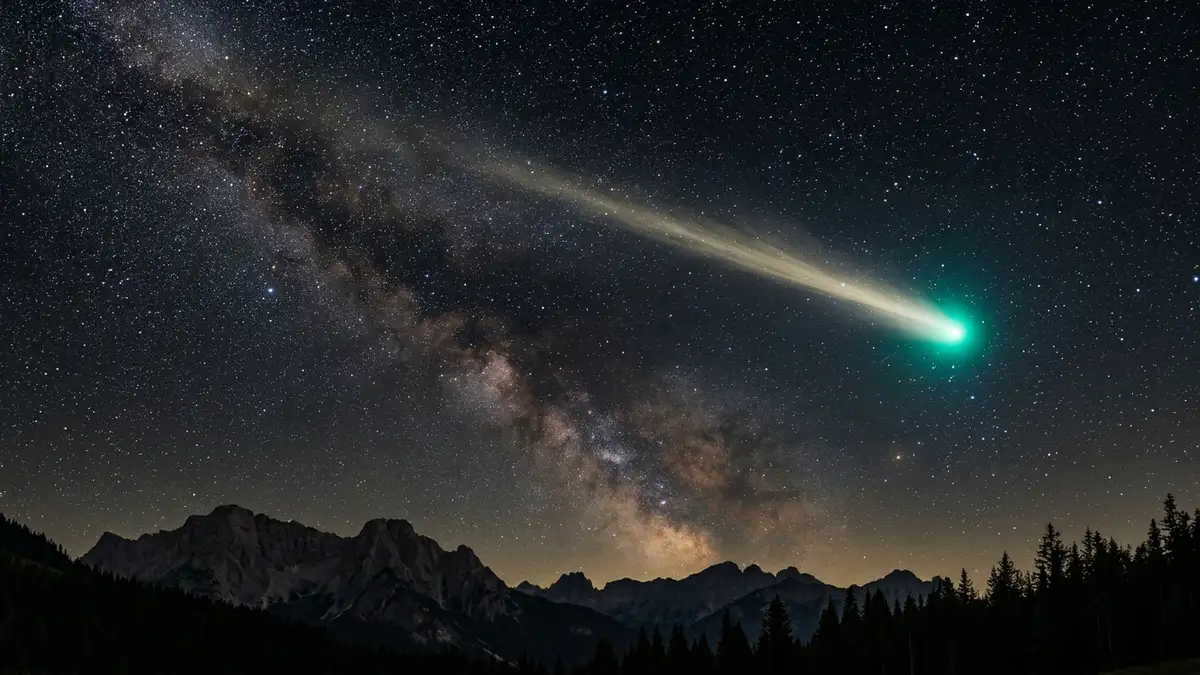
Centennial Encounter: Comet Tempel 2 Makes Its Closest Approach to Earth in 100 Years — High-Fidelity Artistic Illustration created by artificial intelligence based on scientific research.
⚡

Quick Summary

The periodic comet 10P/Tempel 2 makes its closest approach to Earth in a century in early August 2026, mobilizing astronomers worldwide. Global observational astronomy is experiencing a historic moment with the record-breaking approach of one of modern science's most studied periodic comets.

Key Takeaways:

  • Large-scale astronomical observatories worldwide have reconfigured their research schedules to prioritize the passage of comet 10P/Tempel 2.
  • The table below presents comparative data of notable periodic comet approaches to Earth in recent years:
  • The physics of comet tails has fascinated scientists since antiquity due to its dynamic beauty and structural complexity.

Centennial Encounter: Comet Tempel 2 Makes Its Closest Approach to Earth in 100 Years

Comet Tempel 2 Glowing in Space

Global observational astronomy is experiencing a historic moment with the record-breaking approach of one of modern science's most studied periodic comets. The comet 10P/Tempel 2, originally discovered in the late 19th century, is reaching its closest point to Earth in a century. This rare astronomical event offers scientists and amateur astrophotographers a unique opportunity to study the volatile components preserved in the icy core of the celestial body.

With a short orbital period of approximately 5.3 years, Tempel 2 usually passes at considerably safe distances from our planet. However, due to cumulative gravitational perturbations caused by the giant planet Jupiter over decades, the comet's orbit was subtly altered. This new orbital trajectory now culminates in a centennial close pass that had not occurred with such proximity since the beginning of the last century.

Astronomers estimate the comet's rocky core to be approximately 10.6 kilometers in diameter, making it an object of massive dimensions. As it approaches the Sun, intense solar radiation causes the direct sublimation of its internal ice, forming a beautiful greenish coma. This spectacular optical phenomenon is due to the presence of diatomic carbon and cyanogen molecules that react under solar light.
Scientific Observatories Mobilized in the Northern and Southern Hemispheres #

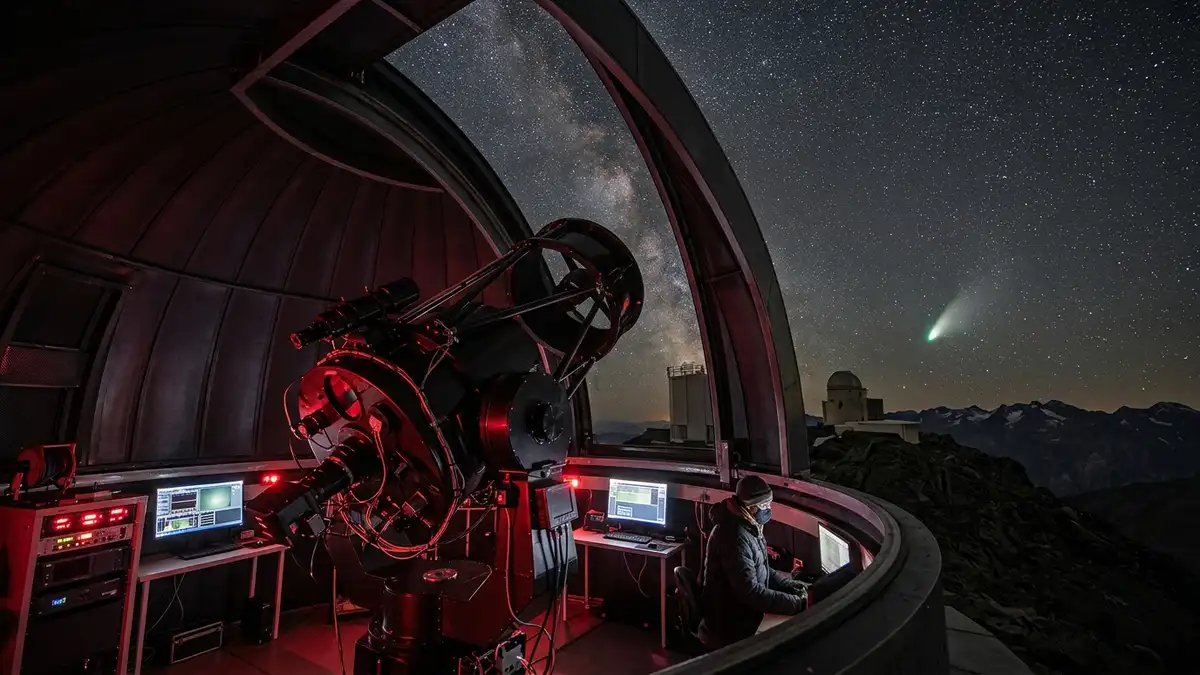
Large-scale astronomical observatories worldwide have reconfigured their research schedules to prioritize the passage of comet 10P/Tempel 2. The dome of professional telescopes in high-altitude areas has begun capturing high-definition spectra of the dust and gas tail. The collected data will allow analyzing the presence of complex organic compounds and water ice dating back to the formation of our Solar System.

Telescope in Observatory Pointed to the Night Sky

Modern spectrographs installed on the telescopes decompose the light reflected by the comet to decipher its exact microscopic chemical signature. Astronomers seek to understand if the ratio of heavy hydrogen in the comet's water is identical to that found in the oceans of early Earth. Established scientific theories suggest that constant collisions of ancient comets brought most of the water to our young planet.

In parallel, amateur astronomers equipped with high-power binoculars and small telescopes can visualize the diffuse glow of the object in the early morning sky. The comet is temporarily located in the constellation of Taurus, facilitating its location near the eastern horizon before sunrise. Global citizen science campaigns are sharing real-time brightness images and measurements on centralized academic servers.

The scientific mobilization surrounding this comet is similar to other major space research efforts focused on the habitability of our stellar system. Recently, the discovery of Honeycomb Structures on Mars by Curiosity revealed that liquid water was dynamically present on neighboring worlds. Now, the study of Tempel 2 can provide clues about how these aquatic building blocks were distributed through space.


Table of Periodic Comets and Recent Close Approach Distances #

The table below presents comparative data of notable periodic comet approaches to Earth in recent years:

Comet Designation Orbital Period (Years) Core Diameter (km) Date of Closest Approach Minimum Passage Distance (AU) Visibility Level
10P/Tempel 2 5.3 10.6 August 02, 2026 0.64 Visible with binoculars and amateur telescopes
46P/Wirtanen 5.4 1.2 December 16, 2018 0.07 Visible to the naked eye in dark sky locations
73P/Schwassmann-Wachmann 5.4 fragmented May 13, 2006 0.07 Visible with telescopes (disintegrating core)
15P/Finlay 6.5 1.8 October 27, 2021 0.37 Only visible with professional photographic equipment

Unraveling the Mysteries of the Comet Tail and Its Implications #

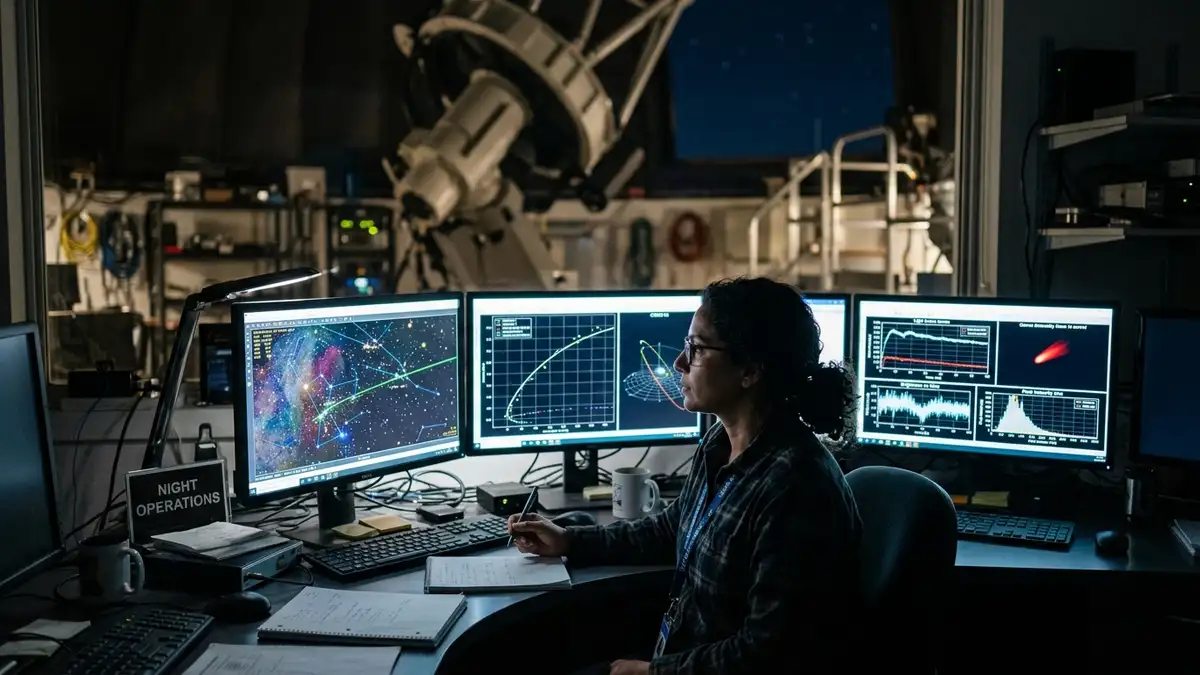
The physics of comet tails has fascinated scientists since antiquity due to its dynamic beauty and structural complexity. Tempel 2 displays two distinct tails: one of dust and another of gaseous ions that respond in different ways to the solar wind. The dust tail, composed of microscopic silicate grains, gently curves along the comet's orbit due to the pressure of solar radiation.

Astronomer Analyzing Orbits and Spectrometry of the Comet

On the other hand, the ion tail, with its characteristic bluish tone, points strictly in the direction opposite to the Sun. This gaseous structure is shaped by the complex interaction of electrically charged particles with the interplanetary magnetic field conducted by the solar wind. The monitoring of these tails helps scientists map the intensity of solar storms that directly affect Earth's space weather.

Tempel 2's core is extremely dark, reflecting only about 4% of the sunlight incident upon it. This low reflectivity is due to a thick crust of carbonaceous dust and complex organic tar covering the comet. As heat opens cracks in this dark crust, violent jets of water vapor and gas are shot into the vacuum of space.

As the comet completes its rapid passage through Earth's orbit, astronomers consolidate the laser spectroscopy data obtained. The three-dimensional modeling information of the core will help plan future robotic landing missions on active celestial bodies. Furthermore, these details contribute significantly to our planetary defense strategies by improving our understanding of comet composition and structural integrity.

Each studied comet works as an untouched cosmic fossil that guards the primordial chemical secrets of the emergence of life. The constant advancement of optical technologies allows us to observe these icy messengers with unprecedented detail, expanding the frontiers of human astronomical knowledge. These projects inspire new generations of researchers to explore the deep universe and understand our origin among the stars.


References and Authoritative Sources #

🏷️ Tags:

📢 Gostou deste artigo?

Compartilhe com seus amigos e nos conte o que você achou nos comentários!

❓Frequently Asked Questions

Comet 10P/Tempel 2 is making its closest approach in 100 years due to gradual gravitational perturbations suffered in its orbit over the last decades. By periodically passing near the gas giant Jupiter, the planet's gravitational pull slightly modified the comet's orbital path. This subtle accumulated orbital perturbation resulted in an updated trajectory that positions the celestial body much closer to our planet in early August 2026.
It is not possible to observe comet Tempel 2 with the naked eye because it does not reach the apparent brightness required to overcome normal atmospheric light pollution. The object's visual magnitude has stabilized around 8.0, requiring the use of high-quality binoculars or small amateur telescopes. To successfully locate it, it is recommended to observe the eastern horizon in the early morning hours, preferably far from the lights of major cities.
The green glow in the comet's coma indicates the release and ionization of specific diatomic carbon and cyanogen gases under the Sun's ultraviolet radiation. When the comet approaches perihelion, solar heat sublimates the ice in its dark core, releasing these gaseous molecules into the vacuum of space. By reacting photochemically with solar light, these gases emit electromagnetic radiation in the wavelength range corresponding to the bright green tone observed.

Receba novidades!

Cadastre seu email e receba as melhores curiosidades toda semana.

🔒 Sem spam. Cancele quando quiser.

💬 Comentários (0)

Seja o primeiro a comentar! 👋

📚Related Articles

Hidden Treasures: Scientists Use Seismic Waves to Map Ice Beneath the Moon's SoilScience and Nature

Hidden Treasures: Scientists Use Seismic Waves to Map Ice Beneath the Moon's Soil

A new scientific technique utilizing the propagation of seismic waves allowed mapping large reservoirs of water ice hidden beneath the Moon's south pole subsurface.

⏱️5 minLer mais →
Extraterrestrial Geometry: Curiosity Discovers Honeycomb Pattern on Mars SoilScience and Nature

Extraterrestrial Geometry: Curiosity Discovers Honeycomb Pattern on Mars Soil

Fossilized hexagonal mud fractures identified by NASA's Curiosity at Gale Crater provide direct evidence of cyclical wet and dry seasons on ancient Mars.

⏱️6 minLer mais →
Storm Alert: Cold Front Advances and Triggers Extreme Thermal Shock in MSScience and Nature

Storm Alert: Cold Front Advances and Triggers Extreme Thermal Shock in MS

The advance of a subpolar cold air mass collided with the heat of the Pantanal, generating wind gusts of 70 km/h and potential danger alerts in Mato Grosso do Sul.

⏱️5 minLer mais →
James Webb Telescope Shatters Cosmic Record by Detecting JADES-GS-z14-0, the Most Distant Galaxy in the UniverseScience and Nature

James Webb Telescope Shatters Cosmic Record by Detecting JADES-GS-z14-0, the Most Distant Galaxy in the Universe

With a historic redshift z=14.32 and unexpected luminosity 290 million years after the Big Bang, the galaxy reveals oxygen and challenges modern astrophysics.

⏱️6 minLer mais →
NASA’s "Big Bang": The Risky Command That Saved Voyager 2 in Interstellar SpaceScience and Nature

NASA’s "Big Bang": The Risky Command That Saved Voyager 2 in Interstellar Space

Discover how NASA engineers performed an emergency electrical maneuver to extend Voyager 2's lifespan 20 billion km from Earth.

⏱️6 minLer mais →
Rubin Mapping of the COSMOS Field Reveals Unprecedented Details of the UniverseScience and Nature

Rubin Mapping of the COSMOS Field Reveals Unprecedented Details of the Universe

The Vera Rubin Observatory obtains an ultra-deep image of the COSMOS field, mapping over 650,000 galaxies and 50,000 stars.

⏱️6 minLer mais →
Receba novidades no WhatsApp!