🌍 Your knowledge portal
Ciencia e Natureza

James Webb Telescope Reveals Sand Clouds and Water Vapor on Exoplanet WASP-107b

📅 2026-09-08⏱️ 5 min read📝
⚡

Quick Summary

Spectroscopic observations from JWST unveil the atmospheric composition of WASP-107b, revealing silicate rain and sulfur dioxide on a low-density world. Astronomers operating the James Webb Space Telescope have released unprecedented spectroscopic data on the atmosphere of exoplanet WASP-107b.

Key Takeaways:

  • Measurements obtained by the telescope's mid-infrared and near-infrared instruments were analyzed by teams associated with NASA.
  • Unlike the gas planets in our solar system, WASP-107b has an average atmospheric temperature of five hundred degrees Celsius.
  • One of the most surprising findings from the spectral analysis was the unambiguous identification of sulfur dioxide in the atmosphere of WASP-107b.
James Webb Telescope Reveals Sand Clouds and Water Vapor on Exoplanet WASP-107b
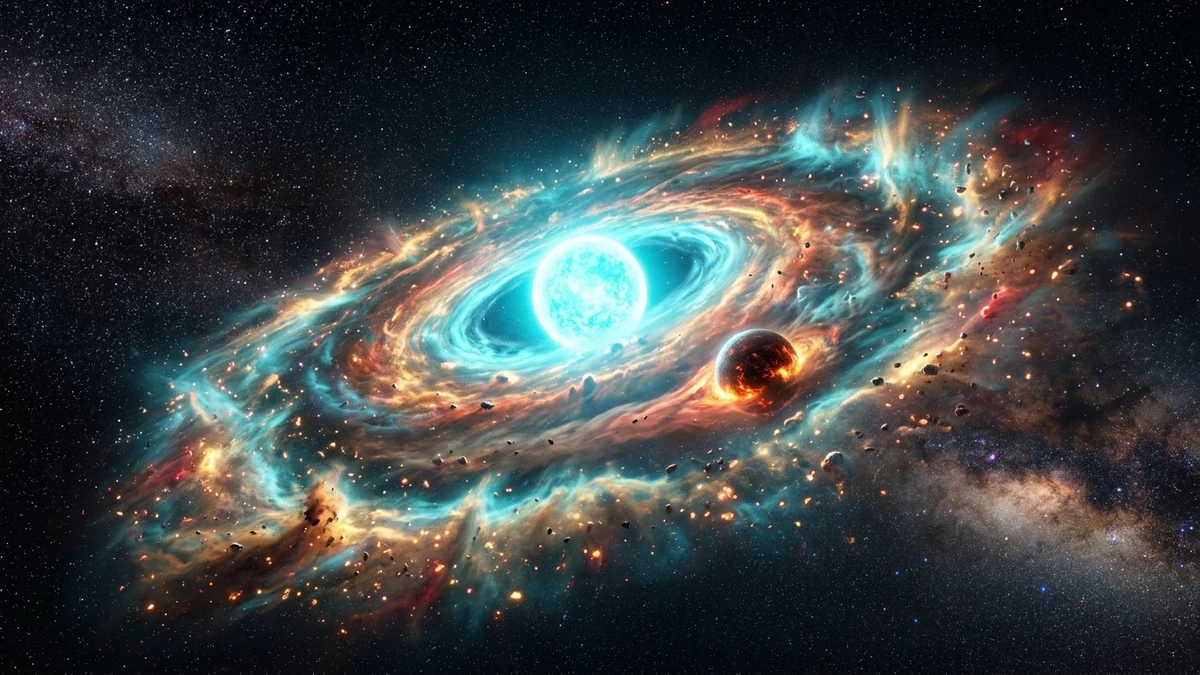
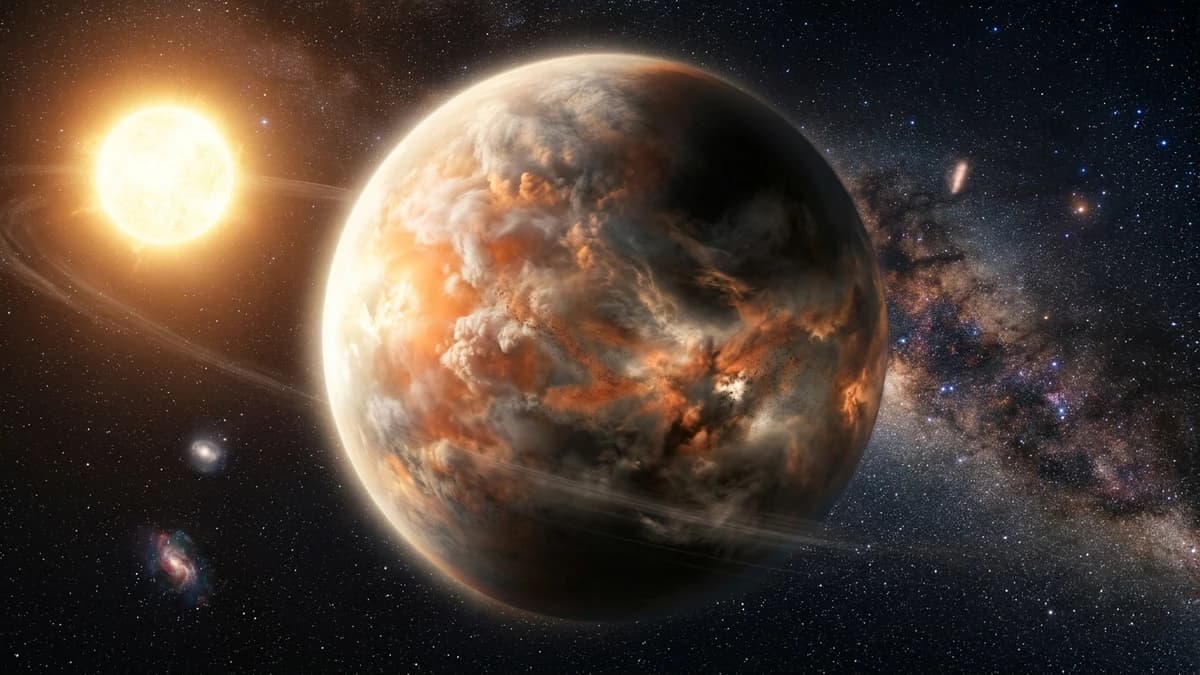
James Webb Telescope Reveals Sand Clouds and Water Vapor on Exoplanet WASP-107b — High-Fidelity Artistic Illustration created by artificial intelligence based on scientific research.

A Spectacular Discovery in the Atmosphere of an Exotic World #

Astronomers operating the James Webb Space Telescope have released unprecedented spectroscopic data on the atmosphere of exoplanet WASP-107b. Located about two hundred light-years from Earth in the constellation Virgo, the planet is renowned for its exceptionally low density. New observations revealed a dynamic atmosphere containing water vapor, sulfur dioxide, and clouds composed of fine silicate sand particles.

Measurements obtained by the telescope's mid-infrared and near-infrared instruments were analyzed by teams associated with NASA. The study made it possible to map the climate cycle of silicates on an extrasolar world for the first time in astronomical history. The phenomenon is equivalent to a water cycle on Earth, but with sand grains evaporating and condensing at high altitudes.

This breakthrough represents a quantum leap in understanding planetary meteorology outside our solar system. The ability to identify complex chemical compounds in alien atmospheres demonstrates the revolutionary power of the orbital observatory. The discovery provides key clues regarding the formation of low-mass gas giants across the universe.
+------------------------------------+----------------------------------+------------------------------------+
| Astrophysical Parameter            | Exoplanet WASP-107b              | Planet Jupiter (Reference)         |
+------------------------------------+----------------------------------+------------------------------------+
| Relative Radius                    | 0.94 Jupiter Radius              | 1.00 Jupiter Radius                |
| Relative Mass                      | 0.10 Jupiter Mass (30 Earths)    | 1.00 Jupiter Mass (318 Earths)     |
| Average Density                    | 0.13 g/cm³ (Extremely Low)       | 1.33 g/cm³                         |
| Orbital Period                     | 5.7 Earth Days                   | 11.8 Earth Years                   |
| Main Atmospheric Components        | Water Vapor, SO2, Silicates (SiO2)| Hydrogen, Helium, Methane          |
+------------------------------------+----------------------------------+------------------------------------+

The Unique Dynamics of the Sand Rain Cycle #

Unlike the gas planets in our solar system, WASP-107b has an average atmospheric temperature of five hundred degrees Celsius. In this extreme thermal range, magnesium and iron silicate grains pass from a solid state directly into the gas phase in deep layers. As the gases rise powered by internal convection, they cool and condense into tiny sand clouds.

These liquid silicate droplets and microscopic crystals remain suspended in the upper atmosphere before falling back toward the hot interior. This continuous process creates a permanent, planet-wide sand rain storm in the boundary regions of the exoplanet. Scientists report that this vertical condensation cycle explains why the clouds appear so thick and reflective.

Research published in the journal Nature highlights that partial transparency of the atmosphere allowed Webb to peer deep into its layers. Detecting silicate clouds confirms theoretical predictions formulated by astrophysicists over recent decades. The model is now empirically proven through direct observations in infrared wavelengths.

The Chemistry of Sulfur Dioxide and the Absence of Methane #

One of the most surprising findings from the spectral analysis was the unambiguous identification of sulfur dioxide in the atmosphere of WASP-107b. Producing this chemical compound requires high-energy ultraviolet photons originating from the host star. Stellar radiation splits water molecules, releasing free radicals that react with elemental sulfur in the upper atmosphere.

On the other hand, the unexpected absence of methane puzzled researchers during initial data analysis stages. Previous theoretical models predicted that methane should be the dominant carbon compound in atmospheres at these temperatures. Its scarcity points to rapid vertical transport that mixes the gas before it can reach chemical equilibrium.

This photochemical dynamics demonstrates that the planet's atmosphere is maintained in a continuous state of disequilibrium driven by internal heat. The core of WASP-107b must be substantially hotter than previously estimated to sustain such updrafts. This recent discovery aligns with detailed analyses conducted on the confirmation of temperate exoplanet Gliese 12 b and planetary diversity studies.

Transmission Spectroscopy with the James Webb Telescope #

The technique employed to characterize the atmosphere of WASP-107b is known as transit transmission spectroscopy. As the exoplanet crosses the front of its star's bright disk, a fraction of starlight filters through the gases along the atmospheric limb. Different atoms and molecules absorb specific colors of the infrared spectrum, creating molecular fingerprints.

Scientists supported by the ESA utilized MIRI and NIRSpec instruments to capture tiny variations in stellar brightness across hundreds of wavelength channels. Combining these two sensors allowed coverage of a broad and uninterrupted infrared spectral range. The unprecedented quality of the data enabled isolation of faint signals that would be invisible to previous observatories.

The precision achieved by the telescope made it possible to determine the relative abundance of water vapor with minimal uncertainties. The results prove that water vapor is abundant but partially masked by the thick layer of sand clouds. This level of detail provides an unparalleled three-dimensional model of the planet's atmospheric structure.

The Relationship Between Host Star and Photochemical Effect #

The host star, known as WASP-107, is a K-type orange dwarf slightly cooler and less massive than our Sun. Despite its moderate luminosity, the planet's close orbital proximity causes it to receive a significant amount of ultraviolet radiation. This flux of radiation is the key ingredient activating photochemical reactions in the upper gas layer.

Had the planet been located in a more distant orbit, the production rate of sulfur dioxide would be drastically lower. The constant interaction between the fluffy atmosphere and the stellar radiation field continues to shape the exoplanet's evolution over billions of years. Atmospheric mass loss is monitored by astrophysicists to predict the world's ultimate fate.

Studying starlight-driven chemistry helps astronomers understand how planetary atmospheres respond to illumination from different stellar types. This knowledge is essential for interpreting future spectral data from smaller and potentially habitable planets. The research expands the frontiers of modern planetary science.

Internal Structure and the Nature of Cotton-Candy Planets #

With a mass equivalent to just thirty times that of Earth spread over a volume nearly equal to Jupiter, WASP-107b has a mean density of only 0.13 grams per cubic centimeter. For comparison, water has a density of one gram per cubic centimeter, meaning the planet would float if placed in a giant ocean.

This extremely expanded structure suggests a relatively small rocky core surrounded by a massive envelope of hydrogen and helium. Residual tidal heating generated by orbital eccentricity may be injecting continuous energy into the planet's interior. This internal heat prevents the atmosphere from cooling and contracting under its own gravity.

Understanding why the atmosphere remained so inflated without completely dissipating into space is a fascinating astrophysical enigma. Webb's new observations supply the necessary data to calibrate computational models of planetary interior evolution. The world remains one of the most extraordinary targets in contemporary astronomy.

Impact of Results on the Study of Gas Exoplanets #

The detailed characterization of WASP-107b sets a new benchmark for studying gas exoplanet atmospheres across the galaxy. The discoveries prove that clouds on distant worlds are not merely composed of water or ammonia, but silicates and complex minerals. This mineralogical diversity profoundly alters thermal balance and planetary wind circulation.

As the James Webb Telescope continues its cosmic exploration mission, dozens of other giant exoplanets are undergoing similar analyses. Astronomers expect to build a complete taxonomy of extrasolar climates based on temperature, mass, and stellar type. Every new discovery reveals that the universe is far more varied than our solar neighborhood suggested.

Publishing these data by the international team opens new avenues for continued theoretical and observational research. Astronomy enters a golden era in which the climate of distant worlds can be mapped with scientific rigor. WASP-107b will continue to inspire new generations of researchers in their quest to understand the cosmos.

🏷️ Tags:

#wasp107b#jameswebbspacetelescope#exoplanet#nasa#esa#sandclouds#silicaterain#astrophysics2026

📢 Gostou deste artigo?

Compartilhe com seus amigos e nos conte o que você achou nos comentários!

❓Frequently Asked Questions

Exoplanet WASP-107b is a gas giant exoplanet located about 200 light-years from Earth in the constellation Virgo. It earned the nickname cotton-candy planet due to its extraordinarily low density, possessing a size equivalent to Jupiter but with only ten percent of its mass. This extremely expanded and fluffy atmosphere facilitates starlight transmission through its gaseous layers, making it an ideal target for high-precision spectroscopic analyses.
The James Webb Space Telescope utilized its NIRSpec and MIRI infrared instruments to capture the transmission spectrum during the planet transit in front of its star. As starlight filtered through the atmosphere of WASP-107b, gaseous molecules and aerosol particles absorbed specific wavelengths. The resulting spectral signature conclusively revealed the presence of tiny iron and magnesium silicate grains suspended in high-altitude clouds.
The unexpected scarcity of methane combined with the clear detection of sulfur dioxide indicates highly dynamic photochemical processes and vertical mixing in the atmosphere. Sulfur dioxide is produced when ultraviolet radiation from the host star breaks apart water molecules and reacts with gaseous sulfur. Furthermore, heat originating from the planet interior drives vigorous convection currents that transport material from the deep atmosphere to upper layers.

Receba novidades!

Cadastre seu email e receba as melhores curiosidades toda semana.

🔒 Sem spam. Cancele quando quiser.

💬 Comentários (0)

Seja o primeiro a comentar! 👋

📚Related Articles

Receba novidades no WhatsApp!