🌍 Your knowledge portal
Ciencia e Natureza

CERN NA62 Experiment Observes Ultra-Rare Kaon Decay and Opens New Window in Physics

📅 2026-09-09⏱️ 5 min read📝
⚡

Quick Summary

Physicists at CERN achieve five-sigma statistical significance in measuring the rarest decay of the Standard Model, opening doors to physics beyond the known. The scientific collaboration operating the NA62 experiment, based at the prestigious CERN laboratory in Switzerland, announced the unambiguous observation of the ultra-rare decay of a charged kaon.

Key Takeaways:

  • The phenomenon consists of the spontaneous transformation of a positively charged kaon into a charged pion and a pair formed by a neutrino and an antineutrino.
  • To capture such an exceptionally rare process, the NA62 experiment operates connected to the Super Proton Synchrotron accelerator along a two-hundred-and-seventy-meter underground tunnel.
  • In particle physics, the decay of a kaon into a pion and neutrinos proceeds through flavor-changing neutral currents involving quarks.
CERN NA62 Experiment Observes Ultra-Rare Kaon Decay and Opens New Window in Physics
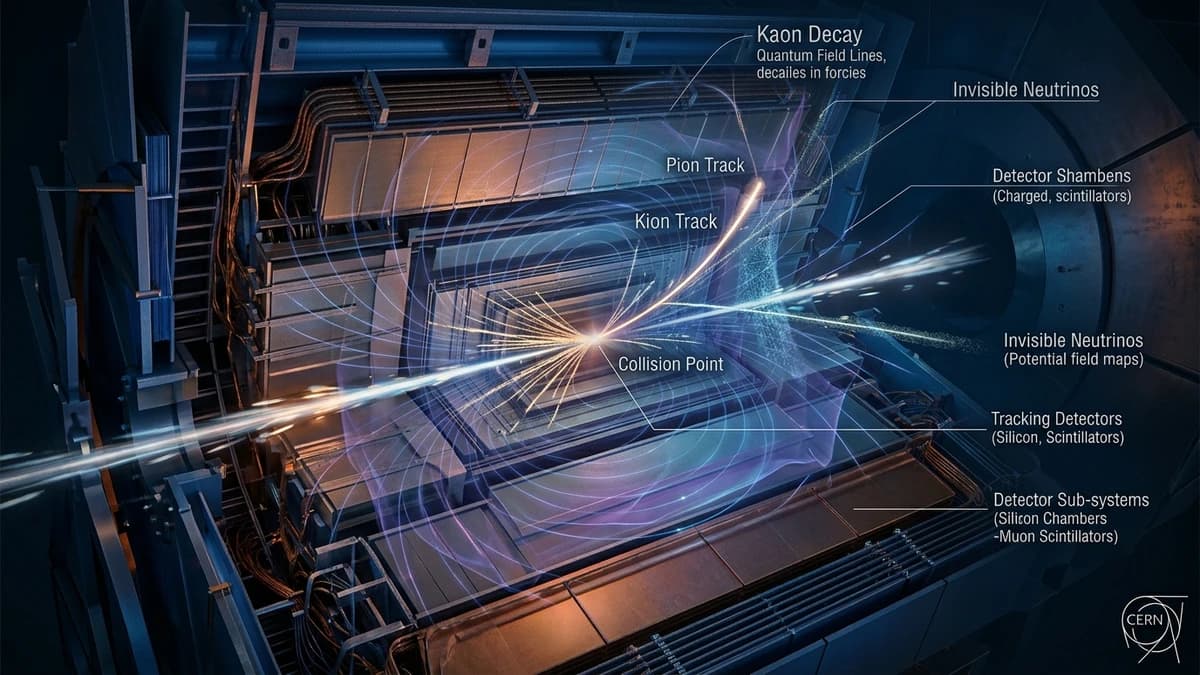
CERN NA62 Experiment Observes Ultra-Rare Kaon Decay and Opens New Window in Physics — High-Fidelity Artistic Illustration created by artificial intelligence based on scientific research.

Historical Milestone in Subatomic Physics at CERN #

The scientific collaboration operating the NA62 experiment, based at the prestigious CERN laboratory in Switzerland, announced the unambiguous observation of the ultra-rare decay of a charged kaon. The event achieved the rigorous statistical threshold of five standard deviations, recognized across the global scientific community as the definitive gold standard of a proven physical discovery.

The phenomenon consists of the spontaneous transformation of a positively charged kaon into a charged pion and a pair formed by a neutrino and an antineutrino. The theoretical probability of this quantum process occurring is calculated at roughly eight times for every one hundred billion disintegrations. Isolating this signal amidst trillions of background particles represents one of the greatest triumphs of modern experimental engineering.

Precise measurement of this decay channel provides a rigorous stress test for the Standard Model of particle physics. Because theory predicts the behavior of this system with minimal uncertainty, any measurable variation holds the potential to unveil new forces and particles in the universe. Findings mark the beginning of a new exploratory phase in high-energy physics.

+------------------------------------+----------------------------------+------------------------------------+
| Physical Parameter / Measurement   | Theoretical Value (Standard Model)| Experimental Measurement (NA62 CERN)|
+------------------------------------+----------------------------------+------------------------------------+
| Branching Ratio                    | (8.4 ± 1.0) × 10⁻¹¹              | (13.0 ± 3.3) × 10⁻¹¹               |
| Frequency of Occurrence            | Less than 1 in 10 Billion        | Confirmed with High Precision      |
| Statistical Significance           | Theoretical (5 Sigma Required)   | 5.0 Standard Deviations (Discovery)|
| Resulting Detected Particles       | Charged Pion + Neutrinos         | Positive Pion + Missing Energy     |
| Suppression Mechanism              | GIM Cancellation & Quark Loops   | Experimentally Verified            |
+------------------------------------+----------------------------------+------------------------------------+

Technological Complexity of the NA62 Detector #

To capture such an exceptionally rare process, the NA62 experiment operates connected to the Super Proton Synchrotron accelerator along a two-hundred-and-seventy-meter underground tunnel. High-energy protons collide against a fixed beryllium target, generating a secondary beam of particles containing about six percent positive kaons.

Cryogenically cooled silicon micro-tracking detectors measure the exact momentum and direction of every particle before it enters a giant vacuum tank. In the complete absence of air, kaons decay naturally in flight, allowing advanced liquid krypton calorimeters to track fragmentation products. This infrastructure operates with temporal resolution on the order of one hundred picoseconds.

The greatest challenge facing physicists is distinguishing the targeted decay from common decay channels that occur millions of times more frequently. To ensure no background noise contaminates the dataset, hermetic veto systems reject photons and muons with efficiency exceeding ninety-nine point nine percent. The strictness of this experimental filter is comparable to finding a specific needle in a planetary haystack.

Role of the GIM Mechanism and Quantum Suppression #

In particle physics, the decay of a kaon into a pion and neutrinos proceeds through flavor-changing neutral currents involving quarks. The constituent strange quark of the kaon must transform into an up quark through processes involving intermediate vector bosons and heavy virtual quarks.

In the Standard Model, this transition is strongly suppressed by the Glashow-Iliopoulos-Maiani mechanism, widely known as the GIM mechanism. This nearly perfect quantum cancellation is the exact reason why the process is so astonishingly improbable. Detailed analyses published in the prestigious journal Nature Physics confirm the mathematical subtlety of this quantum cancellation.

Because it is dominated by closed electroweak loop Feynman diagrams, the decay is sensitive to particle masses that lie far beyond the direct collision reach of the Large Hadron Collider. This unique attribute turns the kaon into a quantum microscope of unprecedented diagnostic depth. The study admirably complements historical investigations into the doubly charmed baryon discovered at CERN and fundamental matter structures.

The Search for Signatures of New Physics and Dark Matter #

The branching ratio observed by NA62 measured slightly higher than the central average predicted by traditional Standard Model equations. Although the result remains statistically compatible with existing theory, the upward trend sparks fertile speculation among modern theoretical physicists.

Multiple theoretical models suggest that particles beyond the current catalog, such as axions, dark bosons, or leptoquarks, could participate virtually in the decay loop. These hypothetical particles would subtly increase the transition probability without leaving detectable traces in conventional sensors. Scientists from various institutions debate these profound implications in papers submitted to Physical Review Letters.

If future measurements with larger data volumes confirm a persistent discrepancy, the foundations of quantum physics will have to be revised and expanded. The academic community views this research line as one of the most promising avenues for unraveling the mysterious nature of dark matter. Precision physics once again proves its indispensable value alongside direct high-energy collider searches.

Impact on Fundamental Constants and the CKM Matrix #

Measuring this decay provides an independent and exceptionally clean determination of the Vtd element of the Cabibbo-Kobayashi-Maskawa quark mixing matrix. This mathematical matrix governs the intensity of weak interactions between the different flavors of quarks existing in the cosmos.

Unlike other meson decays plagued by large theoretical uncertainties associated with non-perturbative quantum chromodynamics, the kaon system has its hadronic matrix elements strictly anchored to data from well-known semileptonic decays. This theoretical cleanliness guarantees that any observed discrepancy stems from genuine fundamental interactions rather than computational ambiguities.

With consolidation of the five-sigma threshold, physicists now possess a calibration benchmark that will guide future decades of precision experimentation. Refined data will help verify the unitarity of the CKM matrix with unprecedented historical precision. The overall coherence of contemporary physical architecture is put to the test under the most rigorous analytical standards ever conceived.

Cosmological Implications and Matter-Antimatter Asymmetry #

The physics of kaons holds a profound historical connection with the greatest enigmas of modern cosmology. It was precisely through studying these particles in the nineteen-sixties that physicists first discovered CP symmetry violation, the fundamental mechanism distinguishing matter from antimatter.

Understanding kaon disintegration with surgical precision helps clarify why the observable universe is composed almost exclusively of matter. If physical laws had remained perfectly symmetrical, all matter and antimatter would have mutually annihilated shortly after the Big Bang. Any small discrepancy discovered in flavor processes delivers vital clues regarding the initial conditions of the early cosmos.

Theoretical physicists maintain that additional sources of CP violation must exist to account for the current abundance of protons and electrons. The decay measured by NA62 serves as a direct test to verify whether these additional sources operate at the electroweak scale. This bridge between the subatomic realm and large-scale cosmic structure highlights the profound importance of the experiment.

Future Steps and Upcoming Detector Upgrades #

The NA62 collaboration will continue collecting data following implementation of new beamline improvements at CERN during upcoming operational cycles. The primary objective is to reduce experimental uncertainty to under ten percent, allowing a definitive comparison against theoretical calculations.

Furthermore, new conceptual projects are being developed to study the neutral counterpart of kaon decay, which presents even more formidable technical challenges. Detecting the decay of a neutral kaon into a neutral pion and neutrinos will require completely novel detector geometries capable of measuring isolated photons without charged tracking beams.

These advances establish kaon physics as one of the most vital pillars for exploring uncharted territory in fundamental science. The genuine enthusiasm among researchers reflects the conviction that the universe still holds deep secrets waiting for sufficiently sensitive instruments to reveal them. CERN thus reaffirms its unquestioned leadership at the forefront of investigating matter, energy, and spacetime.

🏷️ Tags:

#cern#na62#kaon#ultra-raredecay#particlephysics#standardmodel#neutrinos#bosons

📢 Gostou deste artigo?

Compartilhe com seus amigos e nos conte o que você achou nos comentários!

❓Frequently Asked Questions

The ultra-rare decay of a positive kaon into a pion and a neutrino-antineutrino pair is one of the scarcest and most precise processes predicted by the Standard Model of physics. It theoretically occurs in fewer than one out of ten billion kaon disintegrations. Because it is a strongly suppressed process in the Standard Model and theoretically exceptionally clean, any deviation in its branching ratio serves as an ultra-sensitive probe to identify hypothetical particles and unknown interactions.
The NA62 international collaboration utilizes a high-intensity secondary beam generated by the Super Proton Synchrotron accelerator at CERN to produce billions of kaons per second. Ultra-fast silicon pixel detectors and liquid krypton gas calorimeters track the exact trajectory of every particle before and after decaying in flight. Because neutrinos do not interact with the sensors, physicists identify the event by missing momentum and the strict absence of any other secondary particle.
The decay rate measured by NA62 showed a slight elevation compared to the central value predicted by theory, though it remains compatible within experimental uncertainty margins. This small excess excites researchers because it may signal the influence of dark matter mediators or uncataloged heavy bosons participating in quantum loops. Additional data collection in coming years will determine whether this subtle anomaly is a statistical fluctuation or the first direct evidence of revolutionary physics.

Receba novidades!

Cadastre seu email e receba as melhores curiosidades toda semana.

🔒 Sem spam. Cancele quando quiser.

💬 Comentários (0)

Seja o primeiro a comentar! 👋

Receba novidades no WhatsApp!