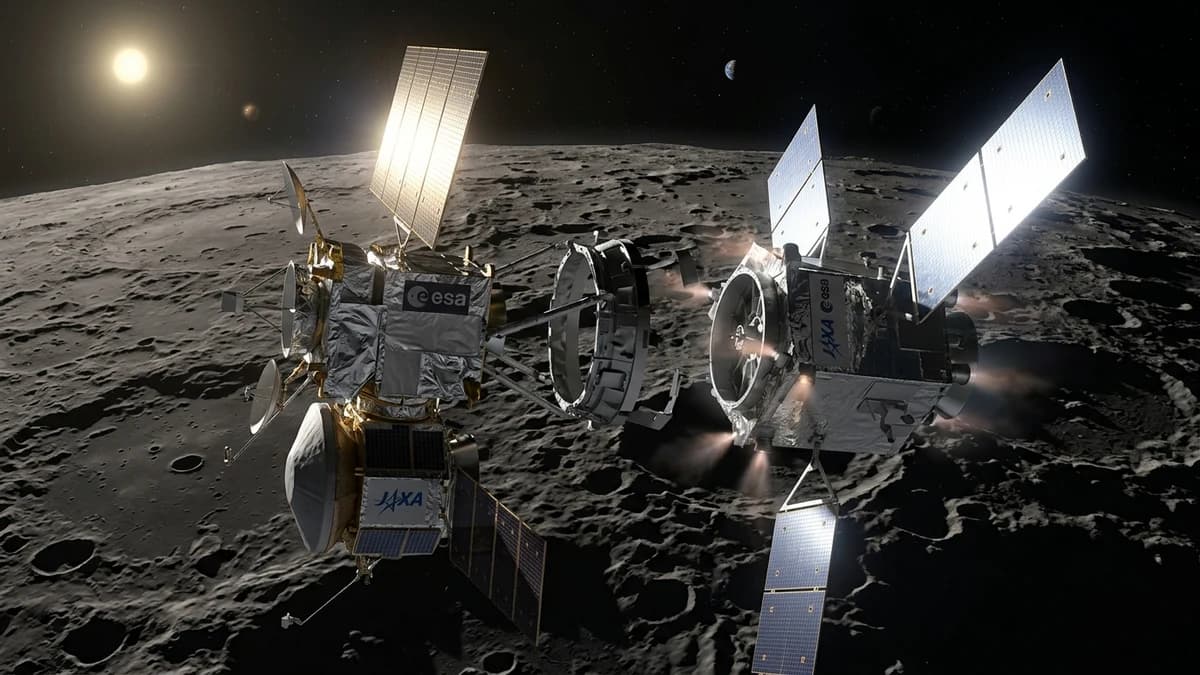
The cooperation between these two distinct orbiters will provide a truly three-dimensional and holistic view of the Mercurian system like never before. While the MPO observes the surface from a relatively low polar orbit, Mio will travel in a much more highly elliptical orbit. This unique geometric configuration will allow simultaneous and complementary measurements that will unravel the intricate relationship between the planet's interior, its exospheric surface, and its protective magnetosphere.
Operating a spacecraft around Mercury is arguably one of the greatest challenges ever faced by space exploration engineering. The planet's extreme proximity to the Sun means that external temperatures can reach mind-boggling peaks of over 450 degrees Celsius. To survive this blazing inferno, BepiColombo has been equipped with innovative thermal shields, multi-layered insulation, and highly efficient radiating systems.
Solar radiation is not the only severe threat; the planet itself radiates an immense amount of infrared heat reflected from its superheated surface. This means the probes face a constant and formidable thermal "crossfire", requiring rigorous attitude control to protect their delicate instruments. Any orientation error, no matter how small, could expose sensitive components to lethal heat, causing catastrophic failures in a matter of minutes.
In addition to the extreme thermal conditions, the radiation environment is terribly severe, with highly energetic particles emanating directly from the nearby solar corona. The onboard electronic systems were meticulously hardened to withstand these intense radiation bombardments throughout the nominal mission years. Every piece of technology incorporated into BepiColombo is the result of years of grueling testing and pioneering research in extreme resistance materials.
To fully understand the magnitude of the BepiColombo mission, it is crucial to compare it with the pioneering missions that preceded it in this hostile environment. The table below highlights the notable technological, methodological, and scientific scope differences between the three main journeys to the first planet. The formidable advancement in space technology becomes remarkably evident when observing the evolution of instrumentation and orbital complexity of each successive project.
| Feature |
Mariner 10 (NASA) |
MESSENGER (NASA) |
BepiColombo (ESA/JAXA) |
| Arrival Year |
1974 (Flybys) |
2011 (Orbit) |
2026 (Dual Orbit) |
| Mission Type |
Flybys Only |
Single Orbiter |
Dual Orbiters (MPO and Mio) |
| Travel Duration |
Less than 1 year |
6.5 years |
Nearly 8 years |
| Main Propulsion |
Conventional chemical |
Conventional chemical |
Solar ionic (MTM) + Chemical |
| Scientific Focus |
First images, magnetosphere detection |
Global mapping, ice at poles |
Simultaneous dual investigation (Surface and Magnetosphere) |
| Total Launch Weight |
~500 kg |
~1,100 kg |
~4,100 kg |
This historical progression perfectly illustrates how humanity's ambition and technical capabilities have expanded exponentially in recent decades. BepiColombo is not just a natural successor; it is a colossal evolution in terms of payload, international collaboration, and sheer scientific scope. The sheer volume of data expected from this mission will far surpass everything that has ever been collected about Mercury in combined past missions.