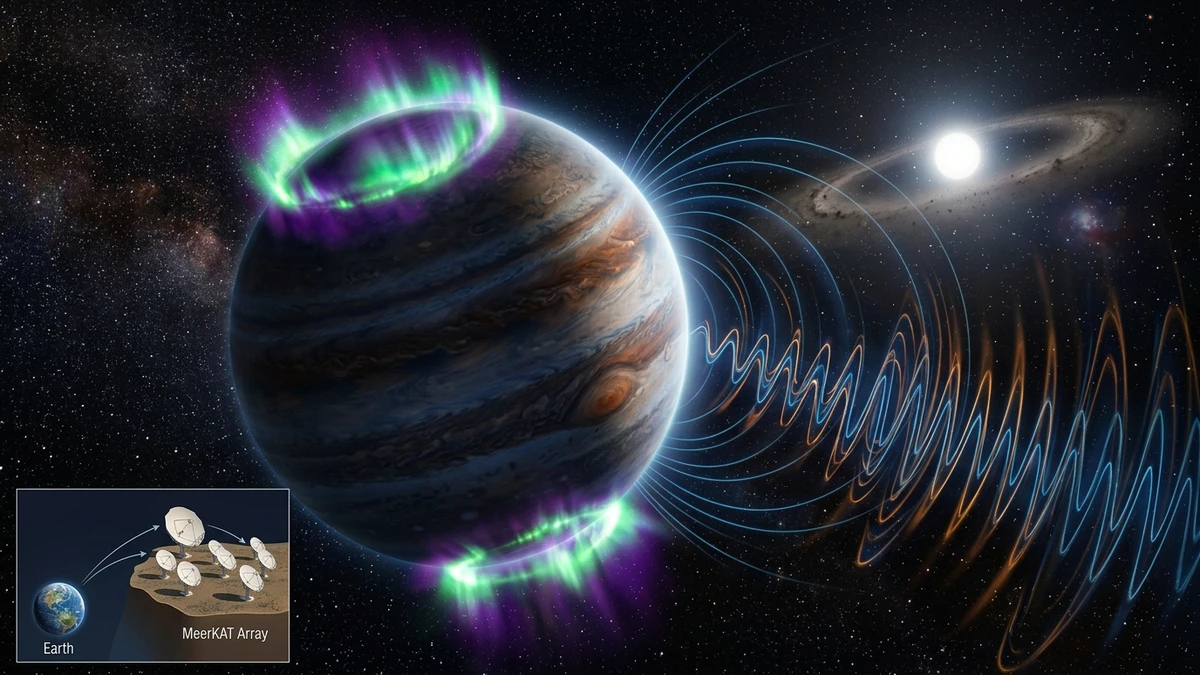
An international team of astronomers has detected the first radio signal captured directly from an exoplanet, confirming the presence of a giant magnetic field around the gas giant Beta Pictoris b. Located approximately 63 light-years from Earth in the constellation Pictor, the planet with a mass 9 to 13 times that of Jupiter emits highly polarized radio bursts between 0.85 and 3.5 gigahertz. This historic discovery, achieved using the MeerKAT radio telescope array in South Africa, isolates for the first time in modern science radio emissions from a distant world without interference from its host star.
The identified radio signal is generated by intense auroral emissions driven by the physical mechanism known as electron cyclotron maser instability. This same magnetospheric process occurs within our Solar System in the polar auroras of Jupiter, Earth, and Saturn when charged particles collide with magnetic field lines. Empirical measurements demonstrate that the magnetic field strength of Beta Pictoris b reaches at least 1.25 kilogauss, making it hundreds of times more powerful than Earth's magnetosphere.
The detection was made possible because the host star Beta Pictoris is a young star that is energetically quiet in the radio frequency spectrum, allowing scientists to clearly distinguish the planet's radio bursts. Researchers emphasize that the radio pulses represent a completely natural physical phenomenon generated by plasma interactions and electrical currents in the upper planetary atmosphere. This pioneering study provides an unprecedented, model-independent tool to probe the internal structure, rotation, and protective shields of worlds beyond our Solar System.
Magnetospheric Physics and MeerKAT Radio Telescope Technology
Observations conducted by the MeerKAT observatory captured both rapid pulsed bursts and a persistent low-intensity continuous radio emission originating from Beta Pictoris b. The rapid rotation of the exoplanet, which completes a full turn on its spin axis in roughly eight hours, causes its auroral beams to sweep across cosmic space like a light beacon. This strict periodicity enabled scientists to calculate with high precision the rotation parameters and dipolar geometry of the planetary magnetic field.
A magnetosphere plays a crucial role in preserving a planet's atmosphere against erosion caused by stellar winds and high-energy cosmic radiation. On giant worlds such as Beta Pictoris b, the internal dynamo generated by the convection of molten metallic hydrogen in the core creates a magnetic shield of colossal dimensions. Direct measurement of this protective barrier provides essential benchmark parameters to calibrate simulations concerning the potential habitability of smaller rocky exoplanets in the future.
Astronomers utilized advanced radio frequency interferometry techniques to filter out galactic background noise and map the precise origin of the radio pulses. By synchronizing the dish antennas of the South African observatory complex, the resulting angular resolution surpassed previous limits in planetary detection. This technical milestone opens a brand-new era in radio astronomy dedicated to studying extra-solar exoplanets and distant magnetic fields.
| Astronomical Parameter | Observed Value | Unit / Reference |
|---|---|---|
| System Distance | 63 | Light-years from Earth |
| Exoplanet Mass | 9 to 13 | Jupiter Masses |
| Magnetic Intensity | >= 1.25 | Kilogauss (kG) |
| Radio Frequency Range | 0.85 to 3.5 | Gigahertz (GHz) |
| Detection Observatory | MeerKAT Array | South Africa |
| Emission Mechanism | Cyclotron Masers | Natural Auroral Process |
Physical Mechanisms of Auroral Emissions and Planetary Dynamos
The circularly polarized radio bursts result from the spiral motion of accelerated electrons traveling along magnetic field lines toward the exoplanet's poles. As these charged particles impact the upper atmosphere, they release energy in the form of coherent radio radiation and brilliant curtains of visible auroral light. This phenomenon demonstrates that the exoplanet harbors an extremely dynamic plasma environment continuously fed by particle winds or neighboring moons.
Comparisons with Jupiter establish direct scientific parallels regarding how giant planetary magnetic fields interact with their surrounding space environments. In our Solar System, the volcanic moon Io injects tons of sulfur dioxide into Jupiter's magnetosphere, dramatically intensifying its radio and optical auroral displays. Astrophysicists speculate that Beta Pictoris b may possess active exo-volcanic moons providing material to sustain its constant auroral glow.
Generating a magnetic field of 1.25 kilogauss requires a hot, fluid-dynamic interior powered by the primordial heat of planetary formation. Because the Beta Pictoris system is only about 20 million years old, the exoplanet is still undergoing active gravitational contraction and thermal cooling. This stellar youth favors the maintenance of intense internal dynamos and large-scale electrical currents throughout its interior structure.
Radio Astronomy Implications for the Search for Habitable Worlds
The ability to detect exoplanetary magnetic fields via radio signals represents a game-changing breakthrough for astrophysics and the search for extraterrestrial life. Earth's magnetic field was vital in preventing our atmosphere from being stripped away by early solar radiation over billions of years. Mapping the presence of these magnetic shields on rocky exoplanets in the future will allow scientists to identify which distant worlds possess adequate protection for liquid water.
Theoretical models of planetary evolution are currently undergoing major revisions to incorporate the direct physical measurements obtained by the MeerKAT project. Future next-generation radio telescope networks, such as the Square Kilometre Array, will be capable of detecting similar radio signals on smaller and more distant exoplanets. This methodological transition expands research horizons far beyond traditional optical transit and radial velocity observation techniques.
Investigation of the Beta Pictoris b system will continue over coming years to monitor long-term variations in the exoplanet's radio emission output. Mapping fluctuations in auroral intensity will reveal how the magnetic shield responds to stellar weather variations from the host star. This integrated understanding consolidates radio astronomy as a fundamental pillar of modern exoplanetary exploration.
Frequently Asked Questions About the Beta Pictoris b Radio Signal
Is the radio signal detected from exoplanet Beta Pictoris b a message from extraterrestrial life?
No, the radio signal detected from exoplanet Beta Pictoris b is a completely natural physical phenomenon produced by extreme planetary auroral emissions in deep space. The radio bursts are generated by the active interaction of energetic electrons with the exoplanet's powerful magnetic field via the electron cyclotron maser instability mechanism. This is the exact same natural physical process that generates radio emissions and brilliant auroral curtains at the polar regions of Jupiter, Earth, and Saturn within our own Solar System.
Which astronomical instrument was used to isolate the radio signal coming from the exoplanet?
This landmark discovery was accomplished by an international team of professional astronomers using the advanced MeerKAT radio telescope array located in the remote Karoo region of South Africa. The observatory used high-precision interferometric dish networks to isolate the radio emissions of the exoplanet from surrounding young host star electromagnetic background noise. The complete absence of strong radio activity from the young host star Beta Pictoris allowed scientists to unequivocally confirm the strictly planetary origin of the detected extra-solar radio pulses.
What is the scientific significance of directly measuring an exoplanet's magnetic field?
Directly measuring a powerful 1.25 kilogauss magnetic field on Beta Pictoris b provides the first concrete empirical proof of protective magnetospheric shields around worlds outside our Solar System. This unprecedented physical data reveals vital insights regarding the rapid rotation rate, internal planetary dynamo, and geological structure of the exoplanet without relying on theoretical estimates. The pioneering technique paves the way for mapping magnetic protection on rocky exoplanets in the future, a decisive factor in determining planetary habitability over deep geological time.