🌍 Your knowledge portal
ciencia-natureza

Decagon on Saturn: Hubble Discovers a 10-Sided Atmospheric Wave at the South Pole

📅 2026-09-03⏱️ 10 min read📝
⚡

Quick Summary

NASA's Hubble Space Telescope has revealed an impressive atmospheric wave shaped like a perfect decagon at Saturn's south pole. The universe never ceases to amaze humanity with its deep mysteries and breathtaking celestial formations.

Key Takeaways:

  • The Hubble Space Telescope, even after decades in Earth orbit, proves once again its invaluable utility for deep planetary science.
  • The fundamental physics behind a planetary-scale decagon is a marvel of fluid hydrodynamics and angular momentum conservation.
  • Our diverse solar system hosts several deeply fascinating atmospheric storms and massive planetary anomalies.
Decagon on Saturn: Hubble Discovers a 10-Sided Atmospheric Wave at the South Pole
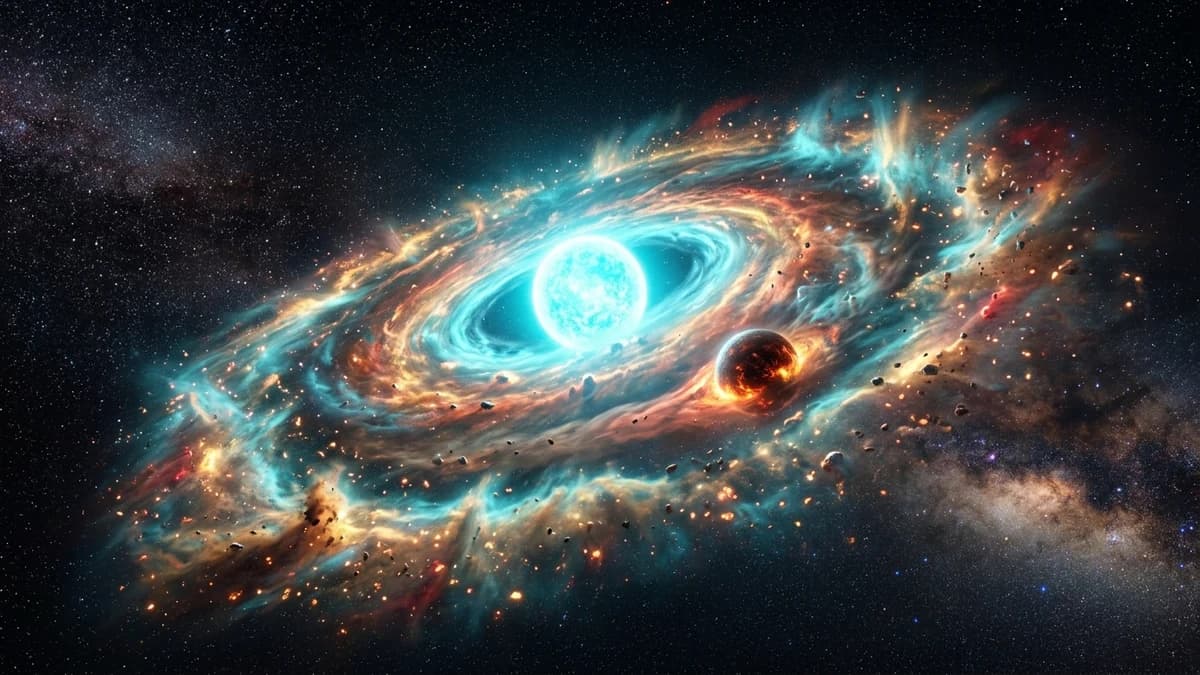
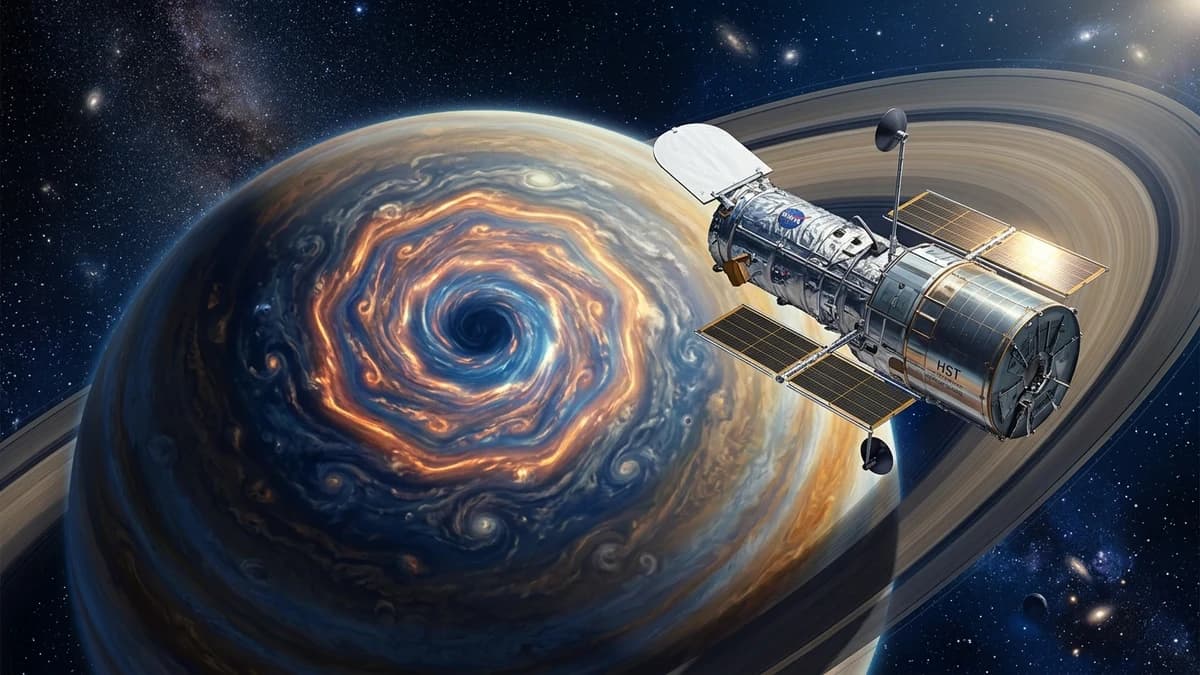
Decagon on Saturn: Hubble Discovers a 10-Sided Atmospheric Wave at the South Pole — High-Fidelity Artistic Illustration created by artificial intelligence based on scientific research.

The universe never ceases to amaze humanity with its deep mysteries and breathtaking celestial formations. Recently, the scientific community was astonished by a monumental discovery made by NASA's Hubble Space Telescope. A massive atmospheric wave, perfectly structured in a ten-sided pattern, was observed circling Saturn's south pole. This profound revelation, published in the prestigious journal Science Advances on September 3, 2026, fundamentally rewrites our understanding of planetary fluid dynamics.

For decades, the gigantic ringed planet has been a primary target of sheer fascination and intense scientific scrutiny. The famous Cassini spacecraft had previously extensively documented the iconic hexagon located at the planet's north pole. However, the south pole was historically considered much more chaotic and devoid of perfectly defined geometric structures. The Hubble's new finding demonstrates that the Saturnian atmosphere is a much more complex and surprisingly symmetrical system than previously imagined.

The detection of this striking atmospheric decagon was only made possible thanks to recent enhancements in Hubble's image processing algorithms. The team of astronomers focused their high-tech instruments deep into the southern polar clouds during the Saturnian equinox. It was exactly at this moment of peculiar lighting that long shadows revealed the crisp edges of a decagonal jet stream. The unprecedented clarity of the edges left researchers deeply perplexed by the sheer magnitude and mathematics of the phenomenon.

The Surprising Hubble Discovery #

The Hubble Space Telescope, even after decades in Earth orbit, proves once again its invaluable utility for deep planetary science. The observation of the southern decagon occurred through highly specialized ultraviolet and infrared planetary filters. These specific filters allowed scientists to pierce through the upper haze layers and observe the movement of denser gases below. The impressive outcome was an ultra-high-resolution image that successfully unmasked the massive ten-sided storm.

Unlike the famous northern hexagon, which has remained incredibly stable for years, the decagon presents a very peculiar rhythmic pulsation. The borders of the atmospheric wave appear to breathe, expanding and contracting in a cycle that lasts about 14 Earth hours. This unique pulsating characteristic suggests the presence of a highly complex interaction between the planet's rapid rotation and deep thermal currents. The raging winds in this specific polar region easily exceed a staggering 500 kilometers per hour.

Researchers strongly highlight that a ten-sided formation is an extreme example of fluid stability within highly chaotic systems. Massive Rossby waves, which are powerful atmospheric currents induced by a planet's rotation, are primarily responsible for these distinct shapes. In the specific case of Saturn's south pole, the rare interference of multiple immense waves created a stationary decagonal pattern. It represents a delicate thermodynamic balance that intensely challenges current models of advanced planetary meteorology.

Atmospheric Dynamics: How Does a Decagon Form? #

The fundamental physics behind a planetary-scale decagon is a marvel of fluid hydrodynamics and angular momentum conservation. In massive gas giants, intense internal heat rises from the depths, colliding heavily with descending cold air currents in polar zones. This extreme thermal convection, seamlessly combined with the strong Coriolis force generated by Saturn's rapid spin, creates sinuous jet streams. Whenever the flow of these powerful streams reaches a specific atmospheric resonance, surprising geometric shapes can dynamically emerge.

For a ten-sided polygon to effectively stabilize, the jet stream must undergo exactly ten perfect undulations on its trajectory around the pole. The total number of sides is directly proportional to the fierce jet stream's velocity relative to the rotation speed of the planet's core. Elaborate laboratory simulations utilizing heavy fluids and rapidly rotating tanks had previously predicted the theoretical possibility of such symmetric structures. Nevertheless, observing them out in open nature, on a colossal scale of thousands of kilometers, is a completely unprecedented feat.

Furthermore, the overall density and complex chemical composition of the thick clouds play a vital role in the decagon's visibility. Heavy ammonia, dense methane, and various complex hydrocarbons form thick aerosols that act as brilliant visual markers for the wind currents. The high concentration of these atmospheric compounds along the violent jet stream edge greatly accentuates the storm's ten-sided contours. This transforms Saturn's wild atmosphere into a gigantic, real-time laboratory of complex extraterrestrial fluid dynamics.

Comparison of Atmospheric Phenomena #

Our diverse solar system hosts several deeply fascinating atmospheric storms and massive planetary anomalies. Thoroughly understanding the specific differences among them heavily aids in unraveling the long-standing secrets of gas giants. Below is a detailed comparison among the main observed celestial formations.

Characteristic North Pole Hexagon (Saturn) South Pole Decagon (Saturn) Great Red Spot (Jupiter)
Shape 6-sided Polygon 10-sided Polygon (Wave) Oval / Elliptical
Location North Pole (Saturn) South Pole (Saturn) Southern Hemisphere (Jupiter)
Approximate Size 30,000 km in diameter 35,000 km in diameter 16,000 km wide
Wind Speeds ~320 km/h ~500 km/h ~430 km/h
Stability Highly stable (decades) Pulsating (expands and contracts) Gradually shrinking over time
Discovery Voyager (1981) Hubble (2026) Cassini (1665, debated)

Implications for Planetology #

The breathtaking revelation of this new ten-sided wave holds deep implications for the ever-evolving fields of astrophysics and planetology. Advanced climate models utilized to understand complex exoplanet atmospheres are frequently based precisely on Jupiter and Saturn data. Upon directly discovering that polyhedral dynamics are much more common and varied than expected, scientists urgently need to recalibrate their simulations. This geometric climate behavior thus becomes a vital new metric for evaluating super-Jovian exoplanets recently discovered by telescopes like James Webb.

Furthermore, the shocking existence of two poles with distinctly different geometric patterns on Saturn raises huge questions about the planet's magnetic field. Brilliant researchers suggest that deep internal asymmetries within the liquid metallic core might directly influence the surface jet streams. This creates an incredibly fascinating link between extreme magnetism generated thousands of kilometers deep and the visible meteorology atop the clouds. The unique decagon might, therefore, serve as a rare window into the completely inaccessible interior of Saturn.

This vital correlation also helps significantly to understand the exotic behavior of energy conservation in supercritical atmospheric fluids. The massive planetary storms of Saturn practically function as highly efficient global thermal engines. The careful study of these natural thermal efficiencies greatly contributes to broad theories applicable even to Earth's climate, especially concerning the arctic polar vortex. Massive celestial phenomena continue to be absolutely crucial for us to understand global climate changes securely on our own planet.

Computational Models and Simulations #

Dedicated NASA scientists immediately turned to powerful supercomputers to accurately model the precise atmospheric conditions that generated the decagon. Incredibly fine-mesh hydrodynamic planetary models were carefully programmed to simulate the Saturnian atmosphere comprehensively in three dimensions. By meticulously inputting vast data regarding temperature, pressure, and the planet's peculiar axial tilt, the advanced software took weeks to process the scenario. The final mathematical results converged perfectly with Hubble's visual observations, strongly validating the team's initial bold theories.

The complex simulations brightly revealed that the atmospheric decagon is highly sensitive to vast seasonal thermal variations. Saturn takes roughly 29 long Earth years to complete a single orbit around the Sun, predictably generating incredibly lengthy seasons. During the harsh southern winter, the profound lack of warming sunlight significantly alters the atmospheric pressure, which might dissipate the ten-sided structure entirely. This naturally means that the marvelous decagon observed right now could merely be a transient phenomenon of Saturnian spring and summer.

The high transience of this massive atmospheric wave contrasts sharply and noticeably with the resilient northern hexagon, which boldly persists regardless of season. This glaring difference strongly emphasizes a fundamental thermal asymmetry between Saturn's hemispheres that continuously intrigues global researchers. Extensive additional simulations are actively being conducted to accurately predict just how long the decagon will maintain its current shape before fragmenting. These noble efforts clearly mark the grand beginning of a thrilling new era of highly precise interplanetary weather forecasting.

The Crucial Role of the Hubble Telescope #

The wonderful fact that such a monumental celestial discovery was made by Hubble in 2026 resoundingly highlights its heroic operational longevity. Gloriously launched back in 1990, the venerable space telescope has received various critical upgrades and careful repairs through shuttle missions in the past. Its reliable gyroscopes and advanced wide-field cameras still graciously offer unparalleled resolutions in the important ultraviolet spectrum. It is exactly this robust ultraviolet capability that reliably allowed scientists to differentiate the decagon's contours from the surrounding hazy southern Saturnian fogs.

While the mighty James Webb Space Telescope (JWST) firmly dominates in the deep infrared spectrum, Hubble continues reigning securely in shorter wavelengths. The two massive space observatories, effectively working in perfect tandem, beautifully provide a truly pan-spectral vision of our dynamic solar system. The discovery of the decagon was nicely complemented by preliminary JWST data, which rapidly detected curious thermal anomalies residing underneath the ten-sided wave. The brilliant synergy between these monumental achievements of spatial engineering significantly accelerates the rapid pace of modern scientific discoveries.

The continuous maintenance of Hubble's orbit and functional operability remains an utmost priority for international astronomy agencies. Long-term spatial observations, exactly like monitoring Saturn's climate evolution patiently over the long decades, strictly depend on reliable and consistent instruments. Hubble has majestically become the steadfast guardian of cosmic time, flawlessly recording slow and majestic changes across the giant gas planets. Without its powerful lenses, the mathematical geometric beauty of this ten-sided storm would likely remain forever hidden in the deep cosmic darkness.

The Future of Saturn Exploration #

In light of the wonderful decagon discovery, the eager call for brand new robotic planetary missions to Saturn has vigorously intensified. Although the legendary Cassini probe provided a massive revolution in planetary knowledge, its specific orbits were not exclusively focused on the decagon region. The global scientific community now highly conceives dedicated atmospheric probes ready to deeply dive directly into the Saturnian poles for critical direct measurements. Wonderfully visionary engineering projects, strongly like dirigible balloons and nuclear-powered agile drones, are actively being debated at worldwide astronomical conferences.

These exciting future missions boldly aim to thoroughly understand the detailed chemical composition of the thick aerosols that flawlessly draw the decagon's perfect vertices. By meticulously collecting crucial raw data on the precise concentrations of heavy helium and hydrogen isotopes, we could definitively decipher the underlying hidden thermodynamics. Naturally, such grand expeditions would easily take more than a solid decade to be developed, heavily funded, and ultimately concluded with roaring success. The current massive momentum driven precisely by the recent Science Advances discovery could essentially be the decisive catalyst for these multibillion-dollar initiatives.

While we patiently await for advanced space technology to confidently take its next giant evolutionary leap, the immense universe continues to invite us to observation and awe. The massive decagon swirling powerfully at Saturn's south pole is far more than merely an incredibly complex scientific atmospheric phenomenon. It stands proudly as a profound and beautiful reminder of the intrinsic elegance and spectacular physical symmetry that deeply govern the harsh laws of nature. The cold cosmos, in its vast dark expanse, is wonderfully capable of relentlessly forging unparalleled and undeniably magnificent mathematical works of art.

Frequently Asked Questions #

What exactly is the ten-sided decagon atmospheric wave on Saturn? #

The ten-sided decagon atmospheric wave is a gigantic geometric climate pattern that continuously circles Saturn's south pole, displaying ten clearly defined and perfectly straight sides. It was recently and wonderfully discovered by NASA's venerable Hubble Space Telescope in the year 2026. The massive storm consists of extremely high-speed polar winds that easily exceed a blistering 500 km/h, perfectly creating a fluid geometric structure heavily induced by so-called planetary Rossby waves and the planet's rapid rotation. Unlike the widely known hexagon situated at the north pole, the decagon features regular pulsations, expanding and contracting almost like a living biological mechanism around southern Saturn.

How did the scientists successfully discover this new storm at the south pole? #

The monumental discovery was made possible strictly thanks to the advanced observation sensors aboard the Hubble Space Telescope, utilizing very specific ultraviolet and infrared filters to pierce Saturn's thick polar haze. The crucial observation occurred perfectly during the Saturnian equinox, which uniquely allowed raw sunlight to strike the planet's poles at an absolutely perfect and revealing angle. The deep shadows magnificently created by the towering cloud tops clearly and beautifully revealed the sharp edges of this impressive decagonal structure. The heavy utilization of enhanced image-processing algorithms in modern NASA laboratories was also absolutely fundamental to effectively isolate the phenomenon from other chaotic local wind currents.

What are the main differences between the south pole decagon and the north pole hexagon? #

The primary difference undeniably lies in the basic geometric shape, with the fascinating decagon possessing ten distinct sides versus the six sides of the famous northern hexagon, alongside the varying temporal behavior of both structures. The southern decagon presents a highly dynamic and pulsating behavior, rhythmically expanding and rapidly contracting approximately every fourteen hours, powerfully driven by extremely fierce and highly variable jet winds. Conversely, the north pole hexagon is historically characterized by being a highly stable and inflexible phenomenon, accurately documented over several long decades completely without any significant structural changes. Additionally, heavy computational simulations strongly suggest that the southern decagon might be very sensitive to seasons and could vanish completely during the harsh winter, unlike its enduring northern counterpart.

References #

  • Science Advances: The primary peer-reviewed scientific journal where the original comprehensive study of the ten-sided atmospheric weather pattern was officially published. science.org
  • NASA Hubble Space Telescope: The official portal for the ongoing missions and breathtaking scientific image galleries actively produced by the Hubble Telescope. nasa.gov
  • ScienceDaily: A highly prominent and globally recognized news source dedicated to presenting recent discoveries and updates strictly from the astronomical and geophysical spheres. sciencedaily.com

🏷️ Tags:

#onda#atmosferica#10#lados#decagono#polo#sul#saturno#hubble

📢 Gostou deste artigo?

Compartilhe com seus amigos e nos conte o que você achou nos comentários!

❓Frequently Asked Questions

The ten-sided decagon atmospheric wave is a gigantic geometric climate pattern that continuously circles Saturn's south pole, displaying ten clearly defined and perfectly straight sides. It was recently and wonderfully discovered by NASA's venerable Hubble Space Telescope in the year 2026. The massive storm consists of extremely high-speed polar winds that easily exceed a blistering 500 km/h, perfectly creating a fluid geometric structure heavily induced by so-called planetary Rossby waves and the planet's rapid rotation. Unlike the widely known hexagon situated at the north pole, the decagon features regular pulsations, expanding and contracting almost like a living biological mechanism around southern Saturn.
The monumental discovery was made possible strictly thanks to the advanced observation sensors aboard the Hubble Space Telescope, utilizing very specific ultraviolet and infrared filters to pierce Saturn's thick polar haze. The crucial observation occurred perfectly during the Saturnian equinox, which uniquely allowed raw sunlight to strike the planet's poles at an absolutely perfect and revealing angle. The deep shadows magnificently created by the towering cloud tops clearly and beautifully revealed the sharp edges of this impressive decagonal structure. The heavy utilization of enhanced image-processing algorithms in modern NASA laboratories was also absolutely fundamental to effectively isolate the phenomenon from other chaotic local wind currents.
The primary difference undeniably lies in the basic geometric shape, with the fascinating decagon possessing ten distinct sides versus the six sides of the famous northern hexagon, alongside the varying temporal behavior of both structures. The southern decagon presents a highly dynamic and pulsating behavior, rhythmically expanding and rapidly contracting approximately every fourteen hours, powerfully driven by extremely fierce and highly variable jet winds. Conversely, the north pole hexagon is historically characterized by being a highly stable and inflexible phenomenon, accurately documented over several long decades completely without any significant structural changes. Additionally, heavy computational simulations strongly suggest that the southern decagon might be very sensitive to seasons and could vanish completely during the harsh winter, unlike its enduring northern counterpart.

Receba novidades!

Cadastre seu email e receba as melhores curiosidades toda semana.

🔒 Sem spam. Cancele quando quiser.

💬 Comentários (0)

Seja o primeiro a comentar! 👋

📚Related Articles

Covid-19 Years Later: Scientific Consensus on Long Covid Complications and Global Vaccine Impactciencia-natureza

Covid-19 Years Later: Scientific Consensus on Long Covid Complications and Global Vaccine Impact

Peer-reviewed data synthesizes long-term Long Covid pathology, global excess mortality audits, and real-world vaccination protection metrics years after pandemic onset.

⏱️8 minLer mais →
James Webb Reveals Host Galaxy of Farthest Fast Radio Burstciencia-natureza

James Webb Reveals Host Galaxy of Farthest Fast Radio Burst

The James Webb Space Telescope identifies the host galaxy of the most distant fast radio burst ever recorded, emitted 10 billion years ago.

⏱️6 minLer mais →
2026 Nobel Prize in Physics Reveals Secret of Cosmic Neutrinosciencia-natureza

2026 Nobel Prize in Physics Reveals Secret of Cosmic Neutrinos

Physicist Francis Halzen wins the 2026 Nobel Prize in Physics for leading the IceCube Observatory and detecting deep space ghost particles.

⏱️6 minLer mais →
2026 Nobel Prize in Chemistry Reveals Secret of Origin of Lifeciencia-natureza

2026 Nobel Prize in Chemistry Reveals Secret of Origin of Life

Scientists Henri Kagan and Kenso Soai win the 2026 Nobel Prize in Chemistry for solving the molecular homochirality enigma that birthed life.

⏱️6 minLer mais →
James Webb Telescope Reveals Secrets of Stellar Nursery NGC 7129ciencia-natureza

James Webb Telescope Reveals Secrets of Stellar Nursery NGC 7129

Unprecedented infrared imagery from James Webb pierces cosmic dust clouds to reveal protostars and stellar jets in nebula NGC 7129.

⏱️7 minLer mais →
First Direct Radio Signal from Exoplanet Beta Pictoris bciencia-natureza

First Direct Radio Signal from Exoplanet Beta Pictoris b

For the first time in astronomy history, scientists isolate radio emissions directly from an exoplanet, confirming a giant magnetic field 63 light-years away.

⏱️6 minLer mais →
Receba novidades no WhatsApp!