🌍 Your knowledge portal
science-nature

NASA Discovers McGetchin Crater: Century's Largest Lunar Impact

📅 2026-09-19⏱️ 8 min read📝
NASA Discovers McGetchin Crater: Century's Largest Lunar Impact
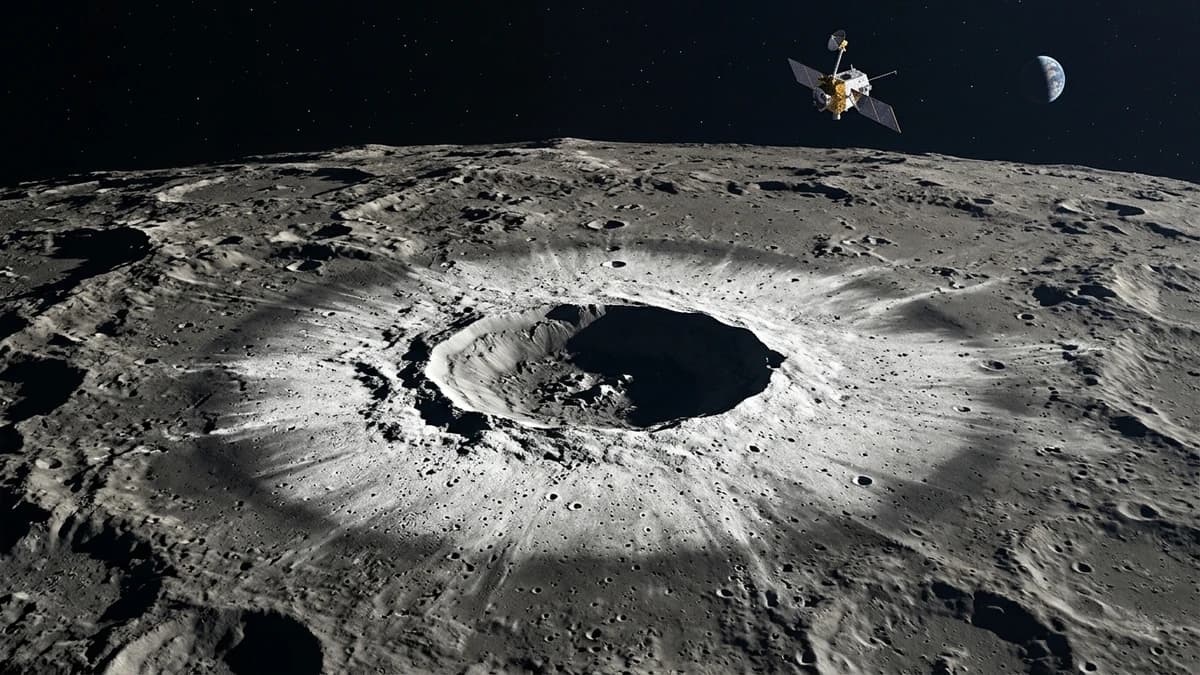
NASA Discovers McGetchin Crater: Century's Largest Lunar Impact — High-Fidelity Artistic Illustration created by artificial intelligence based on scientific research.
⚡

Quick Summary

NASA scientists confirm a 222-meter diameter impact crater on the Moon, formed by an asteroid collision recorded by the Lunar Reconnaissance Orbiter. NASA's Lunar Reconnaissance Orbiter (LRO) has formally confirmed the discovery of McGetchin Crater, a fresh impact excavation measuring 222 meters in diameter and 43 meters deep on the lunar nearside.

Key Takeaways:

  • The identification of McGetchin Crater was spearheaded by planetary scientist Robert Wagner and the LROC science operations team at Arizona State University.
  • The extraordinary scale of McGetchin Crater relative to routine lunar impacts monitored by orbital spacecraft is demonstrated in the detailed comparative matrix below:
  • Among the most intriguing geophysical phenomena associated with McGetchin Crater is the thermal signature documented by the Diviner Lunar Radiometer Experiment.

NASA's Lunar Reconnaissance Orbiter (LRO) has formally confirmed the discovery of McGetchin Crater, a fresh impact excavation measuring 222 meters in diameter and 43 meters deep on the lunar nearside. The astronomical event, detailed in a comprehensive study published in Science Advances in September 2026, represents the largest single cosmic impact scar witnessed and documented by scientific instrumentation on any planetary body in over a century. Rigorous temporal comparison of high-resolution orbital imagery constrained the exact moment of collision to an unobserved window between April and May 2024.

The impacting body was a near-Earth asteroid estimated between 15 and 30 meters in diameter, travelling at a relative velocity of approximately 18 to 22 kilometers per second before impacting the airless lunar surface. The instantaneous kinetic deceleration converted the projectile's kinetic energy into a catastrophic mechanical blast exceeding 3.4 megatons of TNT equivalent. The explosion completely vaporized the asteroid, excavated millions of metric tons of basaltic and anorthositic bedrock, and lofted fine reflective ejecta across a radial zone extending more than 15 kilometers from the rim crest.

The formal designation honors the late planetary geologist Thomas McGetchin, whose pioneering mid-twentieth-century research on impact cratering mechanics and explosive volcanism laid the theoretical foundations for interpreting lunar crater morphology. The rapid detection of this pristine feature offers researchers an unprecedented natural laboratory to calibrate numerical hydrodynamic shock wave simulations and observe the earliest stages of space weathering on newly exposed rock surfaces before solar energetic particles degrade the pristine crystal lattices.
Orbital Detection Algorithms and Bolide Dynamics #

The identification of McGetchin Crater was spearheaded by planetary scientist Robert Wagner and the LROC science operations team at Arizona State University. The team employed automated differential photometry algorithms across temporal image pairs captured by the spacecraft's Narrow Angle Cameras (NAC), which resolve surface features down to 50 centimeters per pixel from orbital altitudes of 50 to 100 kilometers. The software flagged a distinct albedo anomaly characterized by a brilliant central core enveloped by a diffuse halo of disrupted surface soil, triggering targeted re-observation campaigns across multiple orbital passes.

Hydrodynamic computer simulations using the iSALE-2D shock physics code indicated that the impactor possessed a bulk density consistent with ordinary L-chondrite stony meteorites, representing an estimated mass of approximately 35,000 metric tons. Striking the Moon at an oblique incidence angle of approximately 45 degrees from the northwest, the compressional shock wave generated instantaneous peak pressures exceeding 100 gigapascals at the point of contact. This extreme pressure regime induced immediate shock-melting and vaporization of target rock, creating glass-rich impact breccias and microscopic agglutinates.

The continuous ejecta blanket displays a distinctly asymmetric radial distribution, reflecting the northwest-to-southeast trajectory of the incoming bolide. Highly reflective secondary ray systems, exhibiting optical albedo values up to 40 percent brighter than the surrounding mature regolith, extend outward across adjacent crater walls and mare plains. Because these materials have experienced zero cumulative exposure to solar wind irradiation or micrometeorite bombardment, spectroscopic measurements captured by LRO's Lyman-Alpha Mapping Project (LAMP) provide pure chemical profiles of deep lunar anorthosite and pyroxene minerals.

Quantitative Comparison: McGetchin vs. Baseline Lunar Impacts #

The extraordinary scale of McGetchin Crater relative to routine lunar impacts monitored by orbital spacecraft is demonstrated in the detailed comparative matrix below:

Astrophysical & Geological Parameter McGetchin Impact Crater (2026 Confirmation) Routine Lunar Surface Impacts LRO Spacecraft Sensor Methodology Artemis Infrastructure Engineering Impact
Crest-to-Crest Rim Diameter 222 meters across circular cavity 5 to 20 meters average diameter Lunar Orbiter Laser Altimeter (LOLA) High-consequence regional kinetic destruction zone
Maximum Central Cavity Depth 43 meters vertical excavation Less than 4 meters excavation Digital Elevation Models (DEM) from NAC pairs Direct exposure of deep regolith and ancient stratigraphy
Impactor Bolide Mass Estimated ~35,000 metric tons Less than 500 kilograms Hydrodynamic iSALE modeling & kinetic scaling Calibration of planetary defense kinetic intercept models
Thermal Cold-Spot Anomaly 6-kilometer radial inertia zone Undetectable or limited to tens of meters Diviner Lunar Radiometer Experiment (DLRE) Alters radiative thermal dissipation of surface base camps
Estimated Recurrence Frequency 1 event every 80 to 120 years Hundreds of localized events annually LROC temporal image subtraction library Revision of 30-year mission structural survival statistics

This empirical comparison demonstrates that McGetchin Crater belongs to an entirely different energy regime than the routine meteoroid impacts detected by Apollo passive seismometers. It establishes a critical ground-truth data point for planetary defense models, verifying how kinetic energy couples into dry, porous planetary crusts.

The Diviner Infrared Cold-Spot Anomaly #

Among the most intriguing geophysical phenomena associated with McGetchin Crater is the thermal signature documented by the Diviner Lunar Radiometer Experiment. Infrared nighttime measurements revealed an immense "cold spot"—a region of anomalously low thermal inertia extending more than six kilometers radially from the impact center. During the fourteen-day lunar night, when surface temperatures normally decrease at a predictable rate dictated by bedrock conductivity, this extensive perimeter radiates heat into space far more rapidly than adjacent undisturbed terrain, appearing noticeably colder in thermal infrared bands.

Geophysicists attribute this thermal anomaly to the action of a low-density supersonic vapor and debris cloud produced during the initial shock decompression. As millions of tons of vaporized rock and ultrafine dust expanded outward at several kilometers per second, the blast wave scoured and fluidized the uppermost two to five centimeters of the surrounding regolith. This mechanical disruption broke apart the compacted agglutinate matrix that had developed over hundreds of millions of years, creating an ultra-porous, fluffy surface layer with extremely poor thermal conductivity.

During lunar daylight, this disrupted, low-density mantle heats rapidly on its immediate surface, but insulates the underlying bedrock from absorbing thermal energy. When the Sun sets, the shallow heat reservoir dissipates almost immediately, causing the localized surface temperature to drop steeply. Mapping the spatial boundaries of this cold spot provides planetary geologists with their first direct measurement of the atmospheric-equivalent airblast radius generated by hypervelocity impacts on vacuum-exposed worlds.

Implications for Long-Duration Artemis Lunar Architecture #

The occurrence of a multi-megaton kinetic impact on the lunar surface during the active operational timeframe of the Artemis campaign has introduced urgent structural considerations for NASA's exploration architecture. While the statistical probability of an asteroid striking directly on a specific human habitat remains extremely low (estimated at less than one in ten million over a thirty-year operating baseline), the secondary hazards demonstrated by McGetchin Crater extend across vast geographic territories.

High-velocity ejecta fragments, ranging from boulder-sized blocks to micro-shrapnel travelling at hundreds of meters per second, were propelled past the line of sight for tens of kilometers across the horizon. Furthermore, seismic energy generated by the 3.4-megaton impact produced long-duration surface shear waves that shook the lunar crust across a radius of more than 100 kilometers. On an airless body with zero acoustic dampening, surface vibrations reverberate within the fractured megaregolith for tens of minutes, threatening to induce structural fatigue in pressurized habitat modules, rupture cryogenic fuel storage tanks, and misalign precision optical communication arrays.

In response to the Science Advances publication, NASA's Moon-to-Mars Architecture Team initiated a comprehensive review of surface infrastructure shielding requirements. Engineers are prioritizing the deployment of sintered regolith berms—engineered protective mounds built using autonomous microwave rovers to melt surface dust into solid ceramic barriers around habitats and nuclear power reactors. Additionally, foundational habitat structures are incorporating elastomeric seismic isolation dampeners to isolate pressurized living quarters from the persistent ringing vibrations characteristic of lunar impact events.

Establishing a Benchmark for Future Planetary Science #

The discovery of McGetchin Crater transforms lunar science by providing an incontrovertible temporal zero-point for modern impact studies. Because the exact formation window is established to within a few weeks in early 2024, every subsequent observation of the site by orbital spacecraft and future robotic surface missions will document the progressive degradation of fresh geological materials in real time.

Planetary scientists will monitor how micrometeorite bombardment progressively breaks down the sharp crest of the crater rim, how solar ultraviolet radiation and solar wind protons sputter volatile atoms from fresh impact glasses, and how cosmic rays induce the gradual optical darkening of the high-albedo ejecta rays. Over the coming decades, these measurements will replace theoretical guesswork with empirical calibration curves, refining crater-count dating methods used across the entire inner solar system from Mercury to the moons of Mars.

McGetchin Crater stands as a stark cosmic reminder: the solar system remains an active, dynamic, and occasionally violent environment. The Moon's cratered face is not an ancient fossil frozen in immutable history, but an ongoing geological canvas continually shaped by cosmic collisions. Documenting these events with rigorous scientific precision ensures that humanity's expansion beyond low Earth orbit is grounded in an accurate, unvarnished understanding of the physical cosmos.

Official Scientific References #

  • Wagner, R. V., et al.: Discovery of the 222-Meter McGetchin Impact Crater on the Moon: Kinetic Energy Scaling and Morphology from LRO Observations, Science Advances, September 2026.
  • NASA Lunar Reconnaissance Orbiter Project: LROC Temporal Observation Database and Digital Terrain Models of Fresh Lunar Craters, Arizona State University, Tempe, AZ.
  • Paige, D. A., et al.: Thermal Radiative Decay and Regolith Decompaction in the McGetchin Impact Cold Spot from Diviner Data, Journal of Geophysical Research: Planets.
  • NASA Moon-to-Mars Architecture Team: Engineering Safeguards for Surface Infrastructure Against Hypervelocity Impact and Secondary Ejecta Hazards, Washington, D.C.

🏷️ Tags:

#mcgetchincratermoon#lunarimpact2026#lronasadiscovery#scienceadvancesmoonasteroid#lunarreconnaissanceorbiter

📢 Gostou deste artigo?

Compartilhe com seus amigos e nos conte o que você achou nos comentários!

❓Frequently Asked Questions

McGetchin Crater measures 222 meters in diameter from rim to rim and extends 43 meters vertically into the lunar bedrock, exhibiting an extraordinarily fresh depth-to-diameter ratio of 0.194. The structure formed from the hypervelocity collision of a rocky asteroid measuring between fifteen and thirty meters across that struck the airless lunar surface at approximately twenty kilometers per second. The instantaneous kinetic detonation released energy equivalent to 3.4 megatons of TNT, pulverizing the incoming bolide, excavating millions of tons of primordial basaltic regolith, and hurling brilliant ejecta rays outward across neighboring terrain.
The discovery was achieved by planetary scientists operating the Lunar Reconnaissance Orbiter Camera (LROC) at Arizona State University using automated temporal image subtraction algorithms. By cross-referencing narrow-angle orbital mosaics captured between April and May 2024 against baseline cartographic imagery recorded years earlier, researchers detected a prominent high-albedo optical anomaly surrounded by shock-darkened terrain. Subsequent infrared observations by the Diviner radiometer revealed a massive six-kilometer thermal cold spot, confirming that the crater represented the largest fresh impact observed on any terrestrial body in the modern scientific era.
Statistical impact flux models of the inner solar system indicate that asteroidal collisions capable of excavating craters exceeding two hundred meters in diameter occur on the Moon on average once every eighty to one hundred twenty years. Detecting McGetchin Crater provides the first opportunity in modern astrophysics to examine an impact scar of this magnitude with orbital sensors before and after the collision occurred. This unique temporal benchmark enables geologists to study unweathered lunar mineralogy, crystalline shock physics in a hard vacuum, and space weathering rates before solar wind ions degrade the newly exposed regolith.

Receba novidades!

Cadastre seu email e receba as melhores curiosidades toda semana.

🔒 Sem spam. Cancele quando quiser.

💬 Comentários (0)

Seja o primeiro a comentar! 👋

Receba novidades no WhatsApp!