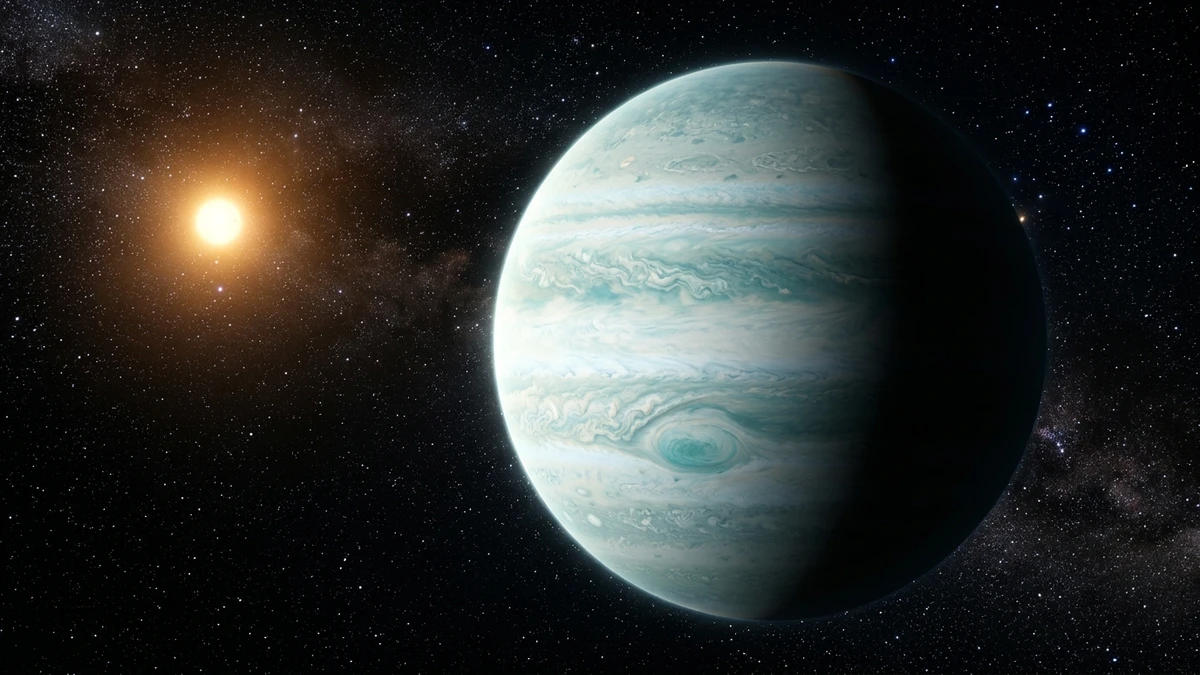
The James Webb Space Telescope has successfully captured a direct coronagraphic image of the cold giant exoplanet 14 Herculis c, a massive gas world roughly seven times the mass of Jupiter located 60 light-years from Earth in the constellation Hercules. The scientific breakthrough, published in The Astrophysical Journal Letters by an international research team led by William Balmer of Johns Hopkins University and the Space Telescope Science Institute (STScI), alongside Daniella Bardalez Gagliuffi of Amherst College, represents a revolutionary milestone in exoplanetary science. High-contrast infrared measurements reveal that the planet maintains an effective atmospheric temperature of approximately -3 °C (270 Kelvin or 26 °F), making it one of the coldest exoplanets ever directly photographed in human history.
Among the more than 5,600 exoplanets discovered across the Milky Way, the vast majority were identified through indirect methods such as radial velocity measurements and transit photometry. In stark contrast, fewer than a hundred exoplanets have ever been directly imaged through optical or infrared observatories. Nearly all previously photographed planetary companions were extraordinarily young gas giants—under one hundred million years old—still glowing incandescently from their primordial gravitational contraction at temperatures ranging between 1,000 °C and 2,000 °C. The 14 Herculis system presents an entirely different regime: it is a mature, four-billion-year-old planetary architecture, roughly the same evolutionary age as our own Solar System, where planets have long shed their formation heat and cooled into steady radiative equilibrium.
To isolate the faint thermal emission of the planet from the blinding glare of its nearby parent star, the research team deployed the coronagraph of Webb's Near-Infrared Camera (NIRCam). The host star, 14 Herculis, is a main-sequence orange dwarf of spectral type K0V, harboring approximately ninety percent of the Sun's mass and shining tens of thousands of times brighter than its planetary companion. By placing opaque coronagraphic masks directly into the telescope's optical path, NIRCam blocked the overwhelming diffraction rings of the star, allowing the subtle thermal photons emitted by the frigid gas giant to register clearly across narrow-band filters centered between four and five micrometers.
Astrometric and photometric modeling confirmed that 14 Herculis c orbits at a semi-major axis of approximately 27 astronomical units (roughly 1.4 billion miles), requiring decades to complete a single orbital revolution. Rather than traveling along a stable circular path akin to the giant planets in our Solar System, 14 Herculis c traces an elongated, football-shaped ellipse with an orbital eccentricity exceeding 0.6. This dramatic eccentricity, paired with a significant angular tilt relative to the inner planet 14 Herculis b, provides undeniable empirical evidence of a violent dynamical history.
Observational Data and Physical Properties of the 14 Herculis System
The structured table below synthesizes the fundamental astrophysical measurements, physical parameters, and dynamical classifications obtained from the James Webb NIRCam coronagraphic observations and archival radial velocity surveys. These metrics highlight why the 14 Herculis architecture challenges traditional models of calm, coplanar planetary accretion.
| Astrophysical Parameter | Measured / Determined Value | Scientific Significance |
|---|---|---|
| Host Star | 14 Herculis (HD 145675) | Mature K0V orange dwarf located roughly 59 light-years from Earth. |
| System Age | Approximately 4 billion years | Mature evolutionary stage equivalent to our own Solar System. |
| Planetary Mass (14 Her c) | Approximately 7 Jupiter masses ($7,M_J$) | Massive super-Jupiter capable of sustaining deep atmospheric layers. |
| Estimated Effective Temp | Approx. $-3,^\circ\text{C}$ ($270,\text{K}$ / $26,^\circ\text{F}$) | One of the coldest exoplanets ever imaged directly by astronomers. |
| Instrument Deployed | NIRCam Coronagraph (JWST) | High-contrast diffractive mask suppressing host star glare. |
| Semi-Major Orbital Axis | Approx. 27 Astronomical Units | Broad outer orbit situated between the equivalent distances of Uranus and Neptune. |
| Dynamical Architecture | "Dynamically hot" multi-planet system | Severe mutual inclination and high eccentricity caused by ancient gravitational scattering. |
The bizarre geometry between 14 Herculis c and its inner sibling 14 Herculis b (a five-Jupiter-mass planet orbiting closely at 2.8 astronomical units) firmly categorizes the system as "dynamically hot." In settled architectures such as our Solar System, planets orbit within nearly coplanar, circular paths inherited from the peaceful dissipation of the primordial protoplanetary disk. In 14 Herculis, however, the orbital planes of the two massive gas giants are tilted sharply against one another. This misaligned orbital architecture indicates that early in the system's history, multiple giant protoplanets engaged in chaotic gravitational scattering events that ejected other sibling worlds into interstellar space while stranding the survivors in skewed, highly eccentric orbits.
Beyond orbital mechanics, the infrared spectral data acquired by NIRCam yielded surprising insights into the atmospheric physics of cold giant worlds. In specific mid-infrared filter bands, 14 Herculis c appeared markedly fainter than predicted by standard planetary evolutionary tracks for a seven-Jupiter-mass body at four billion years of age. Astrobiologists and atmospheric modelers deduced that this subtle flux deficit stems from disequilibrium chemistry driven by vigorous vertical convective mixing within the cold planet's atmosphere.
In mature, cold gas giants, carbon monoxide and methane exist in delicate chemical balances dictated by local pressure and temperature gradients. When intense convective updrafts rapidly dredge up carbon monoxide from scorching deeper layers into the frigid outer troposphere faster than chemical reactions can convert it back into methane, the observed spectral energy distribution is altered. Furthermore, a surface temperature of -3 °C places the outer atmosphere squarely in the thermal regime where water vapor freezes into thick clouds of water-ice crystals, which selectively scatter and absorb escaping infrared radiation.
The successful direct imaging of 14 Herculis c establishes an essential technological stepping stone for future planetary characterization missions. Proving that NIRCam can detect and isolate mature, cold planets demonstrates that astronomers are no longer restricted to studying extreme, scorching infant worlds. The observational methods and high-contrast imaging reductions refined in this survey directly inform development strategies for NASA's upcoming Nancy Grace Roman Space Telescope and the flagship Habitable Worlds Observatory (HWO), which will attempt direct spectroscopy of temperate rocky exoplanets in the decades ahead.
The discovery of 14 Herculis c marks a decisive transition from statistical planet hunting to rigorous astrophysical and meteorological investigation. Exploring the complex cloud decks and dynamical scars of this frigid giant reveals that the cosmos produces an astonishing diversity of planetary architectures far wilder than the familiar tranquility of our Solar System.
Frequently Asked Questions About the Direct Imaging of 14 Herculis c
Why is the direct image of 14 Herculis c considered a milestone for the James Webb Space Telescope?
Directly capturing an image of 14 Herculis c is an extraordinary milestone because the exoplanet is a mature gas giant with an evolutionary age of four billion years and an atmospheric temperature of minus three degrees Celsius. Virtually all exoplanets directly imaged over the past two decades were extremely young worlds glowing with residual heat from their formation at temperatures exceeding one thousand degrees. Photographing an ancient, cold world in the infrared spectrum demonstrates the unmatched sensitivity of the James Webb telescope in characterizing mature planetary systems.
How did the coronagraph on NIRCam isolate the faint planet from the bright host star?
The coronagraph on Webb's Near-Infrared Camera uses specialized circular opaque masks positioned precisely in the telescope's optical beam to block the direct light emitted by the star 14 Herculis. Because the host star shines tens of thousands of times brighter than its planetary companion, unattenuated starlight would completely blind the detector. By eliminating the stellar glare and associated diffraction patterns, the coronagraph allowed the faint infrared photons originating from the cold gas giant to be resolved clearly.
What does the 14 Herculis system reveal about chaotic planetary system formation?
The 14 Herculis system is described by astronomers as dynamically hot because its two massive giant planets have misaligned orbital planes and steep eccentricities rather than flat circular paths. The outer giant 14 Herculis c orbits along an elongated ellipse tilted dramatically relative to the inner giant 14 Herculis b. This disordered configuration proves that the system underwent severe planet-planet gravitational scattering in its youth, violently ejecting other protoplanets into deep space while locking the remaining giants in chaotic trajectories.\n