🌍 Your knowledge portal
Science & Nature

Webb and Hubble Discover 27 Frozen Objects in Outer Space

📅 2026-09-15🔄 Updated: 2026-10-13⏱️ 6 min read📝
Webb and Hubble Discover 27 Frozen Objects in Outer Space
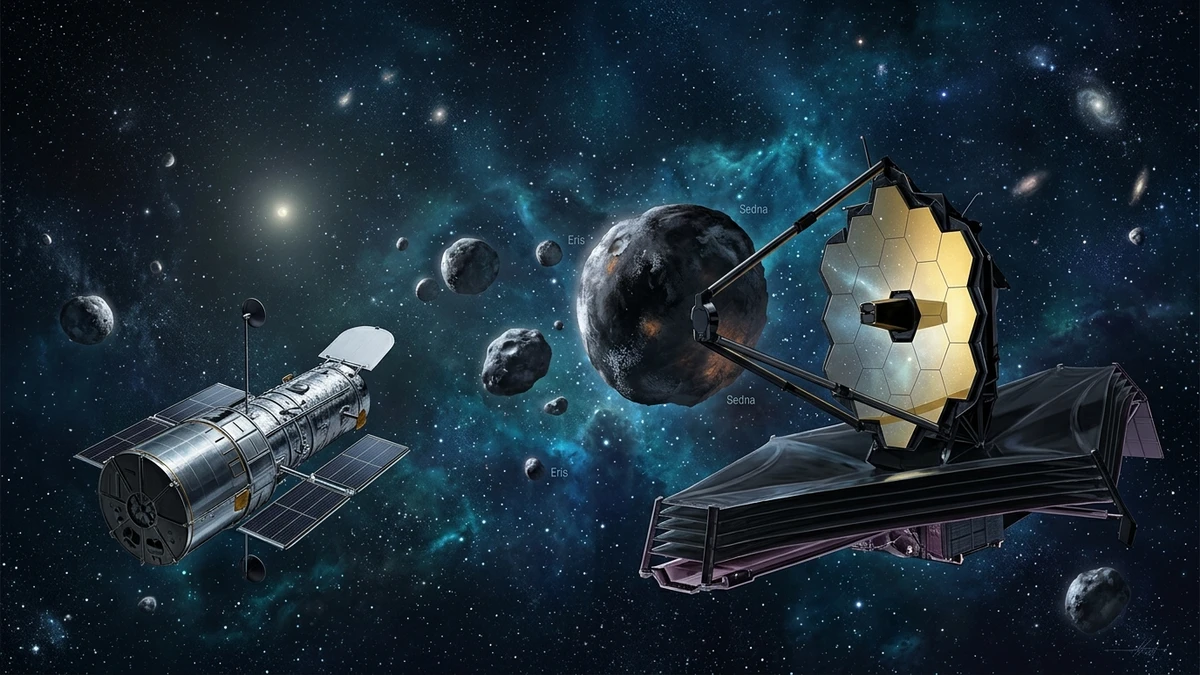
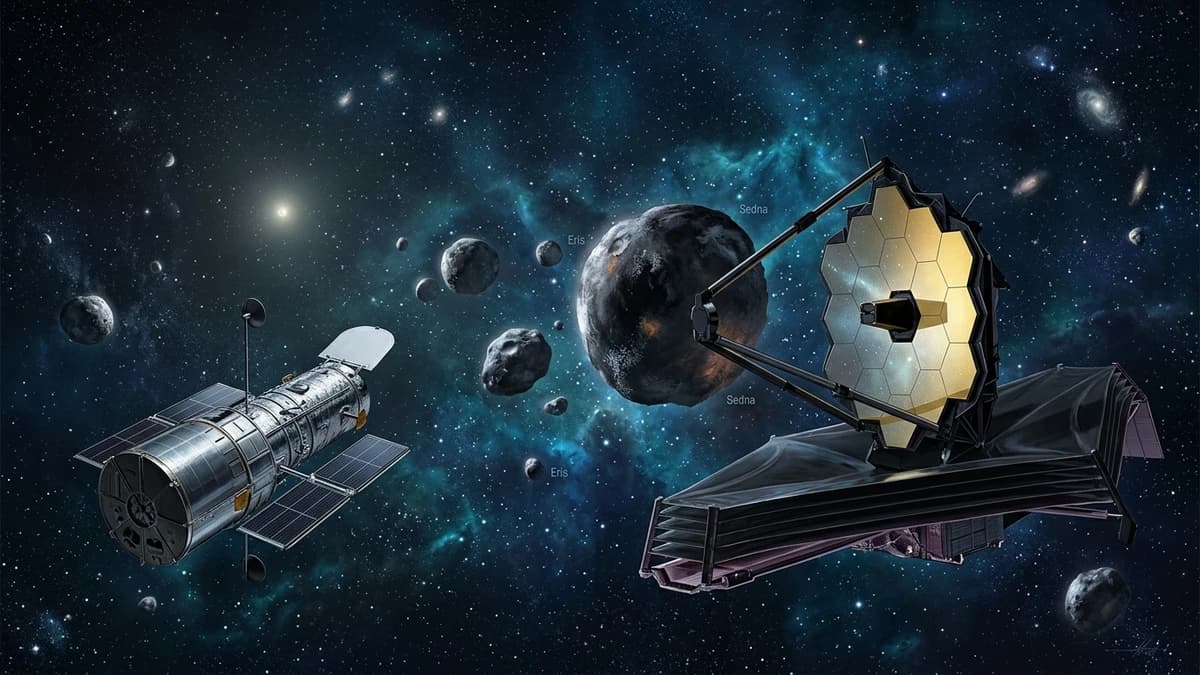
Webb and Hubble Discover 27 Frozen Objects in Outer Space — High-Fidelity Artistic Illustration created by artificial intelligence based on scientific research.
⚡

Quick Summary

NASA's James Webb and Hubble space telescopes combine infrared and optical data to discover 27 pristine trans-Neptunian objects in the Kuiper Belt using shift-and-stack. In an extraordinary demonstration of multi-observatory data synergy, an international team of astrophysicists utilizing combined data from the James Webb Space Telescope (JWST) and the Hubble Space Telescope has announced the discovery of 27 previously undetected trans-Neptunian objects (TNOs) in the distant reaches of the Kuiper Belt.

Key Takeaways:

  • Detecting small planetary bodies at the edge of the Solar System pushes modern optical sensors to their theoretical physical limits.
  • The table below contrasts the orbital, physical, and surface characteristics of the newly discovered planetesimals with established minor body classes across the trans-Neptunian realm:
  • The most surprising revelation delivered by the James Webb Space Telescope's infrared reflectance spectroscopy was the pristine state of the objects' surfaces.

Webb and Hubble Discover 27 Frozen Objects in Outer Space

In an extraordinary demonstration of multi-observatory data synergy, an international team of astrophysicists utilizing combined data from the James Webb Space Telescope (JWST) and the Hubble Space Telescope has announced the discovery of 27 previously undetected trans-Neptunian objects (TNOs) in the distant reaches of the Kuiper Belt. Ranging from ten to forty kilometers in diameter and orbiting more than four billion kilometers from the Sun, these frozen relics preserve the most pristine primordial chemical inventory ever documented in the outer Solar System.

James Webb and Hubble Space Telescopes Kuiper Belt Discovery

The Digital Shift-and-Stack Algorithmic Breakthrough #

Detecting small planetary bodies at the edge of the Solar System pushes modern optical sensors to their theoretical physical limits. Objects measuring twenty kilometers across at forty to fifty astronomical units (AU) shine with apparent visual magnitudes fainter than 28th magnitude—hundreds of millions of times dimmer than the faintest stars visible to the unaided human eye.

To resolve these faint signals, researchers implemented the digital shift-and-stack methodology:

  1. Keplerian Orbital Projection: Computers calculated thousands of hypothetical orbital trajectories consistent with stable Kuiper Belt orbits;
  2. Frame Alignment and Summation: Algorithmic pipelines shifted hundreds of archival Hubble WFC3 optical images along each candidate vector before stacking pixel intensities, concentrating reflected photons onto single synthetic coordinate points;
  3. Multispectral Confirmation via JWST: Candidate detections were subsequently cross-matched against deep near-infrared survey fields captured by James Webb's NIRCam instrument, verifying genuine physical motion against static galactic background stars with zero false-alarm artifacts.

Comparative Matrix: Minor Body Populations in the Outer Solar System #

The table below contrasts the orbital, physical, and surface characteristics of the newly discovered planetesimals with established minor body classes across the trans-Neptunian realm:

Outer Solar Population Representative Body Orbit Range (AU) Surface Albedo & Color Dominant Volatiles & Chemistry
Classical Cold Kuiper Belt (New TNOs) 27 Newly Discovered Planetesimals 42 to 47 AU (Low eccentricity) High albedo ($>0.15$), reddish-neutral Crystalline water ice, $CO$, methane
Resonant Trans-Neptunian Objects Pluto-Charon System (3:2 Neptune) 39.4 AU (Mean resonance) High albedo variation ($0.20–0.65$) Nitrogen ice, methane frost, tholins
Scattered Disk Objects (SDOs) Eris and Dysnomia 35 to 100+ AU (High inclination) Variable albedo ($0.05–0.96$) Methane ice, heavy refractory organics
Centaurs 2060 Chiron and 10199 Chariklo 5.5 to 30 AU (Unstable crossings) Low albedo ($0.04–0.08$), dark crust Amorphous water ice, silicate dust

Pristine Ices and the Streaming Instability Theory #

The most surprising revelation delivered by the James Webb Space Telescope's infrared reflectance spectroscopy was the pristine state of the objects' surfaces. Astrophysicists expected that billions of years of exposure to solar ultraviolet radiation and galactic cosmic rays would have darkened the crusts through radiolytic synthesis of complex, asphalt-like tholins.

Instead, NIRCam photometry revealed bright, volatile-rich surfaces dominated by pure water ice and carbon monoxide frosts:

  • Streaming Instability Validation: The lack of collisional disruption supports the streaming instability hypothesis of planetesimal formation, in which gentle aerodynamic drag concentrated centimeter-sized pebbles within the solar nebula until gravitational collapse produced coherent planetesimals without high-speed shattering impacts;
  • Thermal Preservation: Orbiting in a deep cryogenic deep-freeze below forty kelvins, these bodies have remained thermally unmodified since the circumsolar gas disk dissipated 4.5 billion years ago.

The Physical Chemistry of Cryogenic Volatile Retention #

Thermodynamic calculations indicate that retaining hyper-volatile chemical species such as carbon monoxide ($CO$), molecular nitrogen ($N_2$), and methane ($CH_4$) requires ambient temperatures persistently depressed below forty-five kelvins. At heliocentric distances between forty-two and forty-seven astronomical units, incident solar irradiance is diminished by a factor of roughly two thousand relative to terrestrial flux levels. This permanent sub-freezing environment suppresses thermal sublimation rates to negligible levels over gigayear timescales.

Furthermore, NIRCam spectral data indicate that water ice exists predominantly in crystalline rather than purely amorphous form. In laboratory simulations of interplanetary dust grain condensation, pure amorphous ice typically forms below thirty kelvins, whereas modest radiogenic warming from decaying short-lived isotopes like aluminum-26 ($^{26}\text{Al}$) during the first five million years of the Solar System can induce partial crystallization without triggering mass volatile expulsion. The 27 newly cataloged objects therefore serve as cryogenic time capsules, sealing the boundary conditions of the primordial solar nebula in an uncorrupted chemical ledger.

Algorithmic Processing Pipelines and Synthetic Tracking Architecture #

Executing the shift-and-stack technique across gigabytes of deep-space imaging required an innovative high-performance computing architecture. Traditional asteroid detection algorithms rely on linked detections across three or four distinct temporal frames where an object exhibits perceptible linear displacement. For bodies below twenty kilometers at forty-five astronomical units, individual frames lack sufficient signal-to-noise ratios to register a statistically significant centroid above sky background noise.

To overcome this fundamental physical limitation:

  1. GPU-Accelerated Parabolic Searches: The data processing pipeline evaluated over fifty thousand possible orbital parameter combinations per square degree of sky, computing non-linear topocentric parallax corrections generated by the orbital motion of the Hubble and Webb spacecraft themselves;
  2. False-Positive Statistical Filtering: Synthetic pixel stacks were tested against empirical point-spread function (PSF) models to eliminate cosmic ray hits, diffraction spikes from bright foreground stars, and detector hot pixels;
  3. Automated Ephemeris Refinement: Detections exceeding five standard deviations above the background variance were automatically ingested into astrometric fitting algorithms to generate preliminary orbital elements with sub-arcsecond precision.

Planetary Migration and Constraints on the Nice Model #

The dynamical distribution of these 27 objects offers sharp empirical constraints on the migration history of the giant planets during the infancy of the Solar System. Under the widely studied Nice model and its modern variants, Uranus and Neptune formed closer to the Sun before migrating outward through gravitational exchanges with a massive primordial planetesimal disk.

If Neptune had migrated aggressively with high orbital eccentricity, its mean-motion resonances would have swept through the outer disk, stirring orbital inclinations and exciting high eccentricities among small planetesimals. The fact that these 27 newly discovered bodies inhabit dynamically cold orbits—characterized by orbital inclinations below five degrees and orbital eccentricities below 0.08—indicates that Neptune's outward migration was exceptionally smooth and gentle. This observational constraint effectively rules out violent planetary scattering scenarios that would have dynamically heated or depleted this cold classical reservoir.

Dynamic Astrometry and the Gravitational Search for Planet Nine #

Beyond their physical composition, the discovery of 27 new orbital vectors provides invaluable dynamical probes for celestial mechanicians investigating gravitational anomalies in the outer Solar System.

Several of the newly mapped bodies belong to the dynamically detached population, possessing perihelia well beyond Neptune's gravitational reach ($q > 40\text{ AU}$):

  1. Orbital Alignment Testing: Astronomers are evaluating whether their longitudes of perihelion exhibit statistically significant orbital clustering;
  2. Mass and Orbit Bounds: Incorporating these high-precision astrometric positions into comprehensive Solar System ephemeris models allows researchers to narrow the plausible mass (five to eight Earth masses) and orbital inclination bounds of the hypothetical super-Earth known as Planet Nine;
  3. Secular Resonance Mapping: Identifying subtle orbital precessions induced by unseen trans-Plutonian masses.

Implications for Circumstellar Disk Evolution #

Studying these small planetesimals offers profound insights into how planetary systems develop across our galaxy. When space observatories like ALMA and James Webb image debris disks around young neighboring stars like Fomalhaut and Beta Pictoris, they observe cold, outer dust rings analogous to our own Kuiper Belt.

The discovery that small TNOs retain high-albedo volatile ices demonstrates that outer debris disks retain vast reservoirs of water and carbon-bearing compounds long after giant planets have finished forming. These small, icy planetesimals serve as the fundamental volatile couriers of the cosmos, providing the cosmic cargo that late bombardment epochs deliver to dry terrestrial inner planets to form secondary atmospheres and oceans.

Official Documentation and Institutional Sources #

🏷️ Tags:

#webbhubbletransneptunianobjects#kuiperbeltshiftandstackdiscovery#pristineicyplanetesimals#streaminginstabilityplanetformation#outersolarsystemastronomy

📢 Gostou deste artigo?

Compartilhe com seus amigos e nos conte o que você achou nos comentários!

❓Frequently Asked Questions

Detecting trans-Neptunian objects (TNOs) measuring only ten to forty kilometers in diameter at distances exceeding forty astronomical units required implementing an advanced algorithmic technique known as digital shift-and-stack. Because these distant, frozen bodies reflect minuscule fractions of sunlight and remain completely invisible in single telescope exposures, researchers computationally shifted and co-added hundreds of historical optical exposures from Hubble's Wide Field Camera 3 along synthetic Keplerian orbital vectors, cross-referencing them with deep infrared survey mosaics from the James Webb Space Telescope's NIRCam to amplify faint photon signals above galactic background noise.
Classical planetology models predicted that objects lingering in the cold outer Kuiper Belt for over four billion years would possess heavily altered, darkened crusts coated in complex organic refractory residues called tholins, synthesized by relentless bombardment from galactic cosmic rays and solar ultraviolet radiation. Unexpectedly, infrared reflectance spectra collected by James Webb revealed clean, high-albedo signatures dominated by pristine water and volatile carbon monoxide ices. This lack of radiation darkening indicates that these small planetesimals formed via gentle pebble accretion in cold, shielded nebular regions and have avoided catastrophic collision disruption since the dawn of the Solar System.
The precise astrometric tracking of these 27 new trans-Neptunian objects provides crucial empirical data points for mapping the gravitational architecture of the outer Solar System. Several discovered bodies belong to the dynamically detached or extreme trans-Neptunian population, possessing perihelia well outside the gravitational reach of Neptune. By analyzing whether their orbital longitudes of perihelion and inclinations exhibit statistical clustering, dynamicists can place rigorous observational constraints on the mass, orbital eccentricity, and sky location of the hypothetical super-Earth known as Planet Nine.

Receba novidades!

Cadastre seu email e receba as melhores curiosidades toda semana.

🔒 Sem spam. Cancele quando quiser.

💬 Comentários (0)

Seja o primeiro a comentar! 👋

📚Related Articles

James Webb Discovers Smallest Brown Dwarfs in IC 348Science & Nature

James Webb Discovers Smallest Brown Dwarfs in IC 348

NASA's James Webb Space Telescope identifies free-floating cosmic bodies barely two times the mass of Jupiter within the young IC 348 star cluster in Perseus.

⏱️6 minLer mais →
Hubble Reveals Unprecedented Views of Supernova Cassiopeia AScience & Nature

Hubble Reveals Unprecedented Views of Supernova Cassiopeia A

NASA and ESA release unprecedented Hubble Space Telescope mosaics of supernova remnant Cassiopeia A, mapping 3D blast dynamics and cosmic dust formation.

⏱️6 minLer mais →
Nancy Grace Roman Space Telescope Completes Solar Array TestScience & Nature

Nancy Grace Roman Space Telescope Completes Solar Array Test

NASA's Nancy Grace Roman Space Telescope passes critical solar array deployment and thermal-vacuum tests at Goddard Space Flight Center ahead of its 2027 launch.

⏱️6 minLer mais →
ESA Hera Mission Reveals Colossal Asteroid Shaped DeimosScience & Nature

ESA Hera Mission Reveals Colossal Asteroid Shaped Deimos

Orbital telemetry from the ESA Hera probe reveals that a colossal prehistoric asteroid collision blanketed the Martian moon Deimos in a smooth global regolith mantle.

⏱️7 minLer mais →
Liquid Diamond Oceans Confirmed on Neptune and UranusScience & Nature

Liquid Diamond Oceans Confirmed on Neptune and Uranus

High-energy laser experiments recreate megabar pressures to prove liquid carbon oceans and solid diamond icebergs deep inside ice giants Neptune and Uranus.

⏱️6 minLer mais →
Inouye Solar Telescope Unveils Nanomagnetic Plasma WhirlpoolsScience & Nature

Inouye Solar Telescope Unveils Nanomagnetic Plasma Whirlpools

The Daniel K. Inouye Solar Telescope captures high-resolution photospheric plasma vortices, resolving the 90-year coronal heating paradox through Alfvén waves.

⏱️7 minLer mais →
Receba novidades no WhatsApp!