The Karolinska Institutet in Sweden announced the awarding of the 2026 Nobel Prize in Physiology or Medicine to neuroscientists and biophysicists Karl Deisseroth, Peter Hegemann, and Georg Nagel. The three researchers were honored for the historic discovery and technological development of optogenetics, a revolutionary methodology that enables controlling the activity of specific neurons in the living brain using pulses of light. This monumental achievement radically transformed modern neurobiology and opened new avenues for treating devastating neurological diseases.
Prior to the advent of optogenetics, brain investigation relied on imprecise metal electrodes or slow-acting drugs that affected millions of undifferentiated cells simultaneously. These traditional methods prevented scientists from isolating the individual function of specific neural circuits involved in complex behaviors or neurological pathologies. The inability to manipulate distinct cellular populations severely limited the progress of psychiatry and neurology for over a century of experimental research.
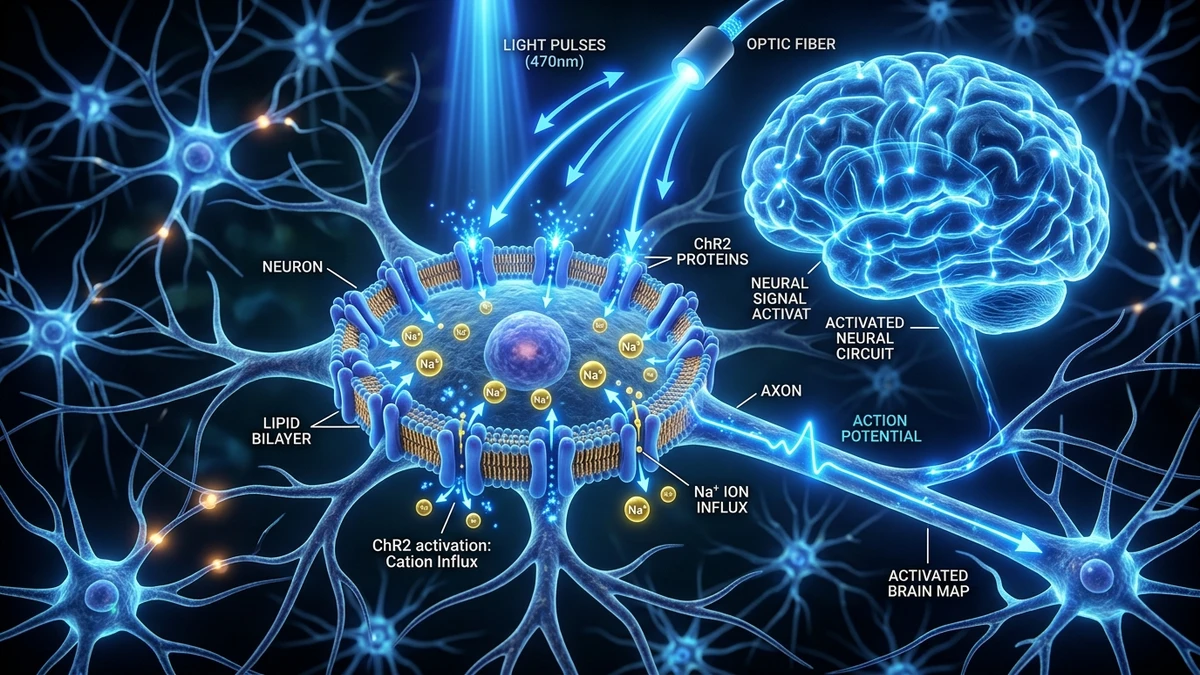
The major conceptual breakthrough began when Peter Hegemann and Georg Nagel identified and characterized channelrhodopsin-2, a light-sensitive protein found in the green microalga Chlamydomonas reinhardtii. They demonstrated that this protein acts as an ion channel directly activated by blue light, allowing positive ions to pass through the cell membrane. Subsequently, Karl Deisseroth introduced the gene for this protein into mammalian neurons via modified viral vectors, rendering brain cells responsive to optical stimuli with millisecond precision.
By connecting tiny optical fibers to brain tissue, the research team managed to turn specific neural circuits on and off instantly in animal models without affecting neighboring cells. This unprecedented advance made it possible to decipher how specific patterns of electrical firings generate thoughts, memories, emotions, voluntary movements, and painful sensations. For the first time in biological history, the human mind gained a cellular-precision optical light switch.
Scientific Data and Methodological Parameters of the 2026 Nobel Prize in Medicine
To understand the methodological breadth and historical importance of this announcement made by the Nobel Committee in Sweden, consult the detailed informative table below. The data summarizes the names of the laureates, fundamental biophysical concepts, and impacts on global neuroscience. These measurements demonstrate how light-based control has transformed regenerative medicine and contemporary neuropsychiatry.
| Scientific Parameter | Award-Winning Discovery Detail | Impact on Neuroscience and Medicine |
|---|---|---|
| 2026 Nobel Laureates | Karl Deisseroth, Peter Hegemann, and Georg Nagel | Global recognition of optogenetics development. |
| Photoreceptor Protein | Channelrhodopsin-2 (ChR2) and Halorhodopsin | Light-activated ion channels via blue and yellow light. |
| Temporal Precision | Millisecond Resolution (ms) | Allows mimicking real action potential firing rates. |
| Genetic Delivery Vector | Recombinant Adeno-Associated Virus (rAAV) | Selective protein expression in targeted cell types. |
| Clinical Applications | Parkinson's Disease, Depression, and Blindness | Motor circuit rehabilitation and sight restoration. |
The application of optogenetics revealed the exact mechanisms underlying Parkinson's disease, pinpointing the striatal circuits responsible for muscle rigidity and uncontrollable tremors. With this crucial knowledge, researchers optimized deep brain stimulation parameters, drastically reducing side effects in human patients. Furthermore, the technique elucidated the dopaminergic pathways involved in drug addiction and severe chemical dependency.
In the field of psychiatry, the ability to map the amygdala and prefrontal cortex revolutionized the understanding of pathological anxiety and post-traumatic stress disorder. Scientists demonstrated how light pulses could temporarily quiet activated traumatic memories, offering valuable clues for novel therapeutic interventions. Treatment-resistant depression also gained promising new options based on rebalancing specific dysfunctional neural circuits.
Another extraordinary breakthrough facilitated by optogenetics was the partial restoration of sight in patients suffering from advanced retinitis pigmentosa. By introducing the channelrhodopsin gene into surviving retinal ganglion cells, physicians successfully made ocular neurons sensitive to visible ambient light. In recent clinical trials, previously blind patients were able to recognize objects and read large letters on high-contrast display screens.
The molecular engineering pioneered by the laureates expanded to create new variants of light-sensitive proteins with diverse spectral properties. Today, scientists possess opsins activated by deep-tissue-penetrating red light alongside channels that inhibit electrical firing with immediate hyperpolarization. This diverse library of optical tools enables simultaneous control of multiple interacting brain circuits with unprecedented precision.
Integrating optogenetics with laser scanning microscopy and calcium imaging enabled scientists to observe and manipulate the activity of thousands of individual neurons during complex behaviors. This continuous functional mapping accelerated global connectomics projects aimed at charting the complete wiring diagram of the human brain. The fusion of optics, genetics, and computation has forever reshaped the frontiers of neurotechnology.
During the official press conference in Stockholm, the Nobel Committee emphasized that optogenetics exemplifies the transformative power of interdisciplinary research combining microbiology, structural biology, and clinical neuroscience. The transition from discovering a light-activated protein in unicellular algae to implementing a transformative technology in the mammalian brain illustrates the beauty of basic science. The seminal work of Deisseroth, Hegemann, and Nagel established a vibrant new era in mental health and cognitive science.
In conclusion, the 2026 Nobel Prize in Medicine honors one of the greatest inventions in modern biological history, opening boundless horizons for curing diseases previously deemed irreversible. Light, which once merely illuminated the external world, has become the ultimate tool for unlocking the deepest mysteries of the mind's inner cosmos. Humanity takes a giant leap forward toward mastering the neural code of conscious existence.
Frequently Asked Questions about the 2026 Nobel Prize in Medicine and Optogenetics
What is optogenetics and how does it allow controlling brain neurons with light pulses?
Optogenetics is a groundbreaking neuroscience technique combining genetic biology and optical technology to manipulate specific nerve cells within living tissue with extreme precision. Scientists insert genes encoding light-sensitive proteins, such as channelrhodopsin found in green algae, into targeted neurons using harmless viral vectors. When targeted laser light pulses of specific wavelengths are delivered to those neurons through micro-optical fibers, the proteins open ion channels across the cell membrane, instantly triggering or suppressing electrical nerve signals.
What were the individual contributions of scientists Karl Deisseroth, Peter Hegemann, and Georg Nagel?
The three scientists awarded the 2026 Nobel Prize in Medicine worked in complementary stages that enabled the creation of modern optogenetics. German researchers Peter Hegemann and Georg Nagel made foundational biological and biophysical discoveries by isolating and characterizing channelrhodopsin proteins in single-celled algae. Subsequently, American neuroscientist and psychiatrist Karl Deisseroth demonstrated how to express these algal genes in mammalian brain neurons and engineered fiber-optic hardware to control functional neural circuits.
How is optogenetics helping develop new treatments for Parkinson's disease, depression, and blindness?
Optogenetics allows researchers to map with surgical precision the exact neuronal circuits that malfunction in neurodegenerative diseases and severe psychiatric conditions. In Parkinson's disease, the technique pinpointed the specific striatal neurons causing tremors, refining deep brain stimulation parameters to minimize side effects in patients. In cases of blindness caused by retinitis pigmentosa, expressing light-sensitive opsin genes in remaining retinal ganglion cells successfully restored light perception and shape vision in advanced clinical trials.