- Two deformable mirrors driven by thousands of microscopic actuators deform their reflective surfaces by fractions of a nanometer to cancel out optical imperfections in real time;
- Advanced shaped pupil masks suppress diffracted starlight by an unprecedented factor of one billion to one ($10^{-9}$);
- This extraordinary contrast enables direct imaging and reflected-light spectroscopy of mature, cold gas giants and Neptune-sized worlds in nearby stellar systems.
The primary cosmological objective of the Roman mission is resolving the physical nature of dark energy, the mysterious force driving the accelerated expansion of the universe.
Roman will employ three complementary cosmological probes:
- High-Redshift Type Ia Supernovae: Measuring precise distance-redshift relations for thousands of exploding white dwarfs across ten billion years of cosmic time;
- Baryon Acoustic Oscillations (BAO): Utilizing frozen acoustic sound waves from the early universe as a standard cosmological ruler to measure cosmic geometry across cosmic epochs;
- Weak Gravitational Lensing: Measuring the subtle shearing and distortion of millions of background galaxies to map the three-dimensional cosmic web distribution of invisible dark matter.
Unlike historical space observatories that granted proprietary observational periods to principal investigators, NASA has established a revolutionary one hundred percent open data policy for the Roman Space Telescope. Every gigabyte of scientific telemetry downlinked from L2 will be processed and released to the global scientific community immediately without proprietary hold periods.
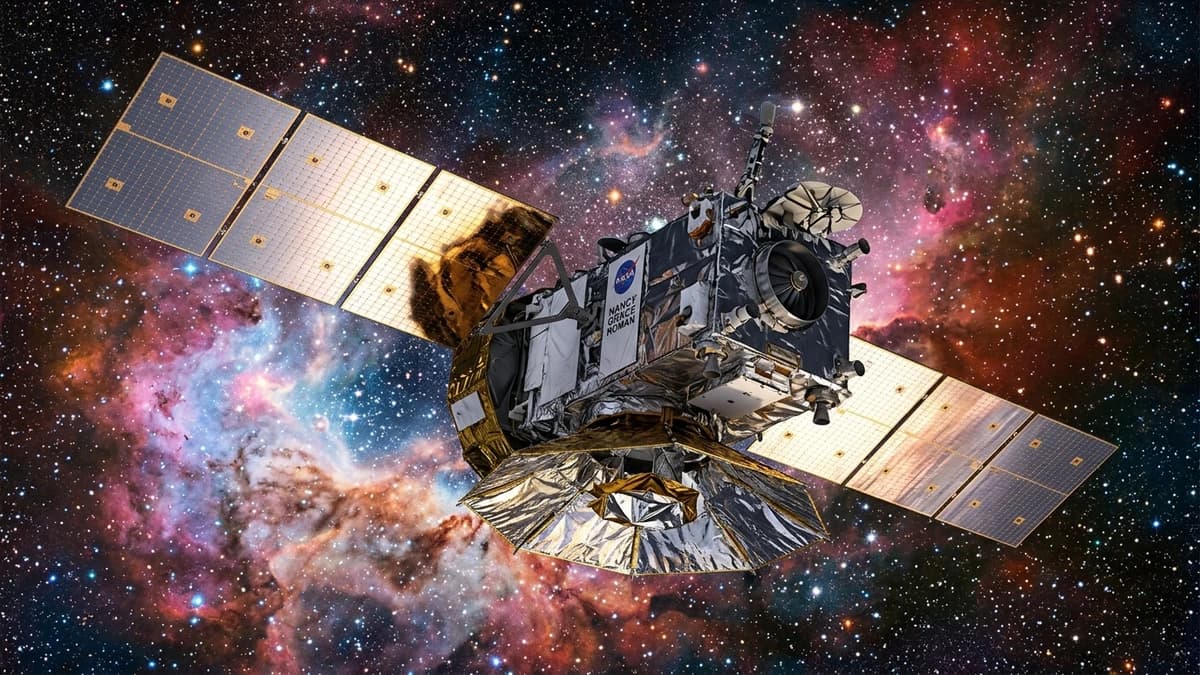
Following the successful solar array qualification, the flight vehicle will undergo vibration and acoustic testing before integration with its Falcon Heavy launch vehicle at the Kennedy Space Center. When launched in May 2027 to the gravitational calm of Lagrange Point 2, the Nancy Grace Roman Space Telescope will open a vast, panoramic window onto the cosmos, accelerating humanity's quest to understand dark energy, cosmic structure, and the prevalence of habitable worlds across our galaxy.
Operating a 300-megapixel infrared observatory at Sun-Earth Lagrange Point 2 presents immense communication challenges. The Wide Field Instrument will generate more than 1.4 terabytes of raw compressed scientific data every twenty-four hours—an information volume that exceeds Hubble's data return by orders of magnitude and will quickly saturate traditional radio frequency networks.
To transfer this vast scientific harvest to ground stations, the Roman Space Telescope incorporates a state-of-the-art dual-band high-gain antenna architecture operating in the Ka-band (26 GHz). Downlinking at continuous data rates exceeding 500 megabits per second to NASA's Deep Space Network dishes in Goldstone, Madrid, and Canberra, the observatory ensures that high-resolution panoramic survey imagery is transmitted to Earth without operational buffering or onboard storage bottlenecks.