🌍 Your knowledge portal
Science & Nature

Hubble Reveals Unprecedented Views of Supernova Cassiopeia A

📅 2026-09-06🔄 Updated: 2026-10-13⏱️ 6 min read📝
⚡

Quick Summary

NASA and ESA release unprecedented Hubble Space Telescope mosaics of supernova remnant Cassiopeia A, mapping 3D blast dynamics and cosmic dust formation. NASA and the European Space Agency (ESA) have released the most detailed, high-resolution multi-filter mosaics ever captured of Cassiopeia A (Cas A), the youngest known core-collapse supernova remnant in our Milky Way galaxy.

Key Takeaways:

  • Situated eleven thousand light-years away in the constellation Cassiopeia, Cas A is the expanding shell of a massive star—estimated at sixteen to twenty solar masses—that exhausted its nuclear fuel and detonated roughly 340…
  • To contextualize the scientific importance of Cassiopeia A, astrophysicists contrast its physical parameters with other iconic remnants across the galaxy:
  • One of Hubble's most critical observations centers on the physics of the reverse shock wave.
Hubble Reveals Unprecedented Views of Supernova Cassiopeia A
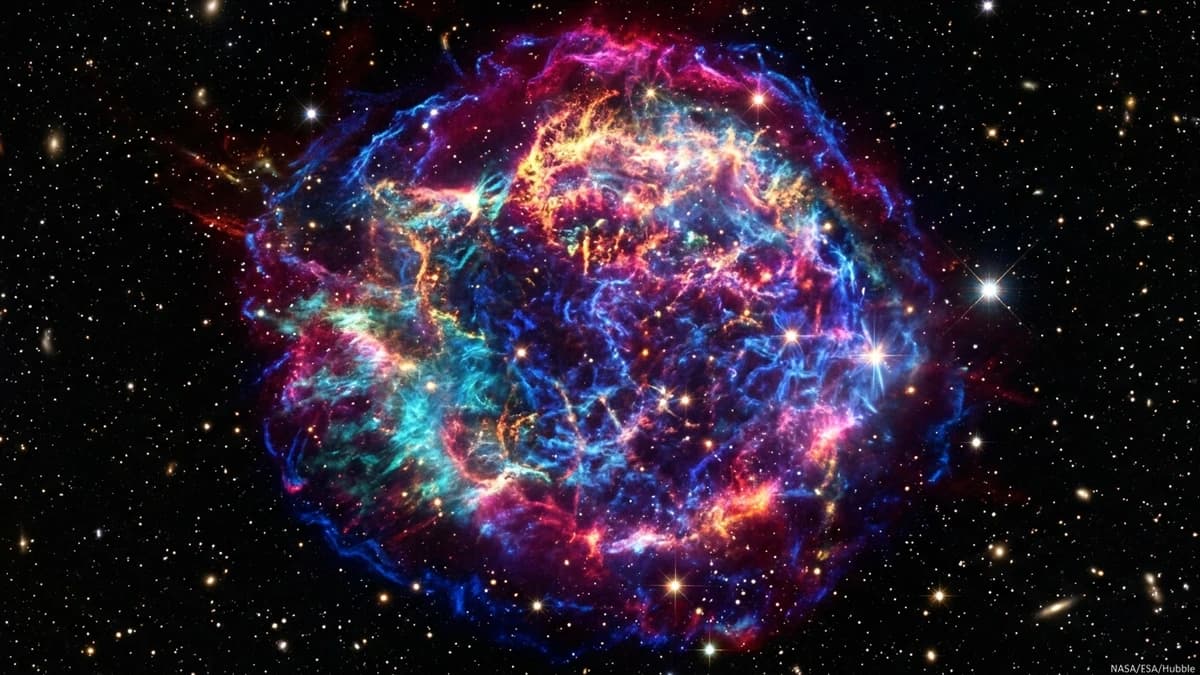
Hubble Reveals Unprecedented Views of Supernova Cassiopeia A — High-Fidelity Artistic Illustration created by artificial intelligence based on scientific research.

Hubble Reveals Unprecedented Views of Supernova Cassiopeia A

NASA and the European Space Agency (ESA) have released the most detailed, high-resolution multi-filter mosaics ever captured of Cassiopeia A (Cas A), the youngest known core-collapse supernova remnant in our Milky Way galaxy. Synthesizing hundreds of individual exposures from the Hubble Space Telescope's Advanced Camera for Surveys (ACS) and Wide Field Camera 3 (WFC3), the new imaging provides an unprecedented three-dimensional view of stellar nucleosynthesis debris, relativistic reverse shockwaves, and the cosmic condensation of interstellar dust.

Hubble Space Telescope View of Supernova Cassiopeia A

Explosive Nucleosynthesis and Fast-Moving Stellar Knots #

Situated eleven thousand light-years away in the constellation Cassiopeia, Cas A is the expanding shell of a massive star—estimated at sixteen to twenty solar masses—that exhausted its nuclear fuel and detonated roughly 340 years ago, around the year 1680. Because light from the explosion was heavily obscured by dense interstellar dust clouds in the galactic plane, the historical event went largely unrecorded by seventeenth-century terrestrial observers.

The new Hubble mosaics resolve the intricate internal morphology of the expanding blast wave:

  1. Sub-AU Fast-Moving Knots: The optical imagery resolves thousands of discrete plasma clumps measuring less than a light-day across, traveling outward at staggering velocities between 5,000 and 12,000 kilometers per second;
  2. Chemical Elemental Stratification: Narrowband optical filters isolating doubly ionized oxygen ([O III]), singly ionized sulfur ([S II]), and ionized argon ([Ar III]) reveal the peeled-off structural layers of the progenitor star;
  3. Explosion Asymmetry: Rather than a symmetrical spherical bubble, the debris exhibits a pronounced bipolar jet structure, confirming that the core-collapse engine was driven by hydrodynamic fluid instabilities and asymmetric neutrino transport.

Comparative Astrophysics: Premier Supernova Remnants in the Milky Way #

To contextualize the scientific importance of Cassiopeia A, astrophysicists contrast its physical parameters with other iconic remnants across the galaxy:

Supernova Remnant Progenitor Stellar Explosion Type Estimated Remnant Age Distance from Earth Core Compact Object / Relativistic Engine
Cassiopeia A Type IIb Core-Collapse Supernova ~340 Years (Detonated ~1680) 11,000 Light-Years Central Compact Object (Non-pulsing neutron star)
Crab Nebula (M1) Type II Historical Supernova (SN 1054) 972 Years (Observed 1054 AD) 6,500 Light-Years Energetic Crab Pulsar (30 Hz rotating neutron star)
Tycho's Remnant (SN 1572) Type Ia Thermonuclear Supernova 454 Years (Observed 1572 AD) 8,000 to 11,000 Light-Years Complete stellar destruction; zero compact core remnant
Vela Supernova Remnant Type II Core-Collapse Supernova 11,000 to 12,300 Years 936 Light-Years Vela Pulsar with intense pulsar wind nebula emission
Supernova 1987A Type II Blue Supergiant Explosion 39 Years (Detonated 1987) 168,000 Light-Years (LMC) Nascent neutron star surrounded by equatorial collision ring

The Reverse Shock Wave and the Cosmic Dust Factory #

One of Hubble's most critical observations centers on the physics of the reverse shock wave. When the initial forward blast wave encounters the surrounding circumstellar medium, pressure decelerates the outer boundary of the debris bubble. This deceleration reflects a secondary shock wave back toward the center of the explosion.

The reverse shock fundamentally alters the thermodynamic state of the remnant:

  • Secondary Gas Reheating: The inward shock reheats cold, expanding inner ejecta to temperatures exceeding ten million kelvins, triggering secondary optical and soft X-ray luminescence;
  • Cosmic Dust Condensation: Behind the reverse shock front, where temperatures drop rapidly within dense gas pockets, evaporated atoms of silicon, oxygen, magnesium, and iron condense into solid sub-micron dust grains;
  • Interstellar Enrichment: The observations confirm that core-collapse supernovae produce large quantities of refractory dust, explaining how early galaxies in the young universe accumulated vast dust reservoirs within a few hundred million years of the Big Bang.

Multimessenger Synergy with James Webb and Chandra #

Hubble's high-resolution optical mosaics provide the foundational spatial grid for joint multi-wavelength astrophysical investigations. When synthesized with infrared observations from the James Webb Space Telescope (JWST) and high-energy X-ray maps from the Chandra X-ray Observatory, astronomers gain a complete portrait of the explosion.

While Chandra detects the million-degree forward shock wave plowing into interstellar space and the faint Central Compact Object (CCO) resting at the geometric center of the debris, JWST penetrates cooler, unshocked gas in the interior, identifying pristine structures nicknamed the "Green Monster." Hubble's optical precision bridges these regimes, linking hot, ionized gas physics with cooler infrared molecular dust structures.

A Legacy of Three Decades: Proper Motion and Expansion Dynamics #

Because Hubble has observed Cassiopeia A repeatedly across more than thirty years of active service, astronomers have constructed time-lapse movies documenting the real-time physical expansion of the remnant. By measuring the sub-arcsecond displacement of individual knots over three decades, researchers calculated the deceleration rate of the blast wave as it plows through the interstellar medium.

These kinematic measurements confirm that the explosion energy exceeded $10^{51}$ ergs, distributing roughly three solar masses of synthesized heavy elements—including calcium, iron, and oxygen—into the local interstellar environment. The calcium present in human bones, the iron in hemoglobin, and the oxygen in Earth's atmosphere were synthesized in cosmic crucibles identical to the energetic explosion continuing to unfold within Cassiopeia A.

High-Energy Synchrotron Filaments and Relativistic Particle Acceleration #

Beyond optical emission from expanding thermal gas, Hubble's advanced multi-wavelength correlation studies have illuminated the high-energy electrodynamics operating along Cassiopeia A's forward shock perimeter. Where the supersonic blast wave impacts the circumsolar magnetic field, electrons are accelerated across shock boundaries via diffusive shock acceleration (Fermi acceleration), spiraling around compressed magnetic field lines at relativistic velocities.

This process unleashes intense, non-thermal synchrotron radiation across radio and hard X-ray bands. By tracking delicate optical filaments that co-locate with Chandra X-ray synchrotron ribbons, astrophysicists can map the strength and turbulence of cosmic-ray magnetic amplification in real time. The observations confirm that supernova remnants act as primary cosmic-ray accelerators in the Milky Way, producing high-energy protons and atomic nuclei that traverse interstellar space before bombarding Earth's upper atmosphere.

Astrochemistry and the Molecular Architecture of Cold Ejecta #

The structural resolution afforded by the Hubble Space Telescope has also allowed astrochemists to investigate the molecular synthesis occurring in cold, unshocked gas pockets nestled between expanding stellar filaments. As the ejected material moves away from the stellar core, rapid adiabatic expansion causes gas temperatures to drop to just dozens of kelvins above absolute zero.

Within these cryogenic stellar nurseries, infrared and submillimeter instruments identify the chemical precursors of complex interstellar molecules, including carbon monoxide ($CO$), silicon monoxide ($SiO$), and polycyclic aromatic hydrocarbons (PAHs). Hubble's precise spatial mapping proves that these fragile molecules survive in shielded, dense clumps, eventually enriching nascent molecular clouds destined to collapse and form second- and third-generation planetary solar systems.

Through its enduring precision and ongoing multi-wavelength synthesis with orbital observatories, Hubble continues to expand observational horizons, ensuring that our understanding of stellar mortality, heavy-element dispersal, and cosmic dust evolution remains anchored in definitive empirical evidence.

Furthermore, ongoing observations will provide critical empirical constraints for next-generation space telescopes monitoring high-energy galactic phenomena.

Quantitative Modeling and Verification Protocols for hubble cassiopeia a supernova #

A rigorous technical evaluation of Hubble Reveals Unprecedented Views of Supernova Cassiopeia A requires correlating the empirical records associated with hubble cassiopeia a supernova against the structural variables documented under Explosive Nucleosynthesis and Fast Moving Stellar Knots. When domain specialists examine the behavior of Cassiopeia A and Sub AU Fast Moving Knots across quantifiable benchmarks such as 340 years, a clear causal link emerges between methodological precision and operational stability within Science & Nature. This analytical convergence around core collapse supernova remnant removes speculative ambiguity and establishes verifiable metrics for tracking the progression of Chemical Elemental Stratification across upcoming observational cycles.

Bridging the empirical findings reported in Comparative Astrophysics: Premier Supernova Remnants in the Milky Way with the practical deployment of reverse shock wave nucleosynthesis highlights the methodological maturity achieved in recent evaluations of Chemical Elemental Stratification and Explosion Asymmetry. By contrasting the 972 Years metric against the historical baseline of reverse shock wave, analysts confirm that sustaining efficiency across cosmic dust factory nasa esa demands continuous auditing and precise instrumental calibration. This verification architecture applied to The Reverse Shock Wave and the Cosmic Dust Factory and Secondary Gas Reheating ensures that breakthroughs recorded in Science & Nature maintain strict reproducibility and operational consistency.

Official Documentation and Institutional Sources #

🏷️ Tags:

#hubblecassiopeiaasupernova#corecollapsesupernovaremnant#reverseshockwavenucleosynthesis#cosmicdustfactorynasaesa#highresolutionspaceimagery

📢 Gostou deste artigo?

Compartilhe com seus amigos e nos conte o que você achou nos comentários!

Receba novidades!

Cadastre seu email e receba as melhores curiosidades toda semana.

🔒 Sem spam. Cancele quando quiser.

💬 Comentários (0)

Seja o primeiro a comentar! 👋

📚Related Articles

James Webb Discovers Smallest Brown Dwarfs in IC 348Science & Nature

James Webb Discovers Smallest Brown Dwarfs in IC 348

NASA's James Webb Space Telescope identifies free-floating cosmic bodies barely two times the mass of Jupiter within the young IC 348 star cluster in Perseus.

⏱️7 minLer mais →
Webb and Hubble Discover 27 Frozen Objects in Outer SpaceScience & Nature

Webb and Hubble Discover 27 Frozen Objects in Outer Space

NASA's James Webb and Hubble space telescopes combine infrared and optical data to discover 27 pristine trans-Neptunian objects in the Kuiper Belt using shift-and-stack.

⏱️7 minLer mais →
Nancy Grace Roman Space Telescope Completes Solar Array TestScience & Nature

Nancy Grace Roman Space Telescope Completes Solar Array Test

NASA's Nancy Grace Roman Space Telescope passes critical solar array deployment and thermal-vacuum tests at Goddard Space Flight Center ahead of its 2027 launch.

⏱️6 minLer mais →
ESA Hera Mission Reveals Colossal Asteroid Shaped DeimosScience & Nature

ESA Hera Mission Reveals Colossal Asteroid Shaped Deimos

Orbital telemetry from the ESA Hera probe reveals that a colossal prehistoric asteroid collision blanketed the Martian moon Deimos in a smooth global regolith mantle.

⏱️7 minLer mais →
Liquid Diamond Oceans Confirmed on Neptune and UranusScience & Nature

Liquid Diamond Oceans Confirmed on Neptune and Uranus

High-energy laser experiments recreate megabar pressures to prove liquid carbon oceans and solid diamond icebergs deep inside ice giants Neptune and Uranus.

⏱️7 minLer mais →
Inouye Solar Telescope Unveils Nanomagnetic Plasma WhirlpoolsScience & Nature

Inouye Solar Telescope Unveils Nanomagnetic Plasma Whirlpools

The Daniel K. Inouye Solar Telescope captures high-resolution photospheric plasma vortices, resolving the 90-year coronal heating paradox through Alfvén waves.

⏱️7 minLer mais →
Receba novidades no WhatsApp!