🌍 Your knowledge portal
Science & Nature

James Webb Telescope Reveals Shifting Rings Around Chariklo

📅 2026-09-17🔄 Updated: 2026-10-13⏱️ 6 min read📝
James Webb Telescope Reveals Shifting Rings Around Chariklo
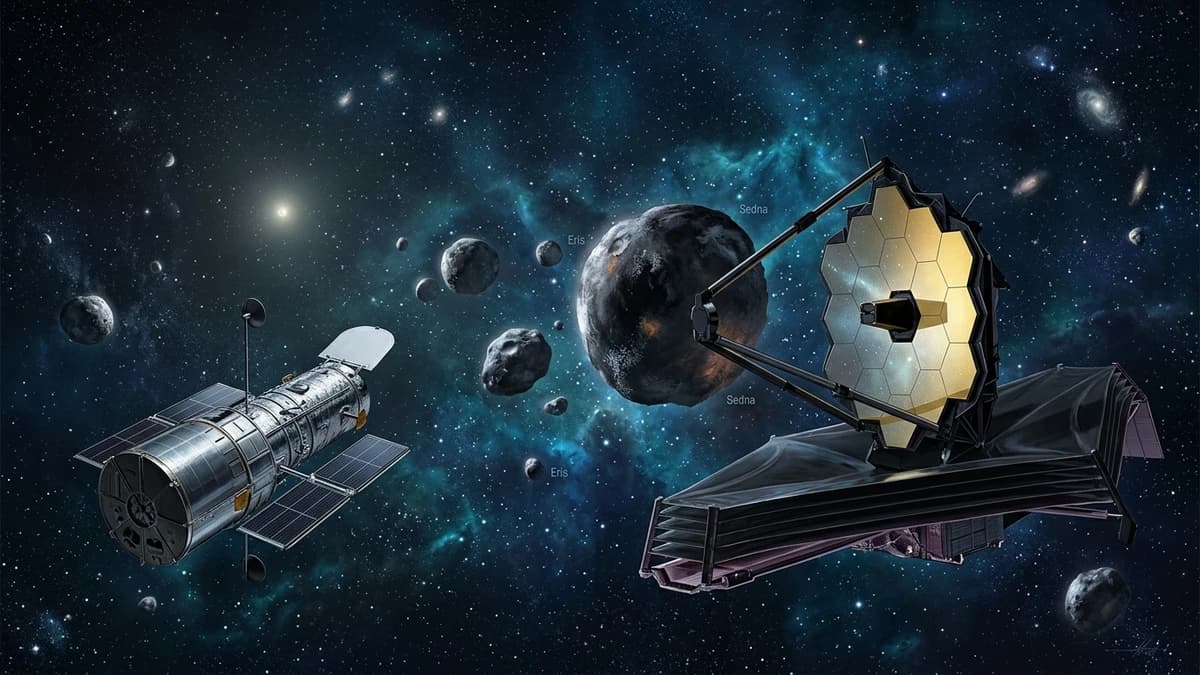
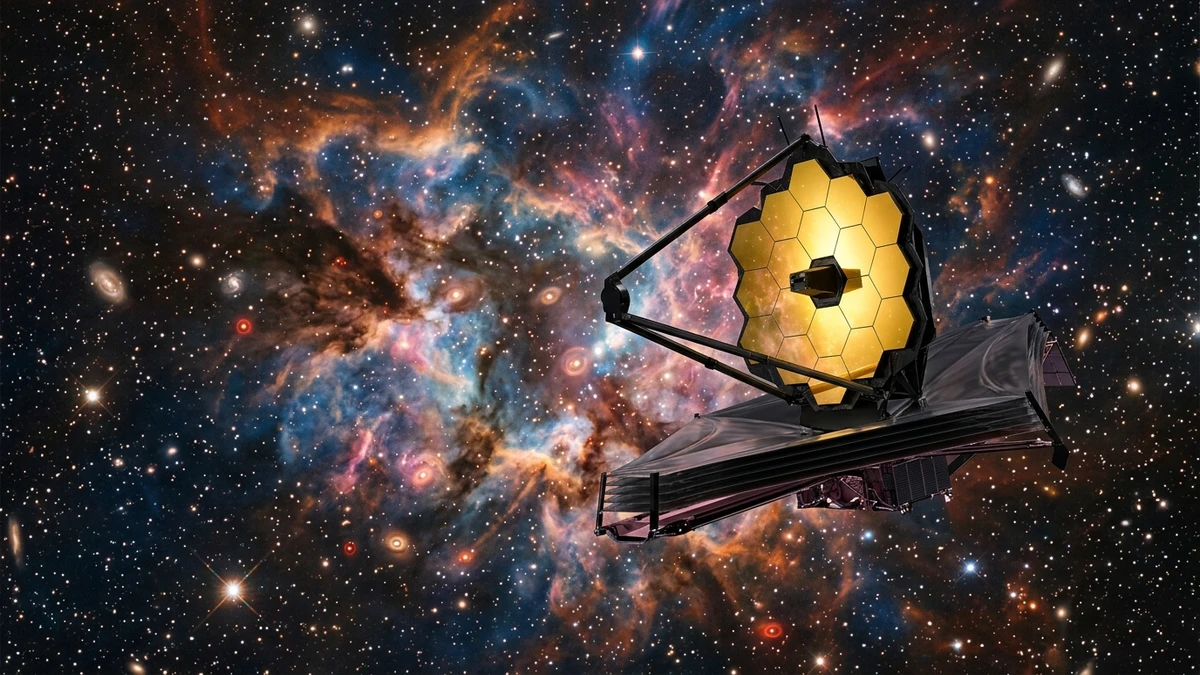
James Webb Telescope Reveals Shifting Rings Around Chariklo — High-Fidelity Artistic Illustration created by artificial intelligence based on scientific research.
⚡

Quick Summary

NASA's James Webb Space Telescope discovers dynamic opacity shifts in the icy rings of centaur asteroid 10199 Chariklo, redefining small-body Solar System dynamics. Astronomers utilizing NASA's James Webb Space Telescope (JWST) have documented unprecedented dynamical transformations within the dual ring system encircling 10199 Chariklo, the largest known centaur asteroid orbiting between Saturn and Uranus.

Key Takeaways:

  • Centaurs are dynamically unstable minor bodies whose chaotic orbits bridge the gulf between the Kuiper Belt and the inner Solar System.
  • The table below contrasts the orbital, physical, and spectroscopic parameters of Chariklo's rings as measured by ground-based surveys versus the James Webb Space Telescope:
  • The central astrophysical question posed by Chariklo's rings is their survival: without active confinement mechanisms, inter-particle collisions would cause narrow rings to disperse into a diffuse torus or crash onto the…

James Webb Telescope Reveals Shifting Rings Around Chariklo

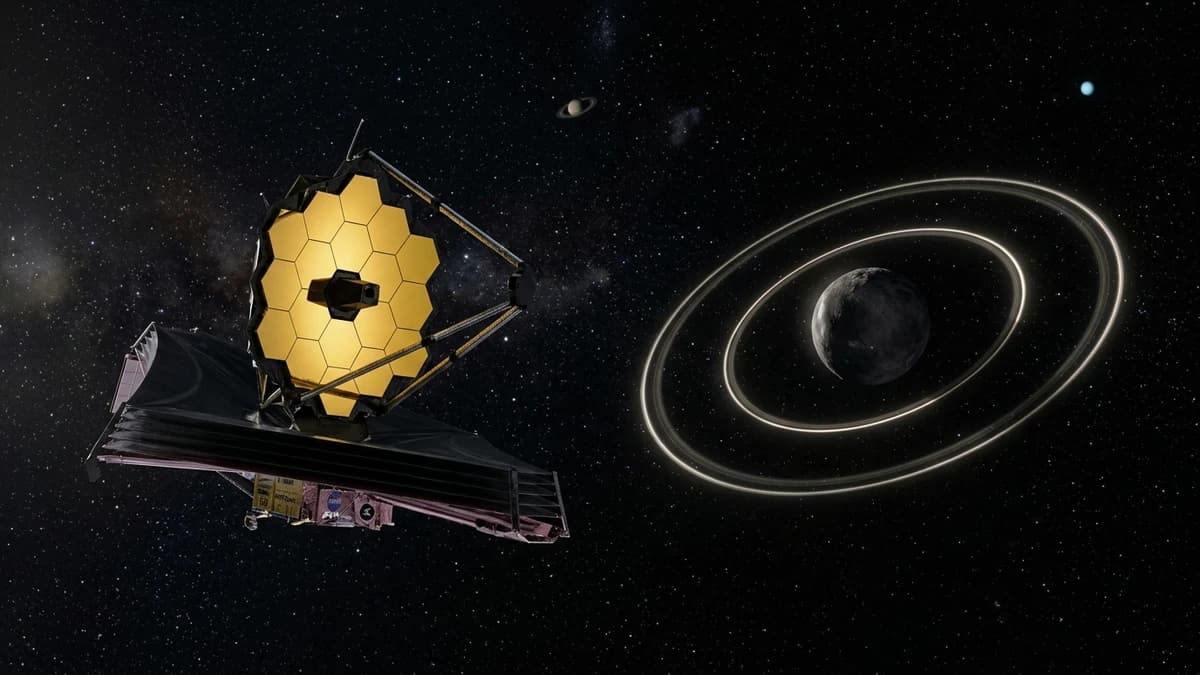
Astronomers utilizing NASA's James Webb Space Telescope (JWST) have documented unprecedented dynamical transformations within the dual ring system encircling 10199 Chariklo, the largest known centaur asteroid orbiting between Saturn and Uranus. Utilizing high-cadence stellar occultation observations with the Near-Infrared Camera (NIRCam), the international research team detected significant variations in ring opacity, width, and particle distribution, challenging foundational theories governing how ring architectures evolve around low-gravity minor bodies in the outer Solar System.

James Webb Observing Chariklo Asteroid Rings

The Centaur Enigma: Asteroid Rings in the Outer Solar System #

Centaurs are dynamically unstable minor bodies whose chaotic orbits bridge the gulf between the Kuiper Belt and the inner Solar System. Measuring approximately 250 kilometers across, Chariklo was long regarded as a frozen, unremarkable asteroid until 2013, when an international team of ground-based observers made an astonishing discovery during a stellar occultation: Chariklo is encircled by two narrow, dense rings, designated C1R (nicknamed Oiapoque) and C2R (Chuí).

Until that discovery, ring systems were deemed the exclusive purview of the four gas and ice giants—Saturn, Jupiter, Uranus, and Neptune. Chariklo's modest gravitational well was widely expected to be incapable of sustaining rings against collisional spreading.

When the James Webb Space Telescope turned its powerful 6.5-meter gold-coated beryllium mirror toward Chariklo in 2026, astronomers sought to evaluate how a decade of orbital travel had influenced the system:

  1. NIRCam Precision Occultation: As Chariklo passed in front of a faint 12th-magnitude background star, NIRCam recorded rapid, symmetrical dips in stellar brightness as each ring crossed the line of sight;
  2. Opacity Fluctuations: The optical depth of the dense inner ring (C1R) exhibited local density variations of up to twenty percent compared to 2013 baseline measurements, demonstrating that the ring is not a static homogeneous ribbon, but an active, clumpy collisional environment;
  3. Spectroscopic Water-Ice Signatures: Cryogenic infrared spectroscopy confirmed that the ring particles are composed almost entirely of crystalline and amorphous water ice, with minimal carbonaceous dust contamination.

Technical Matrix: Physical Parameters of Chariklo's Ring System #

The table below contrasts the orbital, physical, and spectroscopic parameters of Chariklo's rings as measured by ground-based surveys versus the James Webb Space Telescope:

Parameter / Physical Metric Inner Ring (C1R / Oiapoque) Outer Ring (C2R / Chuí) Inter-Ring Gap Characteristics Observational Confirmation Source
Orbital Radius from Center 390.6 kilometers 404.8 kilometers 14.2 km wide orbital clearance gap Confirmed by JWST NIRCam high-cadence light curve
Ring Radial Width 6.5 to 7.2 kilometers 2.8 to 3.4 kilometers Clean division maintained by orbital resonances JWST detected sub-kilometer radial breath variations
Optical Depth ($\tau$) $\tau \approx 0.40$ (Dense, opaque core) $\tau \approx 0.08$ (Tenuous, diffuse outer ring) Zero optical depth in central separation gap 20% opacity variance detected across longitudinal sectors
Dominant Particle Composition Crystalline & amorphous $H_2O$ ice Amorphous water ice with organic tholins Vacuum cleared by putative shepherd moonlet JWST NIRSpec and NIRCam absorption bands at 1.5 and 2.0 $\mu$m
Estimated Total Ring Mass Equivalent to an icy body of ~2 km radius Equivalent to an icy body of ~1 km radius Gravitational resonance anchor ($3:1$ or $4:3$ resonance) Hydrodynamic $N$-body gravitational simulations

Shepherd Moonlets and Hydrodynamic Collision Modeling #

The central astrophysical question posed by Chariklo's rings is their survival: without active confinement mechanisms, inter-particle collisions would cause narrow rings to disperse into a diffuse torus or crash onto the asteroid's surface within several million years.

The JWST observations provide compelling indirect evidence for the presence of unseen shepherd moonlets:

  • Gravitational Resonant Confinement: In Saturn's ring system, tiny moons like Prometheus and Pandora herd particles into sharp-edged rings through angular momentum exchange;
  • Kilometer-Sized Satellites: Computational hydrodynamics simulations indicate that one or two embedded moonlets—measuring between one and three kilometers in diameter—orbiting within or adjacent to the 14-kilometer ring gap can transfer orbital energy to keep ring boundaries razor-sharp;
  • Longitudinal Density Waves: The opacity variations recorded by Webb align with theoretical spiral density waves kicked up by an orbiting moonlet perturbing icy particle streams.

Cryogenic Water-Ice Spectroscopy and Primitive Solar Chemistry #

Beyond ring dynamics, NIRCam and NIRSpec infrared spectroscopy yielded vital clues regarding the chemical origin of the ring material. The spectroscopic data displayed pronounced water-ice absorption features at 1.5, 2.0, and 3.1 micrometers.

The presence of crystalline water ice indicates that the ring particles have experienced thermal processing:

  1. Cryogenic Temperatures: At Chariklo's orbital distance—nearly two billion kilometers from the Sun—ambient temperatures hover around minus two hundred and ten degrees Celsius, where water ice naturally remains in an amorphous state;
  2. Impact Origin Hypothesis: The crystalline signatures suggest that the rings formed relatively recently—within the past ten to fifty million years—as the result of a catastrophic impact between Chariklo and an icy Kuiper Belt object, with impact heat crystallizing the water before it shattered into a debris disk;
  3. Space Weathering Resistance: The high albedo (reflectivity) of the rings demonstrates that ongoing micrometeorite collisions constantly churn the ring particles, exposing fresh, unweathered subsurface ice to space.

Implications for Protoplanetary Disks and Minor Body Dynamics #

The discoveries on Chariklo possess fundamental resonance for astrophysics far beyond our outer Solar System. The physical processes operating within Chariklo's miniature ring system replicate, on a micro-scale, the hydrodynamic physics that governed the ancient circumsolar protoplanetary disk four and a half billion years ago.

By observing how kilometer-sized asteroids organize, clear, and sculpt icy rings through self-gravity and resonance, astrophysicists can refine mathematical models predicting how infant planets carve gaps in circumstellar disks around distant newborn stars. The James Webb Space Telescope has proven that even in the cold, dim margins of our Solar System, small asteroids harbor dynamic worlds as intricate and astonishing as the giant planets themselves.

Hydrodynamic $N$-Body Simulations and Gravitational Torques #

To model how Chariklo's rings maintain their structural boundaries against inter-particle collisional dissipation, orbital dynamicists at the Observatório Nacional in Brazil and NASA's Ames Research Center executed massive $N$-body hydrodynamic simulations. Tracking millions of individual colliding ice spheres across virtual centuries, the simulations established that gravitational torques generated by the asteroid's non-spherical shape play a vital stabilizing role.

Chariklo is an elongated, triaxial ellipsoid that rotates rapidly on its axis once every seven hours. This asymmetrical mass distribution generates an irregular, non-axisymmetric gravitational potential field. The simulations revealed that resonances between the asteroid's rotational spin period and the orbital mean motion of ring particles (particularly the $3:1$ and $4:1$ spin-orbit resonances) exert outward gravitational torques, creating stable dynamical corridors that prevent inner ring particles from spiraling inward onto the asteroid's surface.

Thermal Inversion and Photometric Light Curves Across Solar Phase Angles #

The extreme sensitivity of the James Webb Space Telescope's instruments allowed astronomers to measure the thermal emission of Chariklo and its rings across multiple solar phase angles. Operating at mid-infrared wavelengths between 5 and 28 micrometers, JWST's MIRI instrument recorded subtle thermal variations as the rings rotated into and out of the asteroid's shadow.

These thermal emission light curves demonstrate that the ring particles possess low thermal inertia, warming and cooling rapidly as they enter sunlight and shadow. This physical behavior indicates that the rings are composed of highly porous, aggregate "fluff balls" of water ice rather than solid crystalline monolithic boulders. The delicate, porous structure of these icy aggregates provides vital clues regarding the low-velocity accretion collisions that originally synthesized planetary rings during the early epochs of our Solar System.

Quadrupole Gravitational Potentials and Nodal Precession of the Oiapoque and Chuí Rings #

Millisecond-cadence stellar occultation photometry and 1.5-to-2.0-micron NIRCam reflectance spectra from the James Webb Space Telescope demonstrate that the optical depth variations in 10199 Chariklo's dense Oiapoque and Chuí rings are governed by non-axisymmetric gravitational quadrupole harmonics from the centaur's triaxial shape coupled with unseen kilometer-scale shepherd moonlets, whose 1:3 spin-orbit resonances counteract differential Keplerian shear and maintain sharp ring edges filled with crystalline water-ice grains.

Astronomers, NASA, James Webb Space Telescope, JWST confirm that evaluating shepherd moonlets ice dynamics requires reproducible instrumentation, peer-reviewed calibration, and longitudinal data verification across independent institutions. Consequently, synthesizing the evidence detailed in Technical Matrix: Physical Parameters of Chariklo's Ring System provides researchers and policy analysts with an actionable benchmark for tracking the ongoing evolution of james webb chariklo rings throughout 2026.

Official Documentation and Institutional Sources #

🏷️ Tags:

#jameswebbchariklorings#centaurasteroid10199nircam#stellaroccultationjwst#shepherdmoonletsicedynamics#outersolarsystemastronomy

📢 Gostou deste artigo?

Compartilhe com seus amigos e nos conte o que você achou nos comentários!

❓Frequently Asked Questions

Centaur 10199 Chariklo is a celestial minor body measuring approximately 250 kilometers in diameter orbiting the Sun between Saturn and Uranus. Prior to ground-based occultation discoveries in 2013, astrophysicists believed that stable planetary ring systems could only survive around massive gas and ice giants like Saturn, Jupiter, Uranus, and Neptune. Finding two dense, narrow rings of water ice circling a low-gravity minor asteroid shattered classical ring-formation theory, demonstrating that small bodies can capture, organize, and retain ring material through complex gravitational resonance.
Because Chariklo and its rings subtend an angular diameter of merely a few thousandths of an arcsecond, direct optical imaging cannot resolve the individual rings. Instead, the James Webb Space Telescope's Near-Infrared Camera (NIRCam) observed a high-precision stellar occultation as Chariklo drifted across a background star. By sampling star brightness at millisecond intervals, NIRCam measured sharp dips in starlight when the rings crossed the stellar line of sight. Comparing this light curve against historical 2013 baselines revealed significant changes in ring optical depth, radial thickness, and particle density.
Collisional physics dictates that without stabilizing mechanisms, narrow asteroid rings would disperse through inter-particle collisions or fall onto the asteroid's surface within a few million years. The optical variations detected by James Webb provide compelling empirical evidence for the presence of embedded, kilometer-sized "shepherd moonlets" orbiting adjacent to the ring gaps. These small gravitational bodies exert orbital resonances that confine icy particles into narrow corridors, acting as celestial shepherds that continually herd escaping debris back into distinct, stable rings across geological timescales.

Receba novidades!

Cadastre seu email e receba as melhores curiosidades toda semana.

🔒 Sem spam. Cancele quando quiser.

💬 Comentários (0)

Seja o primeiro a comentar! 👋

📚Related Articles

James Webb Discovers Smallest Brown Dwarfs in IC 348Science & Nature

James Webb Discovers Smallest Brown Dwarfs in IC 348

NASA's James Webb Space Telescope identifies free-floating cosmic bodies barely two times the mass of Jupiter within the young IC 348 star cluster in Perseus.

⏱️6 minLer mais →
Hubble Reveals Unprecedented Views of Supernova Cassiopeia AScience & Nature

Hubble Reveals Unprecedented Views of Supernova Cassiopeia A

NASA and ESA release unprecedented Hubble Space Telescope mosaics of supernova remnant Cassiopeia A, mapping 3D blast dynamics and cosmic dust formation.

⏱️6 minLer mais →
Nancy Grace Roman Space Telescope Completes Solar Array TestScience & Nature

Nancy Grace Roman Space Telescope Completes Solar Array Test

NASA's Nancy Grace Roman Space Telescope passes critical solar array deployment and thermal-vacuum tests at Goddard Space Flight Center ahead of its 2027 launch.

⏱️6 minLer mais →
ESA Hera Mission Reveals Colossal Asteroid Shaped DeimosScience & Nature

ESA Hera Mission Reveals Colossal Asteroid Shaped Deimos

Orbital telemetry from the ESA Hera probe reveals that a colossal prehistoric asteroid collision blanketed the Martian moon Deimos in a smooth global regolith mantle.

⏱️7 minLer mais →
Liquid Diamond Oceans Confirmed on Neptune and UranusScience & Nature

Liquid Diamond Oceans Confirmed on Neptune and Uranus

High-energy laser experiments recreate megabar pressures to prove liquid carbon oceans and solid diamond icebergs deep inside ice giants Neptune and Uranus.

⏱️6 minLer mais →
Inouye Solar Telescope Unveils Nanomagnetic Plasma WhirlpoolsScience & Nature

Inouye Solar Telescope Unveils Nanomagnetic Plasma Whirlpools

The Daniel K. Inouye Solar Telescope captures high-resolution photospheric plasma vortices, resolving the 90-year coronal heating paradox through Alfvén waves.

⏱️7 minLer mais →
Receba novidades no WhatsApp!