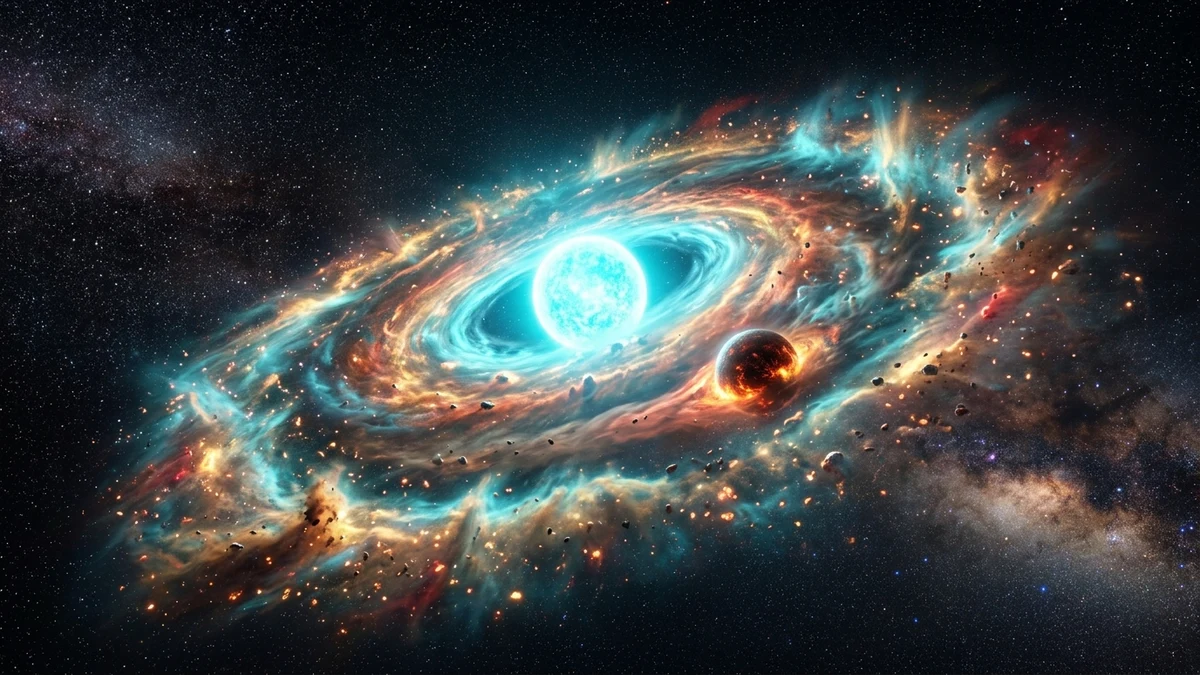
The final, staggering result of all this delicate but brutal balance of opposing extreme cosmic forces is a singular, imposing celestial body effectively the staggering size of our own vast solar system. This ancient cosmic giant, in turn, glows intensely, persistently, and consistently, clearly manifesting itself boldly across the broad infrared spectrum with an unmatched, mysterious, and beautifully vivid bright red luminescence. The James Webb Space Telescope was, undeniably and absolutely, the fundamental and most perfect technological scientific tool ever built to definitively unravel this complex, intricate cosmic mystery thanks to its state-of-the-art sensory instruments.
Unlike the venerable, historically glorious, and incredibly famous older Hubble Telescope, which primarily and beautifully observes the universe in standard visible light and somewhat energetic ultraviolet cosmic radiation, JWST was purposefully different. The newer JWST was specifically and meticulously engineered right from its initial conceptual design phase to uniquely and powerfully capture strictly the faint infrared wavelengths present deep within the expanding fabric of cold space. The incredibly faint, ancient light from these exceptionally distant, exotic primordial objects has traveled continuously across the dark expanse of space for so incredibly long that the physically expanding universe has dramatically altered its fundamental essence. The constant, relentless stretching of these light waves over billions of years has deeply shifted all the original energetic light radiation directly into the far infrared region of the vast electromagnetic spectrum.
To properly, accurately, and adequately put the incredibly formidable and revolutionary technological capability of the James Webb Space Telescope into its correct and appropriate historical astronomical perspective, we must look at the alternatives. It is extremely vital and informative to carefully compare it with the other major, highly renowned, and historical space telescopes that have significantly defined the proud history of observational astronomy. The continued, rapid, and constant evolution of modern observational astronomy relies heavily and critically on the profound, necessary complementarity and synergistic integration of all these fantastic and complex scientific tools. The following rich and detailed comparative table perfectly highlights the main fundamental differences, primary focal capabilities, and the distinct, vital scientific specialties of each prominent major space observatory listed carefully below.
| Space Observatory |
Main Wavelength Coverage |
Primary Mission Objective |
Launch Date |
| Hubble (HST) |
Visible, Ultraviolet, Near-Infrared |
General observation, ancient galaxies, dynamic stars, solar system planets |
1990 |
| James Webb (JWST) |
Mid-Infrared and Near-Infrared |
Primordial early universe, massive exoplanet atmospheres, intense star formation |
2021 |
| Euclid |
Visible, Specialized Near-Infrared |
Detailed mapping of undetectable dark matter and invisible probing dark energy |
2023 |
| Nancy Grace Roman |
Wide Near-Infrared |
Mysteries of universal dark energy dynamics, precise exoplanet surveys, extreme wide-field |
~2027 |
The overwhelming, profound scientific impact of the recent confirmed discovery of these massive, bizarre black hole stars definitely extends far beyond the mere routine theoretical astrophysics classification of a strange new object. This impactful, structural revelation quickly provides absolutely crucial, long-lost conceptual puzzle pieces essential for understanding the complex galactic evolution and the mysterious, violent formation of the earliest supermassive galactic black holes. For a very long time, brilliant and highly experienced theoretical scientists have genuinely and persistently wondered how exactly the gigantic black holes at the dark, chaotic center of immense spiral galaxies grew so incredibly massive. These enigmatic, terrifying supermassive monsters mysteriously and inexplicably reached such colossal, titanic proportions incredibly quickly right at the violent, fiery dawn of the young, newly illuminated universe's chaotic and turbulent infancy.
The ancient, hypermassive black hole stars might finally and conclusively be the long-sought, highly elusive, and heavily debated foundational initial gravitational seed critical to solving this cosmic puzzle. Or, at the absolute very least, they certainly vividly represent the incredibly crucial, vital, and highly necessary transitional intermediate stage of this entire formidable, colossal, and continuous process of extreme, accelerated cosmic growth. The extremely distant, remote primitive universe of many long billions of years ago was formidably dense, dark, and utterly filled with incredibly voluminous, colossal, and completely unperturbed gigantic gas clouds. These abundant, massive clouds were composed strictly of extremely pristine, cold primary molecular hydrogen gas that had completely never undergone any previous chemical fusion or experienced intense stellar radiative heating processes.
Under these incredibly strange, dense, and ancient extreme conditions, the very first massive radiant primary stars to successfully form from the cold void could easily have reached terrifyingly colossal and absurd masses. Such formidable, massive sizes were blatantly, vastly, and extremely disproportionally superior to anything typically observed, analyzed, and thoroughly documented in the relatively contained, peaceful, and highly stable modern cosmic era. When one of these immense, brilliant primordial super-stars fatally and inevitably entered its catastrophic, highly violent, and completely devastating final gravitational collapse, the resulting physical scenario was totally devastating and universally transformative. The completely catastrophic final event suddenly and violently formed a terrifying newborn black hole that intensely and rapidly began to relentlessly and passionately devour the massive surrounding static gas that incredibly was not ejected.
If the immense, precise conditions of local concentration and incredibly high molecular density were mathematically, physically, and perfectly continuous and perfectly maintained over vast stretches of time, the outcome was spectacular. The gigantic, chaotic, and violently swollen massive structure heavily irradiated by the bizarre, newly-formed, feeding black hole star could perfectly and sustainably last for many long, stable, and uninterrupted cosmic millions of years. The fantastic, proven, and verified existence of these gigantic, anomalous, and highly swollen celestial massive structures strongly and vehemently suggests startling conclusions about the violent antiquity and profound nature of the early universe. The model conclusively and decisively indicates that the violent, frequent dynamic interactions and brutal gravitational collisions in the wild primitive cosmos were categorically and significantly more intense than previously estimated conservative predictions ever foretold.
The constant, incredibly aggressive, and highly lethal emission of violent, extreme cosmic radiation continuously expelled intensely during the prolonged, turbulent feeding phase of this gigantic black hole star would have had a devastating result. The profound, widespread, and extremely long-lasting impact on the complex process of dramatic, cataclysmic cosmic reionization of the vast plasma bubble of the surrounding early universe would be simply immediate and irreversible. The impressively strong, tempestuous, and completely destructive charged solar winds combined with the incredibly powerful, extreme nuclear thermal radiation emitted violently in all directions could easily clear massive regions of space. This would entirely alter galactic destiny, vigorously delaying and even severely halting initial densification, or paradoxically abruptly accelerating and aggressively triggering the complex, large-scale physical formation of entirely new, massive elliptical galaxies.
The rich, detailed understanding of exactly how these enigmatic, highly hidden, and immensely powerful black hole stars effectively and factually operate in vital internal structural details could even be completely surprising. They can easily and predictably generate immediate, profound, revolutionary, and even totally transformative theoretical implications for the tireless, vital ongoing study and deep understanding of the elusive, invisible, and ghostly galactic dark matter. The absurd, gigantic, and strictly necessary physical densities of thick intergalactic gas and heavy primordial dust obligatorily required to successfully form and violently ignite these intense supermassive macrostructures might be harbored in specific locations. These incredibly deep gravitational wells would be perfectly hidden exactly at the dark center of immense, unexplored, and enormous dense galactic halos composed entirely of abundant, mysterious, and highly concentrated dark matter.
The tremendous, overwhelming, and terrifyingly intense force of the inescapable, unified gravity of these colossal, completely invisible, and frigid primordial dark halos would act exactly like a gigantic, perfectly efficient cosmic funnel. This invisible, powerful gravitational funnel rapidly and incredibly efficiently gathered, attracted, and effectively accumulated all the rich, abundant, and extremely necessary primordial gaseous material directly toward the central singularity with shocking speed. In this peculiar, strangely beautiful, and highly efficient cosmic harmonic way, the enigmatic, massive black hole stars shine brightly and proudly act today, specifically in the sensitive modern cryogenic detectors of our space telescopes. They are essentially observed as authentic, incredibly efficient intergalactic cosmic lighthouses, intensely, broadly, and proudly illuminating the crucial, forgotten regions that were once the most populated, ancient, and highly dense hidden corners of the cosmos.
The long, difficult, and arduous journey of constant, relentless human search for real, solid, and empirical deep astronomical knowledge never ceases, and in fact, our dedicated scientific commitment firmly remains unshaken. The dedicated, passionate, and extremely brilliant scientific researchers engaged in this project must obligatorily, at this very exact crucial academic moment, immediately initiate the arduous, meticulous, and highly complex mathematical and theoretical work. This colossal, highly detailed, patient, and profoundly laborious scientific task will safely and absolutely guarantee that the entire noble field of modern, centuries-old astronomy continues to stand strong, accurate, and proudly verified. It will boldly proceed, proudly traversing the illuminated, magnificent, and fascinating path of true existential revelation during the incipient, ongoing cosmic exploration toward the grand, unexplored future that awaits our endlessly curious humanity.
A singular, immensely distant, and fascinating black hole star is fundamentally, essentially, and truly an immense astrophysical celestial object of utterly gigantic and practically terrifying planetary proportions. This impressive, formidable type of enigmatic remote cosmic body unbelievably harbors a very dangerous, incredibly dense, and highly active central feeding black hole in its hot gaseous core instead of a common nuclear reactor. This bizarre, violently unstable, and powerful formidable system gradually builds when an ancient, completely colossal primeval star suffers its violently natural, irremediable, and catastrophic final gravitational collapse and shrinking toward utter oblivion and singularity. The enormous, fundamental difference in these massive, ancient destructive events is that the entire vast, outer dense stellar envelope incredibly fails to successfully escape the powerful gravitational pull in any violently ejected form. The powerful, dark engine relentlessly churning in the newly created dense core voraciously, rapidly, and implacably devours the entire massive original surrounding mass in an extreme, violent, and exceptionally insatiable frantic manner.
The highly modern, complex, and phenomenally advanced James Webb Space Telescope was meticulously, carefully engineered, perfectly constructed, and finally launched into space exploration primarily to rigorously scan the deep, dark sky in rich infrared bands. As the old, heavily tired, and extremely faint waves of ancient light originating from the exotic, far-flung cosmic beginnings traversed and continuously crossed the immense, stretching vastness of the growing, endlessly elastic universal expansion. These incredibly old, weary ancient celestial light signals unfortunately suffer the expected, implacable, and intense brutal weakening and massive elongation of long exhaustive waves caused directly by the incredibly immense, actively inflated modern expanding universe. The highly valuable, crisp, and sharp ancient light, once originally of an energetic radiant spectrum, highly aggressive ultraviolet, or clearly visible normal light, finally reaches us today completely faded, fundamentally shifted, and physically discolored. This weakened, precious relic, captured with pinpoint precision today, finally assumes the ghostly, long, and highly subtle manifestation of invisible purely thermal infrared light spectrum, successfully capturable by the delicate, frigid robotic mirrors.
The formidable, foundational, structural, and complex initial mathematical understanding regarding exactly how these great, terrifying dark abysses violently emerged so colossally and unbelievably fast was an absolute, completely impenetrable mystery in respected modern cosmology. The old, empirical, and highly conservative classical format, strictly focused solely on the small, progressive, extremely gradual, and calm accumulation, was firmly based on typical, rare, and highly spaced slow collisions of old common stars. This slow, painfully tedious model simply did not adequately justify or successfully fit temporally within the highly restricted, unforgiving existential mathematical timeline of the young, rapidly evolving early universe shortly following the violent beginning. Therefore, the deeply fascinating, massive, giant, and monstrous ancient relics properly called mysterious black hole stars clearly represent the powerful, highly capable, and dynamic devouring missing link completely forgotten by the fragile prior theories. These highly unique, extremely swollen, and rich massive structures perfectly serve as monstrous, endlessly hungry cosmic seeds that efficiently digested and completely absorbed a dense, inexhaustible cosmic source for brutal and rapid stellar mass accumulation.