While Russian hypersonic cruise missiles strike Ukrainian population centers, thousands of children face forced deportation, and documented atrocities mount—the United Nations Security Council remains immobilized by Moscow's diplomatic veto. Meanwhile, European industrial centers continue transitioning away from Russian natural gas at staggering financial cost, China and India purchase discounted crude oil in record volumes, and the Global South—representing roughly eighty-five percent of the human population—abstains from multilateral condemnations. Concurrently, Western democratic societies wrestle with deep-seated war fatigue. Why does the world remain largely paralyzed? This geopolitical analysis decodes the six structural mechanisms of diplomatic silence sustaining Europe's deadliest armed conflict since 1945.
Mechanism 1: The UN Veto as a Diplomatic Shield
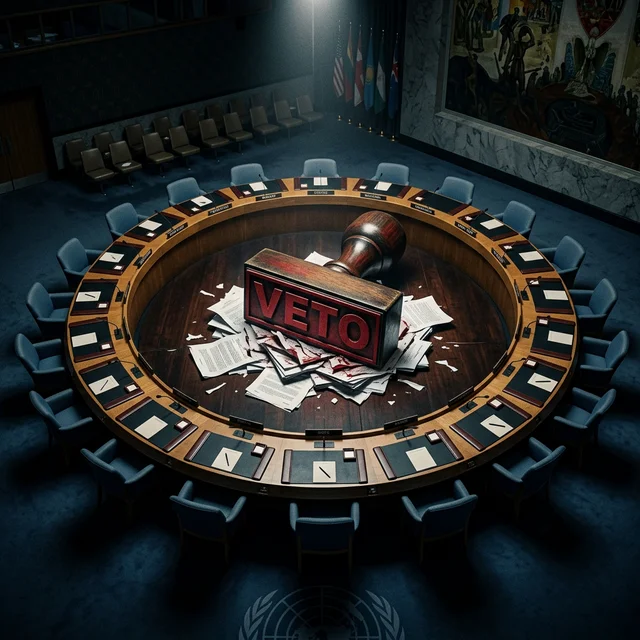
The United Nations Security Council consists of fifteen member states, yet binding authority resides exclusively with five permanent members endowed with unilateral veto privileges: the United States, the United Kingdom, France, China, and the Russian Federation. Any substantive draft resolution, enforcement action, or peacekeeping deployment can be neutralized by a single dissenting vote from a permanent member.
| UNSC Resolution Draft | Voting Session Date | Outcome & Diplomatic Stance |
|---|---|---|
| Condemnation of Full-Scale Invasion | February 2022 | Russia vetoed; China and India abstained |
| Condemnation of Illegal Annexations | September 2022 | Russia vetoed; non-aligned members abstained |
| Humanitarian Ceasefire & Corridors | 2022–2025 | Russia vetoed all binding enforcement measures |
The Founding Paradox: Aggressor as Supreme Judge
The institutional tragedy of the post-WWII security architecture lies in its structural circularity: the state waging an unprovoked war of conquest possesses the statutory authority to veto its own condemnation. This arrangement effectively grants an aggressor constitutional immunity from collective military or economic sanctions under Chapter VII of the UN Charter.
Mechanism 2: Energy Dependence and Strategic Geoeconomics
Prior to February 2022, European industrial competitiveness depended heavily on inexpensive Russian fossil fuels transmitted through a vast pipeline network. Germany received fifty-five percent of its natural gas imports from Gazprom, while Austria and Hungary depended on Russian flows for over eighty percent of domestic demand.
| European Economy | Pre-2022 Russian Gas Reliance | 2026 Energy Transition Status | Primary Alternative Source |
|---|---|---|---|
| Germany | ~55% of total supply | 0% pipeline supply | US & Qatari LNG, renewables |
| Italy | ~40% of total supply | <5% residual supply | Algerian pipeline gas, offshore LNG |
| Austria | ~80% of total supply | ~35% contracted flows | Central European pipeline interconnectors |
| Hungary | ~85% of total supply | ~70% continuous pipeline supply | TurkStream pipeline agreements |
| European Union (Average) | ~40% across member states | <12% aggregate consumption | Global LNG terminals, wind & solar |
While Europe absorbed triple-digit wholesale electricity inflation to decouple from Russian pipelines, China and India dramatically expanded their maritime crude purchases. Offering discounts of ten to twenty dollars per barrel below international benchmark Brent, Russian oil exports redirected eastward, generating hundreds of billions of dollars that insulated federal treasury reserves from Western asset freezes.
Mechanism 3: Calculated Neutrality: Beijing and New Delhi
Neither China nor India endorses Russian territorial expansionism in official diplomatic communiqués; nevertheless, their strategic calculus diverges sharply from transatlantic policy:
Beijing's Strategic Calculus
China approaches the Ukrainian conflict through the prism of its strategic rivalry with the United States. A prolonged standoff in Eastern Europe absorbs American military stockpiles, distracts Western naval focus from the Indo-Pacific, and accelerates Russian economic vassalage to Beijing, ensuring cheap Siberian commodity supplies and yuan-denominated cross-border clearing.
India's Strategic Autonomy
New Delhi balances historic defense ties with emerging Western partnerships. Between seventy and eighty percent of the Indian military's legacy armored vehicles, combat aircraft, and naval submarines are Soviet or Russian manufactured. Furthermore, discounted petroleum sustains domestic energy subsidies for 1.4 billion citizens while checking inflationary pressures.
Comparative Geopolitical Matrix: Blocs, Strategic Interests, and Responses
| Geopolitical Actor | Primary Strategic Objective | Economic / Military Stance | UN Voting Pattern | Tangible Impact on War |
|---|---|---|---|---|
| United States & NATO | Strategic defeat of Russian aggression | Heavy military aid ($180B+), bilateral intelligence | Consistent voting in favor of Ukraine | Sustains Ukrainian military defense |
| European Union | Regional security, democratic defense | Financial macro-assistance, sanctions packages | Unanimous condemnation of Moscow | High inflation, gradual decoupling |
| Russian Federation | Territorial conquest, regime containment | Full wartime economy mobilization (>6% GDP) | Vetoes all binding resolutions | Prolongs frontline offensive operations |
| People's Republic of China | Counterbalance US global primacy | Dual-use electronic trade, energy purchases | Strategic abstention on major resolutions | Backstops Russian industrial base |
| Global South (India, Brazil, SA) | Non-alignment, economic stability | Commercial pragmatism, food/fertilizer imports | Frequent abstention or neutral voting | Weakens global sanctions consensus |
Mechanism 4: The Global South and Post-Colonial Realism
Across Latin America, Africa, and Southeast Asia, diplomatic reactions range from cautious neutrality to outright skepticism toward Western diplomatic initiatives. Developing capitals raise several structural considerations:
- Economic Vulnerability: Developing countries suffered disproportionately from food, fertilizer, and petroleum price spikes triggered by shipping disruptions in the Black Sea.
- Perceived Western Asymmetry: Diplomats in the Global South frequently question why the transatlantic community demands unified global economic sacrifice for a European war after Western coalitions conducted military operations in Iraq, Libya, and Afghanistan without United Nations approval.
- Defense and Food Security: Over thirty African nations depend directly on Russian wheat shipments and private security contingents to preserve internal stability.
- Multipolar Pragmatism: Preserving functional ties with Beijing, Moscow, Brussels, and Washington maximizes diplomatic leverage and financial investment choices.
Mechanism 5: Information Attrition and War Fatigue
Psychological habituation represents a formidable obstacle to sustained civic engagement. As military confrontations extend into multi-year attrition, the initial shock value of satellite devastation and civilian casualties fades into background news:
- Phase 1 (Spring 2022): Global outrage, unprecedented diplomatic unity, and viral digital advocacy.
- Phase 2 (Late 2022): Economic inflation and soaring domestic utility costs dominate public discourse.
- Phase 3 (2023–2024): Competing international flashpoints, notably Middle Eastern escalation, divert geopolitical bandwidth.
- Phase 4 (2025–2026): Algorithmic social media feeds prioritize novel controversy over entrenched positional trench warfare.
Mechanism 6: Nuclear Deterrence and Calculated Escalation Thresholds
The Russian Federation possesses the world's largest deployed nuclear arsenal, containing over 5,500 strategic and tactical warheads. The Kremlin has systematically leveraged this atomic inventory as a form of reverse deterrence—not to defend its sovereign territory against invasion, but to establish rigid red lines that constrain Western military intervention.
| Ukrainian Military Request | Western Coalition Initial Response | Underlying Strategic Rationale |
|---|---|---|
| Enforced No-Fly Zone | Categorically denied | Threat of direct kinetic air clashes with Russian fighters |
| Direct NATO Troop Deployment | Categorically ruled out | Avoidance of nuclear escalation triggers |
| Long-Range Tactical Missiles (ATACMS/Storm Shadow) | Approved after protracted debate | Fears of sovereign Russian territory retaliatory strikes |
| Modern Western Main Battle Tanks | Delayed for eleven months | Escalation calibration concerns |
| Fourth-Generation F-16 Fighter Jets | Delivered after eighteen months of review | Logistical and escalatory considerations |
Western Sanctions: Structural Limitations and Economic Adaptation
The implementation of over 16,000 unilateral and multilateral sanctions against Russian entities constitutes the most extensive economic containment campaign ever attempted against a nuclear power. Despite losing access to SWIFT banking rails and having over $300 billion in sovereign reserves immobilized in European clearing houses, Russia's gross domestic product demonstrated unexpected resilience:
- Hydrocarbon Re-Routing: A dark fleet of hundreds of aging tankers transports crude oil under maritime flags of convenience, bypassing G7 price cap regulations.
- Dual-Use Electronics Supply: Machine tooling, semiconductors, and drone avionics continue entering through intermediate trade channels across Central Asia and the Caucasus.
- Military Keynesianism: Federal budget outlays dedicated to defense production stimulated factory employment and wages across provincial industrial hubs.
The Broader Cost of Geopolitical Inaction
The collective failure to restore sovereign Ukrainian territory undermines the bedrock conventions of post-1945 international law:
- Erosion of Non-Proliferation Norms: In 1994, Ukraine surrendered the world's third-largest nuclear arsenal under the Budapest Memorandum in exchange for explicit territorial integrity assurances from the US, the UK, and Russia. The violation of these guarantees signals to regional powers that only domestic nuclear warheads offer security against external invasion.
- Authoritarian Emulation: Unpunished imperial annexation sets a precedent that encourages revisionist powers to consider unilateral force against disputed islands and border regions worldwide.
- Institutional Discredit: When the world's primary multilateral bodies fail to prevent the devastation of sovereign nations, global faith in democratic alliances and legal norms experiences severe decay.
Systematic Observations and Future Horizons in Russia veto UN Security Council
Within the investigative scope of Why the World Stays Silent: The Politics Killing Ukraine, synthesizing the performance data of Economic Vulnerability with the core parameters of why world silent Ukraine deepens scientific comprehension of the mechanisms detailed in Mechanism 1: The UN Veto as a Diplomatic Shield. Independent evaluations anchored at the 1.4 billion benchmark illustrate how Perceived Western Asymmetry responds to boundary constraints imposed by contemporary operational requirements in History and Russia veto UN Security Council. This granular methodological tracking of Defense and Food Security and energy dependence Europe Russian gas strengthens data traceability and directs subsequent phases of empirical verification.
From the perspective of comparative analysis presented in Mechanism 2: Energy Dependence and Strategic Geoeconomics, the developments surrounding Defense and Food Security and Multipolar Pragmatism substantially reshape baseline projections for energy dependence Europe Russian gas. Investigators tracking China neutrality Ukraine war emphasize that the interaction with Phase 1 (Spring 2022) at the 300 billion threshold requires updating legacy assessment models previously applied across History. Accordingly, the technical documentation accumulated under Mechanism 3: Calculated Neutrality: Beijing and New Delhi provides concrete evidence to anticipate how Phase 2 (Late 2022) will perform under evolving scientific and regulatory standards.
Conclusion: The Peril of Institutional Indifference
International silence does not stem from ignorance; it is the deliberate output of competing national interests, economic dependencies, and nuclear intimidation. Breaking this diplomatic impasse demands structural reforms within multilateral organizations, resolute enforcement of trade restrictions, and an uncompromising recognition that permitting the violent redrawing of borders jeopardizes collective global security.
See Also
- Vladimir Putin at the Hague: International War Crimes Prosecution
- Top 10 Military Powers of 2026: Defense Budgets and Arsenals
- Gold and Silver Surpass Historic Highs Amid Geopolitical Tensions
- Extreme Climate 2026: Earth on Red Alert
References and Sources
- RAND Corporation — Pathways to Russian Escalation and Western Deterrence
- Atlantic Council — Geopolitics of Russian Energy Decoupling
- International Energy Agency — World Energy Outlook Report
- Stockholm International Peace Research Institute (SIPRI) — Global Arms Transfers
- Council on Foreign Relations — Global Conflict Tracker: War in Ukraine