Brazil in 2026 lives a cruel paradox: while intentional homicides dropped 11% in 2025, femicides hit the country's highest historical record. Nearly 6 women are victimized daily — and the numbers may be underreported by up to 40%. Protective orders are violated with impunity, aggressors remain free, and horrifying cases repeat with terrifying regularity.
This article documents the most barbaric cases of 2025-2026, analyzes the data, explores aggressor profiles, maps systemic failures, and asks: why can't Brazil protect its women?
The Numbers That Condemn Brazil
Femicide Statistics
| Data | Value |
|---|---|
| Femicide victims in 2025 | 6,904 (completed + attempted) |
| Daily average | ~6 women per day |
| Growth vs 2024 | +34% |
| 10-year growth | +316% |
| Underreporting estimate | ~40% |
| Pending arrest warrants | 336 men still wanted |
| São Paulo record (Jan 2026) | 27 femicides in a single month |

Regional Map of Femicide
Violence is not evenly distributed across the territory. The 2025 data reveals alarming regional patterns that expose deep structural inequalities in women's protection.
| Region | Rate per 100k women | Change vs 2024 | Worst state |
|---|---|---|---|
| North | 3.8 | +42% | Roraima (5.1) |
| Northeast | 3.2 | +38% | Ceará (4.3) |
| Central-West | 2.9 | +29% | Mato Grosso (3.7) |
| South | 2.4 | +31% | Paraná (2.9) |
| Southeast | 2.1 | +27% | São Paulo (2.5) |
Roraima leads the ranking with the highest proportional rate, followed by Ceará and Mato Grosso. Experts point out that areas with less state presence, fewer women's police stations, and more patriarchal regional cultures tend to show higher rates. Northern Brazil has only 7% of the country's Specialized Women's Police Stations (DEAMs), despite having the highest proportional femicide rate.
Most Shocking Cases of 2025-2026
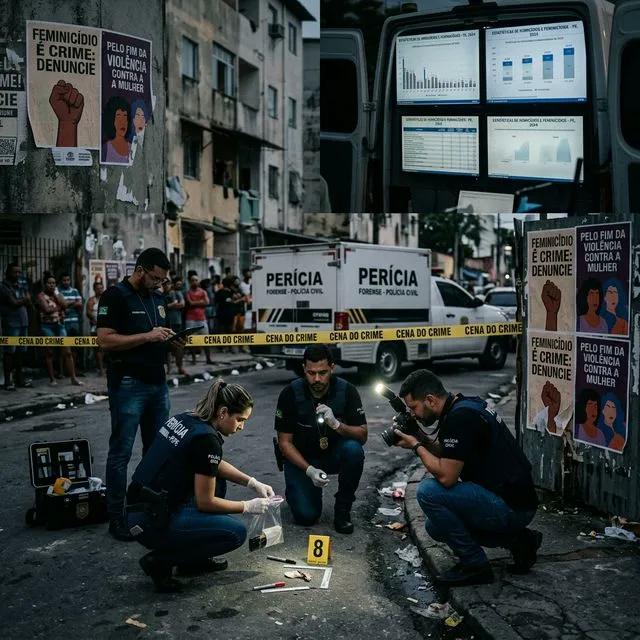
January 2026: A Bloody Start
1. New Year's Day Femicide — Bom Repouso (MG)
On January 1st, Bruna Aline Rodrigues de Souza, 27, was murdered by her ex-boyfriend in front of her children. The aggressor broke into the house at dawn, ignoring an active protective order. The children, ages 3 and 6, were found next to their mother's body. The same day, Eva Sofia Santo Silva, 16, was killed in São José dos Campos (SP) in a premeditated crime.
2. Copacabana Gang Rape — Rio de Janeiro
On January 31st, a teenage girl was the victim of gang rape in Copacabana. Four adults and one minor are involved in what was described as "heinous" and "shocking." The victim suffered multiple injuries. Security cameras captured part of the attack, and international backlash forced the creation of a special task force by Rio's Civil Police.
3. Robbery Violence — 16 Deaths in January (RJ)
The Rio de Janeiro Metropolitan Area recorded 16 deaths in robberies or robbery attempts in January — one death every two days. Rideshare drivers and shopkeepers were the main victims, with 5 and 4 deaths respectively. The North Zone concentrated 62% of cases.
February 2026: The Violence Doesn't Stop
4. Amanda Loureiro — Killed Despite Protective Order (RJ)
On February 4th, Amanda Loureiro da Silva Mendes, 32, a community health worker, was shot dead by ex-partner Wagner Araújo, despite having an active protective order against him. Amanda had filed seven police reports over the previous two years. In her last social media post, three days before the crime, she wrote: "I'm afraid justice will arrive too late." The phrase went viral as a symbol of the system's failure.
5. Júlia Gabriela and Boyfriend — Executed by Ex (SP)
On February 21st in Botucatu, Júlia Gabriela Bravin Trovão, 24, and her boyfriend Eduardo Santos, 26, were shot dead by Júlia's ex-partner. The aggressor had already been the subject of 10 police reports and 3 protective orders, all violated without consequence. He was awaiting trial on bail for previous threats.
6. Cibelle at the Jewelry Store — Killed in a Mall (SP)
In São Bernardo do Campo, Cibelle Monteiro Alves, 29, was stabbed to death by her ex-boyfriend inside a jewelry store in a shopping mall, in broad daylight, in front of dozens of witnesses. She also had an active protective order. The case sparked protests in 14 Brazilian state capitals.
7. Femicide in Cascavel — In Front of Her Child (PR)
On February 19th, Mayara Araújo Krupiniski Rodrigues, 31, was stabbed to death in front of her 5-year-old son. The boy tried to protect his mother and suffered minor injuries. The aggressor fled and was arrested 48 hours later at the Paraguay border.
March 2026: The Brutality Continues
In Pernambuco, in early March, a woman was stabbed and set on fire after refusing a relationship. Neighbors managed to extinguish the flames, but she suffered burns over 60% of her body. In Goiás, the same week, a 44-year-old teacher was killed by her ex-husband inside the school where she taught, in front of her 5th-grade students.
Aggressor Profile: Who Kills Brazilian Women
Studies from the Brazilian Forum on Public Safety paint a disturbingly consistent profile of femicide perpetrators in Brazil.
| Characteristic | Data |
|---|---|
| Relationship to victim | 82% were partners or ex-partners |
| Predominant age group | 25-44 years (68%) |
| Weapon used | Knife/blade (52%), firearm (28%), asphyxiation (12%) |
| Prior police records | 61% already had previous reports |
| Alcohol use at time | 47% of cases |
| Stated motivation | "Refusal to accept the breakup" (74%) |
| Suicide after crime | 18% of cases |
The most disturbing pattern is the escalation cycle: in 78% of fatal cases, there were prior records of physical aggression, threats, or stalking. Lethal violence is rarely the first episode — it's the last in a chain the state failed to interrupt.
🔴 The most disturbing statistic: In 74% of femicides, the aggressor killed because the woman decided to end the relationship. Female freedom is literally punished with death.
The Protection System Failure
| Problem | Data |
|---|---|
| Unfulfilled warrants | 336 femicide suspects still free |
| Violated protective orders | Amanda, Júlia, and Cibelle all had active orders |
| Average police response time | 45 min in capitals, 3+ hours in rural areas |
| Electronic monitoring | Supply covers only 12% of demand |
| Shelters | 1 per 100 municipalities |
| Women's police stations (DEAMs) | 416 for 5,570 municipalities (7.5%) |
| DEAMs with 24h service | Only 91 in the entire country |
The Critical Path of Reporting
The journey a woman takes when trying to report domestic violence is long, bureaucratic, and frequently retraumatizing:
- Police report — Often attended by untrained officers, in regular stations (92.5% of municipalities have no DEAM)
- Protective order — Legal deadline of 48h, but in practice takes 5-15 days in smaller districts
- Aggressor notification — Court officer must locate them; if not found, the order remains "on paper"
- Monitoring — Ankle bracelets rarely available; Maria da Penha patrols cover fewer than 200 municipalities
- Violations — When the aggressor violates the order, the woman must file a NEW report and await a NEW judicial decision
This bureaucratic cycle takes an average of 23 days from initial report to effective protection. In Amanda Loureiro's case, it was 14 months between the first report and her murder.
The Invisible Orphans: Impact on Children
A frequently overlooked dimension of femicide is the children who survive. According to IPEA, in 2025:
- 12,437 children were orphaned by femicide (cumulative 2020-2025)
- 34% of femicides occurred in the presence of minor children
- 67% of these children develop PTSD
- 42% end up in the custody of the aggressor's family
- Only 8% receive adequate public psychological support
The Cascavel (PR) case, where the 5-year-old tried to protect Mayara, is emblematic. The child was referred to Child Protective Services and, initially, temporary custody was granted to the paternal grandmother — the killer's mother. Only after intervention by the Public Prosecutor's Office was custody transferred to the maternal family.
International Comparison: Where Brazil Stands
| Country | Femicide rate (per 100k) | Specific law | Electronic monitoring |
|---|---|---|---|
| 🇧🇷 Brazil | 1.4 | Maria da Penha Law (2006) | Partial (12% coverage) |
| 🇲🇽 Mexico | 1.3 | Typified (2012) | Partial |
| 🇪🇸 Spain | 0.3 | Integral Law (2004) | Yes (VioGén, 98%) |
| 🇫🇷 France | 0.2 | "Bracelet anti-rapprochement" (2020) | Yes |
| 🇦🇷 Argentina | 0.8 | Brisa Law (2018) for orphans | Partial |
| 🇺🇸 USA | 0.5 | Violence Against Women Act | State-level |
Spain is considered a global reference: the VioGén system electronically monitors 98% of aggressors with active protective orders and has reduced femicides by 72% since 2004. In Brazil, the system covers only 12% of cases.
Legislative Timeline
| Year | Milestone | Result |
|---|---|---|
| 2006 | Maria da Penha Law (11,340) | Created protective orders and DEAMs |
| 2015 | Femicide Law (13,104) | Classified as qualified homicide |
| 2018 | Maria da Penha Patrol | In-person monitoring (few municipalities) |
| 2019 | Safe Women Program | Ankle bracelets (insufficient) |
| 2021 | Law 14,188 — Psychological violence | Criminalized stalking and emotional abuse |
| 2023 | Bill 3,890 — Red Signal | Silent reporting in pharmacies |
| 2026 | Immediate Protective Order Bill | Under review (mandatory 48h response + monitoring) |
What Needs to Change: 10 Urgent Actions
- Immediate warrant enforcement — 336 free femicide suspects is unacceptable
- Brazilian VioGén system — electronic monitoring for 100% of protective orders
- GPS ankle bracelets with real-time alerts — emergency national production
- 24/7 specialized police stations — coverage in all districts, not just 7.5%
- Gender education — mandatory programs in schools from childhood
- Harsher sentences — eliminate sentence reduction for repeat femicide offenders
- National Orphan Fund — inspired by Argentina's Brisa Law
- Mandatory training — gender violence training for 100% of police officers
- Emergency shelters — network of safe houses in all municipalities over 50,000
- Panic app — with geolocation and direct dispatch to nearest patrol
Conclusion: A Country That Kills Its Women
When a country records 6 femicides daily, when women are murdered with protective orders in hand, when children watch their mothers being stabbed — it's not a security crisis. It's a civilizational crisis.
Spain proved it's possible to reduce femicides by 72% with political will and technology. Brazil has the laws — the Maria da Penha Law is considered one of the best in the world by the UN — but lacks execution. Lacks infrastructure. Lacks priority.
Every name in this article — Bruna, Amanda, Júlia, Cibelle, Mayara — is a woman who reported, who sought state help, who asked for protection. And the state failed each one of them.
The roses on the ground. The broken mirror. The silence of a country that pretends not to see. How much longer?
References
- CNN Brasil — Copacabana Rape
- G1 Globo — Record Femicides
- Folha de S. Paulo — Violence Data
- Gazeta do Paraná — Cascavel Femicides
- Le Monde Diplomatique — Femicide +316%
- Brazilian Forum on Public Safety — 2025 Yearbook
- IPEA — Gender Violence Atlas
- UN Women — Brazil Report 2025
- Government of Spain — VioGén System