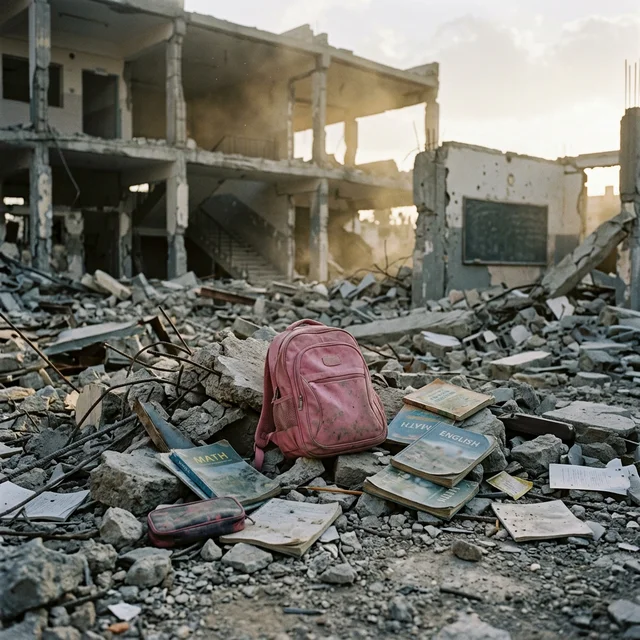
On February 28, 2026, an airstrike struck the Shajareh Tayyebeh secondary girls' school in the southern Iranian city of Minab, Hormozgan province, collapsing the two-story concrete building and killing more than 150 female students aged twelve to eighteen alongside twelve teachers. Occurring during morning classroom instruction as regional armed conflict intensified across the Middle East, the tragedy generated immediate international condemnation and ignited urgent debates across the United Nations Security Council regarding civilian protection and proportionality under International Humanitarian Law.
The devastation at Minab highlights the humanitarian toll of modern aerial warfare within populated urban centers. Rescue teams and local volunteers spent more than three days digging through concrete rubble and twisted steel reinforcement bars to recover survivors and retrieve victims. With over 200 students hospitalized across regional medical centers suffering from crushing injuries and severe burns, the event stands as the deadliest single civilian casualty incident of the 2026 regional conflict.
The disaster produced immediate diplomatic fallout worldwide. As the United Nations General Assembly convened an emergency plenary session in New York, human rights organizations and legal scholars questioned the targeting parameters and weapon-yield selections deployed near civilian educational facilities. The incident sparked mass memorial demonstrations from Tehran to London and ignited a profound legal examination of accountability for collateral civilian destruction during high-intensity military campaigns.
The Strike on Shajareh Tayyebeh School: Chronology and Structural Collapse
The Shajareh Tayyebeh school (translating as "Goodly Tree" in Persian) operated as a public secondary institution serving approximately 400 enrolled students from middle- and working-class neighborhoods in Minab, a coastal agricultural city of 120,000 residents near the Strait of Hormuz. The campus comprised sixteen classrooms distributed across two above-ground floors, administrative offices, a library, and an open central courtyard used for physical recreation.
At 10:15 AM local time, while students were engaged in regular mid-morning classes, high-explosive munitions struck the northern wing of the educational complex. The blast instantly shattered the building's load-bearing structural columns, causing concrete roof slabs to pancake downward onto active classrooms.
First-response efforts were hindered by damaged municipal infrastructure. Earlier airstrikes throughout Hormozgan province had cratered primary access highways and severed cellular communications and internet connectivity across the region. Local parents, teachers, and municipal workers initially excavated rubble using hand shovels, crowbars, and bare hands before heavy excavation equipment and Iranian Red Crescent disaster teams arrived twelve hours later.
Casualty Figures, Hospitalization, and Rescue Operations
Emergency responders worked continuously for seventy-two hours under auxiliary floodlights to clear debris from the collapsed academic wing. Medical triage centers set up at Minab Provincial Hospital and transferred critical burn and crush syndrome patients to specialized intensive care units in Bandar Abbas.
The following table summarizes the documented human and physical toll resulting from the Minab educational facility strike:
| Casualty / Operational Indicator | Documented Metric | Field Verification Source | Medical & Forensic Context |
|---|---|---|---|
| Confirmed Student Fatalities | 152 female students | Iranian Red Crescent & Hospital Morgues | Girls aged 12 to 18; crushing asphyxia & trauma |
| Faculty & Staff Fatalities | 12 teachers and administrators | Ministry of Education Registrar | Majority female secondary educators |
| Critical Trauma Injuries | 95+ hospitalized patients | Minab & Bandar Abbas Trauma Units | Severe burn wounds, limb amputations, head trauma |
| Structural Facility Damage | 70% destroyed; north wing pancaked | Satellite Synthetic Aperture Radar (SAR) | Total structural collapse of load-bearing frames |
| Search & Recovery Duration | 76 continuous operational hours | International Committee of the Red Cross | Manual and mechanical rubble extraction |
| Unidentified Remains | 23 victims requiring DNA profiling | Legal Medicine Organization of Iran | Severe blast fragmentation and thermal impact |
Eyewitness testimonies recorded by humanitarian workers captured the profound shock felt across the community. Survivors described loud sonic detonations followed instantly by falling concrete dust that plunged classrooms into darkness, leaving survivors trapped beneath collapsed masonry until rescue crews breached the exterior walls.
Conflicting Military Narratives and Targeting Justifications
The strike sparked sharp disputes regarding operational intent, intelligence fidelity, and target selection. Military coalition briefers acknowledged that high-explosive munitions struck within the vicinity of the school but claimed the intended target was an Islamic Revolutionary Guard Corps (IRGC) logistics command depot situated 450 meters away.
Coalition officials suggested that a guidance malfunction or software coordinate error led precision-guided glide bombs to impact off-target. Military spokespersons maintained that armed forces never intentionally target civilian schools and expressed regret for collateral civilian deaths.
Iranian authorities, international legal observers, and human rights investigators challenged this account. Analysts pointed out that deploying heavy unitary blast warheads carrying hundreds of kilograms of explosives within a few hundred meters of an active school violates standard collateral damage estimation (CDE) protocols. Independent conflict monitors argued that even if the school was not intentionally targeted, authorizing high-yield blast weapons near a school during morning class hours constitutes reckless disregard for civilian life.
International Legal Framework: Geneva Conventions and Proportionality
The legal debate surrounding the Minab school bombing centers on fundamental principles of International Humanitarian Law (IHL), codified within the 1949 Geneva Conventions and the 1977 Additional Protocols:
- The Principle of Distinction: Belligerents must distinguish at all times between military objectives and civilian objects. Schools, hospitals, and residential dwellings are presumed civilian unless proven to be actively used for military purposes.
- The Principle of Proportionality: Launching an attack that may be expected to cause incidental loss of civilian life, injury to civilians, or damage to civilian objects that would be excessive in relation to the concrete and direct military advantage anticipated is prohibited.
- The Obligation of Precaution: Military planners must take all feasible precautions in the choice of means and methods of attack to avoid or minimize civilian casualties, including aborting strikes if civilian collateral damage appears excessive.
Human rights organizations, including Amnesty International and Human Rights Watch, emphasized that even if a military depot existed 450 meters away, the loss of over 150 civilian children makes the strike disproportionate under customary international law. Legal experts called on the International Criminal Court (ICC) to initiate a formal inquiry to evaluate command accountability and targeting protocols.
Global Reactions and Diplomatic Repercussions
The scale of civilian casualties in Minab triggered demonstrations and diplomatic protests across major world capitals:
- United Nations Agencies: UNESCO Director-General issued a formal declaration stating that attacks on schools violate international law and undermine the fundamental right to education. UNICEF declared that schools must remain safe havens for children regardless of political conflict.
- Civic Demonstrations: Mass candlelight vigils and street demonstrations mobilized tens of thousands of citizens across London, Paris, New York, Berlin, Istanbul, and São Paulo, with demonstrators carrying photographs of the schoolgirls and demanding an immediate humanitarian ceasefire.
- Domestic Impact on Iranian Education: The Ministry of Education temporarily suspended in-person classes across Hormozgan province, affecting over 180,000 students as parents withdrew children from schools over fears of further airstrikes.
The tragedy highlighted the historical reality that Iran possesses one of the highest female literacy rates in the Middle East, standing at 97 percent, with women comprising over 60 percent of university enrollments. The loss of an entire class of young women struck at the heart of the nation's academic and social fabric.
Broader Humanitarian Crisis and the Need for Protection
The disaster at Minab occurred against the backdrop of a widening regional humanitarian crisis. Across southern and western Iran, sustained airstrikes damaged power grids, disrupted municipal water desalination facilities, and strained medical supply chains. Humanitarian organizations reported severe shortages of burn dressings, intravenous fluids, and surgical anesthetics across regional hospitals.
International relief agencies are urging all belligerents to implement immediate humanitarian pauses to enable medical evacuations, permit unhindered access for Red Cross supply convoys, and establish demilitarized safety zones around educational and medical facilities.
The tragedy of Shajareh Tayyebeh serves as an urgent reminder of the civilian costs of modern warfare. As concrete rubble is cleared from the schoolyard in Minab, the international community faces the challenge of enforcing humanitarian norms and ensuring that civilian schools remain inviolable sanctuaries of learning.
Official Human Rights References and International Documentation
- UNESCO — Statements on the Protection of Educational Institutions and Civilian Infrastructure in Armed Conflicts.
- UNICEF — Humanitarian Monitoring Reports on Children Affected by Armed Conflict in the Middle East.
- International Committee of the Red Cross (ICRC) — Geneva Conventions, Protocol I Additional, and Rules of Customary International Humanitarian Law.
- Human Rights Watch & Amnesty International — Field Documentation, Satellite Imagery Verification, and Legal Analyses of Civilian Casualties in Iran.